
Politics
Bruce Blakeman’s Kafkaesque Albany sojourn

DAYS THE BUDGET IS LATE: 31
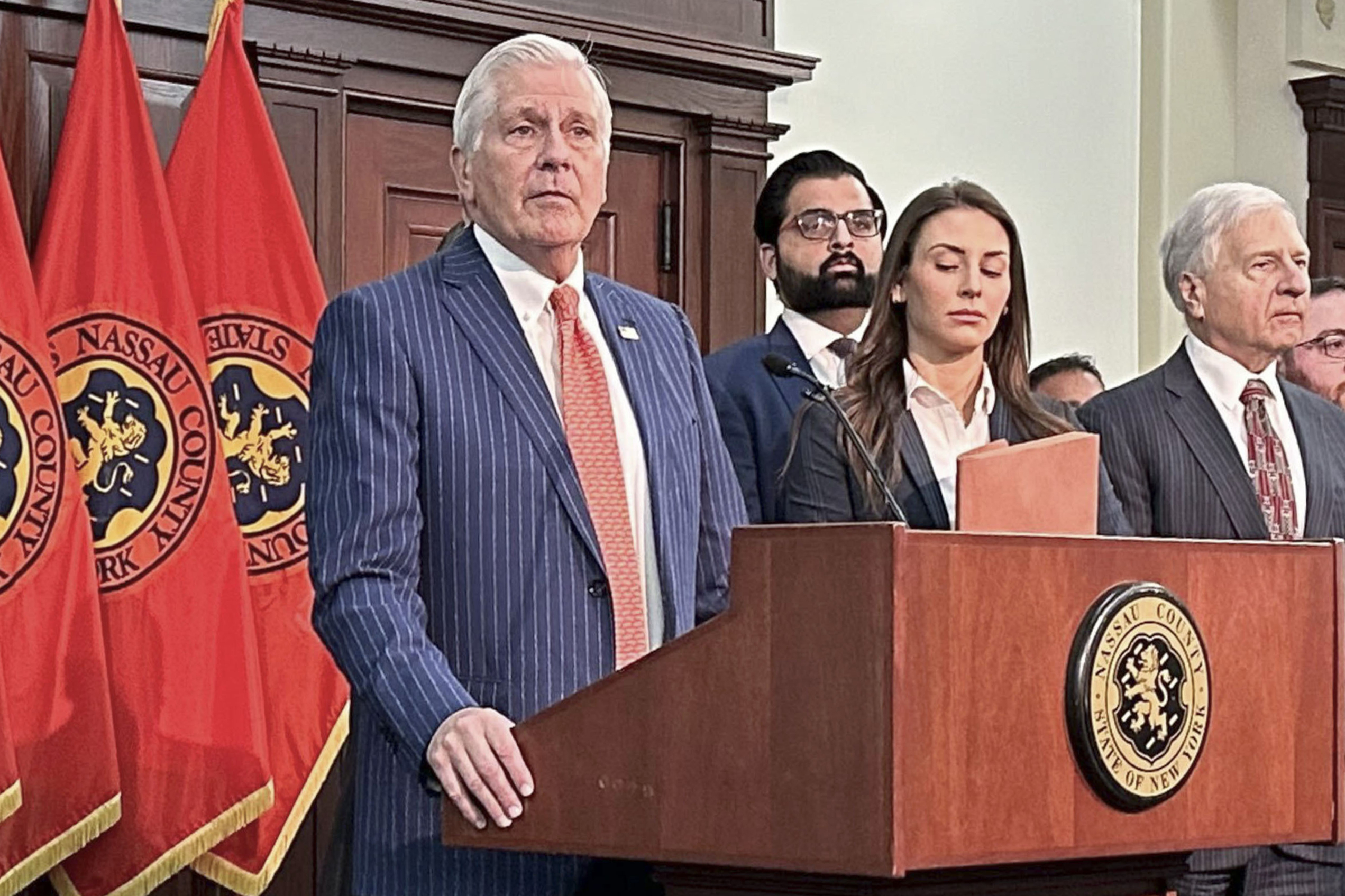
BLAKEMAN’S DAY IN COURT: Republican gubernatorial candidate Bruce Blakeman’s battle to access the state’s new public campaign finance program made its way to an Albany County courthouse this afternoon.
The legal fight is over hypertechnical matters like whether duplicate copies of a “PCF-22” form submitted separately should be considered as a joint submission.
But the repercussions are significant. Blakeman is seeking to build momentum for his underdog campaign in a blue state, and a win would provide a $3.5 million boost to his effort, guaranteeing he’d be one of the better-funded state Republican candidates in recent decades. It would also give him bragging rights over the Democrats who call all the shots in Albany.
The GOP case rests on the idea that Democrats made the rules for joining the program impossible to follow. Blakeman lawyer Adam Fusco noted that none of the gubernatorial candidates who applied are likely to receive any money.
“There is a hidden ball trick,” Fusco said. “And everyone who tried to do this failed to do it correctly: 0-7. It sounds like my high school baseball career.”
Blakeman was booted from the program in March. During the same week in December, he received a letter saying he was accepted into the program and the Public Campaign Finance Board approved a new rule that gubernatorial candidates and their running mates must apply jointly.
The board never published the form they’d need to submit and never mentioned the need for a signature from Blakeman’s running mate, lieutenant governor hopeful Todd Hood. The requirement was also absent from a training Blakeman sat through in January and wasn’t mentioned in a recent update to the campaign finance handbook. But since the nonexistent form was never received, the board’s Democratic majority deemed Blakeman no longer eligible.
Democratic lawyer Chris Massaroni rejected the idea that the decision stemmed from partisan gamesmanship. Any serious campaign for governor should stay abreast of changing rules, he said.
“It wasn’t a sort of casual, quick determination,” Massaroni said. “It was a careful consideration that we have to apply the rules carefully, and we can’t appear to be giving exceptions. … If we start bending these election rules once, we don’t know where that’s going to end.”
Justice Denise Hartman, who was first nominated to the bench by former Gov. Andrew Cuomo, seemed perturbed by the board’s failure to produce the form Blakeman was expected to file.
“This is very problematic that there was no joint form,” she said.
“Under the board’s own regulation, the board shall — it’s a shall — produce a joint form for the candidates. Why hasn’t that happened?” she later asked.
She also noted, however, that the fact Hood never even attempted to file anything at all was a “concern.”
Fusco is requesting the court to require the board to produce a form that Blakeman and Hood can jointly fill out and allow for a new “window for filing that form.”
Hartman promised to “hurry this along” and issue a decision in the next week or two. That will allow for arguments in a mid-level appellate court before the end of May, making it more likely the matter will be resolved before judges start taking summer vacations. — Bill Mahoney
From the Capitol
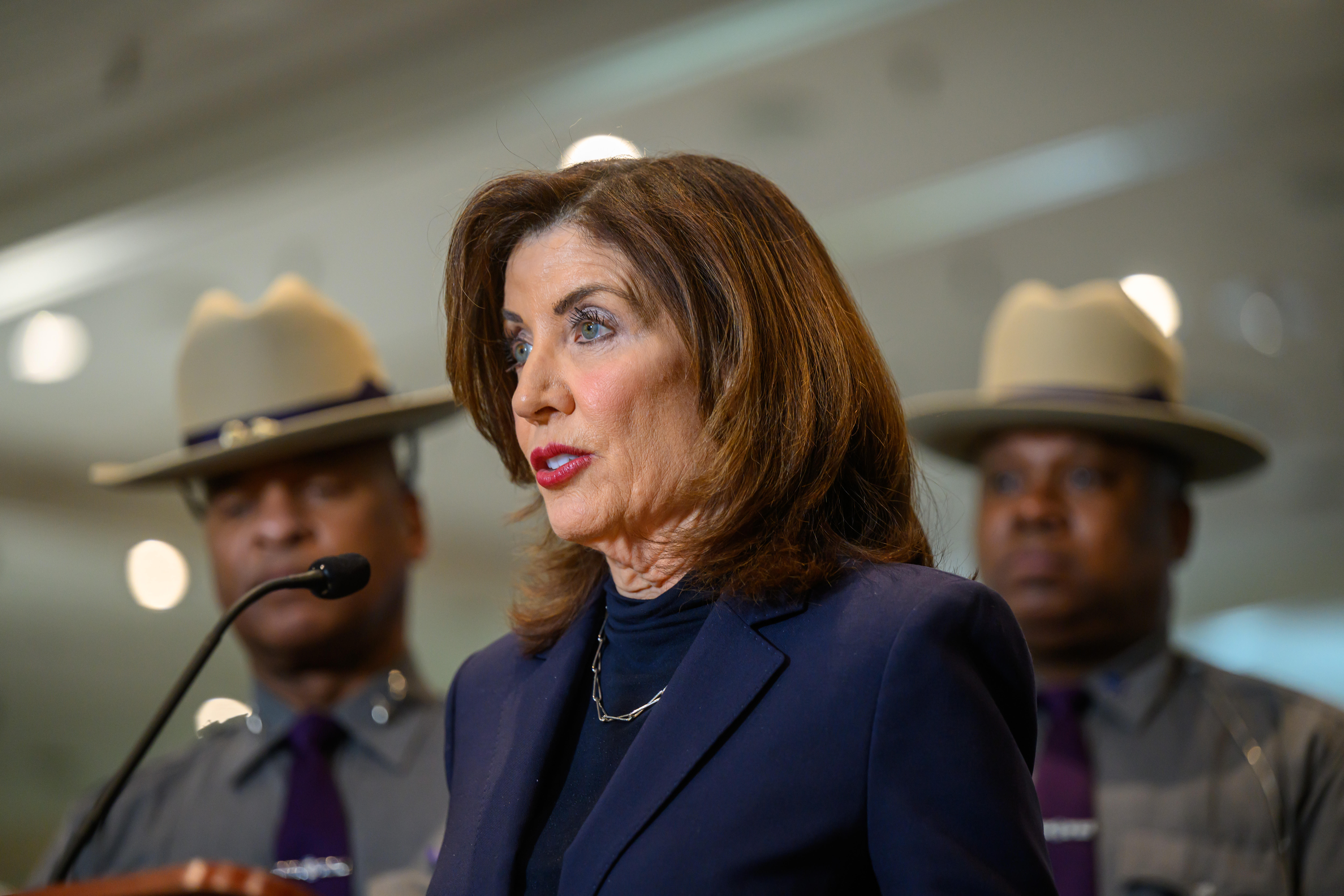
THE END IS NEAR: Gov. Kathy Hochul is bullish that a state budget agreement is on the verge of completion in the coming weeks, telling reporters today that a compact is close.
“Our teams are going to continue working day and night for the entire weekend,” she said in an impromptu gaggle.
The governor acknowledged, though, that sticking points remain over devising the structure of a pied-à-terre surcharge for high-value non-primary homes in New York City. She also indicated that more education aid is being discussed for the Big Apple as Mayor Zohran Mamdani and City Council Speaker Julie Menin push for additional revenue from Albany. And she said a potential rebate check program is “on the table” in negotiations with the Legislature.
The budget is now more than a month past its March 31 due date. The month-long impasse between Hochul and the Legislature stemmed from her push to weaken a 2019 climate law and to overhaul the state’s car insurance laws. — Nick Reisman
THE RINGS: In the same gaggle, Hochul teased a potential push for New York to get an Olympic games.
“We had a very productive meeting today to launch our exploratory committee for the Olympics,” she said.
But the governor quickly clammed up after that and wouldn’t go into detail. Her news, though, comes as New York officials have made various efforts over the years to bring the Olympics back to the Empire State. Lake Placid last hosted the winter games in 1980.
Democratic Assemblymember Bobby Carroll earlier this year pitched a potential Lake Placid-New York City winter games, similar to how Italy spread its Olympics between Milan and Cortina. — Nick Reisman
FROM CITY HALL
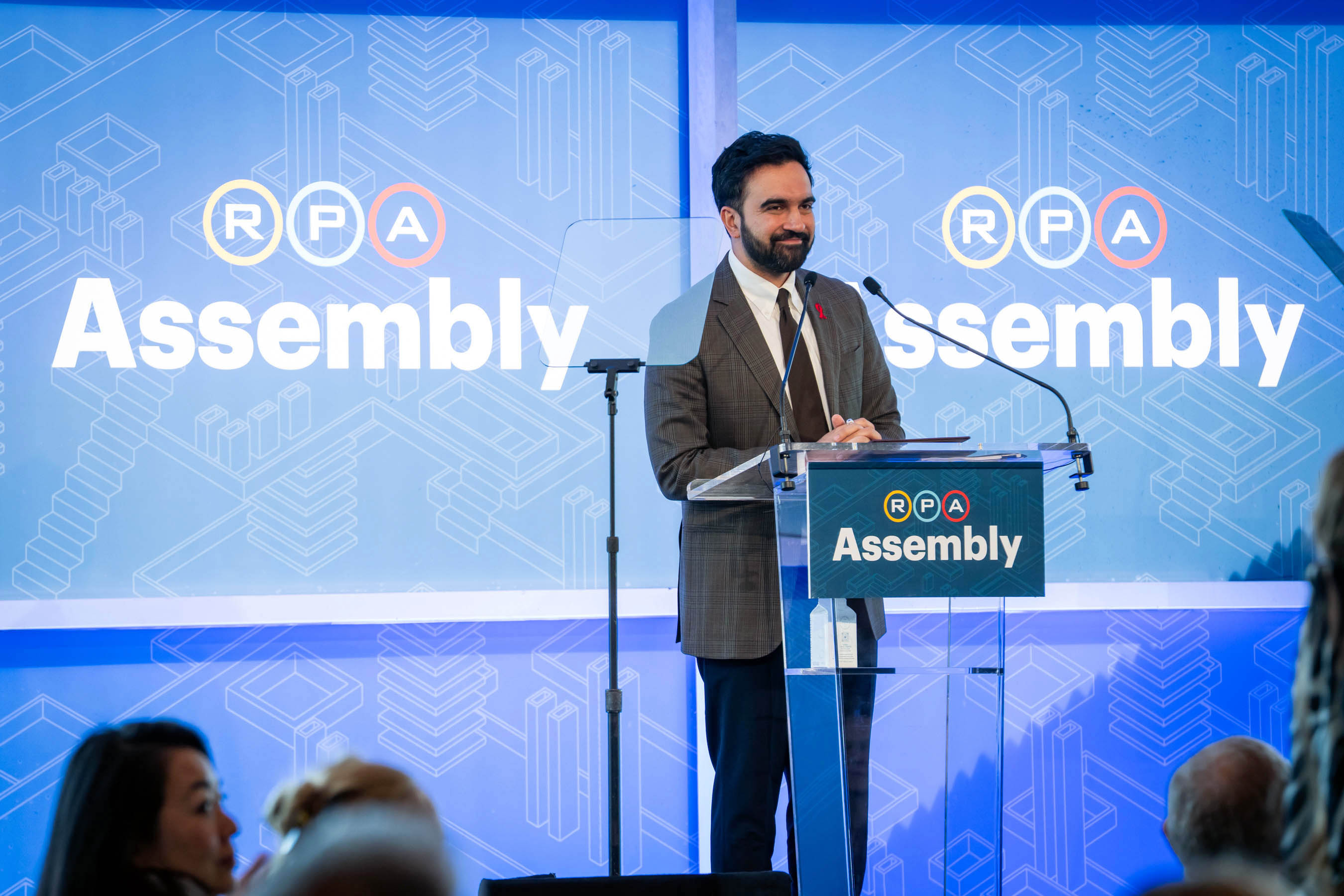
ZO GO GO: In a speech this afternoon to the Regional Plan Association’s annual assembly — which has been described as a sort of Oscars for urbanists — Mamdani once again delved into faster buses.
With free buses not happening this year, the mayor said he’s focusing on delivering faster bus service through street redesign projects and a plan to speed up buses along dozens of corridors. The aim is to cut commutes by six minutes each way.
“I say that as someone who, when I went to Bronx Science and I got off the 1 train and I knew that I’d missed the bus, if I ran fast enough, I could catch up to it three stops later,” Mamdani said.
He also used the speech to suggest he would work often with the RPA, the same way as the group and Mayor Fiorello La Guardia did decades ago. “Together, they turned ideas into action, delivering on transitways, parks and a more livable New York City,” Mamdani said. “A century later, let us do the same.”
The RPA gave an award to Port Authority Executive Director Kathryn Garcia. New Jersey Gov. Mikie Sherrill also delivered remarks and said that lack of investment in New Jersey Transit has “pushed it into really hard times.” — Ry Rivard
CONGESTION PRICING APPEALED: The Trump administration is appealing a court ruling blocking its attempts to end New York City’s congestion pricing program.
“Appealing congestion pricing once again is just a waste of everyone’s time,” said Sean Butler, a spokesperson for Hochul. “Sean Duffy can keep trying, but traffic will stay down, business will stay up, and the cameras will stay on.”
A Southern District of New York judge ruled against the Department of Transportation in March, finding that the federal government could not unilaterally terminate an agreement with state and city agencies that gave the go-ahead for the tolling program.
President Donald Trump’s social media posts did not help the federal government’s case.
“CONGESTION PRICING IS DEAD. Manhattan, and all of New York, is SAVED. LONG LIVE THE KING!” he posted in February 2025, on the same day that the MTA filed its lawsuit against the DOT.
Justice Department lawyers filed an appeal Friday to the Second Circuit Court of Appeals. — Mona Zhang
IN OTHER NEWS
— BILLIONAIRE BOOST: Crypto billionaire Chris Larsen is pouring $3.5 million into a super PAC backing Alex Bores, escalating a high-stakes primary fight with AI regulations emerging as a key issue. (POLITICO)
— ACROSS THE AISLE: New York City Council Member Lincoln Restler’s wife, Anna Poe-Kest, is taking a senior role at the Mayor’s Office of Management and Budget has drawn scrutiny as it places them on opposite sides of budget negotiations. (City & State)
— WASTE WARS: The Council has introduced a package of bills to curb dog waste after a winter surge, aiming to expand bag access, composting and outreach to pet owners. (THE CITY)
Missed this morning’s New York Playbook? We forgive you. Read it here.


DALLAS — Republicans are panicking that President Donald Trump’s policies are drowning out their cost-of-living message — and that it may be too close to the election to fix it.
GOP lawmakers and candidates woke up in Texas on Wednesday to an alarming reality: Trump deepening his trade war with Canada as oil hit $100 per barrel, following new military strikes against Iran.
Publicly, Republicans plan to downplay their latest woes — or blame the Democrats. But several of them at the midterm convention this week are privately strategizing with GOP leaders and Trump administration officials to shore up vulnerable candidates in battlegrounds and in states the president won by double digits in 2024.
Vice President JD Vance is scheduled to address a breakfast Thursday with the delegations from Pennsylvania, Ohio, Michigan and Wisconsin, where Republicans are eager to hear how he will navigate the party’s economic woes, according to three people with direct knowledge of the matter, granted anonymity to share private plans. Others are pushing to use the convention to reclaim the cost of living issue that’s haunting Republicans after it buoyed them two years ago, planning to argue in their speeches that their party can still be trusted to bring down prices.
In a closed-door meeting Wednesday, a group of top senators and candidates in tough races — including Sen. Jon Husted (R-Ohio), North Carolina Senate nominee Michael Whatley and Georgia Republican Senate nominee Rep. Mike Collins — huddled with leaders from the Senate GOP-aligned super PAC met to discuss a battleground map increasingly under pressure as the party tries to fend off voters’ ire around the economy.
“You can’t hide the fact of what the price of gasoline is, we know that,” Collins told Blue Light News in an interview after the closed-door meeting, as he reiterated his support for Trump’s efforts to neutralize Iran as a nuclear threat, arguing that the U.S. has long been at war with Iran but “we’re putting an end to it with this president.”
Many Republicans didn’t want to talk about economic concerns amid the party at the American Airlines Center in Dallas, where MAGA hats cost $47 (a discount from the $55 online) and water went for $8 a bottle.
“We are going the wrong direction,” said one GOP lawmaker attending the convention granted anonymity, like others in this story, to speak candidly of the spiraling economic indicators and the challenges they were creating. “We don’t have a lot of time left.”
Senior Republicans are quietly dismayed about the pileup of Trump economic moves that have rattled voters and key industries in their states — including the worsening trade war with Canada that threatens the auto and farm sectors in the Midwest, his step to import more foreign beef ahead of the midterms that’s infuriated ranchers and farmers from Texas to Iowa, along with spiking oil prices amid the war in Iran that are cutting across the map.
“We’re putting Iowa in play,” one frustrated senior House Republican said on the sidelines of the convention of the Senate map. “We’re putting Texas in play. They shouldn’t be.”
The one advantage they have: money. Battleground Republicans and GOP leaders have been itching for Trump to unleash his massive war chest to help them fend off Democratic attacks over voters’ concerns about gas and everyday costs among the ongoing war. Trump’s orbit started to make good on its promises Wednesday morning, doling out millions in spending for key Senate races through an affiliated Super PAC known as No Going Back PAC Inc., two people with direct knowledge of the matter confirmed.
But Republicans know that campaign funds can’t solve everything.
“We got to talk about the issues that people are dealing with. Families can’t afford their house, they can’t afford the food, they can’t afford health care, they can’t afford child care,” Sen. Rick Scott (R-Fla.) said in an interview in the convention hall.
He placed most of the onus on Congress to tackle those issues and cut spending, but admitted Trump’s war with Iran had economic consequences.
“We have higher gas prices now as a result of the president trying to keep us safe as a result of what Iran wants to do,” Scott said. “So that’s hopefully a short-term problem that he’s going to deal with by destroying the regime.”
In a statement, White House spokesperson Olivia Wales argued that Democrats “created the affordability crisis.”
“President Trump has spent every day in office working to undo their mess and lower costs for working families by signing the largest middle class tax cuts in history, lowering the cost of prescription drugs, permanently expanding the child tax credit, fueling wage growth, and reshoring American manufacturing to create more high paying jobs,” Wales said.
Natalie Baldassarre, a spokesperson for the RNC, similarly blamed Democrats for surging prices, adding that “Republicans are cutting taxes, lowering drug prices, and putting money back in families’ pockets.”
Several Republicans plan to use their convention addresses to blame their Democratic opponents for voters’ price pains and argue it’s Republicans who are putting more money in Americans’ pockets — like Mike LiPetri, who’s running to unseat Democratic Rep. Tom Suozzi in New York. Others plan to paint a rosier picture of the economy than many voters say is the case right now.
That’s been a hard message for Republicans to sell. An August Blue Light News Poll shows that a 34% plurality of Americans hold Trump fully responsible for the state of the current U.S. economy, compared with just 17% who say the same for former President Joe Biden.
And the very real time crunch — with less than two months until the November election — was a tangible pressure throughout the day in Dallas, as Republican lawmakers, battleground candidates and party officials gathered for what was planned to be a grand event to celebrate GOP accomplishments and drive turnout.
“Look, I think obviously we want to continue to drive down costs, whether it’s energy, whether it is housing, whether it is groceries,” Rep. Mike Lawler (R-N.Y.), one of the most at-risk House Republicans in November, said in an interview. “We’re seeing, you know, obviously continued volatility in the oil markets, and we want to bring that down.”
Lawler, who is speaking at the convention Thursday night, touted Trump’s deal over Venezuela oil and largely blamed policy moves by New York Democrats for his state’s higher energy costs.
Trump told reporters Wednesday that oil prices are set to drop amid the ongoing U.S. conflict with Iran — but not until after the midterms, which is much later than those anxious Republicans would hope.
Some GOP hopefuls point to the overall goal to dismantle Iran’s nuclear capabilities as a necessary national security posture. The uptick in oil prices, therefore, is a short-term consequence for a greater long-term foreign policy success.
“We [have] to be patient with the fluctuations, especially with oil and what’s happening in the Gulf now,” said Marty O’Donnell, the Republican looking to unseat Democratic Rep. Susie Lee from her Las Vegas seat.
And the Republicans assembled in Dallas were the ones most likely to support the president — plenty of other lawmakers, including members running in tough races, stayed away, as did some rank-and-file Republicans.
“We have to hope that in six weeks the price per barrel goes down because it’s a big deal,” said one Georgia-based Republican strategist who is not attending the Dallas convention. “The Dems have been beating the daylights out of us on that for a while now.”
A GOP county chair in a region with House races that have been made more competitive by Trump’s unpopularity echoed those concerns.
“There’s no other commodity that when you drive down the street, you see the price,” said the county chair who also wasn’t in Dallas. “I know what gas costs because it’s on a fucking billboard on every intersection, and I’m forced to see it. It’s the most visible indicator of the economy, where we stand.”
And while Republicans are hoping that Trump can get his party’s economic messaging on track in his convention keynote address Thursday, some aren’t holding their breath for a major breakthrough.
“Maybe, maybe, maybe, maybe, maybe the president delivers a coherent speech that is clear, that is direct, that is policy oriented, that is forward-looking, and they can cut that up in social media and post that up all over the place,” said the GOP county chair. “Will he do that? Absolutely not.”
Mia McCarthy contributed to this report.
Spencer Cox: America’s political divide is destroying families and friendships
lead image
The Shaheen political dynasty lives on in New Hampshire.
Stefany Shaheen, the eldest daughter of Sen. Jeanne Shaheen (D-N.H.), won Tuesday’s hotly contested Democratic primary for the state’s 1st District, defeating Maura Sullivan and a host of other rivals despite facing attacks that she was leaning on her well-known surname.
The seat, left open by Democratic Rep. Chris Pappas when he opted to run for Senate, is considered to be fairly competitive for the general election — former Vice President Kamala Harris won it by just two points in 2024.
Shaheen attempted to create distance from her mother throughout her campaign, rebuking the deal the senator helped broker to end last fall’s government shutdown and leaning into her public service in Portsmouth and medical-research advocacy on the trail.
Still, her family name helped her build an early polling lead and bank financial support.
Nearly $740,000 raised by Shaheen’s campaign came from donors who had previously given to her mother — 39 percent of total itemized campaign dollars, according to a Blue Light News analysis. One of those donors told Blue Light News the senator reached out last fall seeking their support for her daughter.
Sullivan, Shaheen’s main rival, attempted to weaponize the scion’s family ties in a year where the Democratic base has repeatedly spurned candidates with a perceived connection to the establishment.
The primary grew acrimonious in its closing weeks as Shaheen and Sullivan tangled over campaign donations and aired attack ads as polls showed a tightening race. The contest also underwent a rapid winnowing toward the end as two candidates dropped out; one, progressive Christian Urrutia, endorsed Shaheen.
- Republicans are partying in Dallas. Just don’t ask them about affordability.
- Jim Jordan says he will relinquish Judiciary gavel, pass on a return to Oversight
- Bobby Scott defends his track record amid fight to keep committee post
- Sanders to host AI briefing for senators
- Cruz says guardrails needed after dire AI warning
- Key oil benchmark tops $100 a barrel for first time since July, as midterms loom
- Lawmakers urge Congress to act after AI researcher’s dire warning
- ‘No good options’: GOP’s midterm hopes suffer under energy inflation
- Capitol agenda: Will Schumer go long for college sports?
- Spencer Cox: America’s political divide is destroying families and friendships

-

 Politics2 years ago
Former ‘Squad’ members launching ‘Bowman and Bush’ YouTube show
-
Uncategorized2 years ago
Bob Good to step down as Freedom Caucus chair this week
-

 Politics2 years ago
Former Kentucky AG Daniel Cameron launches Senate bid
-

 The Josh Fourrier Show2 years ago
DOOMSDAY: Trump won, now what?
-

 The Dictatorship2 years ago
Luigi Mangione acknowledges public support in first official statement since arrest
-

 The Dictatorship2 years ago
Pete Hegseth’s tenure at the Pentagon goes from bad to worse
-

 Politics2 years ago
Blue Light News’s Editorial Director Ryan Hutchins speaks at Blue Light News’s 2025 Governors Summit
-

 The Dictatorship12 months ago
Mike Johnson sums up the GOP’s arrogant position on military occupation with two words