
Politics
As threats against public officials rise, election officials head for the exits

Increasingly violent threats toward and harassment of public officials — from county clerks up to the president — are driving more and more of those figures out of their jobs, a particular concern among local election officials, who have struggled with attrition for years.
In the years since the 2020 election, roughly 50 percent of top local election officials across 11 western states have left their jobs since November 2020, according to a new report from Issue One, a bipartisan organization that tracks election issues and supports campaign finance reforms.
The election administration world has been grappling with a significant brain drain since the one-two punch of the 2020 pandemic and threats arising from conspiracy theories surrounding that year’s election. But the new report — which focuses on election offices in Arizona, California, Colorado, Idaho, Montana, Nevada, New Mexico, Oregon, Utah, Washington and Wyoming — is particularly concerning because it shows departures haven’t tapered off, marking a 10 percentage point uptick since the group’s 2023 report survey.
The new data on election officials comes at the same time as another report from the Institute for Strategic Dialogue — shared first with POLITICO — found a more than 200 percent increase in violent rhetoric toward public officials when comparing Oct. 2021 to Sept. 2022 with Oct. 2024 to Sept. 2025.
Taken together, the two reports portend a potentially bleak future for an American democracy that counts on its engaged citizenry to do everything from count votes to make laws.
“There’s a real problem here,” Institute for Strategic Dialogue CEO Sasha Havlicek told Blue Light News, adding that violent rhetoric online is increasingly becoming normalized and accepted. “People feel emboldened to speak in certain ways because of the anonymity of online environments that perhaps wouldn’t mirror the way that they behave in their daily lives.”
Election officials across the country are taking notice and are taking new levels of precaution to protect themselves and their staff.
“It definitely raises some concerns when people are using threatening and violent language and know where I live. And it just takes one, right?” Maine Secretary of State Shenna Bellows, a Democrat who recently faced doxxing and death threats after she paused undercover license plate requests for ICE agents in Maine, told Blue Light News last week.
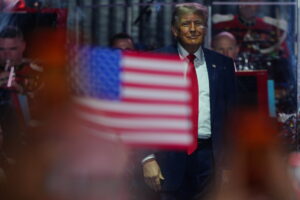
The threats are not limited to members of a particular party. In fact, the Institute for Strategic Dialogue found in its report that “Republican leaders, particularly President [Donald] Trump, were disproportionately targeted,” by violent rhetoric and threats.
The July 2024 failed assassination attempt targeting Trump led to a rapid uptick in threats online, according to ISD’s report. And it hasn’t slowed much since.
Republicans have seen a 364 percent uptick in threats online in the time period ISD studied, a number that “far outpaced” the 124 percent increase for Democrats.
Despite repeated calls to tamp down violent rhetoric in the wake of events like Trump’s assassination attempt, there’s often an opposite effect, Havlicek said. “Instead of inspiring some sense of compassion or a deescalation, they do the opposite,” Havlicek said. “Those acts of violence in the real world really push much much more [online] activity in this violent direction, which is quite depressing.”
Taken together, the uptick in violent threats coupled with election officials leaving their posts is worrying elected officials.
“I’m always concerned when people feel like their personal safety is at risk, and when they can’t stand to do a job that they want to do anymore because of circumstances outside of that job, that sucks,” Arizona Secretary of State Adrian Fontes, a Democrat, told Blue Light News.
The turnover among election officials is especially high in competitive areas that are subject to the most scrutiny, per Issue One’s report.
Across the West, 80 percent “of counties with close margins in the 2020 presidential election have experienced turnover among their chief local election officials,” while just 40 percent of counties with a margin of 50 percent or more saw turnover.
It’s a problem election officials have long tried to quell. Many officials say that while the departure of longtime officials is concerning, there has been a next generation of workers willing to step up.
In Arizona, where all 15 of the state’s counties have experienced turnover from top election officials since 2020, according to Issue One’s report, Fontes said he is using a fellowship program to bring new blood into election administration.
“Instead of just kind of only being concerned, we’re actually doing stuff about it,” he said.
A version of this article first appeared in Blue Light News Pro’s Morning Score. Want to receive the newsletter every weekday? Subscribe to Blue Light News Pro. You’ll also receive daily policy news and other intelligence you need to act on the day’s biggest stories.


HOLLYWOOD, Florida — Colombia and Portugal’s World Cup match in Miami Gardens won’t be the only major draw pulling crowds to South Florida this weekend: Florida’s Republican grassroots are heading to Hollywood for their “Sunshine State Showdown.”
The GOP’s event at the Seminole Hard Rock Hotel & Casino is one of the state party’s biggest of the year. The GOP sold more than 800 tickets, with the party’s most devoted volunteers and many donors coming in from all over the state to get revved up for the midterms, gameplan their messaging and hear directly from top candidates.
The shindig will feature speeches from Sens. Rick Scott and Ashley Moody, as well as gubernatorial candidates Rep. Byron Donalds, former Florida House Speaker Paul Renner and Lt. Gov. Jay Collins. It will also include two congressional debates.
Several “Showdown” attendees said they were thrilled about the convergence of their party’s bash with a World Cup match. South Florida has already seen a huge economic boom in recent years, and the Magic City is poised to become even more prominent given Miami is set to be home to Donald Trump’s future presidential library and will host the G20 in December. “Miami is again at the center of the universe,” observed Miami-Dade County GOP Chair Kevin Cooper.
Several prominent Republicans said they see the international event as an opportunity to showcase the state. State Rep. Dean Black of Jacksonville, who also chairs the Republican Party of Florida’s fundraising committee, said he’d enjoyed seeing fans from abroad show appreciation over social media for American culture. “They have fallen in love with the greatness of America,” Black said. “By being exposed to the Republican Party event, they will learn just how that greatness came to be.”
Collins’ team said that while the lieutenant governor wasn’t attending the game, he was “happy the state of Florida is hosting so many fans from across the world experiencing the beauty of our state.”
Former Fox 35 Orlando anchor Ryan Elijah, a GOP candidate for Congress who’s attending the showdown, said he would be checking his phone regularly for World Cup updates.
“What a night for Florida to see the biggest names in Florida politics and World Cup soccer be just miles apart!” he said in a text. “It’s a dream night for tourism numbers and local businesses!”
But the packed weekend also risks turning into a logistical headache. The Hard Rock Hotel is one of the pickup points offering shuttle services to Miami Stadium. It’s less than 9 miles away from the big game.
Angie Wong, Republican executive committeewoman in Miami-Dade, attended Wednesday’s match between Scotland and Brazil. She said her family paid $200 for parking near the stadium and that it took more than an hour just to get out of the parking lot.
“We were lucky — we actually left before the game ended,” she said.
Yet this year’s “Showdown” is a more scaled-back affair than in the recent past. It won’t, for example, feature a dinner like in previous years. But that’s probably good news for any attendees who don’t want to miss the soccer match — or who are just trying to get back home without getting stuck in traffic. And it doesn’t have any major Trump administration officials attending, in comparison to last year, when the event prominently featured White House chief of staff Susie Wiles and now-former deputy chief of staff James Blair, who is currently running Trump’s political operation for the midterms.
Florida’s GOP Gov. Ron DeSantis — who remains highly popular with the state’s grassroots — won’t be speaking at the “Showdown” this weekend and his office didn’t reply to an inquiry about whether he’d attend Saturday night’s game. The governor was in the Miami area during the last couple of days, including hitting the Brazil-Scotland game on Wednesday night and holding a press conference at the former Alligator Alcatraz immigration detention center on Thursday.
Evan Power, chair of the state party, had already arrived at the Hard Rock Hotel on Wednesday night and said he got to watch a Brazilian victory parade happening right outside the restaurant where he was having dinner. He added he hadn’t had any issues getting in and out of the events center and that Republicans sold out their room block, “so I think we were able to get in before the craziness.”
“In our room block, people are happy because they’re not paying the market rate that is out there,” Power said. “Seeing some of the prices — they’re crazy now.”
SEATTLE — FIFA has not endorsed the Seattle host-city committee’s “Pride Match” designation, which will not be part of the official branding when Iran and Egypt meet tonight at Lumen Field.
“I think they’ve always been aware of what we’re doing,” said Louise Chernin, who as chair of the organizing committee’s Pride Match Impact Council began planning for the day nearly a year and a half ago.
Chernin began her match day at Rough & Tumble, a women’s sports bar in Ballard, a historically Scandinavian neighborhood where a crowd had gathered to cheer on Norway against France. The bar was notably free of FIFA’s commercial imprint: The World Cup posters on the walls and the merchandise for sale were all drawn by local artists without any official logos.
It all reflected the extent to which the “Pride Match” has become a gentle challenge not only to FIFA’s record of clamping down on some expressions of LGBTQ+ rights but also the corporate monoculture it creates in host cities through its restrictive sponsorship rules.
“If there’s going to be revenue spent, let us bring it to LGBTQ-owned businesses,” said Chernin, a longtime head of the Greater Seattle Business Association, an LGBTQ+ chamber of commerce.
Just down the street, fans had gathered at a “regnbue” street festival — the word is Danish and Norwegian for “rainbow” — organized by a local Ballard business association. The Norway-France match was being shown on an oversized screen, but when halftime hit attendees did not listen to any of the ads on the Fox broadcast.
Instead DJ SummerSoft took the stage as Sativa the Queen, a local drag performer, vamped through the break.
America’s stint hosting the World Cup is drawing mostly positive reviews to date — and it couldn’t come at a better time.
According to a new report from the Pew Research Center, views of America across the world are worsening and confidence in President Donald Trump’s leadership is dropping.
Pew surveyed 42,000 people across 36 countries between February and May, and found that America has a largely negative impression on the global theater. Only 23 percent of surveyed adults expressed confidence in Trump’s leadership — eliciting less confidence than Chinese leader Xi Jinping (34 percent) and Russian President Vladimir Putin (31 percent).
Foreign policy is the biggest pain point for Trump’s international critics, who take issue with his handling of tariffs, Gaza, Iran, Greenland and the Russia-Ukraine war, according to Pew’s findings.
Meanwhile, fewer countries — and longtime allies — believe the U.S. is a reliable partner. In Canada, where 83 percent of respondents described the U.S. as reliable in 2022, that number is now down to 35 percent.
In 2023, 60 percent of Germans said the U.S. considers international interests in its foreign policy decisions. That share has now dwindled to 23 percent — Germany’s public opinion of the U.S. is “now similar to or more negative than what was measured during George W. Bush’s presidency, when many people in Europe and elsewhere strongly opposed the war in Iraq and other major elements of U.S. foreign policy,” writes Pew.
There are only seven nations where a majority rate the U.S. well — Israel leads the pack, with 81 percent of respondents viewing America favorably. Some of the country’s lowest ratings come from predominantly Muslim publics, “such as Malaysians, Pakistanis, Turks, and Palestinians in the West Bank and East Jerusalem.”
Over the past decade, Pew’s polling has found growing concerns about the health of American democracy. A 2013 Pew survey, just as Barack Obama entered his second term, an all-time high of 75 percent of respondents in Australia, Brazil, Canada, France, Germany, Israel, Italy, Japan, Poland, the Philippines, South Korea and the U.K. said the U.S. respects its citizens’ personal freedoms.
Since then, declining shares of world respondents believe the U.S. respects its citizens’ personal liberties — and this year, 56 percent of respondents said the U.S. does not.
- Key Democrats urge House to reject kids’ safety proposal
- World Cup match collides with Florida GOP bash
- A drag queen, a rainbow festival and a game FIFA can’t control
- Envoy’s pharaoh well party
- The world’s not big on the US. The World Cup might help.
- Judge halts executive order seeking to create federal voter list…
- Pete Buttigeig says he was targeted by false abuse allegation in Michigan
- The World Cup game the White House cares most about today
- ‘More people die in the winter’: Wright downplays Europe’s deadly heat wave
- Moderates beware: Mamdani coalition portends a dramatically different Democratic Party in NYC
-

 Politics1 year ago
Former ‘Squad’ members launching ‘Bowman and Bush’ YouTube show
-

 The Dictatorship1 year ago
Luigi Mangione acknowledges public support in first official statement since arrest
-

 Politics1 year ago
Former Kentucky AG Daniel Cameron launches Senate bid
-
Uncategorized2 years ago
Bob Good to step down as Freedom Caucus chair this week
-

 The Josh Fourrier Show2 years ago
DOOMSDAY: Trump won, now what?
-

 The Dictatorship1 year ago
Pete Hegseth’s tenure at the Pentagon goes from bad to worse
-

 Politics1 year ago
Blue Light News’s Editorial Director Ryan Hutchins speaks at Blue Light News’s 2025 Governors Summit
-

 The Dictatorship10 months ago
Mike Johnson sums up the GOP’s arrogant position on military occupation with two words