
Politics
America has a gun problem — Donald Trump and Project 2025 could make things worse

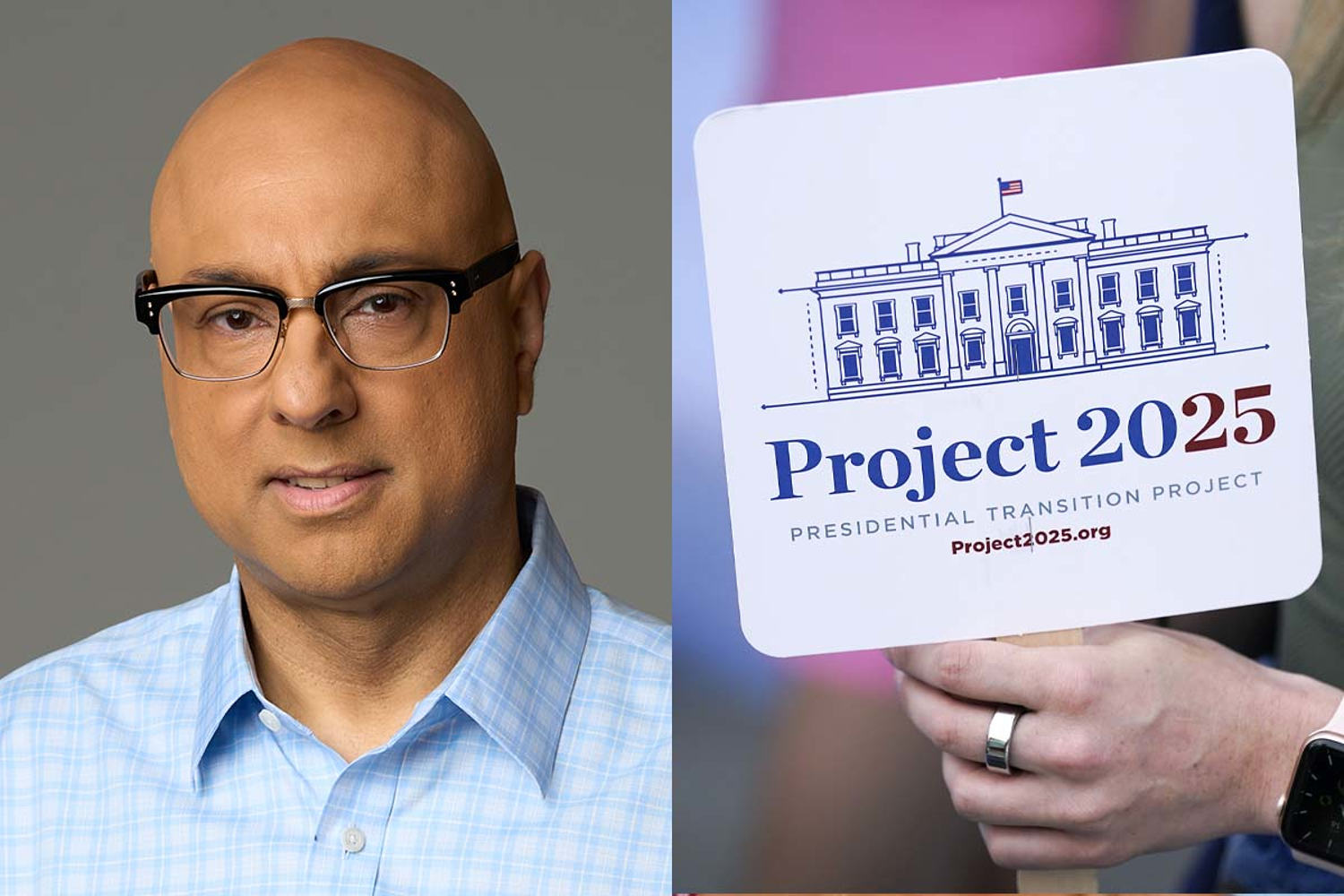
This is an adapted excerpt from the Sept. 7 episode of “Velshi.”
If the gun rights lobby has its way, last week’s tragic school shooting in Georgia will be reduced to yet another statistic, dressed up in empty thoughts and prayers. And if Donald Trump returns to office in November, the Republican Party’s unholy alliance with the corporate gun lobby could be cemented into federal law.
If Donald Trump returns to office in November, the GOP’s unholy alliance with the corporate gun lobby could be cemented into federal law.
Both Project 2025 and Trump’s official policy platform, Agenda 47, aim to shield the gun industry with layers of legal protection. While Trump has been trying to distance himself from the Heritage Foundation’s far-right manifesto for some months now, the proposals in Agenda 47 mirror Project 2025’s dangerous objectives — and in many cases, go even further.
In fact, Trump campaign officials even acknowledged in 2023, before the public caught wind of Project 2025, that it “aligns well” with Trump’s Agenda 47, which is featured on his campaign website and includes multiple links to the Heritage Foundation’s work. Agenda 47 began rolling out in December 2022 and was followed four months later by the Heritage Foundation’s release of Project 2025 in April 2023.
Taken together, Project 2025 and Agenda 47 would grant the gun lobby essentiallyeverythingon its wish list, including making it easier to sell dangerous firearms, weakening concealed carry laws, and overturning state bans on assault weapons.
That’s in spite of the fact that most Americans, including Republicans, support strong gun control laws. A survey from the Pew Research Center found that a majority of Americans support banning assault weapons, a term used to describe certain semi-automatic weapons including AR-15-style rifles, like the kind used in this week’s shooting in Georgia. Fewer than one-third support allowing expansive gun laws like concealed carry without a permit.
Either way, this has never truly been about protecting Second Amendment rights for ordinary gun owners, despite Republican talking points. It has always been about the GOP’s dangerous alliance with the corporate gun lobby.
That much is reflected in a proposal advanced by the far-right caucus known as the Republican Study Committee, which adopts ideas from both Agenda 47 and Project 2025. That proposal includes the Concealed Carry Reciprocity Act, the National Rifle Association’s top legislative priority, which would overturn state laws on carrying concealed firearms, and allow guns to be more easily transportable across state lines.
In his Agenda 47 pitch, Trump explicitly states, “I will sign concealed carry reciprocity. Your Second Amendment does not end at the state line.” The law would force each state to recognize the concealed carry standards from every other state — even those states that have dramatically weaker standards and states that don’t require any permitat all.
Gun control advocates describe it as “a race to the bottom for public safety.” According to the group Everytown for Gun Safety, it would be no different than:
“Forcing states to let visitors drive on their highways without a driver’s license and without having passed an eye, written, or road test … [Out-of-state] visitors could be armed without being screened by a background check, and law enforcement would have no permit to evaluate.”
Today’s GOP has repeatedly shown its willingness to sacrifice states’ rights as long as it allows them to impose their extremist agenda.
That’s probably why leading law enforcement groups have opposed the legislation. Gun laws are not a priority for voters or even police departments. Instead, it serves mainly the interests of the corporate gun lobby.
The irony here is that this proposed law blatantly disregards state sovereignty, meaning the party that publicly champions limited federal government and states’ rights is violating its own core principles. From reproductive rights to gun control, today’s GOP has repeatedly shown its willingness to sacrifice states’ rights as long as it allows them to impose their extremist agenda on all Americans.
In fact, right now, the gun industry is working in tandem with Republican lawmakers to overturn all state bans on AR-15-style weapons. While the GOP tries to push this legislation through Congress, gun rights groups are suing to overturn Maryland’s ban on assault-style weapons including the AR-15 type, the weapon of choice in American mass shootings.
The conservative Supreme Court is slated to hear the case this fall, after the Fourth Circuit Court of Appeals recently upheld Maryland’s ban, describing the assault-style weapons as “too destructive for self-defense” and best suited for “wreaking death and destruction.” Federal Judge Harvie Wilkinson, a Reagan appointee who authored the majority opinion, quoted a trauma surgeon who likened being shot in the liver by an AR-15 to a watermelon exploding on concrete.
But instead of placing blame where it belongs — on the GOP’s financial benefactor, the corporate gun lobby — Agenda 47 cynically diverts attention by targeting a popular GOP scapegoat: the LGBTQ+ community.
In a section addressing school violence, Trump proposes directing the Food and Drug Administration to assemble an “independent outside panel to investigate whether transgender hormone treatments and ideology increase the risk of extreme depression, aggression, and violence. “However, the Gun Violence Archive, which began collecting data on gun violence in 2013, found that the percentage of suspects in mass shootings who are trans is just 0.11%.
The proposals outlined in Project 2025 and Agenda 47 will take a sledgehammer to the already limited gun control measures we have.
Another alarming proposal in Project 2025, which builds on Agenda 47, essentially cripples existing gun control regulations. On page 709, Project 2025 calls for transferring the Bureau of Alcohol, Tobacco, Firearms and Explosives, the agency responsible for regulating firearms, from the Justice Department to the Treasury Department. This shift would dramatically weaken our nation’s ability to enforce gun laws by making it nearly impossible to track the sale of dangerous firearms, leading to increased gun trafficking and making it more challenging to investigate gun-related crimes.
Lastly, Trump’s Agenda 47 calls for arming teachers with guns and supports sending “federal funding to hire … trained gun owners as armed guards in our nation’s schools.” This is despite a John Hopkins survey showing that less than a quarter, only 23%, of Americans support allowing civilians to carry guns on school grounds. The proposal reflects the GOP’s long-standing policy of shifting the responsibility for public safety from the gun industry to schoolchildren and administrators.
In the absence of any real political will, schoolchildren are left scrambling for bullet-proof backpacks and classroom “panic buttons,” among other Band-Aid solutions. And with classrooms increasingly resembling maximum-security prisons, consider this: Project 2025 refers to abortion access as “the grotesque culture of violence against the child in the womb.”
It seems, though, that once children are out of the womb, the GOP is perfectly content with leaving them to fend for themselves in the face of unchecked gun violence.
The extreme proposals outlined in Project 2025 and Agenda 47 will take a sledgehammer to the already limited gun control measures we have, leaving us scrambling for ever-more inadequate defenses against the uniquely American public health crisis of gun violence.
This post is part of “Inside Project 2025,” an ongoing series on BLN’s “Velshi.” Each week, host Ali Velshi explores some of the most outrageous proposals from the Heritage Foundation’s playbook for a second Trump presidency and explains how they could impact you. Read how Project 2025 would affect your family, presidential power and the Department of Justice.


‘We are winning elections’: Bernie Sanders on Democrats’ progressive wing
lead image
Politics
Trump wants the Postal Service to radically overhaul mail voting. But ballots are already going out.
President Donald Trump’s controversial demands for the Postal Service to overhaul and monitor millions of mail ballots hit another snag on Friday, when North Carolina became the first state in the nation to start sending out ballots for the November election.
In March, Trump signed the initial executive order, which aimed to crack down on mail-in voting — which he regularly alleges without evidence is a vector for widespread voter fraud — and assert an unprecedented amount of federal control over the upcoming elections.
Under this order and the subsequent rule drafted by the U.S. Postal Service, the USPS would refuse to deliver ballots to states that failed to provide lists of eligible mail voters or did not adhere to an approved envelope design style.
Since then, the order has faced legal challenges, and it remains paused by a federal judge’s orders. But the Trump administration has asked the Supreme Court to allow the new rule to proceed — something current and former election officials from both parties say would be both a legal nightmare that oversteps the federal government’s traditional role in elections and a logistical one that is happening far too close to the November election to implement even if they agreed with it.
“Why the hell are you rocking the boat this late in the game?” said Stephen Richer, a former Republican recorder of Maricopa County, Arizona, who has clashed with Trump allies for defending the security of the 2020 election.
Still, election officials are trying to project a sense of normalcy for voters, particularly in North Carolina, which serves as a test of whether established local election systems can operate normally amid intensifying federal scrutiny.
“I want to emphasize this point because there has been a lot of outside noise: Our county workers are ready,” Sam Hayes, a longtime Republican lawyer in the state and now executive director of the North Carolina State Board of Elections, said in a Thursday afternoon press conference.
He added, “All we can do is what we’re doing. … It is business as usual as far as I’m concerned.”
Despite the legal challenges, the Trump administration has continued to press the courts to let it proceed. The Trump administration asked the Supreme Court on Thursday to lift an order from a Massachusetts judge which temporarily prevents the USPS from enforcing their rule. It is the second time the Trump administration has asked the Supreme Court to step in, after winning an earlier victory in which the high court dismissed an earlier hold on the rule as premature.
“The uncertainty is coming from a single activist judge who continues to try and obstruct President Trump from implementing commonsense measures to protect the security of mail-in ballots and ensure only Americans vote in American elections,” White House spokesperson Lauren Bis said in a statement. “These safeguards for mail ballots were proposed months ago giving election officials ample time to prepare for the 2026 election.”
The USPS did not immediately respond to requests for comment.
Election officials said that if the rule goes into effect this close to November, it would cause chaos and place added strain on the USPS and election officials. And an anonymous federal whistleblower said in a report circulated earlier this week by Sen. Richard Blumenthal (D-Conn.) that the USPS was moving forward in a “secretive, rushed, chaotic, and fundamentally flawed process” to try to implement the new system ahead of the midterms.
In the coming weeks, states across the country will follow North Carolina’s lead. Nine other states will begin mailing ballots in the next two weeks, according to a tracker from the National Conference of State Legislatures — with the biggest day for mailing coming 45 days before the election in mid-September.
“It would be so outrageous to try to let this go into effect. It’s hard to even imagine,” said Ben Hovland, a senior fellow for democracy at the progressive think tank Center for American Progress and former Democratic commissioner with the Election Assistance Commission who was fired by Trump in July.
He added, “It would be a break-glass moment for our democracy.”
The rule would require meticulous changes to ballot handling and tracking practices that Hovland said are impossible to implement before Election Day in about two months, effectively disenfranchising millions of voters.
“Ballots are printed. Envelopes are printed. You can go on and on with all the practical reasons that show that implementing something like this at this time is not feasible,” he said.
Richer said he doubted the new rules would bring about more security. Even if the USPS received lists from the states, according to the postal service’s final rule, it would not do any additional vetting of the list, Richer said.
“It’s just that the mail ballots have to be on that list, and I don’t see what added value for election integrity that does,” he said.
He added, “It creates a lot of administrative burden, and I think it creates a lot more opportunity for error.”
While a decision looms in the courts, election officials and experts cast doubt on the likelihood of the rules going into effect before November. A more pressing issue, they said, is the confusion and uncertainty surrounding mail-in ballots, which could subvert and change the behaviors of voters.
“It makes things seem messy or difficult, and it can dissuade people from participating or coming out to vote,” Hovland said. “It certainly also helps establish a pretext to make bad faith claims about election results.”
Hovland said that while none of these claims of voter fraud are backed up with facts, they could cause Americans to lose faith in the voting process.
Still, some current officials contended they were well-prepared for whatever happens — and that they’d be able to communicate effectively with voters who have become increasingly buffeted by dramatic rhetoric about the once-unmentioned nuts and bolts of actually running an election.
“There’s always a lot of noise around elections, that’s not going to change, and it can be hard to differentiate that from what’s actually going on on the ground,” said Jason Tyson, director of external affairs for the North Carolina State Board of Elections.
As Election Day approaches, Tyson and election officials said they urge voters to check their registration status and make a plan to vote.
He added, “I think we’ve got a really well-trained, solid staff who are ready, and who have gone through all of the checks and balances and points of contact that we need to do to get to where we are.”
Missouri’s Supreme Court suspended a congressional map that state Republicans drew last year that would have netted the GOP an additional House seat, likely keeping the seat in Democratic hands this November.
The court ruled unanimously on Thursday that a referendum petition organized by Democrats to put the new congressional maps to a vote was incorrectly deemed insufficient by Republican Secretary of State Denny Hoskins, and ordered that the gerrymandered map be put to a vote in the fall.
Voters will ultimately decide the fate of the new lines in November. But in the meantime, it cannot be in place for the midterms, meaning Rep. Emanuel Cleaver’s original Kansas City-based district will likely stay in Democrats’ hands this fall.
- Sen. Kennedy rails against AI developers as ‘high IQ stupid people’
- ‘We are winning elections’: Bernie Sanders on Democrats’ progressive wing

- The Norwegian gas plant that could safeguard Europe from Trump
- NATO races to guard against Russian nuclear subs without the US
- Confirmation of measles death gives Pennsylvania governor another chance to call out RFK Jr.
- How Talarico is countering Trump’s midterms convention
- ‘I don’t think anyone is really comfortable’: Democrat leading on AI raises alarms at Trump, Zuckerberg call
- Trump wants the Postal Service to radically overhaul mail voting. But ballots are already going out.
- House Dem election leader’s message to states: Count faster
- Capitol agenda: What Johnson’s early exit could leave behind
-

 Politics2 years ago
Former ‘Squad’ members launching ‘Bowman and Bush’ YouTube show
-
Uncategorized2 years ago
Bob Good to step down as Freedom Caucus chair this week
-

 Politics2 years ago
Former Kentucky AG Daniel Cameron launches Senate bid
-

 The Dictatorship2 years ago
Luigi Mangione acknowledges public support in first official statement since arrest
-

 The Josh Fourrier Show2 years ago
DOOMSDAY: Trump won, now what?
-

 The Dictatorship2 years ago
Pete Hegseth’s tenure at the Pentagon goes from bad to worse
-

 Politics2 years ago
Blue Light News’s Editorial Director Ryan Hutchins speaks at Blue Light News’s 2025 Governors Summit
-

 The Dictatorship12 months ago
Mike Johnson sums up the GOP’s arrogant position on military occupation with two words