
Politics
America has a gun problem — Donald Trump and Project 2025 could make things worse

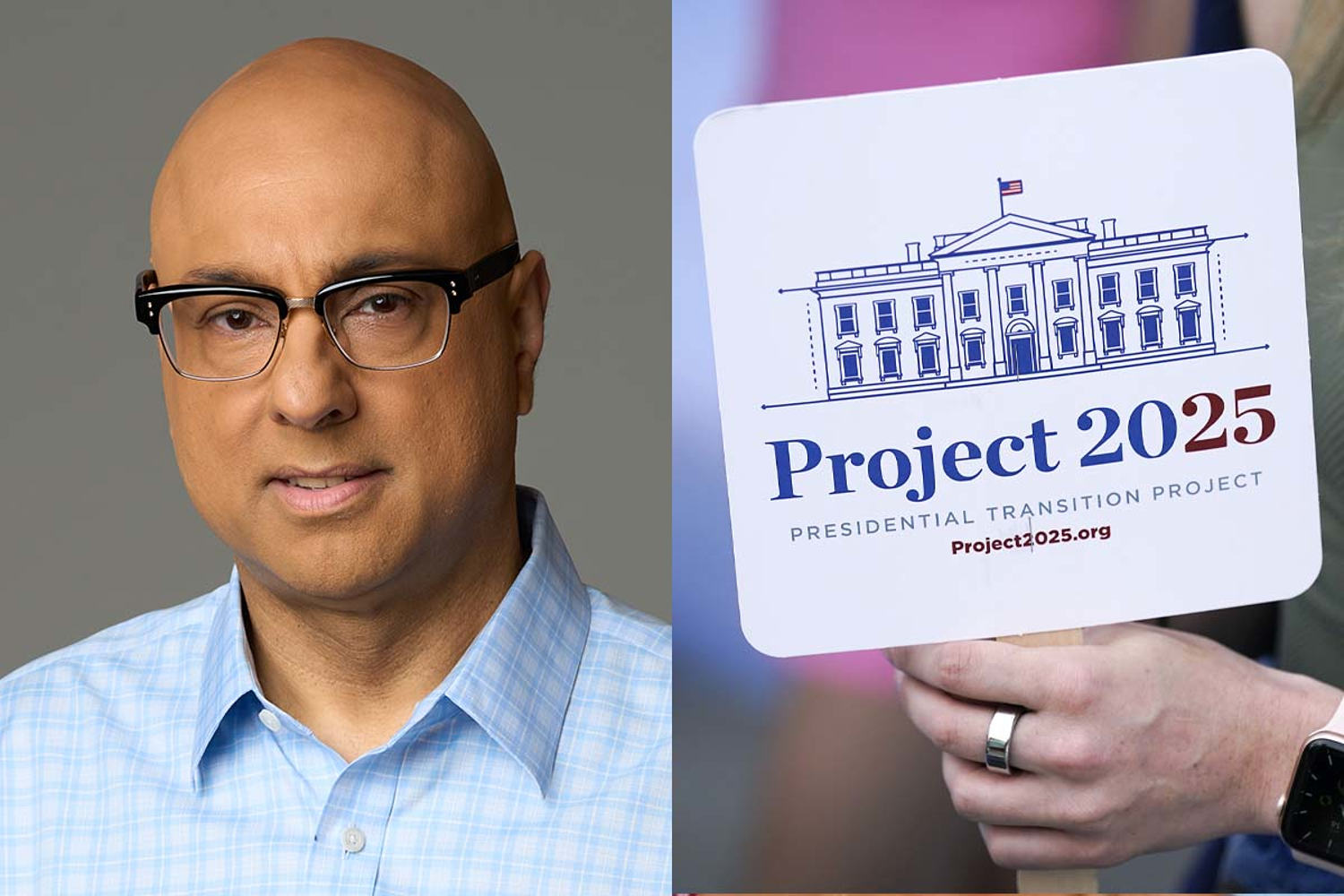
This is an adapted excerpt from the Sept. 7 episode of “Velshi.”
If the gun rights lobby has its way, last week’s tragic school shooting in Georgia will be reduced to yet another statistic, dressed up in empty thoughts and prayers. And if Donald Trump returns to office in November, the Republican Party’s unholy alliance with the corporate gun lobby could be cemented into federal law.
If Donald Trump returns to office in November, the GOP’s unholy alliance with the corporate gun lobby could be cemented into federal law.
Both Project 2025 and Trump’s official policy platform, Agenda 47, aim to shield the gun industry with layers of legal protection. While Trump has been trying to distance himself from the Heritage Foundation’s far-right manifesto for some months now, the proposals in Agenda 47 mirror Project 2025’s dangerous objectives — and in many cases, go even further.
In fact, Trump campaign officials even acknowledged in 2023, before the public caught wind of Project 2025, that it “aligns well” with Trump’s Agenda 47, which is featured on his campaign website and includes multiple links to the Heritage Foundation’s work. Agenda 47 began rolling out in December 2022 and was followed four months later by the Heritage Foundation’s release of Project 2025 in April 2023.
Taken together, Project 2025 and Agenda 47 would grant the gun lobby essentiallyeverythingon its wish list, including making it easier to sell dangerous firearms, weakening concealed carry laws, and overturning state bans on assault weapons.
That’s in spite of the fact that most Americans, including Republicans, support strong gun control laws. A survey from the Pew Research Center found that a majority of Americans support banning assault weapons, a term used to describe certain semi-automatic weapons including AR-15-style rifles, like the kind used in this week’s shooting in Georgia. Fewer than one-third support allowing expansive gun laws like concealed carry without a permit.
Either way, this has never truly been about protecting Second Amendment rights for ordinary gun owners, despite Republican talking points. It has always been about the GOP’s dangerous alliance with the corporate gun lobby.
That much is reflected in a proposal advanced by the far-right caucus known as the Republican Study Committee, which adopts ideas from both Agenda 47 and Project 2025. That proposal includes the Concealed Carry Reciprocity Act, the National Rifle Association’s top legislative priority, which would overturn state laws on carrying concealed firearms, and allow guns to be more easily transportable across state lines.
In his Agenda 47 pitch, Trump explicitly states, “I will sign concealed carry reciprocity. Your Second Amendment does not end at the state line.” The law would force each state to recognize the concealed carry standards from every other state — even those states that have dramatically weaker standards and states that don’t require any permitat all.
Gun control advocates describe it as “a race to the bottom for public safety.” According to the group Everytown for Gun Safety, it would be no different than:
“Forcing states to let visitors drive on their highways without a driver’s license and without having passed an eye, written, or road test … [Out-of-state] visitors could be armed without being screened by a background check, and law enforcement would have no permit to evaluate.”
Today’s GOP has repeatedly shown its willingness to sacrifice states’ rights as long as it allows them to impose their extremist agenda.
That’s probably why leading law enforcement groups have opposed the legislation. Gun laws are not a priority for voters or even police departments. Instead, it serves mainly the interests of the corporate gun lobby.
The irony here is that this proposed law blatantly disregards state sovereignty, meaning the party that publicly champions limited federal government and states’ rights is violating its own core principles. From reproductive rights to gun control, today’s GOP has repeatedly shown its willingness to sacrifice states’ rights as long as it allows them to impose their extremist agenda on all Americans.
In fact, right now, the gun industry is working in tandem with Republican lawmakers to overturn all state bans on AR-15-style weapons. While the GOP tries to push this legislation through Congress, gun rights groups are suing to overturn Maryland’s ban on assault-style weapons including the AR-15 type, the weapon of choice in American mass shootings.
The conservative Supreme Court is slated to hear the case this fall, after the Fourth Circuit Court of Appeals recently upheld Maryland’s ban, describing the assault-style weapons as “too destructive for self-defense” and best suited for “wreaking death and destruction.” Federal Judge Harvie Wilkinson, a Reagan appointee who authored the majority opinion, quoted a trauma surgeon who likened being shot in the liver by an AR-15 to a watermelon exploding on concrete.
But instead of placing blame where it belongs — on the GOP’s financial benefactor, the corporate gun lobby — Agenda 47 cynically diverts attention by targeting a popular GOP scapegoat: the LGBTQ+ community.
In a section addressing school violence, Trump proposes directing the Food and Drug Administration to assemble an “independent outside panel to investigate whether transgender hormone treatments and ideology increase the risk of extreme depression, aggression, and violence. “However, the Gun Violence Archive, which began collecting data on gun violence in 2013, found that the percentage of suspects in mass shootings who are trans is just 0.11%.
The proposals outlined in Project 2025 and Agenda 47 will take a sledgehammer to the already limited gun control measures we have.
Another alarming proposal in Project 2025, which builds on Agenda 47, essentially cripples existing gun control regulations. On page 709, Project 2025 calls for transferring the Bureau of Alcohol, Tobacco, Firearms and Explosives, the agency responsible for regulating firearms, from the Justice Department to the Treasury Department. This shift would dramatically weaken our nation’s ability to enforce gun laws by making it nearly impossible to track the sale of dangerous firearms, leading to increased gun trafficking and making it more challenging to investigate gun-related crimes.
Lastly, Trump’s Agenda 47 calls for arming teachers with guns and supports sending “federal funding to hire … trained gun owners as armed guards in our nation’s schools.” This is despite a John Hopkins survey showing that less than a quarter, only 23%, of Americans support allowing civilians to carry guns on school grounds. The proposal reflects the GOP’s long-standing policy of shifting the responsibility for public safety from the gun industry to schoolchildren and administrators.
In the absence of any real political will, schoolchildren are left scrambling for bullet-proof backpacks and classroom “panic buttons,” among other Band-Aid solutions. And with classrooms increasingly resembling maximum-security prisons, consider this: Project 2025 refers to abortion access as “the grotesque culture of violence against the child in the womb.”
It seems, though, that once children are out of the womb, the GOP is perfectly content with leaving them to fend for themselves in the face of unchecked gun violence.
The extreme proposals outlined in Project 2025 and Agenda 47 will take a sledgehammer to the already limited gun control measures we have, leaving us scrambling for ever-more inadequate defenses against the uniquely American public health crisis of gun violence.
This post is part of “Inside Project 2025,” an ongoing series on BLN’s “Velshi.” Each week, host Ali Velshi explores some of the most outrageous proposals from the Heritage Foundation’s playbook for a second Trump presidency and explains how they could impact you. Read how Project 2025 would affect your family, presidential power and the Department of Justice.


Congressional Black Caucus members, after a stinging loss in the Illinois Democratic Senate primary, are training their ire on Gov. JB Pritzker — and saying it’s on him to rehabilitate the relationship.
After Pritzker’s outsized financial support for Lt. Gov. Juliana Stratton helped lift her to victory, lawmakers vented frustrations that his money unfairly tilted the race in her favor and away from their candidate, Rep. Robin Kelly, a CBC member who finished a distant third. And as Pritzker eyes a 2028 presidential bid, some members, cognizant that the path to winning the Democratic Party’s nomination will run through the caucus, signaled they won’t forget that he crossed them this round.
“He has to justify what he did,” said Rep. Bennie Thompson (D-Miss.). “I’m sure at some point if he decides to run, he’ll have to come with that justification. As to whether or not it has merit or not, remains to be seen.”
Pritzker’s money helped put Stratton on the path to becoming just the sixth Black senator in U.S. history. But by boxing out Kelly, he frayed his relationship with the caucus, which holds significant sway over which candidates break through with Black voters — a large and powerful voting bloc the billionaire governor will need if he chooses to run for the White House.
“Keep in mind, the Democratic candidate for president that prevails has to go through [the CBC],” said Rep. Joyce Beatty (D-Ohio). “The CBC is very strategic and so if there is an issue … we will lay out our framework for what it will take” to get our endorsement, she added.
Many top CBC officials are in no rush to make the first move to mend fences.
“We don’t need to reach out to the governor,” said Rep. Gregory Meeks (D-N.Y.) who chairs the Congressional Black Caucus PAC, adding that the group is focused on midterm races and delivering House Minority Leader Hakeem Jeffries the speaker’s gavel.
“Others are going to have to reach out to us,” he said of Pritzker. “Those conversations happen when those conversations happen.”
Pritzker’s political arm issued a statement in response saying he was “proud” to support Stratton, Illinois’ first Black lieutenant governor: “With only six black women having served in the U.S. Senate throughout its history, Gov. Pritzker supported his partner in governance because he’s worked side by side with her for almost a decade and knows she will deliver for the people of Illinois,” Jordan Abudayyeh, Pritzker’s spokesperson, said.
His team did not address questions about CBC members’ concerns, but did point to Rep. Jim Clyburn, the powerful South Carolina Democrat, saying ahead of the election that Pritzker was “free to support” anyone.
Clyburn on Wednesday told Blue Light News he would “expect” for Pritzker to support his No. 2 and that he was not focused on 2028.
Still, lawmakers’ veiled threats lay bare the difficulties Pritzker could face beyond Tuesday’s primary. And they underscore the duality the CBC is navigating as high-profile defeats of their members in Illinois and Texas raise questions about their political influence — even as they celebrate Stratton’s victory.
In interviews with more than a dozen CBC members on Wednesday, they made clear their irritation is not with Stratton, who many said will be welcomed into the caucus if she wins as expected in November. Their indignation rests solely with Pritzker, who they accused of playing kingmaker by pouring millions of dollars into propping up Stratton.
Tensions flared between the powerful legislative voting bloc and the billionaire governor in early March. CBC Chair Yvette Clarke lashed out at Pritzker, saying she was “beyond frustrated” with the governor for “tipping the scales” a nod to his funneling of $5 million from his super PAC to help catapult Stratton into contention with Rep. Raja Krishnamoorthi, who for much of the primary was leading in the polls and started with a massive cash advantage.
Many CBC members, and Clarke specifically, took Pritzker’s presence in the race as a snub to Kelly, who had a long-standing beef with Pritzker after he worked to oust her as chair of the Illinois Democratic Party in 2022. While both Kelly and Pritzker were said to have moved beyond it, the Senate campaign reopened old wounds.
Clarke issued a statement — some 12 hours after the Illinois Senate primary was called — to congratulate Stratton on her victory, calling it “a significant moment for Illinois and the nation that calls for unity” before pivoting to praise Kelly.
The CBC chair on Wednesday said she and Pritzker had not spoken.
“I’m sure there’ll be a moment where we’ll have a conversation,” Clarke said. When asked if she felt like she needed to initiate a conversation with the governor, she responded tersely. “No, I don’t.”
Former Illinois Sen. Carol Moseley Braun, the first Black woman elected to the body in U.S. history, endorsed Stratton in the race. She took issue with CBC members’ intense focus on the governor’s role in the process instead of the historic outcome, and said the group seemed more focused on backing its own than expanding Black representation.
“To weigh in on this race was just backwards,” she told Blue Light News. “[Kelly] was a member of the caucus and so it’s understandable on that level. But at the same time, Juliana deserved at least something from that group.”
Many current CBC members refrained from attacking Pritzker directly, however — another sign of the complex politics at play. Congressional Democrats want Pritzker’s billions to help bankroll their bid to retake control of the House and make Jeffries, the minority leader and New York Democrat, the first Black speaker. They’ve already been working him behind the scenes.
“I’ve already reached out to Governor Pritzker,” said Rep. Steven Horsford (D-Nev.), a former CBC chair. “I’ve talked to him this morning, in fact, and I’ll talk to him in the weeks and months to come, because I have one objective: to win this House, to help win the Senate, and to make sure we end the chaos that’s coming out of this administration.”
Others took pains to separate their evaluation of Pritzker’s role in propelling Stratton to victory from any campaign he may run in 2028, suggesting they were willing to reset the relationship.
“You will still have to show your bona fides, and you still will have to make your case as to why the CBC and Black people should take you into consideration. So we have reset it,” Rep. Sydney Kamlager-Dove (D-Calif.) said. “Good for him, for her, but that has no bearing on the 2028 race.”
Shia Kapos contributed to this report.

NEW YORK (AP) — A federal judge on Tuesday ordered the Trump administration to restore the government-run Voice of America’s operations after it had effectively been shut down a year ago, putting hundreds of employees who have been on administrative leave back to work.
U.S. District Court Judge Royce C. Lamberth gave the U.S. Agency for Global Media a week to put together a plan for putting Voice of America on the air. It has been operating with a skeleton staff since President Donald Trump issued an executive order to shut it down.
A week ago, Lamberth said Kari Lake, who had been Trump’s choice to lead the agency, did not have the legal authority to do what she had done at Voice of America. In Tuesday’s decision, Lamberth ruled on the actions she had taken to respond to Trump’s order, essentially shelving 1,042 of VOA’s 1,147 employees.
“Defendants have provided nothing approaching a principled basis for their decision,” Lamberth wrote.
There was no immediate comment on the decision by the agency overseeing Voice of America. Lake had denounced Lamberth’s March 7 ruling, saying it would be appealed. Since then, Trump nominated Sarah Rogers, the undersecretary of state for public diplomacy, to run USAGM. That requires Senate approval, a step that was not taken with Lake.
Patsy Widakuswara, Voice of America’s White House bureau chief and a plaintiff in the lawsuit to restore it, said she is deeply grateful for the decision.
“We are eager to begin repairing the damage Kari Lake has inflicted on our agency and our colleagues, to return to our congressional mandate, and to rebuild the trust of the global audience we have been unable to serve for the past year,” she said.
“We know the road to restoring VOA’s operations and reputation will be long and difficult,” she said. “We hope the American people will continue to support our mission to produce journalism, not propaganda.”
Voice of America has transmitted news coverage to countries around the world since its formation in World War II, often in countries with no tradition of a free press. Before Trump’s executive order, VOA had operated in 49 different languages, broadcasting to 362 million people.
NEW YORK (AP) — A federal judge on Tuesday ordered the Trump administration to restore the government-run Voice of America’s operations after it had effectively been shut down a year ago, putting hundreds of employees who have been on administrative leave back to work.
U.S. District Court Judge Royce C. Lamberth gave the U.S. Agency for Global Media a week to put together a plan for putting Voice of America on the air. It has been operating with a skeleton staff since President Donald Trump issued an executive order to shut it down.
A week ago, Lamberth said Kari Lake, who had been Trump’s choice to lead the agency, did not have the legal authority to do what she had done at Voice of America. In Tuesday’s decision, Lamberth ruled on the actions she had taken to respond to Trump’s order, essentially shelving 1,042 of VOA’s 1,147 employees.
“Defendants have provided nothing approaching a principled basis for their decision,” Lamberth wrote.
There was no immediate comment on the decision by the agency overseeing Voice of America. Lake had denounced Lamberth’s March 7 ruling, saying it would be appealed. Since then, Trump nominated Sarah Rogers, the undersecretary of state for public diplomacy, to run USAGM. That requires Senate approval, a step that was not taken with Lake.
Patsy Widakuswara, Voice of America’s White House bureau chief and a plaintiff in the lawsuit to restore it, said she is deeply grateful for the decision.
“We are eager to begin repairing the damage Kari Lake has inflicted on our agency and our colleagues, to return to our congressional mandate, and to rebuild the trust of the global audience we have been unable to serve for the past year,” she said.
“We know the road to restoring VOA’s operations and reputation will be long and difficult,” she said. “We hope the American people will continue to support our mission to produce journalism, not propaganda.”
Voice of America has transmitted news coverage to countries around the world since its formation in World War II, often in countries with no tradition of a free press. Before Trump’s executive order, VOA had operated in 49 different languages, broadcasting to 362 million people.
- Pritzker helped a Black woman become senator. Some Black leaders are still mad at him.
- Judge orders restoration of Voice of America
- Trump delays China trip to focus on war in Iran

- Judge orders restoration of Voice of America
- Judge orders restoration of Voice of America
- Democrats say Bondi won’t commit to testifying in House Epstein investigation
- Senate rejects limits on Trump as Iran war intensifies
- Why Judge Boasberg’s ruling on DOJ’s Jerome Powell investigation is bigger than one case
- Judge writes Kari Lake ‘repeatedly thumbed her nose’ at legal requirements

- In touting SAVE Act, Johnson refuses to cite any fraud it would have prevented
-

 The Dictatorship1 year ago
Luigi Mangione acknowledges public support in first official statement since arrest
-

 Politics1 year ago
Former ‘Squad’ members launching ‘Bowman and Bush’ YouTube show
-

 Politics1 year ago
Blue Light News’s Editorial Director Ryan Hutchins speaks at Blue Light News’s 2025 Governors Summit
-

 Politics1 year ago
Former Kentucky AG Daniel Cameron launches Senate bid
-

 The Dictatorship6 months ago
Mike Johnson sums up the GOP’s arrogant position on military occupation with two words
-

 The Dictatorship1 year ago
Pete Hegseth’s tenure at the Pentagon goes from bad to worse
-

 Politics11 months ago
Democrat challenging Joni Ernst: I want to ‘tear down’ party, ‘build it back up’
-
Uncategorized1 year ago
Bob Good to step down as Freedom Caucus chair this week