
Politics
A political nerd’s guide to Britain’s by-election

For a few seismic days this summer, a scattering of towns and villages in the north of England will become the center of the political world.
The Makerfield parliamentary by-election on June 18 is an improbable setting for a political earthquake.
By-elections — the British equivalent of a U.S. special election — are held when a member of Parliament resigns, dies or (this being Britain) becomes so enmeshed in tabloid scandal that they are flung out of office by angry voters.
There are usually a handful each year, and they tend to be of fleeting political interest — offering a brief snapshot of public sentiment.
Turnout is generally low. Governing parties tend to do poorly. Sometimes a seat changes hands — but with 650 members of Parliament, a single by-election rarely constitutes a significant shift in power. Most are quickly forgotten.
Makerfield is different, in every sense. Here, a few thousand voters in this proudly unglamorous corner of England will choose the future direction of the U.K.
The reason why lies 200 miles away in Westminster, where Prime Minister Keir Starmer’s Labour government is on its knees. Starmer has had a miserable time since winning a landslide general election two years ago. He is historically unpopular, and Labour has collapsed in the polls. Many in the party want a change of leader, with Nigel Farage’s populist-right Reform Party on the march and threatening to sweep to power at the next general election, currently expected in 2029.
But the most viable candidate to take over from Starmer — the most popular figure by far with grassroots Labour Party members — is not an MP at all.
Andy Burnham is a former Labour Cabinet minister, but quit Westminster almost a decade ago to become the Mayor of Greater Manchester. He now oversees England’s second city, and a surrounding region of 2.8 million people — roughly the size of Baltimore and its wider metropolitan area. It has proved an enviable power base.
Burnham, 56, has a populist touch many feel Starmer, 63, lacks. His ability to connect with ordinary voters, and to vocally fight for his region against perceived “Westminster elites,” has struck a chord. He is ambitious and clearly yearns for Downing Street. But he needs a path back to Parliament, and fast.
And so to Makerfield, a parliamentary district 20 miles west of Manchester. Makerfield is not so much a place as a collection of places — of small towns and suburbs in the former industrial heartland midway between Manchester and Liverpool.
Last month, with Starmer’s leadership under intense scrutiny following a catastrophic showing in local authority elections, Makerfield’s Labour MP, Josh Simons — once a close ally of Starmer, but no longer — announced he was resigning from parliament to provide Burnham a route back to Westminster.
In some ways Makerfield is the ideal seat for Burnham. He grew up and still lives in the surrounding area. He was the MP for neighboring Leigh for 15 years. He knows it well.
In other ways, it looks immensely challenging, for this will be no coronation. To become the local MP, Burnham first has to win the by-election triggered by Simons’ resignation. And this is precisely the sort of seat — white working class, Brexit-supporting, furious with the traditional political parties — where support for Reform has surged.
Farage has vowed to throw everything he has at winning the seat. The Reform candidate, Robert Kenyon, is a local plumber who was beaten by Simons in 2024. (Simons received 18,000 votes to Kenyon’s 12,800.) Since then, Labour’s popularity has nosedived, while support for Farage’s party has surged. Were they facing any other candidate, Reform would be red-hot favorites to pick up the seat.
But Burnham is no ordinary Labour candidate. Greater Manchester is his manor, where his name recognition is near-universal. He vastly out-performs Labour on any generic ballot. By-elections are notoriously hard to predict — and this one is expected to be tight — but he has every chance of success.
The stakes are sky high. If Burnham wins on June 18, he will immediately challenge Starmer for the leadership. He appears to have the support among Labour MPs and party members to succeed. Britain would likely have a new prime minister — and an entirely new direction — by the fall.
But if Burnham loses on June 18, his pathway back to Westminster would remain closed. And the argument that he’s the best candidate for Labour to take on Reform would have been thoroughly disproved at the ballot box.
Starmer would likely face a leadership challenge from elsewhere. But no other candidate looks assured of success. Starmer may limp on, perhaps all the way to the general election. And perhaps — if current polls are to be believed — to crushing defeat.
Such is the power invested in the people of Makerfield, where a few thousand swing voters now find themselves deciding the next leader of Britain. The whole world will be watching as they make their choice.


Americans are fed up with data centers and Big Tech, and Republicans are poised to take more of the political blame in the Nov. 3 midterms.
The Blue Light News Poll found last week that Americans were far more likely to associate the GOP with giving tax incentives to tech companies at a time when the public’s concerns about artificial intelligence and data center sprawl are only deepening.
Nearly half of respondents — 47% — called Republicans the party of tech tax breaks, more than double the 21% who said the same for Democrats.
Voters are also far more likely to want candidates who propose stripping away tax incentives for the data centers needed to fuel the AI boom, according to the new poll, conducted by PF Global.
About a fifth of respondents said that ending those tax breaks would be among their most important tax issues in the midterms, while only 1 in 10 wanted to offer new preferences for data centers.
The top tax priorities for voters, according to the poll, are hiking taxes on billionaires and curbing breaks for big companies.
The findings come as lawmakers in both parties have scrambled to respond to the growing voter concerns over AI and data centers — and as Americans increasingly associate Silicon Valley titans with the Republican Party.
But in both Democratic and Republican-led states alike, governors have sought to put new limits on tax incentives that were already approved for data centers.
Sen. Bernie Moreno (R-Ohio) rolled out a proposal last week that would take that a step further by imposing a 100% tax on any state or local incentive offered to AI data centers.
But it’s Democrats who have gone more on the offensive about the issue.
Former Sen. Sherrod Brown, for instance, has made data center incentives a key issue as he tries to unseat Sen. Jon Husted (R-Ohio), a former state lawmaker and lieutenant governor.
“Jon Husted’s ‘deals’ gave wealthy tech companies a windfall and left Ohioans footing the bill,” Brown recently posted on social media.
Democrats have specifically homed in on Meta, which has cut its tax liability in recent years by billions of dollars as it builds out its AI products. And they have sought to tie expanded tax breaks approved by Republicans in last year’s megabill to the increase in data center construction.
The GOP enacted incentives for companies in a broad array of industries as part of the 2025 tax cuts. But Big Tech has found those tax breaks particularly useful, helping to drive a big decrease in corporate tax payments as AI spending keeps trending upward.
Meanwhile, Democrats with 2028 ambitions have floated new taxes on AI companies, while Democratic lawmakers have teed up legislation that would keep data centers from taking advantage of incentives like Opportunity Zones and bonus depreciation, both of which Republicans expanded in 2025.
In fact, Sen. Jon Ossoff (D-Ga.) recently gave last year’s megabill another new name in a recent debate with his opponent, Rep. Mike Collins (R-Ga.).
“I want to know if you will commit to voting to repeal that data center tax scam that you voted for,” Ossoff said.
It’s not clear how much the current anti-AI energy will lead to new legislative limits in the coming months. But the new poll found Americans have a real fear of the unknown with artificial intelligence.
A majority of respondents said that tech chief executives had been secretive about the potential risks of AI, while a plurality of Americans believe both that the risks of artificial intelligence development outweigh the benefits and that the government should strictly regulate the emerging technology.
ANCHORAGE — Alaska Republicans have railed for years against ranked-choice voting. Now some worry it could cost them in a critical Senate race.
GOP Sen. Dan S. Sullivan is facing not only well-known former Democratic Rep. Mary Peltola in the four-way general-election field, but a same-name challenger who Republicans think could siphon votes from him in the close contest.
Some GOP operatives fear the senator will lose first-choice votes to retired teacher Dan J. Sullivan Jr. — and that supporters of his longshot rival might not rank the incumbent at all in the state’s unusual election system where voters can pick backup options that get counted if no candidate clears 50% of the initial vote. Two recent polls that simulated ranked-choice tabulations showed Peltola as the victor.
Art Hackney, a Sullivan ally who runs a super PAC boosting the senator, said Dan J. Sullivan is “going to get a percent of the vote” and warned it could be “potentially” be “significant in terms of impacting” the result of the race.
“Sullivan can win … but it makes it a heck of a lot harder,” added a Republican operative working on other Alaska races. “It’s what the race is going to come down to: If he loses, it’ll for sure be because of that. And if he wins, it’ll be in spite of that.”
Republicans have for years bemoaned the system that allows voters to rank their preference and eliminates candidates until one reaches a majority as “costly” and “confusing,” and argue it has undercut their party. Top Republicans like outgoing GOP Gov. Mike Dunleavy and President Donald Trump have urged voters to repeal the system via a ballot measure this fall after a previous effort failed two years ago.
“Even if he gets a percent or 2% or 3% percent with the phony ranked choice stuff, you never know what they’re going to do with it,” Trump said of Dan J. Sullivan in a rally in Wasilla last week, adding that it “could be the difference.”
It’s happened before: Peltola benefitted in her House win from a split GOP field, while Sen. Lisa Murkowski (R-Alaska) warded off a Trump-backed challenger in 2022 partly because of ranked-choice voting. Alaska Republicans are also fretting about the governor’s race this year, where three GOP candidates are competing, urging voters to “rank the red.”
Dan J. Sullivan, Heikes and Peltola’s campaign did not respond to requests for comment.
The similarly named Sullivans are separated on the ballot by their middle initials and party affiliation (the incumbent is listed as a Republican, the challenger without a party).
But the senator and his allies aren’t taking any chances.
They’re employing several of the tactics Murkowski used during her successful 2010 write-in campaign, including giving out rubber wristbands branded with the senator’s name and party affiliation, and airing a radio jingle with the NRSC.
“Dan S. is your No. 1,” the jingle goes. “If he’s not, rank him second, don’t throw your vote away. Dan S., Daniel, Gerry — just don’t rank Mary.”
“Dan S. Sullivan has two opponents in this race: Democrat Mary Peltola, and the ranked choice system she and her allies have deceptively manipulated to her advantage,” said Nate Adams, a spokesperson for the senator. “But our campaign is confident that Alaskans aren’t confused. They know the real Dan, and we’re making sure every voter can find him: ballot facsimiles on every mailer, voters reached at the door and on the phone, and even a jingle.”
Those pushing to keep ranked-choice voting in Alaska argue the system helps mitigate the so-called spoiler effect. The group behind this year’s repeal measure said in an email that it’s a nonpartisan effort focused solely on eliminating the system.
Outside GOP groups boosting Sullivan like Americans for Prosperity Action and Club for Growth Action have been urging voters at doors and via mailers to rank the incumbent first, a slightly different approach than Sullivan’s campaign. “Make Republican Incumbent DAN S. SULLIVAN your 1ST CHOICE and ONLY CHOICE,” read one Club for Growth Action mailer seen by Blue Light News, a slightly different approach than Sullivan’s campaign.
“In a tight election, it doesn’t take a ton of people to get confused to possibly change the trajectory and the outcome,” said Kevin Greene, senior adviser for AFP Action in Alaska.
A version of this article first appeared in Blue Light News Pro’s Morning Score. Want to receive the newsletter every weekday? Subscribe to Blue Light News Pro.
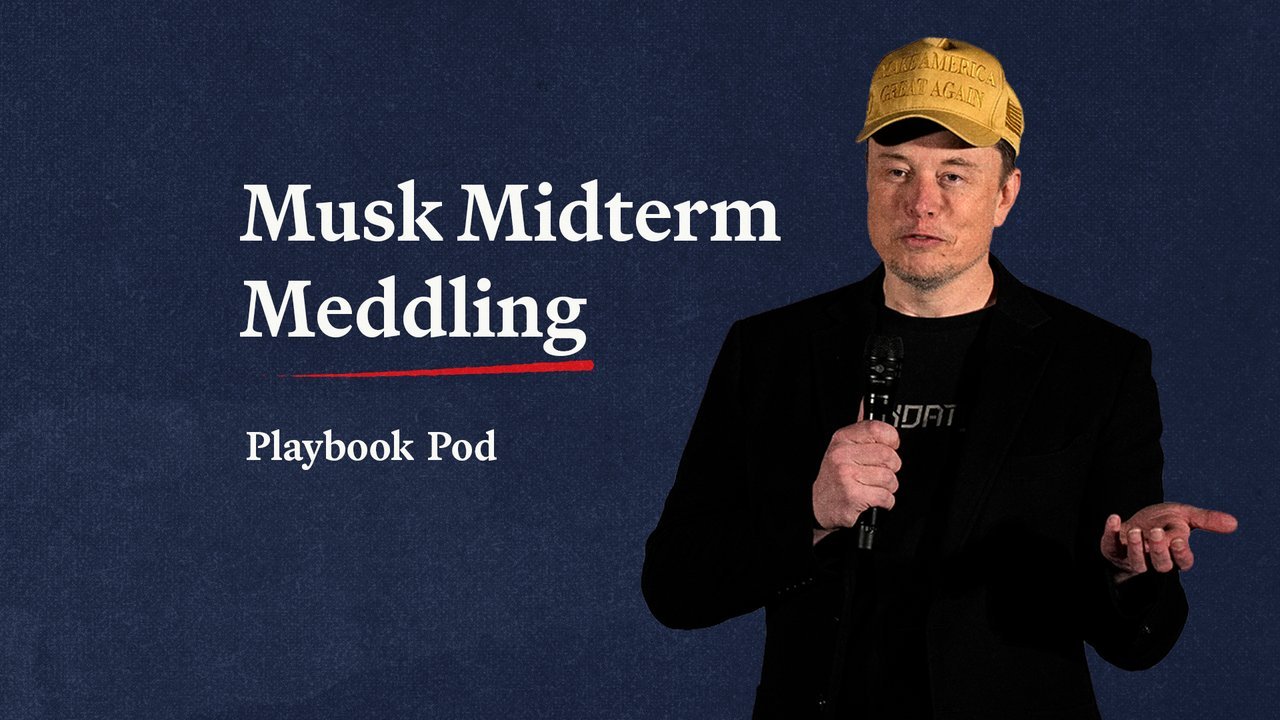
Democrats’ Musk-ask questions
lead image
- Poll: Voters see Republicans as the party of Big Tech tax breaks
- Two Dans, four choices, one big headache for GOP in Alaska Senate race
- Democrats’ Musk-ask questions
- DCCC launches ads against Mike Turner in red Ohio district
- Capitol agenda: Dem gavels are coming for Elon Musk
- Pritzker’s big spending for Black and Hispanic candidates is drawing notice
- The ‘Congress addict’ serving as Trump’s fixer on Capitol Hill
- Elon Musk is in Democrats’ oversight crosshairs
- GOP lawmakers scramble to spare Ukraine from Trump
- Medicaid cuts haunt Republicans in battleground states
-

 Politics2 years ago
Former ‘Squad’ members launching ‘Bowman and Bush’ YouTube show
-
Uncategorized2 years ago
Bob Good to step down as Freedom Caucus chair this week
-

 The Josh Fourrier Show2 years ago
DOOMSDAY: Trump won, now what?
-

 The Dictatorship2 years ago
Pete Hegseth’s tenure at the Pentagon goes from bad to worse
-

 Politics2 years ago
Former Kentucky AG Daniel Cameron launches Senate bid
-

 The Dictatorship2 years ago
Luigi Mangione acknowledges public support in first official statement since arrest
-

 Politics2 years ago
Blue Light News’s Editorial Director Ryan Hutchins speaks at Blue Light News’s 2025 Governors Summit
-

 Politics1 year ago
John Legend advises Trump to drop the ‘dictator s‑‑‑’ if he wants Nobel Peace Prize