The Dictatorship
‘A House of Dynamite’ is absurd — and frighteningly true to life

Director Kathryn Bigelow has a knack for making movies about America’s power on the global stage that make viewers’ heart race. “Zero Dark Thirty” depicts the manhunt for Osama bin Laden, complete with a lifelike recreation of the raid of Abbottabad. “The Hurt Locker” tells the story of a talented Army sergeant carrying out harrowing missions with a bomb disposal squad in Iraq in 2004. Now, Bigelow has made another such thriller in “A House of Dynamite,” about the U.S. government and military’s attempt to respond to a mysterious nuclear missile fired at the U.S. — in under 20 minutes.
But while “Zero Dark Thirty” and “The Hurt Locker” display a fawning awe of imperial power that functions as reactionary pro-War on Terror propaganda“House of Dynamite” questions the wisdom of the American security state. The movie has some flaws, but it’s a worthy exploration of the alarming folly of American — and global — complacency in a world filled with expanding and increasingly sophisticated nuclear arsenals and severely weakened arms control agreements. That nuclear war doesn’t seem zeitgeisty these days might make it seem like an odd time for “A House of Dynamite” to come out — but that’s exactly its point.
Atop our nuclear monarchy today, for example, stands an impulsive, incurious man who has demonstrated no interest in long-term consequences.
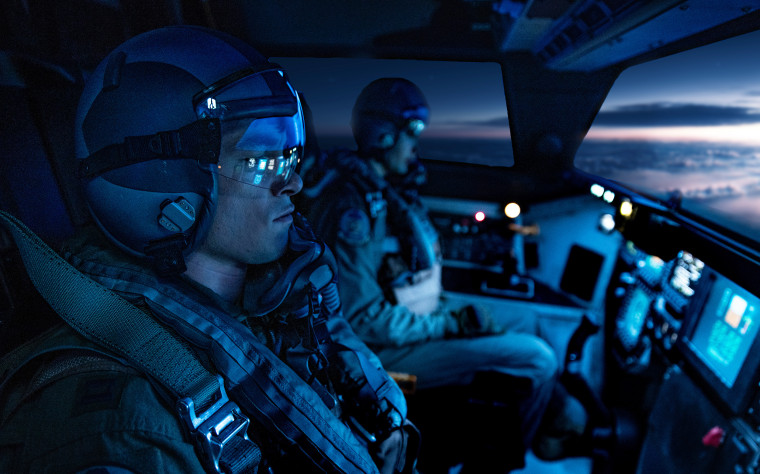
“A House of Dynamite” derives its suspense from an unfathomably intense ticking clock scenario. After the discovery that an airborne intercontinental ballistic missile — initially assumed to be a routine North Korean nuclear test — turns out to be a missile of unknown origin on a trajectory for Chicago, we watch as defense officials, military personnel, bureaucrats and the president, played by Idris Elba, are abruptly ejected from their daily routines and forced to contemplate not just immediate and unprecedented loss of life in the U.S., but also potentially across the globe.
That these operators have to not just absorb the event intellectually but also emotionally, and then scramble to formulate a response in less time than it takes to watch an episode of “Seinfeld,” is absurd — and true to real life. Bigelow’s naturalistic beat-by-beat breakdown of these moments, which includes all kinds of quotidian details of their lives, helps hammer home the absurdity of the predicament. And the film’s conceit of telling the story from the perspectives of different players in the operation illustrates how all of them face extreme constraints in terms of obtaining reliable information for making judgment calls.


After the U.S.’ missile defense fails against the incoming missile, the president is given sharply diverging advice on how to respond to what seems to be an unstoppable extinction event for Chicago. A dovish deputy national security adviser counsels the president to wait for the smoke to clear. A hawkish general at U.S. Strategic Command warns the president that a nonresponse could be worse and advises him to consider immediately preemptively striking at any and all adversaries who could’ve sent the missile, proposing an exchange that could possibly set in motion a global nuclear holocaust. And the president — who has the sole authority to make the final call — can’t even get in touch with his wife, who is abroad, for advice. “This is insanity!” cries out the president. “No, sir. This is reality,” replies the hawkish Gen. Anthony Brady of U.S. Strategic Command, played by Tracy Letts.
Is “A House of Dynamite” actually realistic? (Mild spoilers ahead.) Some experts contest the plausibility of various points of its premise: Experts on nuclear missiles and national security say the lone nuclear missile scenario is far-fetched, and having a missile of unknown origin is also unlikely given the number of potential satellites that could pick up that information. And NPR reports that while “U.S. forces are capable of launching their missiles ‘on warning’ before an attacker’s missiles arrive … the country’s nuclear doctrine actually emphasizes what’s known as a ‘second strike’ capability. That would allow it to strike back even if it were hit with a nuclear attack much larger than the one in the movie.” In other words, the hawkish general in the film is perhaps more trigger-happy than one would likely be in real life.
But none of that should really give us any comfort. Experts say the movie still captures the timing, the decision-making process and the low rate of success of missile defense accurately. And on a deeper level, it serves as a reminder that nuclear deterrence — discouraging a nuclear attack by building one’s own nuclear capabilities — is not necessarily a sufficient safeguard against nuclear exchange that can easily spiral into a global extinction event.
The movie raises the possibility that the mysterious missile could be an error induced by artificial intelligence — which experts say will indeed be baked into nuclear systems in the future. The possibility that nuclear weapons fall into the hands of nonstate extremist actors is always possible, and could unravel the traditional logic of mutually assured destruction. And even conventional warfare can always spiral if the belligerents are armed with nuclear weapons — U.S. intelligence officials believe the risk of nuclear exchange has surged dramatically since Russia has invaded Ukraine. Unlikely events are, well, unlikely, but in this realm their consequences are so vast that they cannot be ignored.

And while in the film the U.S. president is hinted at as an Obama-like reasonable leader who could possibly be trusted to behave as prudently as possible, not every president is. Atop our nuclear monarchy today, for example, stands an impulsive, incurious man who has demonstrated no interest in long-term consequences or for the well-being of people he considers to be not on his team. To have him contemplate how to operate in a nuclear emergency is simply unthinkable.
Ultimately however being a relatively wise and moral leader is little consolation against the reality that nuclear exchange is controlled by actors with little time to make reasoned, ethical and strategic judgment calls. Part of the point of the film — only underscored by its provocative ending — is to elucidate that this scenario is unwinnable. Don’t hate the players; hate the game.
Nuclear arsenals around the world are growing more fearsome, more countries are trying to become nuclear powers, and nuclear disarmament treaties are expiring (the U.S. and Russia only have one remaining — and that expires in 2026). The viewer is likely to leave the movie rightly convinced that there is no humane way to respond to the beginning of a nuclear war, because no humans can or should be trusted with so much power.


Zeeshan Aleem is a writer and editor for BLN Daily. Previously, he worked at Vox, HuffPost and Blue Light News, and he has also been published in, among other places, The New York Times, The Atlantic, The Nation, and The Intercept. You can sign up for his free politics newsletter here.