
The Dictatorship
Trump’s chaos might just jolt libertarianism back to life


A corrupt Republican president abuses his executive power to restrict free markets, placing legal constraints on free trade in goods and services, and then uses the granting of specific exceptions to shake down contributions from businessmen who are hurt by the restrictions. This political extortion is seen as such an abuse of office and betrayal of conservative economics principles that members of his own party band together to oppose him.
That corrupt Republican president? Richard Milhouse Nixon.
When President Nixon imposed his wage and price controls across the country, it wasn’t just economically destructive; it was also corrupt. As Ciara Torres-Spelliscy noted for the Brennan Center, by creating a blanket policy that crushed businessesNixon was soliciting connected business owners to petition him for exceptions in exchange for large donations to his campaign.
Nixon’s wage and price controls inspired David Nolan to gather a group of free market Republicans — all disgusted with Nixon’s schemes — in his Colorado living room. This is how the Libertarian Party was born.
President Donald Trump has in many ways followed Richard Nixon’s economic playbook, though instead of wage and price controls, he has chosen to impose arbitrary blanket tariffsviolating free market principles (and trade deals he negotiated) by putting import taxes on everything American businesses and consumers buy from other countries. Trump has a record of targeting media companies and law firms to extract personal benefits. Imposing tariffs gives him another tool in the box. He may not have used it yet, but he’s already made public statements about how countries can “come to the table” to negotiate an exception from these punitive tariffs. Some impacted businesses are going to ask for exceptions from import taxes and may assume their chances of success are far greater if they offer something of value to Trump’s interests.
Now would be a great time for the Libertarian Party, founded in opposition to Republican corruption, to oppose another president’s meddling with the markets, potentially for his own gain. Alas, the current iteration of the party is far more dedicated to fighting MAGA-friendly culture war battles than standing up for free market principles.
In the wake of the 2017 Charlottesville “Unite the Right” rally and the neo-Nazi murder of counteractivist Heather Heyer, then-Libertarian Party executive director Wes Benedict publicly rejected the hateful and bigoted views of the alt-right groups who marched to chants of “Jews will not replace us.”
Now would be a great time for the Libertarian Party, founded in opposition to Republican corruption, to oppose another president’s meddling with the markets, potentially for his own gain.
However, as a reaction to that anti-bigotry stance, a group called the Mises Caucus was formed to try to steer the Libertarian Party toward a more MAGA-friendly platform that would welcome anti-immigrant, anti-abortion and antisemitic conservatives into a historically pro-freedom party. It took five years, but by the 2022 Libertarian National Conventionthe Mises Caucus was able to install an anti-vaccine activist and former paralegal, Angela McArdle, as Libertarian National Committee Chair and remove the anti-bigotry and pro-choice planks from the Libertarian platform.
With a majority of the national committee sympathetic to a far-right Republican distortion of libertarian principles, Trumpworld figures like Ric Grenell — who has served in both Trump administrations — started communicating directly with McArdle about ways that the Libertarian Party could assist Trump by delivering the Libertarian vote in what promised to be a very close election.
During the 2024 campaign, Angela McArdle seemed more interested in providing public support for fellow anti-vaccine activist Democratic (and later, independent) candidate Robert F. Kennedy Jr. and Republican candidate Donald Trump than she did for Libertarian Party nominee Chase Oliver. Both Kennedy and Trump were given prime-time speaking spots at the Libertarian National Convention in Washington, D.C., where Trump promised to pardon Silk Road founder Ross Ulbricht — who was serving a life sentence in prison — if elected. McArdle used that promise as a fig leaf for her deliberate sabotage of the Libertarian Party’s candidate that contributed to his disappointing fourth-place finish behind Jill Stein of the Green Party and a collapse of the Libertarian Party’s finances. (Trump made good on that promise, pardoning Ulbricht a day after taking office.)
Facing multiple lawsuits and allegations of embezzlement by a former Libertarian Party gubernatorial candidate, Angela McArdle resigned as LNC Chair in January 2025, replaced by Florida business owner Stephen Nekhaila, who defeated a Mises Caucus candidate for the job. (In response to questions about the accusations, McArdle told the libertarian-leaning Reason magazine that she was the victim of “aggressive cyberstalking” by her accusers, and added, “I will be working with new appointees in the Trump administration to find out if the FBI and State Dept have been involved in the attacks on the LP and me.”)
This rejection of the far-right elements in the Libertarian Party, combined with the urgency of President Trump’s tariff schemes, has created an opportunity for Americans —particularly those leaning Republican — who support free people and free markets to rejoin the Libertarian Party and join the opposition to the Trump administration.
Tariffs are taxes Americans pay. The libertarian position is that we should be fighting for zero tariffs, and we certainly shouldn’t let a president unilaterally usurp the constitutional authority of Congress to impose taxes.
There is no legitimate reason for Libertarians in the Trump administration’s orbit to be supporting these tariffs.
Republicans, particularly Trump’s senior trade adviser Peter Navarro, over the past several months have engaged in charm offensive on tariffs, trying to persuade the Libertarian voter that they should adopt the Republican position on the issue instead of the party’s formative view that tariffs harm the United States of America. Navarro has claimed to have proprietary data demonstrating the positive nature of, and even necessity of tariffs. MSNBC’s Rachel Maddowhowever, exposed this charm offensive as being built on a house of cards, as supported by at least one fictional expert, “Ron Vara,” that Navarro made up out of whole cloth.
There is no legitimate reason for Libertarians in the Trump administration’s orbit to be supporting these tariffs. Thankfully, Stephen Nekhaila, the new Chair of the Libertarian Party, has recommitted the party to the fight against Trump’s tariffs.
America needs a vocal Libertarian Party to stand up against a corrupt Republican president even more now than it did in 1971. It’s time for individual libertarians to break with the Republican Party as they did 50 years ago and express our shared condemnation of tariffs and price controls, in our voter registrations where possible, in the voting booth, and even, if possible, at protests with like-minded individuals.
Nicholas Sarwark
Nicholas Sarwark is an attorney and was Chair of the Libertarian National Committee from 2014 to 2020.


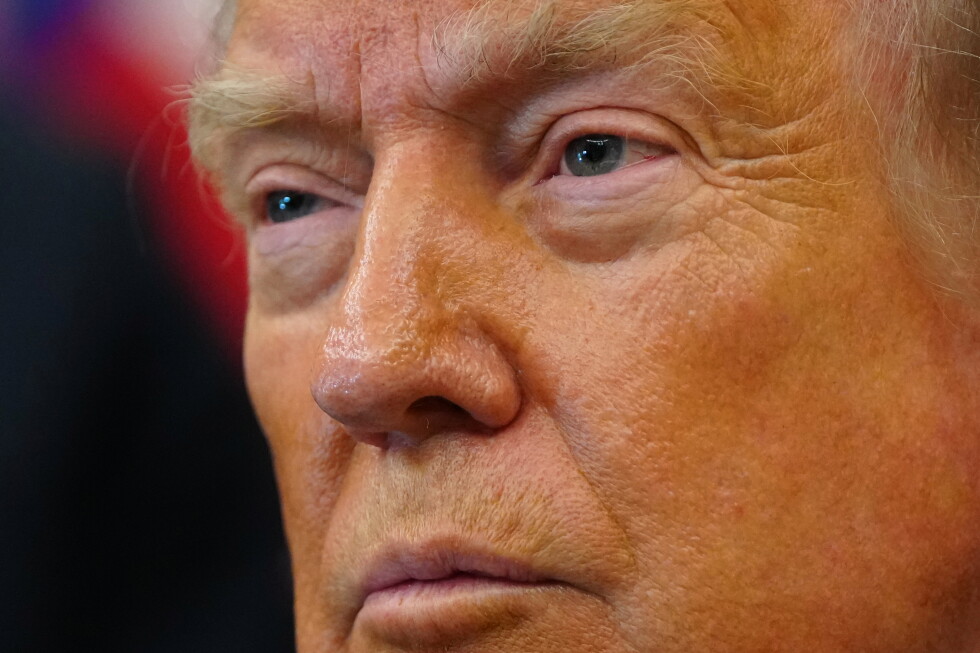

WASHINGTON (AP) — The U.S. Mint has begun producing a new $1 coin bearing President Donald Trump’s face to help celebrate America’s 250th birthdaythe Treasury Department said Wednesday.
The final design for the commemorative coinbeing released in the fall, was approved earlier this year by the U.S. Commission of Fine Arts, whose members were appointed by Trump. But the finished product unveiled Wednesday differs from that version in a few aspects, including that it is not made of gold but rather has a gold finish.
The coin is intended “to honor the enduring legacy of liberty and a lasting symbol of patriotism,” Treasury Secretary Scott Bessent said in a post on X. “Featuring President Trump, it celebrates the strength of American values, and the promise of a nation dedicated to preserving freedom for all.”
The president on Wednesday told Fox Business Network that the move to put his face on a coin is “very unusual, but I was honored by it,” adding that “it’s very cute they gave me a coin.”
Trump, a Republican, has a penchant for putting his name and likeness in the historical record, following his renaming of the U.S. Institute of Peace, the Kennedy Center performing arts venue and a new class of battleshipsamong other tributes. The move to put his face on the gold coin has drawn criticism in particular because federal law prohibits the depiction of a living president on U.S. currency, though the treasury secretary has the authority to authorize the minting and issuance of coins in some circumstances.
The front of the coin features an image of Trump in a suit and tie and with a stern look on his face. Lettering on the top half of the coin’s arc spells “LIBERTY,” with the dates 1776-2026 on the bottom half of the arc. The words “IN GOD WE TRUST” are in the middle.
The reverse side depicts the traditional image of the bald eagle in the Great Seal of the U.S., with “UNITED STATES OF AMERICA” on the top half of the coin and the Latin phrase “E PLURIBUS UNUM,” meaning “Out of many, one,” on the shield emblazoned on the bird’s breast.
Among the other differences from the design approved earlier this year is that Trump doesn’t have his fists resting on top of what is supposed to be a desk as he leans forward. The Treasury Department did not specify Wednesday why the final product diverged from the originally approved design.
The Treasury Department announced in March that it would be putting Trump’s signature on all new U.S. paper currency.
Traditionally, U.S. paper currency carries the signatures of the treasury secretary and the treasurer, not the president.
___
Associated Press writer Darlene Superville contributed to this report.
The president couldn’t be decent even for 24 hours. Less than a day after Immigration and Customs Enforcement announced Tuesday that it would pause most vehicle stopsDonald Trump posted on social media early Wednesday morning that “we CANNOT give up one of I.C.E.’s most important and effective Crime Fighting tools, THE TRAFFIC STOP!”
“The Radical Left Dumocrats would like to see this done, but it won’t happen on my watch,” he wrote on Truth Social. Shortly after, Trump reversed the pause on traffic stops.
ICE operates this way because we as a country have allowed it to happen.
In truth, suspending the stops wouldn’t have brought back Lorenzo Salgado Araujo and Johan Sebastian Guerrerothe two Latino fathers killed by ICE agents during separate stops in a span of a week. They are two more victims of an administration that has terrorized immigrant communities relentlessly. The real issue isn’t whether the traffic stops are now ending or continuing — it’s that ICE agents are never held accountable for killing people.
As I have written in the pastICE operates this way because we as a country have allowed it to happen. ICE is now the country’s largest-funded enforcement agency. Just last month Congress passed $70 billion more in funding. Nothing will change until ICE is abolished.
“They’re just trying to cover for the fact that what they are doing shouldn’t be allowable in the first place,” Rep. Alexandria Ocasio-Cortez said of ICE’s announcement Tuesdaybefore Trump’s post about traffic stops. “And the fact that they’re pausing it is to distract from the fact that in many of these instances they shouldn’t be allowed to do it in the first place.”

AOC is right, and restoring the stops proves her point. There have been many instances. In March of last year, 23-year-old Ruben Ray Martinez was killed by an ICE agent helping route traffic in South Padre Island. The Department of Homeland Security said Martinez tried to run over the agent, but the video didn’t support that claim.
In January, the nation mourned the deaths of Renee Good, a 37-year-old mother of three shot in her SUV as she left a protest, and Alex Pretti, a 37-year-old intensive care nurse killed during another protest. The federal government withheld the evidence in both cases — body camera footage, hard drives, even Good’s bullet-riddled SUV — from state investigators until this week. Minnesota Attorney General Keith Ellison said he was “deeply troubled” that it took that long.
This is a pattern of manipulation: stripping away every detail of a human’s life until all that’s left is “illegal alien.”
“There have been at least 10 deaths involving encounters with immigration agents since Trump launched his deportation campaign,” The Associated Press reported. Nobody has been charged in a single one of those deaths. Guerrero’s also marks at least the 18th time in the past year that federal officers have fired at people in carsaccording to an MS NOW database. That’s on top of at least 22 people who have died in ICE custody this year alone, along with 33 last year.
The Trump administration claimed that Guerrero was a threat to “public safety” instead of a loving husband and parent to a 3-year-old daughter. It’s the same narrative this administration is trying with Salgado Araujo, who has been in this country for 35 years and raised three sons (who all earned college degrees). A week after his death, the FBI even said it was searching Salgado Araujo’s van for drugs. Never mind that, as the New York Times noted, there was “no prior suggestion that Mr. Salgado Araujo or the others in the van had been involved with drugs or had any relevant criminal history.”

This is a pattern of manipulation: stripping away every detail of a human’s life until all that’s left is “illegal alien,” because it’s easier to kill someone once you have already decided they were never fully a person to begin with. Dehumanizing immigrants is official government policy, and people are dying under it.
“Let’s be clear: it never was about documented or undocumented people — what we’re seeing is pure xenophobia and racism. Our community has been targeted and persecuted with zero accountability,” Voto Latino’s Beatriz Lopez saidcalling for the resignation of DHS Secretary Markwayne Mullin.
While the government is in the hands of the prejudiced, the most American things we can do are to reject government talking points when the video evidence says otherwise, and to uplift who the victims really were.
“He had a great vision for getting ahead, so many dreams to fulfill,” Guerrero’s father, Omar Durán, told The New York Times. “My son is a wonderful son — I don’t know why they did that to him.”
Masked agents should not get to decide whether Salgado Araujo and Guerrero get to live.
“He was a hard-working family man who never wanted his name to be known by anyone outside of his family. He wanted nothing else in life but to provide for his wife and see his sons become great people,” said Ronaldo Salgado, Salgado Araujo’s sonlast week at a press conference.
“He did not deserve to die,” Ronaldo added.
Masked agents should not get to decide whether Salgado Araujo and Guerrero get to live. Current ICE tactics have communities terrified. It’s part of why half of Americans support abolishing ICE. Immigration as continued militarized enforcement will only lead to more deaths. It may be hard even to visualize a country without ICE, but as Amy Gottlieb, U.S. migration director for the American Friends Service Committee, noted earlier this yearan ICE-less world can include “legal services, case management, social services, and other community-based support” that would help “navigate immigration processes while keeping families together — creating stability in our communities rather than chaos.”
Immigration policy through continued militarized enforcement will only lead to more deaths. What country do we want to be? One that values humanity, or one that wants to dehumanize people who believe in this country’s promise? This is the choice each American has to make. Are you for killing innocent people in broad daylight, or are you for decency and compassion? The America I believe in would choose the latter. So enough with the dehumanization, enough with the deaths, and no more ICE.
Julio Ricardo Varela is the founder of “The Latino Newsletter” and co-editor of “Pressing Issues from Free Press.”
The Dictatorship
Ken Paxton hasn’t debated a rival in more than a decade. Talarico is now challenging him to one

This is the July 16, 2026, edition of “The Tea, Spilled by Morning Joe” newsletter.Subscribe hereto get it delivered straight to your inbox every Monday through Friday.
“And who is my neighbor?”
— Luke 10:29
A CONVERSATION WITH JAMES TALARICO
Two ICE shootings in nine days have put immigration enforcement at the center of the Texas Senate race. Democratic nominee James Talarico joined “Morning Joe” to discuss border security, the fear in Hispanic communities, and what his grandfather — a Baptist preacher in South Texas — taught him about loving thy neighbor.
MB: Do you believe there should be robust border security?
JT: Absolutely. We have to protect our immigrant neighbors while also securing our southern border with commonsense policies. That means more Border Patrol agents, more surveillance technology, more immigration judges — not this crazy border wall through Big Bend National Park.
JS: Would you agree Democrats made a big mistake not focusing enough on border security?
JT: No question. I’ve called out President Joe Biden for failing to secure our southern border. National Democrats took the border for granted — we stopped showing up, and that’s why people along the border started looking for alternatives.
JS: You’ve been traveling the state, knocking on doors. What are you hearing from Hispanic communities?
JT: So many young people are showing up at our town halls, many of them Hispanic. They tell me they’re worried their parents aren’t going to come home at the end of the day.
The president promised to go after the criminals, and that’s something I support. But that’s not what’s happening. ICE should be cracking down on the cartels, not our communities. ICE should be deporting violent criminals, not small-business owners. ICE should be hunting down human traffickers, not moms and babies.
WG: How are you going to reverse the 30-year trend of Democrats losing statewide in Texas?
JT: The first words out of my mouth when I launched this campaign were that the real fight in this country is not left versus right — it’s top versus bottom. None of us can afford the basics: groceries, gas, utilities, childcare, prescription drugs.
We are trying to take on the megadonors who increasingly control our politics — and the puppet politicians who do their bidding.
WG: Republicans have gone after you personally — calling you a vegan, questioning your “Texas swagger.” How do you answer that?
JT: I think it’s funny. I’m the eighth-generation Texan in this race. Ken Paxton was born in North Dakota, raised in California, and I think transplants like Ken Paxton can become Texans. Texas is a state of mind, as John Steinbeck wrote.
And when I first heard the low-T thingI had to look it up — guys my age aren’t really worried about that. People realize we’re being played by these politicians who want to throw nicknames at each other. They’re ready for a serious senator who’s going to bring both parties together to get this economy back on track.
JS: Ken Paxton spent the Fourth of July on Westminster Bridge — celebrating 250 years of American independence with the British. How about you?
JT: I was with an American treasure — Willie Nelson — at his annual Fourth of July picnic in Austin.
A Tale of Two Fourth of Julys

Talarico and Nelson in Austin. Go”https://www.instagram.com/p/DaZYpSypCGw/”>James Talarico on Instagram

Paxton in London, July 4, 2026. Via @TheLincolnProject on YouTube
JS: Your opponents attack your faith. Jesus told the story of the Good Samaritan — a man is left in a ditch, his own people pass him by, and it’s a despised foreigner who saves him. How is what we’re seeing right now the antithesis of that?
JT: My granddad was a Baptist preacher in South Texas. When I was little, he told me that as Christians, we’re supposed to follow the two commandments Jesus gave us: Love God and love your neighbor. It’s that commandment to love thy neighbor that got me into public service. I’m trying to love my neighbor through public policy.
And the parable of the Good Samaritan has so much to offer us at this moment. Jesus picked a Samaritan — not just an enemy, but a religious enemy. He lifted up the heretic and said, that is where salvation comes from.
MB: We understand you have a message for Ken Paxton.
JT: Ken Paxton hasn’t appeared on a debate stage in more than a decade. He refuses to answer basic questions — like why he gave an Epstein-style sweetheart deal to Adam Hoffman, an admitted child predator, or how he became a multimillionaire on a government salary.
So I am challenging Ken Paxton to three televised debates. I’ll be on that stage because I answer to the people of Texas. Ken Paxton answers to his billionaire megadonors. We’ll see if they let him show up.
This conversation has been condensed and edited for brevity and clarity.
- Vance fails to quell fiscal hawk concerns about GOP reconciliation plans
- After Tillis’ demands, Todd Blanche meets with Jeffrey Epstein’s victims
- US Mint begins producing $1 coin with Trump’s face on it
- Gillibrand and Boozman roll out new bipartisan paid leave bill
- Johnson preps to punt government funding through midterms

- Todd Blanche’s chances of becoming attorney general could hinge on John Cornyn
- Dems churn through cash ahead of tense Michigan Senate primary

- Vance fails to quell fiscal hawk concerns about GOP reconciliation plans
- Gillibrand and Boozman roll out new bipartisan paid leave bill
- The Maine and Texas shootings are two more reasons to abolish ICE
-

 Politics1 year ago
Former ‘Squad’ members launching ‘Bowman and Bush’ YouTube show
-

 The Josh Fourrier Show2 years ago
DOOMSDAY: Trump won, now what?
-

 The Dictatorship1 year ago
Luigi Mangione acknowledges public support in first official statement since arrest
-

 Politics1 year ago
Former Kentucky AG Daniel Cameron launches Senate bid
-
Uncategorized2 years ago
Bob Good to step down as Freedom Caucus chair this week
-

 The Dictatorship1 year ago
Pete Hegseth’s tenure at the Pentagon goes from bad to worse
-

 Politics1 year ago
Blue Light News’s Editorial Director Ryan Hutchins speaks at Blue Light News’s 2025 Governors Summit
-

 The Dictatorship10 months ago
Mike Johnson sums up the GOP’s arrogant position on military occupation with two words