
Politics
Why the co-chair of Trump’s transition team is raising eyebrows

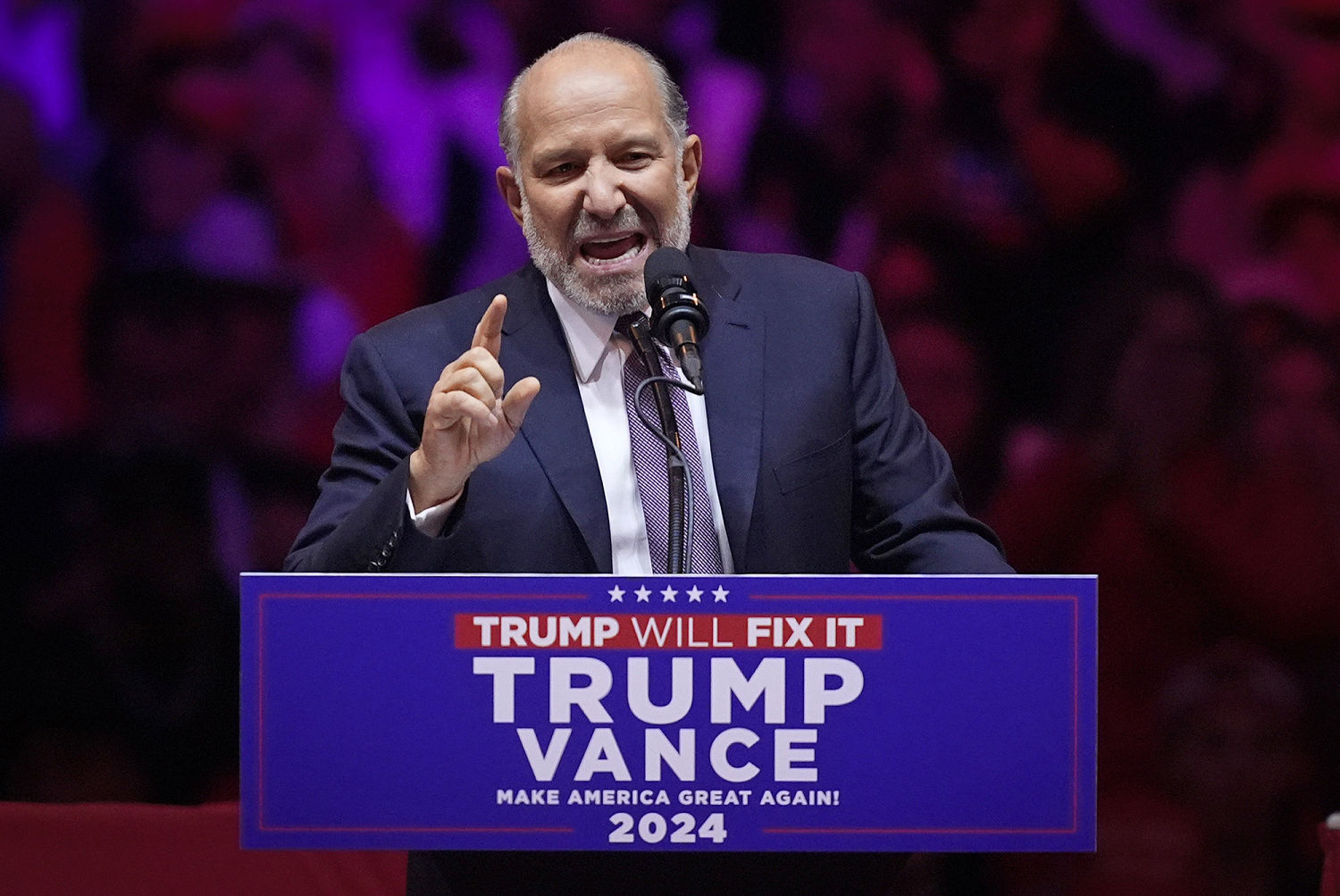

In mid-August, Donald Trump released the names of a five-member transition team, which would be responsible for helping make post-election plans in the event that he wins. The list generated headlines because of the former president’s willingness to keep matters within the family: Eric Trump and Donald Trump Jr. were part of the lineup, despite their lack of qualifications, which struck many observers as odd.
But the one person on the five-member transition team with the lowest public profile was Howard Lutnick, the CEO of a financial services firm called Cantor Fitzgerald. While the billionaire megadonor is certainly known on Wall Street, it’s likely that most Americans are not familiar with him or his message.
That might soon change.
Over the weekend, for example, Lutnick spoke to NBC News’ Vaughn Hillyard and suggested that some of Trump’s high-profile critics from his own former team — including retired Gens. John Kelly and James Mattis — might’ve committed “treason” during their tenure in the administration. Lutnick added that they were “Democrat [sic] generals.”
Soon after, the billionaire spoke at Trump’s hate-filled Madison Square Garden event, where he talked about eliminating all income taxes and touted Trump’s candidacy as necessary to “crush jihad.” (Presumably, the Republican campaign, already hoping Muslim voters will overlook Trump’s years of ugly Islamophobia and discrimination against Muslim Americans, didn’t welcome the rhetoric.)
Common sense might’ve suggested that the Trump campaign keep Lutnick away from microphones for a while, but with just days remaining before Election Day 2024, the co-chair of Trump’s transition team instead appeared on BLN — and the interview didn’t go especially well. Newsweek reported:
Donald Trump transition team co-chair Howard Lutnick questioned the safety of vaccines while speaking with BLN’s Kaitlan Collins on Wednesday night. ‘Vaccines are safe,’ Collins said, while talking about Robert F. Kennedy Jr.’s self-reported possibility of being ‘promised’ by the former president to head the Department of Health and Human Services and U.S. Department of Agriculture if Trump wins the 2024 election. ‘Why do you think vaccines are safe,’ Lutnick shot back, adding, ‘there’s no product liability anymore.’
As part of the same exchange, Lutnick added that he knows “so many more people” now that have autism, prompting the BLN host to emphasize the reality that “vaccines don’t cause autism.”
Wait, it gets worse.
Failed independent presidential candidate Robert F. Kennedy Jr. claimed this week that he received a promise from Trump about a role in his possible second term. As my BLN colleague Clarissa-Jan Lim noted, the fringe conspiracy theorist expects to have control of both the U.S. Agriculture Department and the Department of Health and Human Services and the agencies under its purview, which include the Centers for Disease Control and Prevention, the Food and Drug Administration and the National Institutes of Health.
Given Kennedy’s bizarre ideas and worldview, that’s a rather terrifying prospect — even Trump’s former surgeon general is concerned — though Lutnick defended the idea.
“[Kennedy] wants the data, so he can say, ‘These things are unsafe,’” the billionaire megadonor argued during his BLN appearance. “He says, ‘If you give me the data, all I want is the data, and I’ll take on the data and show that it’s not safe. And then if you pull the product liability, the companies will yank these vaccines right off, off of the market.’ So, that’s his point.”
That’s the plan? Trump will put an unqualified conspiracy theorist in a position of enormous power, and that — according to the handpicked co-chair of Trump’s transition team — might lead to vaccines being pulled from pharmacy shelves?
This is, as New York magazine’s Jon Chait noted, “a glimpse into a public-health nightmare.”
Every day, the stakes in the 2024 presidential race get higher.
Steve Benen is a producer for “The Rachel Maddow Show,” the editor of MaddowBlog and an BLN political contributor. He’s also the bestselling author of “Ministry of Truth: Democracy, Reality, and the Republicans’ War on the Recent Past.”



Donald Trump is facing one of his biggest tests of the midterms — and it’s of his own making.
The president has spent a significant amount of time and money trying to help Sen. Darline Graham defeat Rep. Ralph Norman in Tuesday’s snap GOP Senate primary. He’s done more for Graham than he has for the battleground Republicans whose general election fights will determine control of Congress: Not only did he push her to run for a full term, he also held a rare in-person rally for her and tapped into his MAGA Inc. warchest during the final days of the race.
If, after lending all that support, Graham fails, it would be Trump’s most embarrassing loss of the cycle. A win, however, would let him flex his ability to power an unknown political figure to office.
“If Darline does come up short, it would be just a massive, massive embarrassment to the White House and to the president. Just an utter rejection,” said Matthew Bartlett, a Republican strategist and former Trump State Department appointee during his first term.
Tuesday’s runoff to replace the late Sen. Lindsey Graham on the November ballot won’t meaningfully affect the balance of power in Washington. What it will do is reveal the extent of Trump’s clout, because of just how much personal political capital he has expended in the race to convince voters to elect a virtual stranger.
“The fact that he came to the state on short notice to do a rally, and we haven’t seen that in a lot of endorsements, I think that sends a very strong message that he’s all in,” said Andrew Boucher, a GOP strategist and chair of South Carolina’s Charleston County Republican Party, who is neutral in the race.
Trump has framed the race as nothing less than a referendum on himself. Rallying with Graham in Myrtle Beach last week, the president told voters to “pretend, please, that I’m on the ballot.”
On Monday, a Federal Election Commission report revealed that Trump’s super PAC had spent $827,000 on text messages and phone calls for Graham. It’s one of the largest expenditures this cycle from MAGA Inc., and cash that Republicans in battlegrounds are anxiously awaiting for themselves.
One national Republican operative, who was granted anonymity to candidly discuss the president’s influence on the race, noted just how far Trump’s support has gotten Graham: “She wouldn’t even be in this place if she didn’t have [his support]. The outside help she’s had has kind of made this competitive.”
Before GOP Gov. Henry McMaster appointed her to serve out the remainder of her late brother’s term in July, Graham was a complete political novice. Graham has worked for the South Carolina Vocational Rehabilitation Department and has led the Commission for the Blind since 2019, but she had never held or even sought public office — a fact that her opponents have attacked her for repeatedly on the campaign trail, especially after she stumbled over a key foreign policy question on the debate stage earlier this month. Her clearest connection to electoral politics lay solely in being the late senator’s younger sister.
Trump’s past mistakes in South Carolina loom over the race. The Senate primary has echoes of the state’s governor’s contest earlier this summer, in which Lt. Gov. Pamela Evette, a little-known Trump-backed candidate, fell to the more well-known Attorney General Alan Wilson. As public polling began to show Evette trailing significantly in the first days of that runoff, Trump issued a rare dual endorsement to include Wilson.
Evette’s defeat, coupled with a batch of uncharacteristic losses by Trump endorsees in GOP primaries in Georgia, Iowa, Minnesota, Wyoming and Michigan, has put all the more attention on Graham.
The power of his endorsement is on the president’s own mind, too. In a Sunday night post on Truth Social, Trump mused that his “Endorsements are stronger than ever,” pointing to splashy charts comparing his wins to his comparatively few defeats.
But in the same breath, he acknowledged that his power is not always absolute: “The few that lost were done out of loyalty. It was almost impossible for them to win but, I felt obligated to go with them because they were, in my opinion, good people!”
When asked for comment, a White House spokesperson pointed to specific remarks from Trump’s speech at Friday’s rally with Graham, including his acknowledgement that he urged her to jump in the primary.
“She’s never done it before, but she knows politics well,” Trump told supporters on Myrtle Beach. “She loves our military. She loves things that have to do with greatness for America.”
Graham’s foreign policy debate flub — in which she said “national security is not my thing” in response to a question of U.S. interests in Taiwan — revealed the pitfalls of running for office with no prior experience. Norman has taken advantage of that stumble by hammering her inexperience.
The closing stretch of the race has been characterized by Graham trying to tie herself to Trump and burnish her conservative credentials across the state. Norman has tried to shore up support in his Upstate stronghold and expand into the Low Country where former Gov. Mark Sanford — who endorsed his campaign late last week — dominated in the first round. Norman’s also taken to Fox News to bash Graham as an “unknown” and “propped-up candidate.”
Graham’s campaign hopes to consolidate support from Rep. Russell Fry’s (R-S.C.) district after he endorsed her campaign a few days into the runoff. Her closing ad of the race claims Norman “turned his back on Trump’s agenda” and is interspersed with footage of her on the rally stage alongside the president.
The GOP party establishment in South Carolina has fallen in line behind Graham.
Sen. Tim Scott (R-S.C.) publicly backed her bid on the first day of the runoff, Evette got in line shortly thereafter and McMaster followed several days later.
Graham’s campaign has itself spent just over $1 million in ads since the outset of the race, but that spending is bolstered by at least three other outside groups — including Security is Strength PAC, Palmetto Action PAC, and American Mission PAC — who also supported her late brother’s primary bid earlier this year. Their spending has topped $6 million, according to AdImpact.
Norman has had his own outside help from a notable figure and longtime ally: Former U.N. Ambassador Nikki Haley and her aligned groups have spent more than $700,000 for Norman, including $200,000 on a supportive ad from her issue advocacy group, Stand for America.
But that’s still much lower compared with what Graham has received.
“Sen. Scott engaging in the race, the congressional delegation, all these portions of it. Congressman Fry engaging in the race is a big deal. You could almost say that’s the opposite of what you had in the governor’s race,” said a South Carolina-based Republican operative, who was granted anonymity to speak candidly and is staying neutral in the race.
Spokespeople for Graham and Norman did not respond to requests for comment.
Graham is still somewhat dogged by her high-profile debate stage mistake, though she’s tried to redirect the attention in interviews.
“You know what I’ve done in the last week? I’ve gone around this entire state talking to as many people as I possibly can. And you know how many of them brought up Taiwan and national security? Not one!” she said at a press conference in Columbia on Monday.
The late August runoff date could prove unpredictable for both candidates as they seek to drive out their supporters across the state. The twilight of South Carolina’s sticky, slow summer is in full effect: Most kids have returned to school, families across the state are packing their beach gear for one final getaway and the doldrums of summer are still in full force.
Several Republicans said that could mean a lower turnout — which could be a boon for a known-quantity candidate with a long history in local office, like Norman.
“A lot of the candidates that have defeated Trump-endorsed folks across the map this cycle, they’re well-known entities,” said the national GOP operative. “It’s hard to overcome some of the basics of politics, where name ID goes a long way. Familiarity with the candidate matters. Having a favorable view and someone who aligns with your values more matters, even if there’s a Trump endorsement.”
Samuel Benson contributed to this report.
Michigan Senate nominee Abdul El-Sayed put some distance between himself and his ally, progressive Twitch streamer Hasan Piker, after the latter faced intense criticism for suggesting that American Jewish support for Israel could lead someone to “take action” against Jews in the U.S.
“My commitment to Jewish safety is the same as my commitment to the safety of my own daughters. Antisemitism is a scourge, and we need to address it in all its forms. And I stand against any rhetoric that puts the community at risk,” El-Sayed said in a statement. “But I want to be crystal clear, nobody speaks for this campaign besides me and my campaign spokespeople. And while politicians and pundits try to make this race about a Twitch streamer, we’re going to be talking about gas, groceries, good schools, and healthcare.”
The statement marks El-Sayed’s clearest attempt to disentangle his campaign from Piker, whom he embraced during the primary despite the streamer’s contentious rhetoric. And it reflects his efforts to win back Jewish Democrats and moderates in the state after a primary campaign that alienated many of those voters in the key Senate race.
During a Thursday livestream, Piker called “the idea that Jews are monolithic” in their support of Israel “a very dangerous mode of propaganda.”“If Jews in America keep putting this — this idea out there that they are singularly invested in Israel, eventually someone’s going to come around and take action, not against the state of Israel, mind you, but against American Jews,” he continued. “We’re teaching people the wrong lesson. At the end of the day, American Jews do not prioritize Israel, but they do prioritize antisemitism.” During Piker’s remarks, the stream displayed a social media post showing Michigan Democratic congressional nominee and state Sen. Jeremy Moss, who is Jewish and a supporter of Israel. The post originated from the group Track AIPAC, and featured an image from Moss’ Instagram account of him in Tel Aviv next to the group’s signature red graphic noting contributions from “pro-Israel donors” to Moss’ campaign.
Moss’ support for Israel has made him a lightning rod among progressives opposed to pro-Israel Democrats. An audio clip alleged to be a recording of Moss claiming the purpose of his campaign is to maintain U.S. support for Israel went viral online over the weekend. Moss told The Detroit News that it was a fake, and that “I would never say these things.”
In a statement Monday evening, Moss said he’s been “in continual dialogue” with El-Sayed, including about “Jewish and Arab safety and security, both here at home in Michigan and in the Middle East.”
Moss also denounced Piker’s comments as an attempt to “create further divisions.”
“I will not be lectured by a California podcaster about what Oakland County, Michigan’s Jewish community should and shouldn’t believe,” he said.
El-Sayed has struggled to unify Michigan Democrats since edging out a victory in a bitter primary that was marked by accusations of antisemitism — partly due to his own views on Israel, and partly due his embrace of Piker, who has risen to prominence through controversial and vocal attacks on Israel. El-Sayed also drew criticisms from the Jewish community for his response after a man attacked a Michigan synagogue in March. El-Sayed condemned the attack but pointed out the Israeli military killed some of the attacker’s family in Lebanon, saying “hurt people hurt people.”. He also received blowback for declining repeatedly to answer whether Israel has a right to exist during a BLN interview in June.
His primary campaign made Stevens’ acceptance of contributions from the American Israel Public Affairs Committee a central issue, accusing the group of unfairly influencing the race and steering the party towards stronger U.S. relations with Israel, which he opposes. AIPAC spent $30 million in the race, a record for the group.
El-Sayed has repeatedly condemned antisemitism throughout his campaign.
His failure to corral support from many Jewish voters in Michigan threatens to undermine Democrats’ chances of winning the Senate. The state’s significant Muslim and Arab-American population and its prominent Jewish population pose unique challenges for Democrats’ messaging around Israel — a problem then-Vice President Kamala Harris struggled to navigate in the 2024 presidential election.
Piker’s comments drew a forceful rebuke from Rep. Hillary Scholten (D-Mich.), who endorsed El-Sayed’s opponent Rep. Haley Stevens in the primary and has so far declined to endorse El-Sayed, excoriating Piker’s comments as “dangerous” and “unacceptable.”
“Piker is a hack who thrives on hate, shock and awe because he lacks substance,” she said. “We should all be calling out this disgusting rhetoric so it loses it’s [sic] grip on our politics once and for all. It has no place in Michigan, and no place in our country.”
Piker fired back at Scholten on social media, telling her not to “spend so much time vying for the spotlight by actively defaming a prominent antizionist voice to harm the dem senate majority chances over a 90/10 issue.”
Scholten’s statement accused Piker of “targeting” Moss after Piker displayed images of Moss while making the inflammatory comments. Moss, who is running to succeed El-Sayed’s primary opponent Rep. Haley Stevens, backed Stevens in the primary and has yet to endorse El-Sayed in the general election.
Republican Mike Rogers jumped on the controversy, describing Piker as El-Sayed’s “running mate.”
“Hasan Piker’s call for violence against the Jewish Community, specifically against Jeremy Moss, must be condemned by every single Michigan Democrat. But Conman Abdul El-Sayed doesn’t have the guts to disavow his running mate,” Rogers said in a statement. “Abdul’s attempt at distancing himself from this violent and hateful rhetoric now that he and Hasan won the primary is the epitome of what a conman does — says one thing when it serves him and another when it doesn’t.”
Since winning the nomination earlier this month, El-Sayed has taken steps to keep Piker at arm’s length. In an August interview, El-Sayed disavowed Piker’s comments that “America deserved 9/11” during a 2019 livestream, a comment Piker has since walked back.
Democrats have gone to great lengths to reunify the party after the primary, including with a party unity rally featuring remarks from prominent Michigan Democrats, including unity breakfast Sen. Elissa Slotkin and a rally featuring remarks from former Transportation Secretary Pete Buttigieg. Former President Barack Obama spoke with El-Sayed after his victory and offered a rare readout of the conversation to reporters to signal that El-Sayed has the party’s backing.
This article has been updated with Moss’ response to Piker’s comments.
President Donald Trump is using a bit of his mostly untapped $400 million MAGA Inc. warchest to boost Sen. Darline Graham in South Carolina — the first significant expenditure his team has made this year for one of his chosen candidates, according to campaign finance reports.
The super PAC has funneled more than $827,000 on voter phone calls and text messages for Graham ahead of her tough GOP runoff battle with Rep. Ralph Norman on Tuesday, according to a Federal Election Commission report made public on Monday.
It’s yet another sign that Trump is focusing his efforts on propelling Graham — a political newcomer — to victory, after holding a rare in-person political rally with her on Friday. And it’s a notable spend given MAGA Inc.’s ongoing absence from other battleground races this cycle, even as Republicans have been pushing the president and his team to spend heavily this fall to help counter Democrats’ massive fundraising advantage.
As of last week, the super PAC had reported over $403 million in fundraising.
The money for Graham is just the second time MAGA Inc. has spent on a race this year. The group in March shelled out nearly $18,000 for now-Rep. Clay Fuller (R-Ga.), who was running in the special election to replace former Rep. Marjorie Taylor Greene.
And in late 2025, MAGA Inc. threw roughly $1.7 million into phone calls for Tennessee Republican Matt Van Epps, who won the special election to replace retired Rep. Mark Green (R-Tenn.).
Spokespeople for MAGA Inc. and the White House did immediately respond to requests for comment.
Should Graham become the Republican nominee in South Carolina on Tuesday, it will be in large part thanks to Trump, who expended serious political and financial capital to help her win. Her victory would also help reaffirm Trump’s influence in Republican primaries after a string of losses for his preferred candidates in states like Michigan, Minnesota, and Iowa.
Jessica Piper contributed to this report.
-

 The Josh Fourrier Show2 years ago
DOOMSDAY: Trump won, now what?
-

 Politics2 years ago
Former ‘Squad’ members launching ‘Bowman and Bush’ YouTube show
-

 The Dictatorship2 years ago
Luigi Mangione acknowledges public support in first official statement since arrest
-
Uncategorized2 years ago
Bob Good to step down as Freedom Caucus chair this week
-

 Politics2 years ago
Former Kentucky AG Daniel Cameron launches Senate bid
-

 The Dictatorship2 years ago
Pete Hegseth’s tenure at the Pentagon goes from bad to worse
-

 Politics2 years ago
Blue Light News’s Editorial Director Ryan Hutchins speaks at Blue Light News’s 2025 Governors Summit
-

 The Dictatorship12 months ago
Mike Johnson sums up the GOP’s arrogant position on military occupation with two words