
Politics
The theme of Adams’ SOTC? He’s alive.


RISING FROM HIS GRAVE: Mayor Eric Adams’ State of the City address had a blaring message: I’m not just here — I’m thriving.
“Even dark moments are not burials, they’re plantings,” Adams said. “Allow your planting to happen and you’ll see the fruits of your labor. Mommy did it, and that’s why I’m mayor.”
The first New York City mayor in modern history to be indicted on criminal charges wants the world to know that the federal corruption indictment, the sinking poll numbers and the flurry of federal raids and mass resignations hasn’t chipped his self-belief one bit — lest there had been any doubt.
“Don’t let anyone fool you,” he said. “Don’t listen to the noise, don’t listen to the rhetoric. New York City, the state of our city is strong.”
“The ultimate measure of a man or woman is not where they stand in moments of comfort and convenience, but where they stand at times of challenges and controversy,” he also said, paraphrasing Martin Luther King Jr. as he thanked the members of his staff who hadn’t resigned.
He delivered the hourlong message of defiance after a brief 54 minutes of introduction that included a Christian prayer, a Muslim prayer, a Hindu prayer, a Sikh prayer, a Buddhist prayer, a Jewish prayer, the National anthem, God Bless America, the Black national anthem, two promotional videos, a youth drum line performance and some waiting.
The address, like all State of the City speeches, highlighted accomplishments — the City of Yes housing plan, the (partial) year-over-year drop in crime, the expansion of early childhood programs and the slowing of the city’s once unrelenting migrant crisis.
He also put two priorities for the upcoming legislative session in Albany front and center.
- He wants fellow Democrat Gov. Kathy Hochul to adopt his version of a bill that would allow chronically homeless individuals suffering from mental illness to be involuntarily removed from the streets. (She is set to announce her own plan on involuntary removals, but has also signaled she will work with him on it.)
- He needs the Legislature to back him in completely eliminating city income taxes for families making up to 150 percent of the federal poverty line. The “Axe the Tax” plan has the backing of Assemblymember Rodneyse Bichotte Hermelyn, who praised Adams in a pre-speech video. (Assembly Speaker Carl Heastie signaled Wednesday he might look to end state income taxes for lower-income New Yorkers.)
For the city, the mayor unveiled some key proposals:
- He laid out his extremely ambitious plan to build 100,000 new homes in Manhattan, though the idea so far lacks some much-needed specifics. (We wrote about it this morning in New York Playbook.)
- He pledged $650 million to combat homelessness, including a facility to serve as a shelter and treatment center for the vulnerable population.
- He is opening schoolyards as community parks on weekends and summers for over 10,000 New Yorkers, and he’s adding more cleaning shifts to city parks.
- He’s expanding free internet for low-income homes in Upper Manhattan and all of the Bronx.
- He’s adding a financial literacy teacher in every school district by 2030.
- He’s clearing student loan debt for city employees and their families.
- He’s allowing rent payments from thousands of low-income New Yorkers to count toward building up their credit score.
And he continued to thank Hochul for their simpatico relationship — even featuring her in his promotional video.
“There were some who said, ‘Step down,’” Adams said. “I said, ‘No, I’m gonna step up. I’m gonna step up. That’s what life presents you.’”
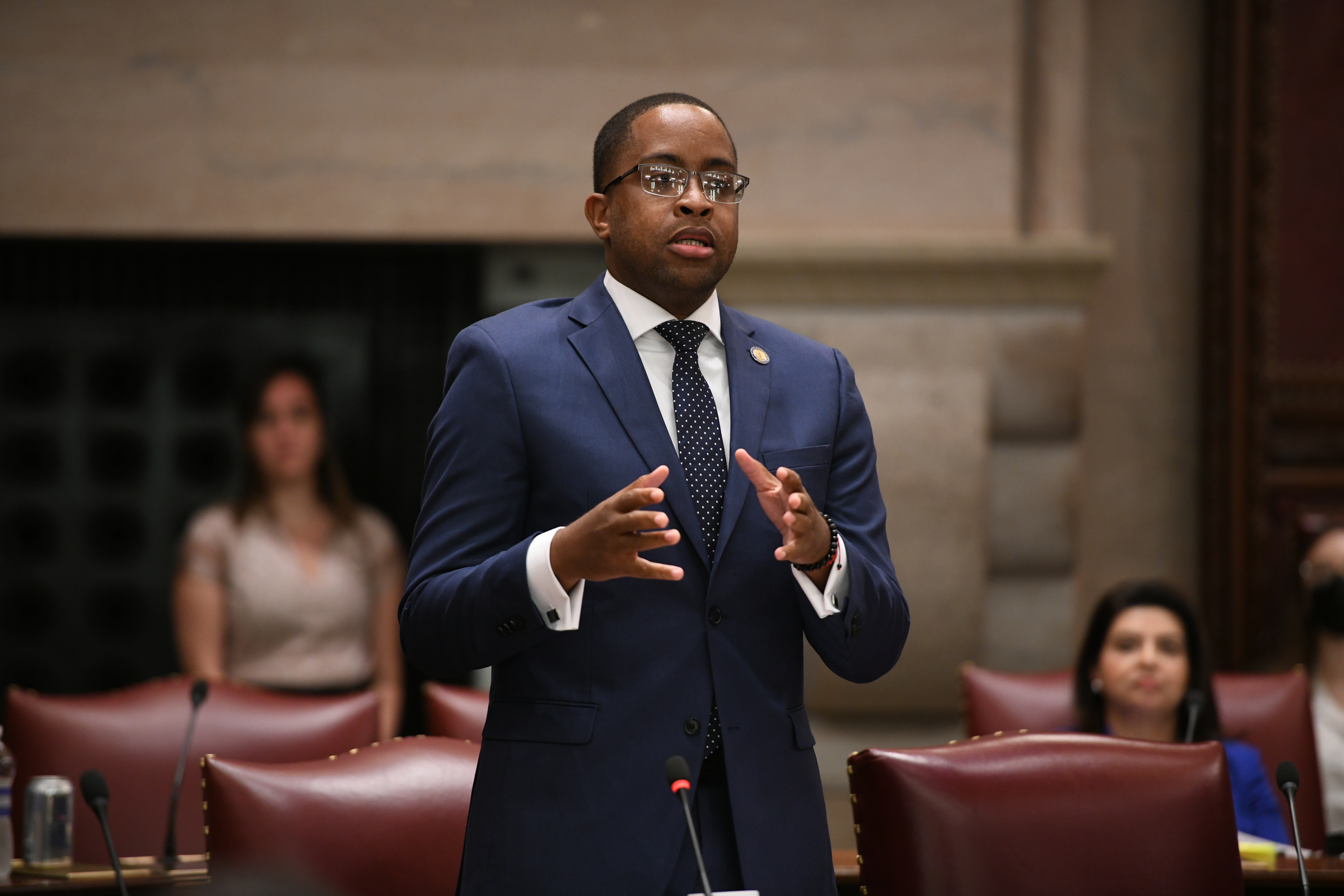
ZELLNOR-CODED: Brooklyn state senator and mayoral candidate Zellnor Myrie has been tapped to lead the Senate Codes committee — a well-timed appointment.
As he prepares for the June primary and begins his seventh year in Albany, Myrie will have a key role in shaping criminal justice policy in Albany while he and his challengers attempt to prove their preparedness on the campaign trail.
An October Siena poll found likely New York City voters identified crime as their biggest concern. Adams has already signaled public safety will again be the crux of his mayoral campaign and he’s likely to call out any left-of-center opponents for prior votes he views as soft on crime.
“I’m grateful the leader has entrusted me to chair this committee, particularly at a time where public safety is on the minds of every New Yorker,” Myrie told Playbook. “As someone who is from New York City, who takes our subways and our buses, who talks to neighbors, I can say confidently this is an issue that is prominent in their minds.”
Myrie most recently helmed the Elections Committee, and his new spot leading Codes — which deals with all things criminal justice — has traditionally been viewed as the third most-powerful committee chair in the Senate. Nevertheless, Majority Leader Andrea Stewart-Cousins — who has a cool relationship with Adams — still wields near absolute power in the chamber, deciding with leadership what bills make it to the floor.
Sen. Jessica Ramos, another mayoral candidate, will remain chair of the Labor Committee. Zohran Mamdani, the other state lawmaker vying to lead City Hall, was not assigned a leadership position in the Assembly.
“We’re at a time where people are going to be using public safety as a political conversation, and I think that there needs to be a seriousness and sobriety in how we talk about actual solutions to this problem,” Myrie added, saying the committee will “be squarely focused on having actual solutions to city problems.” — Jason Beeferman
COMMITTEE ASSIGNMENTS ARE IN: Beyond Myrie, the Senate and Assembly announced all the other new committee leadership positions today, and that came with a host of changes, our colleague Bill Mahoney reported earlier in POLITICO Pro.
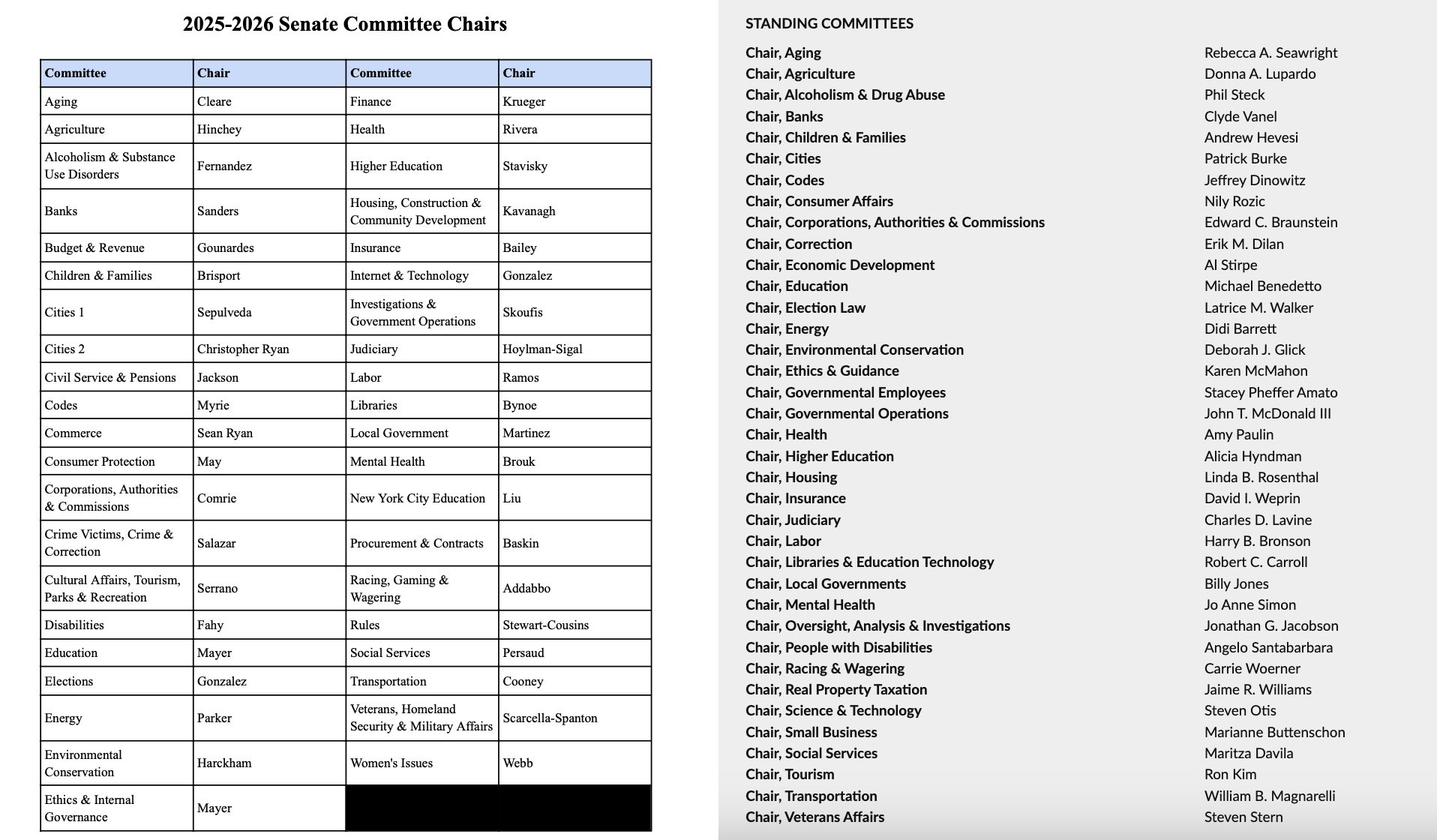
The Assembly
- Gary Pretlow will replace the retired Helene Weinstein as chair of the Ways and Means Committee.
- Carrie Woerner replaces Pretlow to lead the Racing and Wagering Committee.
- Marianne Buttenschon succeeds Woerner as chair of the Small Business Committee.
- Ron Kim will succeed the retired Daniel O’Donnell as Tourism chair.
- Rebecca Seawright will take Kim’s place as chair of the Aging Committee.
- Angelo Santabarbara will succeed Seawright on the People With Disabilities Committee.
- Bobby Carroll will become chair of Libraries and Education Technology, replacing Santabarbara.
- Pamela Hunter is succeeding Jeff Aubry as speaker pro tempore.
- Clyde Vanel will replace Hunter as chair of the Banks Committee.
- Jonathan Jacobson will replace Vanel on Oversight, Analysis and Investigations.
- Ed Braunstein will become chair of Corporations, Authorities and Commissions, replacing the retired Ken Zebrowski.
- Pat Burke will take over the Cities Committee, succeeding Braunstein.
- Jo Anne Simon will become Mental Health chair, following the retirement of Aileen Gunther.
- Karen McMahon will take Simon’s place on Ethics & Guidance.
- Billy Jones will replace the retired Fred Thiele on Local Governments.
- Steve Stern will succeed the retired Kimberly Jean-Pierre on Veterans Affairs.
- Alicia Hyndman will become chair of Higher Education, after previous chair Pat Fahy was elected to the Senate.
The Senate
- Jamaal Bailey will take over retired Neil Breslin’s leadership of the Insurance Committee
- Zellnor Myrie will replace Bailey on the Codes Committee
- Kristen Gonzalez will take over for Myrie on the Elections Committee and remain chair of the Internet and Technology Committee.
- Rachel May will lead the Consumer Protection Committee, which was vacated by Kevin Thomas.
- Freshman Christopher Ryan will succeed May as chair of Cities II, a recently added committee that deals with cities north of the Bronx.
- Freshman Pat Fahy will chair Disabilities, formerly helmed by John Mannion.
- Freshman Siela Bynoe will lead Libraries, which had been chaired by Iwen Chu.
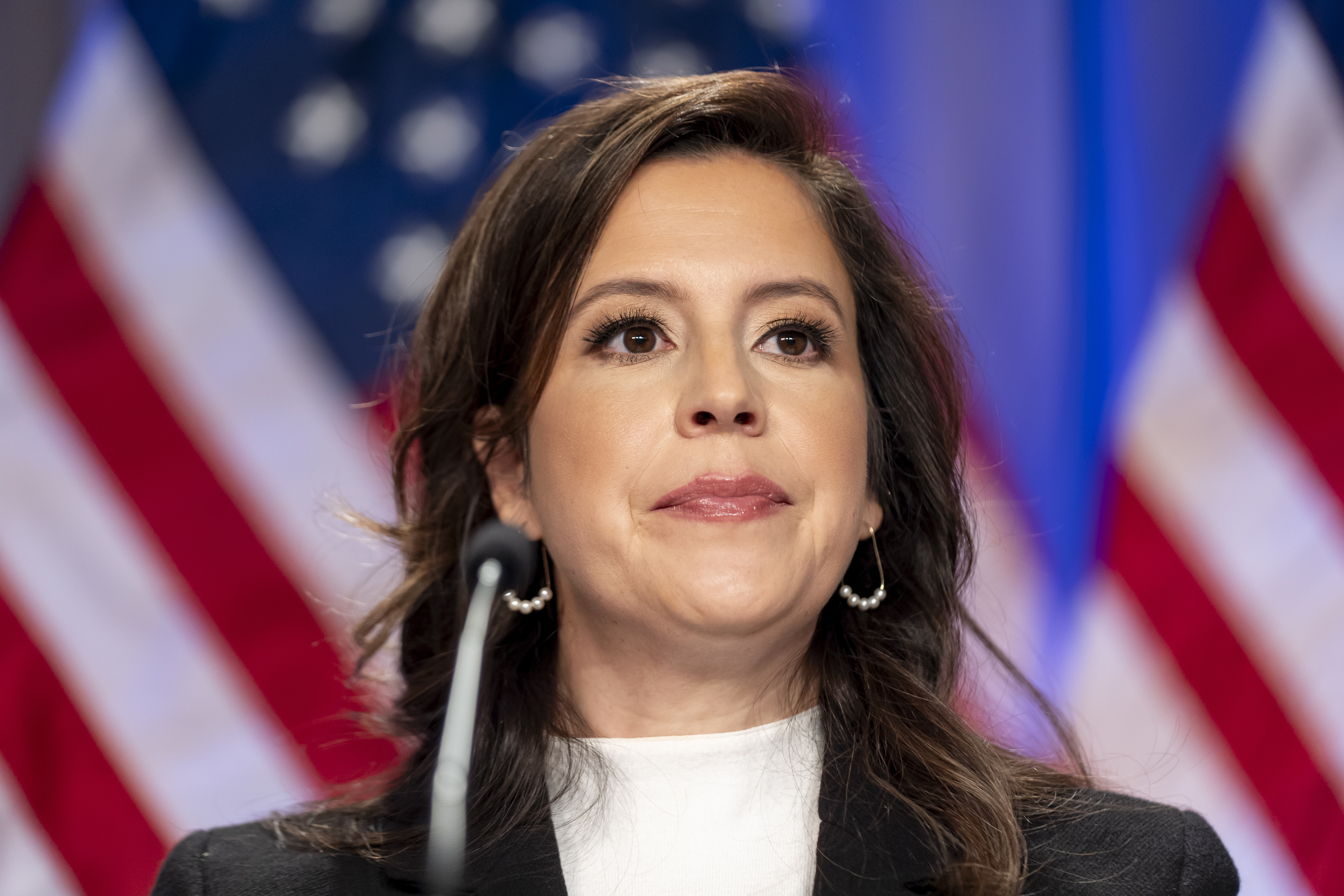
THE WINNOWING: GOP leaders in the North Country House seat being vacated by Rep. Elise Stefanik will narrow the field of potential candidates by the end of the weekend, state party spokesperson David Laska said.
As Playbook reported this morning, Republican county chairs in the sprawling district met over Zoom with a dozen possible nominees. GOP officials expect to winnow that field of some 12 people to less than 10. Those preferred candidates will then advance to another round of vetting by Republican leaders.
Jockeying to replace Stefanik, President-elect Donald Trump’s nominee to serve as United Nations ambassador, has been underway for the past two months. A Republican candidate is expected to be heavily favored in a special election — likely to be scheduled for mid-April — given the party’s enrollment advantage in the largely rural seat. — Nick Reisman
— SALT SLOWDOWN: Members of New York’s GOP delegation, once promising a full repeal of the cap on State and Local Tax Deductions, are now tempering expectations as they signal a full repeal is unlikely. (NY1)
— THE WHEELS ON THE TRAIN GO ROUND AND ROUND … EXCRUCIATINGLY: There’s a mysterious defect on the subway tracks of lettered train lines that’s causing subway wheels to be worn down more quickly than ever. (Daily News)
— TOP NY COURT BUCKS TRUMP: The Court of Appeals denied a request to delay Trump’s sentencing in the “hush money” case. (Times Union)
Missed this morning’s New York Playbook? We forgive you. Read it here.


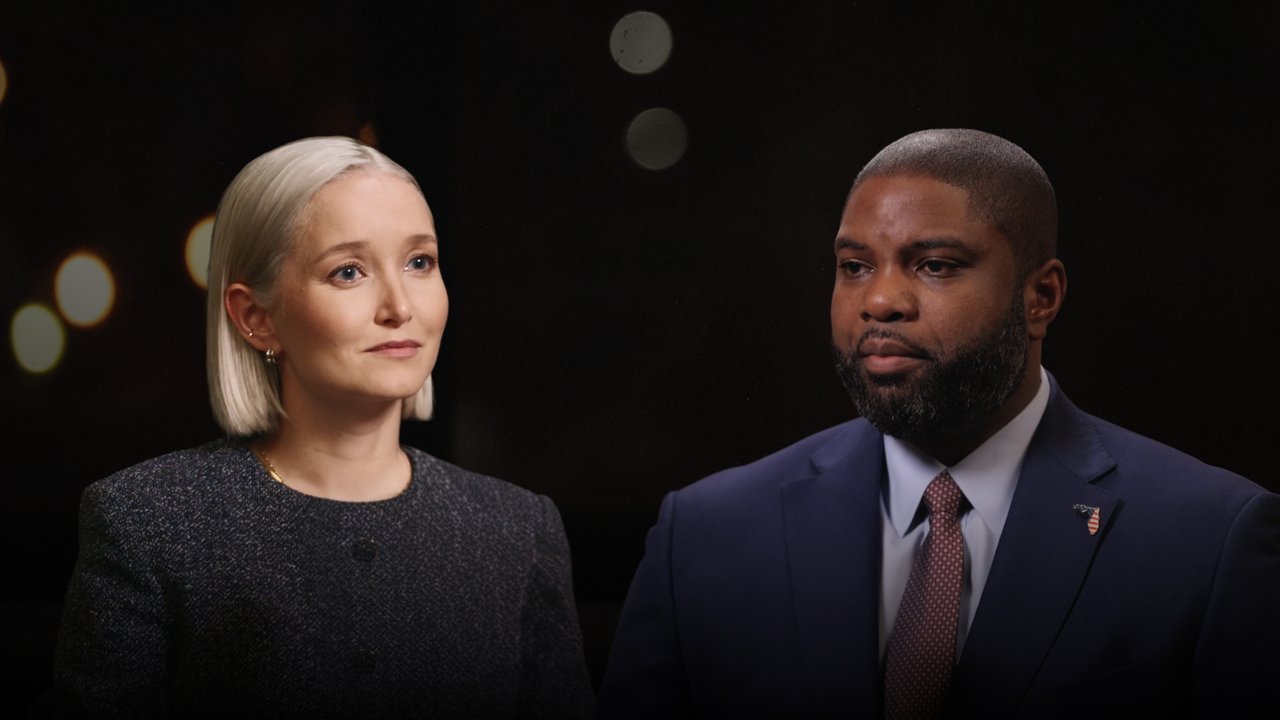
Byron Donalds says he is not a ‘yes man’ to Trump
lead image
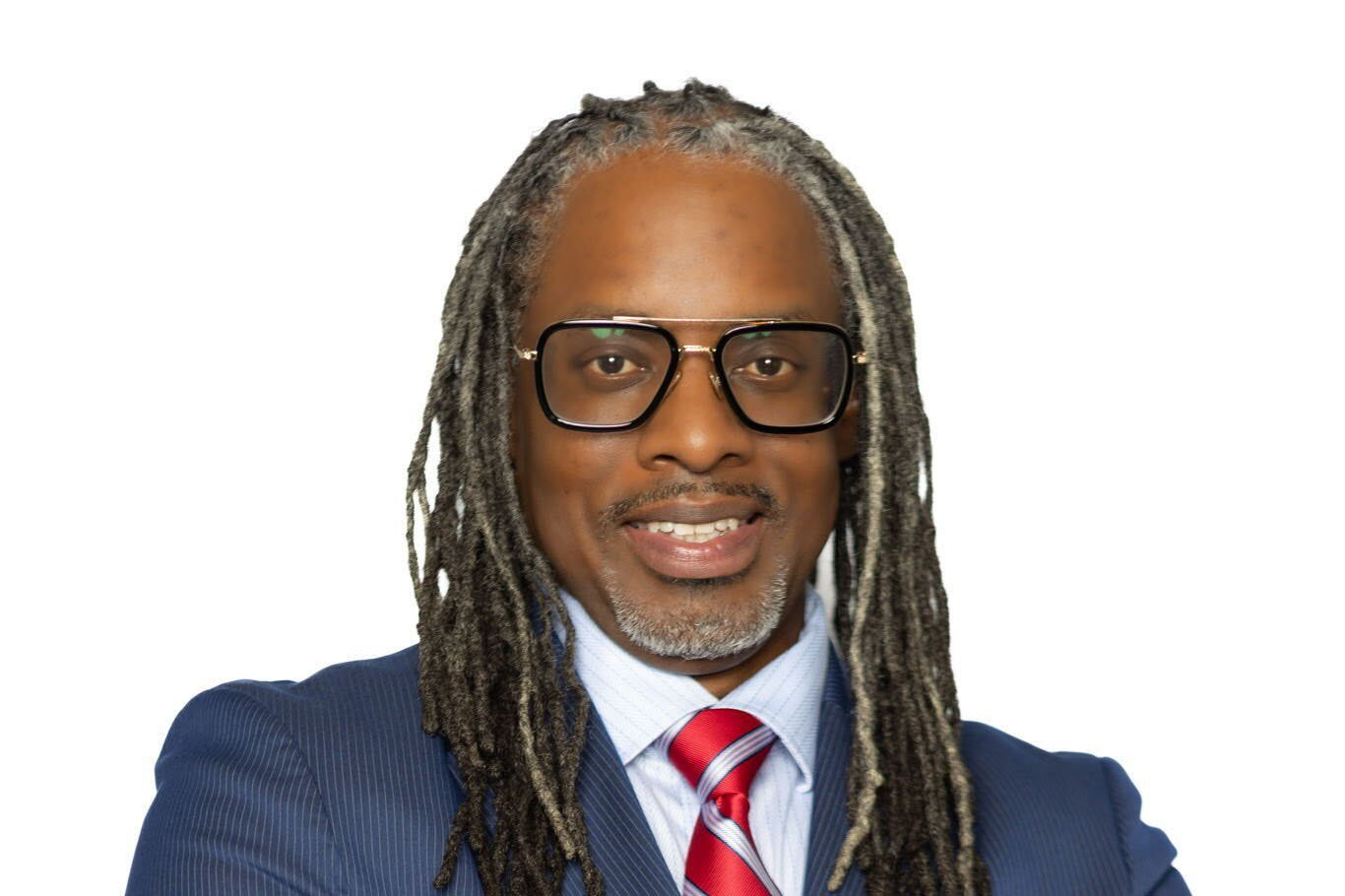
The progressive political action committee Justice Democrats has appointed Rev. Hodari Williams as its new executive director. The change sets the organization up to hone a civil rights message ahead of the 2028 election cycle, Williams told Blue Light News.
His appointment, shared first with Blue Light News, comes at a time when self-proclaimed progressives (and socialists) are flooding the scene. The PAC has had its most successful election cycle ever, helping seven candidates — including Donavan McKinney in Michigan, Melat Kiros in Colorado and Darializa Avila Chevalier in New York — defeat incumbents in the primaries. While those candidates are heavily favored to win on Election Day, the fates of three other Justice Democrats candidates, including Tennessee’s state Rep. Justin Pearson, remain less certain going into November.
At one point, the group tried to get Williams to run for office. Though he declined, Williams said now is the right time to force change.
“America and its present-day politicians, from my experience, have a high blood pressure of promises and anemia of political courage,” Williams said in an interview, using a common Kenyan political expression. “Right now, JD is producing candidates who have the political courage to deal with the crises that are existing in marginalized and disenfranchised communities, and I want to be a part of that.”
Williams, 46, was born and raised in Lakewood, New Jersey. His parents were activists and community organizers who raised him on the legacy of the Civil Rights Movement. After graduating from Francis Marion University in Florence, South Carolina, with his bachelor’s degree, he joined the NAACP as a field organizer for voter rights and empowerment while pursuing his Master’s of Divinity at the Interdenominational Theological Center. In his time with the NAACP, Williams traveled across the Black Belt, where he said he witnessed poverty and inequity up close.
“Civil rights traditionally has been something that people have tried to separate from progressivism … but these movements are inseparable,” said Williams. “What I witnessed in the South as a worker in voter rights and voter empowerment and education, and as a regional representative for the NAACP, was that the conditions that created inequity still existed and needed to be confronted and challenged.”
His work took him to Kenya, where he served as a program coordinator with the Presbyterian Church USA. In Nairobi, he supported the Green Belt Movement’s work against deforestation and its mission to highlight environmental justice as a tool for economic empowerment and self-determination.
Now, as some Black and brown voters express concerns of being tokenized by traditional Democratic candidates, Williams plans to bring his experience working in racial justice circles to his new role.
“I have worked in communities that have borne the brunt of failed promises from the current Democratic leadership,” Williams said. “I have opened the doors of my congregations to politicians and have experienced the absence of those politicians after the elections.”
He continued: “Black communities have become destinations for environmental hazards and data centers. Unemployment has risen. Black federal employees have been targeted. The list goes on. I’ve pastored these people. I’ve prayed with them. I’ve listened to them as they’ve shed tears. Now I’ve decided I want to move from triage work to really transformational work.”
Some of that work will require challenging other Black leaders.
“Unfortunately, many of our Black politicians have become victims of corporate capture, and their voices have been taken by entities like AIPAC,” said Williams, referring to the American Israel Public Affairs Committee. “They have not really been able to stand for the issues that are affecting the communities that that many of us are fighting for, and JD candidates are free from that, and they’re free to take bold and significant action to move forward legislation.”
But with the 2026 election cycle nearly over, the PAC is already brainstorming how to establish a strong progressive coalition for the 2028 presidential election. That will mean convincing the mainstream Democratic party that Justice Democrats have built a lasting coalition of the party’s base, said Williams.
“We hope that the Democratic Party would see that we’re developing a blueprint to show them how the base is being energized around the issues that are kitchen table issues that people want us to deal with,” said Williams.
“It’s not enough for us just to have a call to defeat a fascist president. We don’t want a fascist president. We want him out, but we also want a vision of what America could look like when affordability, healthcare, civil rights, housing, and livable wages — all of those things are at the top of the political agenda,” he added.
Williams succeeds current executive director and co-founder Alexandra Rojas, who will become president of Justice Democrats’ board and will support Williams as a senior adviser.
Iowa Rep. Ashley Hinson took a swipe at the savings habits of millennials as she fielded a question Wednesday about Social Security during a Senate campaign debate.
Hinson, the Republican candidate facing off against Democrat state Rep. Josh Turek, was asked about ensuring the solvency of Social Security when she raised the broader prospect of savings by millennials, the demographic consisting of people born from 1981-1996.
She said the country needed to have a “serious conversation” about “how young people are saving money,” as part of the discussion about the future of Social Security.
“We also need to be talking about millennials saving money,” she later added. “Millennials are the worst group of savers in the country right now and have the least amount of savings. So those are ways where I think we can help have a bigger conversation around saving in general, planning for retirement, and making sure we’re all able to experience a robust retirement.”
Hinson faces a tough race in Iowa against Turek amid a difficult political environment for Republicans. Voters are overwhelmingly pessimistic about the state of the economy and their own personal finances, and they support Social Security while being concerned about the program’s future.
Hinson said she would not support cutting benefits and suggested creating a bipartisan commission to present suggestions to Congress to save the program. When pushed on her statement that “all options should be on the table,” she turned her attention to young people.
“I think my dad and I had this discussion when I was in sixth grade, looking at a ledger book and trying to figure out, hey, how are we going to make sure you’re set up for your life?” she said. “So we need to be having a conversation simultaneously to all solutions on the table, to make sure that it can stay solvent, while we’re also talking about, how do we get more young people to save?”
Hinson’s campaign did not immediately respond to a request for clarification.
Turek, when asked about Social Security, said he supports removing the payroll tax cap.
“The best way we can keep this solvent is by taking off the cap,” Turek said. “Let’s make sure that billionaires and large corporations are paying their fair share. That will move the needle in a very serious way to keep Social Security solvent.”
Hinson disagreed. “The only thing I’m hearing from him is that the only solution to everything is to raise taxes,” she said.
-

 Politics2 years ago
Former ‘Squad’ members launching ‘Bowman and Bush’ YouTube show
-
Uncategorized2 years ago
Bob Good to step down as Freedom Caucus chair this week
-

 The Josh Fourrier Show2 years ago
DOOMSDAY: Trump won, now what?
-

 The Dictatorship2 years ago
Pete Hegseth’s tenure at the Pentagon goes from bad to worse
-

 Politics2 years ago
Former Kentucky AG Daniel Cameron launches Senate bid
-

 The Dictatorship2 years ago
Luigi Mangione acknowledges public support in first official statement since arrest
-

 Politics2 years ago
Blue Light News’s Editorial Director Ryan Hutchins speaks at Blue Light News’s 2025 Governors Summit
-

 The Dictatorship1 year ago
Mike Johnson sums up the GOP’s arrogant position on military occupation with two words