
Congress
Dems fight to Trump-proof the federal judiciary

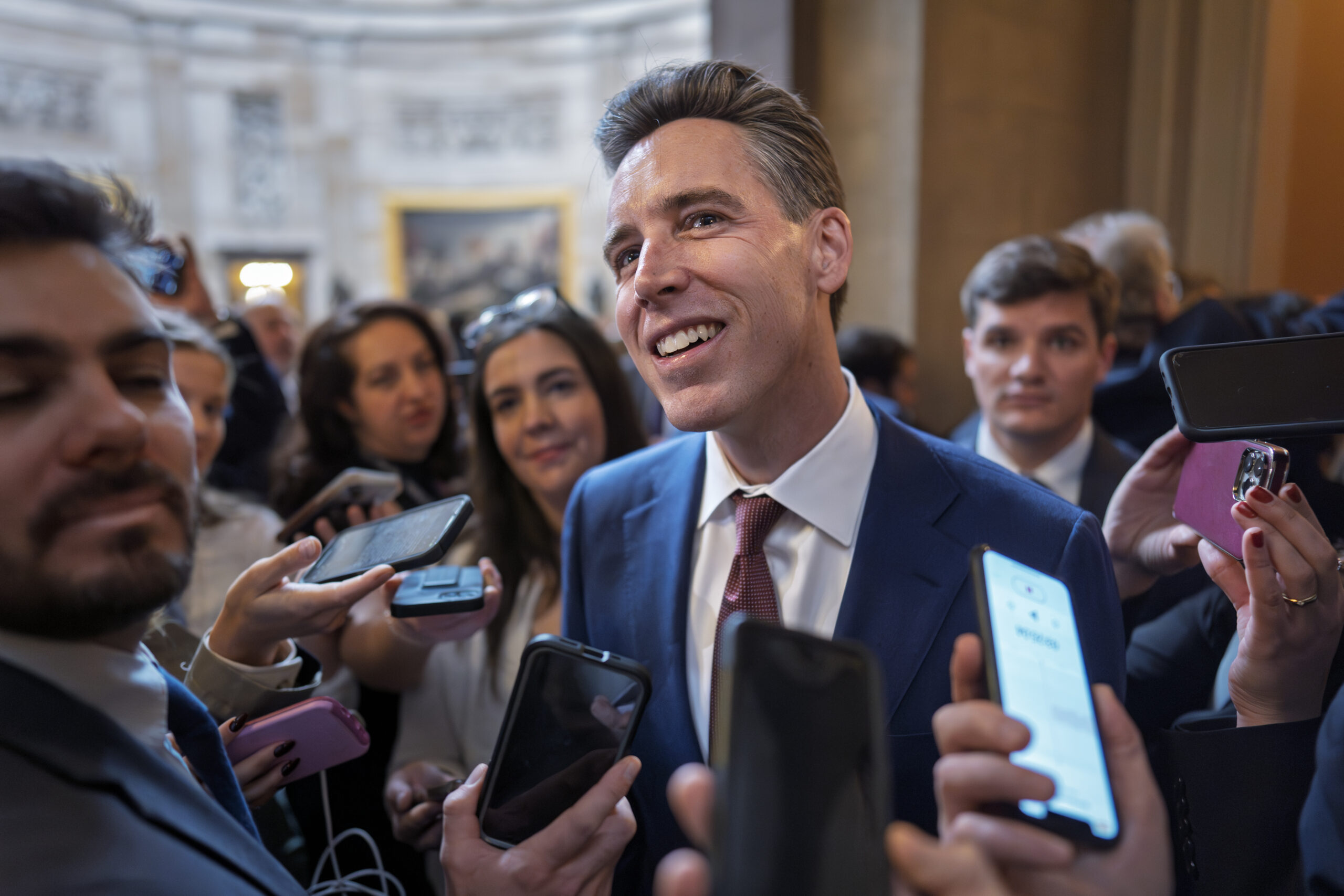
Democrats on Friday hit a major milestone, confirming more judges under President Joe Biden than Republicans did in President-elect Donald Trump’s first term. It deprives Trump of putting a bigger conservative stamp on the judiciary — and Democrats will have leverage to continue fighting next year.
Senate Democrats, despite a narrow majority, have approved 235 of Biden’s judicial picks, eclipsing the 234 judicial nominations Trump got through in his first term. Biden has now appointed a range of judges amounting to about a fourth of the overall federal judiciary.
In a move that could further dent Trump’s judicial impact even with a GOP Senate majority, Democrats are poised to put pressure on Republicans to maintain a practice that requires sign-off from a state’s two senators for lower-level spots on the federal bench.
Top Judiciary Committee Democrats who vet judicial nominations, like outgoing Chair Dick Durbin of Illinois, declined to drop the “blue slip” tradition over the past two years, despite pressure from the party — and are now urging Republicans to do the same.
Asked if he intends to maintain the practice, incoming Senate Judiciary Chair Sen. Chuck Grassley (R-Iowa) responded simply: “Yes.”
That’s a boon for Democrats. Because of population size, there are more judicial slots in larger blue states like California, New York and Illinois — ones that will require two Democratic sign-offs for the Trump administration to fill. Plus, a deal that would have expanded the number of federal judgeships and given Republicans slots to fill is on the verge of getting a Biden veto.
“There are way more district judges in Democratic states than there are in Republican states,” said Sen. Sheldon Whitehouse (D-R.I.), a senior member of the Judiciary Committee. “For us to let the district court blue slip go would create a real structural problem over the long haul, so Chairman Durbin did absolutely the right thing to hold that.”
Democrats hope filling district court slots with less conservative picks will provide a first line of defense against Trump administration policies as the party braces for the incoming president and other Republicans to enact a multitude of new policies, via executive orders and otherwise.
Court decisions could have critical implications for abortion rights, student loan forgiveness, climate change and more. While cases can rise up to appeal courts and beyond, district courts tend to have the first say on challenges to federal policies.
Even Republicans begrudgingly acknowledge Durbin has run an efficient and aggressive operation in filling vacancies over the last four years.
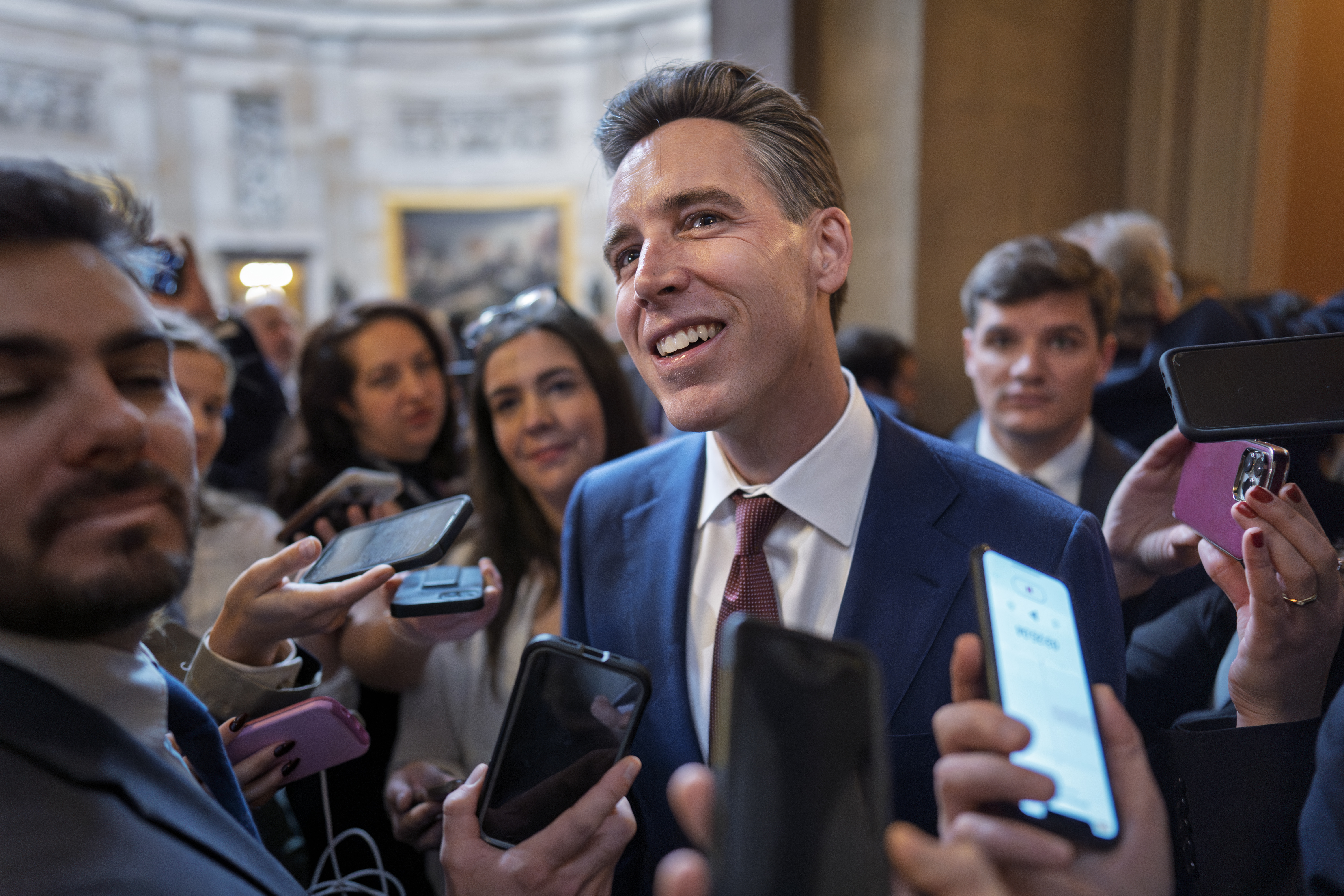
“Dick Durbin has sadly been very effective. He’s been very good. I wish he hadn’t been,” Sen. Josh Hawley (R-Mo.), a member of the Judiciary Committee, said in an interview. “He’s run the committee really, really efficiently.”
Democrats largely cleared the decks: There are just 36 current federal court vacancies and 11 future ones as judges announce planned retirements. By comparison, Trump began his first term in 2017 with an astounding 112 vacancies and 15 future ones.
Biden started his term with 49 current vacancies and five future ones to consider for the federal bench.
Trump may, of course, have the most consequential last laugh at the Supreme Court. Justices Clarence Thomas and Samuel Alito — both in their 70s — are on the retirement watch list. Nominating replacements for either or both of those conservative justices would offer Trump the chance to further cement a decades-long conservative mark on the court. And they’re not the only justices on the retirement watch list; progressive groups launched an unsuccessful pressure campaign following Trump’s win for liberal Justice Sonia Sotomayor to step aside, wary the 70-year-old could create another opening for Trump to tilt the court further rightward.
He already got to fill three vacancies during his first term, meaning about half the court would be his appointees if either or both justices retire.
Plus there are other large states that see a lot of openings, like Texas and Florida, where Trump will have two GOP senators to sign off on his preferred picks.
“I can’t wait for President Trump to nominate some more judges — to me that was one of his great legacies,” said Sen. John Cornyn (R-Texas), a senior member of the Judiciary Committee.
Trump could have come in with a slate of additional judicial openings to fill under a bipartisan deal struck this term, but it now looks unlikely. The Senate earlier this year unanimously approved a bill to add 66 district court judgeships over the next three presidential terms, with advocates saying they wanted to clear it before the 2024 election so neither Republicans nor Democrats would know which party stood to immediately gain from it. But House Republicans waited until after the election to pass it, and Biden has indicated he plans to veto it.
But another deal on judges did make it through — Senate Majority Leader Chuck Schumer struck an agreement with Republicans to let four appeals court slots stay open until next year in exchange for GOP senators allowing quick consideration for a dozen district court judges.
Democrats have said they didn’t have the support for those confirmations anyway. And one of those appeals court jurists later backed out of his stated intention to retire, prompting anger from Republicans.
Despite that, half a dozen GOP senators told Blue Light News they came out on top of that agreement. Sen. Eric Schmitt (R-Mo.), a Judiciary member who’s close to Trump, called it a “good deal.”
Senate Democrats are no stranger to criticism for how they’ve handled judicial openings, but Durbin noted they managed to break Trump’s record despite a narrow number advantage in the chamber.
“Two years, we’ve had a tied Senate and a tied committee, [and] we reported out almost 100 judges,” Durbin said. “Pretty good, huh? You can’t say yes, but I’ll say it for you: Pretty damn good.”
Republicans insist they’re raring to go at confirming more of Trump’s judicial picks — and they’ll take cues from Durbin as they aim to leave no slot unfilled.
“All I can say is: I hope Republicans will look at what he’s done in these last four years,” Hawley said.



NEW YORK — With just five days to go until the primary election in New York, Mayor Zohran Mamdani issued a stark warning to members of Congress who believe “incumbency is a substitute for action”: Watch out.
“People often ask me what I think of the state of the Democratic Party,” Mamdani said to the crowd at the Kings Theatre in Brooklyn as he boosted his endorsed congressional candidates. “This slate here today is our answer. The Democratic Party must change.”
The democratic socialist framed Tuesday’s election as much more than what that means for New York, though. In recounting how people also ask him about the 2028 presidential election, he put it bluntly: “It starts now. It starts on Tuesday.”
“For far too long, our party has seen its job as managing decline instead of delivering material change for working people,” Mamdani said. “That old way of thinking will lose on Tuesday. And frankly, it will lose in South Carolina and New Hampshire. It will fall short of 270 electoral votes, because the party of the past will not be what leads us into the future.”
Mamdani, joined by Vermont Sen. Bernie Sanders, urged his supporters to show up for his endorsed candidates “the way you showed up for me.” They include former New York City Comptroller Brad Lander, who’s challenging two-term Rep. Dan Goldman; state Assemblymember Claire Valdez, who’s vying for retiring Rep. Nydia Velázquez’s seat; and community organizer Darializa Avila Chevalier, who’s trying to unseat five-term Rep. Adriano Espaillat, the chair of the Congressional Hispanic Caucus.
Mamdani’s endorsed slate of legislative candidates were at the rally, too.
The rally featured standard stump speeches from the candidates, highlighting the need to support working class New Yorkers and immigrants. Speakers called out the American Israel Public Affairs Committee, the pro-Israel group that has loomed over many of these primaries — despite no evident spending from its independent expenditure arm. Sanders also emphasized his call to ban super PACs, which have reshaped primaries across the city.
Taking place just hours after the massive ticker-tape parade celebrating the Knicks’ historic championship, there were also Knicks references galore.
“I hate to break it to you, but OG Anunoby is not here to save the day,” said Mamdani, who was wearing a Knicks jersey under his suit. “The only hands we can count on are ours.”

Sanders, who is wildly popular in New York, previously endorsed Valdez and Lander. Both Valdez and Avila Chevalier are members of the Democratic Socialists of America and are backed by the city chapter in their bids. Sanders had not officially endorsed Avila Chevalier prior to the rally.
“Why are progressives and socialist candidates winning elections all across this country?” Sanders asked. “The answer in my view is not complicated. The working class of America understands that our current economic system is rigged, that it is designed to benefit the wealthy and the powerful.”
Polling has shown Lander with a lead over Goldman, and a tight race for Velázquez’s seat. Public polling is scarce in the Espaillat race, but recent internal surveys suggest Avila Chevalier is posing a real challenge to the incumbent. Mamdani endorsed her just weeks ago, much later than Lander and Valdez, but his engagement in the race has significantly elevated its profile.
“Six months ago, they told us this race was over before it started,” Avila Chevalier said at the rally. “They told us Adriano was untouchable, that he was an institution, that you don’t run against someone like him and win. That this district was his, and that we should wait our turn. And they said it with such confidence, like the outcome had already been written. Look around. Look at what we’ve built.”
Mamdani’s decision to get involved in congressional races is stress-testing how the new mayor navigates relations with powerful, well-respected party figures — many of whom he’s on the opposite side of.
Mamdani’s endorsement is expected to be a significant asset for his picks; he had dominant performances across these districts in last year’s mayoral primary. And that shine doesn’t seem to have dulled. Recent polling has shown that Mamdani has high approval ratings.
Goldman did not support Mamdani during last year’s mayoral primary or the general election, as Lander has often pointed out. Espaillat backed former Gov. Andrew Cuomo in the primary, but supported Mamdani in the general election. Valdez’s opponents, Brooklyn Borough President Antonio Reynoso and city Council Member Julie Won, both supported Mamdani in the primary.
The mayor has been active on the trail for his congressional candidates of choice in the closing stretch of the campaign. And he touted them all in an advertisement that ran during the first game of the Knicks’ finals run.
Still, Lander has tried to keep some distance. When asked at a recent press conference why he would appear in that ad with Avila Chevalier, who attended a pro-Palestinian rally the day after Hamas’ Oct. 7 attack in 2023 — the same rally Lander said he left the DSA over — he said it was an “opportunity to show New Yorkers that politics can be a team sport.” He also clarified that he has not endorsed candidates in any other congressional primaries.
Avila Chevalier told reporters that she went to that rally to “stand against” Israel engaging in “a response that is often disproportionate and creates a greater loss of life.” She added that she has “condemned Hamas” and does “not believe that celebrating the loss of anybody’s life is OK.”
Kings Theatre isn’t located in any of the districts these congressional hopefuls are trying to represent — though it neighbors the seats that Lander and Valdez have their eyes on.
It’s especially far from Espaillat’s district, which includes parts of upper Manhattan and the Bronx.
While handing out campaign literature to people walking out of the subway in Hamilton Heights, Blue Light News asked Espaillat if he had thoughts about Avila Chevalier appearing at the rally.
“I’m rallying right here in my district with my constituents — not in Brooklyn,” he replied.
Jason Beeferman contributed to this report.
Retirement groups are calling on Congress to investigate Meta over a wave of social media scams targeting older Americans.
In a letter sent Thursday to House Homeland Security Committee Chair Andrew Garbarino (R-N.Y.) and ranking member Bennie Thompson (D-Miss.), the groups alleged Meta has been slow to take down fraudulent ads, leaving seniors vulnerable to financial loss. The letter, shared exclusively with POLITICO, was signed by the Alliance for Retired Americans, the American Postal Workers Union Retirees and the American Federation of Teachers, among others.
“Fraudulent Medicare ads have proliferated on Meta platforms and too many seniors are getting scammed while Meta profits,” said Richard Fiesta, executive director of the Alliance for Retired Americans. “We are calling on Congress to investigate how these scams are allowed to spread, what Meta knew about them, and why stronger protections are not in place. Seniors should not be left vulnerable while scammers and tech companies cash in.”
The letter’s demands follow a report published last month by the Center for Countering Digital Hate, a nonprofit advocacy group, which alleged that Meta has profited by leaving up fraudulent ads, many of which target Medicare recipients.
“Scammers are determined criminals who use increasingly sophisticated tactics to defraud people and evade detection,” Meta spokesperson Andy Stone said in a statement. “We aggressively fight scams on and off our platforms because they’re not good for us or the people and businesses that rely on our services and for years we’ve been one of law enforcement’s strongest partners in the fight against this type of online crime — identifying criminals, disrupting their crimes and helping bring them to justice.”
Stone pointed to several examples of Meta’s efforts to combat scams on its platform, including a recent collaboration with U.S. and Thai law enforcement to disrupt online scams.
It’s not the first time Meta has faced scrutiny over the scams: Sens. Richard Blumenthal (D-Conn.) and Josh Hawley (R-Mo.) urged the Federal Trade Commission and the Securities Exchange Commission to open an investigation into the company in November after Reuters reported that Meta in internal documents projected 10 percent of its 2024 revenue would come from fraudulent ads. And in February, a group of bipartisan lawmakers pressed Meta CEO Mark Zuckerberg over its plans to prevent and combat fraud on its platforms.
Reps. Dan Meuser (R-Pa.) and Lou Correa (D-Calif.) also introduced bipartisan legislation earlier this year to combat predatory scam ads.
Congress is expected to send a landmark, bipartisan housing affordability bill to President Donald Trump’s desk by the end of next week as the Senate and House schedule action on the legislation in the coming days.
The Senate has teed up the 21st Century ROAD to Housing Act for final passage on Monday, after completing all its necessary procedural votes this week.
The legislation will then move on to the House where GOP leadership plans to open debate on Wednesday, with a vote expected as early as the same day, according to six people familiar with the vote granted anonymity to discuss plans.
House leadership plans to suspend the rules, requiring a two-thirds majority vote, to speed up the bill’s path to Trump’s desk. Final passage could be pushed to Thursday depending on timing, the people said.
The housing bill aims to tackle housing affordability and boost homeownership and supply ahead of a midterm election dominated by cost-of-living concerns.
The four lawmakers leading the negotiations over the legislation — Senate Banking Chair Tim Scott (R-S.C.), ranking member Elizabeth Warren (D-Mass.), House Financial Services Chair French Hill (R-Ark.) and ranking member Maxine Waters (D-Calif.) — came to an agreement Tuesday afternoon after months of back and forth on the bill’s contents.
The housing affordability legislation, which the White House supports, contains a provision limiting the role of large institutional investors in the single-family housing market, which was a key condition for Trump to sign the bill.
- Medication abortion restored in Missouri following court ruling

- White House confirms Vance trip to Switzerland delayed

- Special election for Swalwell’s open House seat heads to runoff
- Trump awards 3 Medals of Honor to war heroes

- Top Senate Democrat calls on FAA to reject White House arch approval pressure

- Matt Dunlap beats DCCC-backed candidate in primary for top Maine battleground
- Democrat Hannah Pingree and MAGA ally Bobby Charles will face off for Maine governor
- Pence-backed think tank joins push to keep kids’ safety bills out of AI package

- ‘Un-American’: Democrats attack Trump’s uneven disaster response
- OMB nominee touts plan to give Trump appointees power to kill grants

-

 Politics1 year ago
Former ‘Squad’ members launching ‘Bowman and Bush’ YouTube show
-

 The Dictatorship1 year ago
Luigi Mangione acknowledges public support in first official statement since arrest
-

 Politics1 year ago
Former Kentucky AG Daniel Cameron launches Senate bid
-
Uncategorized2 years ago
Bob Good to step down as Freedom Caucus chair this week
-

 The Dictatorship1 year ago
Pete Hegseth’s tenure at the Pentagon goes from bad to worse
-

 The Josh Fourrier Show2 years ago
DOOMSDAY: Trump won, now what?
-

 Politics1 year ago
Blue Light News’s Editorial Director Ryan Hutchins speaks at Blue Light News’s 2025 Governors Summit
-

 The Dictatorship9 months ago
Mike Johnson sums up the GOP’s arrogant position on military occupation with two words