
Congress
Capitol agenda: Nvidia’s clout tested as AI debate shifts

Jensen Huang’s clout as the leader of the world’s largest company is about to be tested on Capitol Hill as debates around artificial intelligence safety intensify.
The Nvidia boss and his army of lobbyists want Congress to lay off restricting exports, particularly to China, of high-end computer chips — the building blocks necessary to power AI development. Lawmakers could include these guardrails as part of the annual defense policy bill set for negotiations this fall.
But despite Huang’s team having had some success over the past year in convincing lawmakers to peel back regulations that would hamper exports, the swift shift in the AI political landscape has led the company to start sounding out of touch — at least to some lawmakers’ ears.
One Senate Democratic aide, granted anonymity to describe private meetings, said Huang’s recent visits to congressional offices have “repeatedly been seen as tone deaf, as he’s openly dismissed or downplayed the risks of AI, including denying any likely workforce disruptions from the technology.”
“Jensen makes an argument — I’m not sure I fully buy it — that as long as the world is relying on Nvidia chips, that’s a good thing,” the Senate Intelligence panel’s top Democrat, Mark Warner, said in an interview. He’s among those who fear giving a top U.S. competitor more tools to advance AI technology, which other industry executives have recently warned could have catastrophic consequences for humanity if left unchecked.
Huang last week echoed President Donald Trump’s sentiment that no new AI laws or regulations are necessary. But even Trump this weekend seemed to concede there are some dangers to the emerging technology. In a Truth Social post, he announced an “AI Force” and an AI czar to lead it — though he offered few details about what powers it would have or whether its creation would need congressional approval.
Meanwhile, a trio of GOP senators is trying to convince their leaders to do something — anything — on AI safety, an issue they believe could tilt the midterms and 2028 elections.
Sens. John Curtis, Josh Hawley and John Kennedy aren’t coordinating their efforts, but each is making a push from the back benches to jolt more senior senators to take action, with Curtis and Hawley teaming up with Democrats on various efforts.
Curtis said in an interview lawmakers need to “show that we’re adults in the room, that we can talk about this, that we can find solutions.”
Hawley is also convening a hearing this week in the Judiciary subcommittee he chairs on AI-powered Flock cameras, and using another subcommittee gavel to investigate OpenAI over the runaway model that led to rogue AI agents escaping testing.
But any hopes of passing legislation are facing skepticism among Senate Republicans that they will ever be able to overcome Trump’s opposition to AI regulations and House GOP leaders who side with the administration, according to three people granted anonymity to describe private conversations.
Kennedy said in an interview he hadn’t heard “anything” about movement in the Senate to address AI and that lawmakers who ignore the growing voter uproar around the issue were courting peril.
“We really need to send a memo around explaining we’ve got midterm elections coming,” he said. “I may send that out.”
Meanwhile, a deep dive in POLITICO’s magazine digs into the Trump administration’s complicated relationship with Anthropic and how officials’ perspective has shifted on AI this year as they discover the fearsome computing power being assembled by private companies on their watch.
What else we’re watching:
— DEMS EYE ONE MORE IRAN VOTE — Senate Democrats are hoping to rebuke Trump and the Iran war in one last war powers vote this week before the midterms. Sen. Thom Tillis is expected to flip his vote after saying he would support efforts to curtail the war if the administration hadn’t sought an authorization from Congress to continue it by mid-September. Senate Dems have attempted 14 similar votes in the past seven months with only two advancing due to GOP absences, but are now hoping increased dissatisfaction with the war will drive more defectors.
— CASSIDY SETS TEST FOR FDA PICK — Trump’s pick to lead the FDA must acknowledge the president’s claim that the measles vaccine is lethal is “absurd,” Sen. Bill Cassidy said Sunday. Senate HELP, which Cassidy chairs, is set to consider Dr. Heidi Overton’s nomination to lead the FDA on Thursday. “I need to hear that she understands that calling the measles vaccine lethal is absurd, and we need radical honesty,” Cassidy said on CBS when asked what he needs to be persuaded during the hearing.
Kelsey Brugger, Ari Hawkins, Jordain Carney, Sophia Cai, Cheyenne Haslett, Leo Shane III, Connor O’Brien and Jalen Beckford contributed to this report.


The ranking Democrat on the House Oversight committee is demanding the White House answer questions related to President Donald Trump’s decision to ban BLN, MS NOW and Blue Light News from the White House, calling it the president’s “most blatant, assault on press freedom.”
In a letter sent Monday to White House Communications Director Steven Cheung, Rep. Robert Garcia (D-Calif.) requested that Cheung provide by Oct. 5 a detailed account of when and how he was informed of the ban, how he responded, who was consulted before the decision, the legal justification for it, the facts the White House relied on and whether the outlets had any opportunity to respond.
“The First Amendment guarantees freedom of the press, not freedom from criticism,” wrote Garcia. “The American people need to understand what consideration—if any—the White House gave to this serious and unprecedented decision to protect the President’s ego.”
Garcia also asked for all White House staff documents and communications about the ban and for any other relevant materials to be preserved.
The White House did not immediately respond to a request for comment.
Trump on Friday announced that he was seeking to block journalists from Blue Light News, MS NOW and BLN from the White House, complaining about “constant ‘reporting’” of what he called “FICTION and LIES.” The Trump administration first denied the media outlets entry into the White House grounds on Saturday morning.
The three news organizations are now jointly suing Trump, Cheung and two other top advisers in a bid to immediately restore access for their reporters, calling the ban a “direct assault on the First Amendment.”
Daniel Lippman contributed to this report.
Michigan Republican Senate nominee Mike Rogers said Monday that the war with Iran “needs to end” to bring prices down, making him the second Republican to break with the White House on the issue that day.
“The war with Iran needs to end, and end quickly,” Rogers said in a video published Monday to social media.
“Michigan families can’t afford to wait,” he added. “Here’s what we can do now: place a temporary embargo on Diesel exports. American energy should provide relief to American families first.”
Earlier Monday, Rep. Ashley Hinson, a Republican Senate candidate in Iowa, expressed similar frustrations about the war’s impact on Iowans’ pocketbooks. Both Rogers and Hinson called for a suspension of the state and federal gas tax in their statements.
Ahead of the midterms, GOP candidates have expressed concern about the war in the Middle East, saying it has made it difficult for them to run on affordability. The war with Iran, which began in February, has led to marked increases in gas and diesel prices. On Monday, regular gas was just over $4.45 per gallon, according to AAA; diesel prices hit a record of $6.50 per gallon.
Rogers, a former representative, is facing Democrat Abdul El-Sayed in the race for a Senate seat in battleground Michigan.
Senate Appropriations Chair Susan Collins warned Monday that President Donald Trump would be defying Congress if he moves forward with empowering top political appointees to decide who gets grant funding for health research.
“Any attempt to politicize grantmaking … is contrary to congressional intent,” the Maine Republican said in a statement.
Trump wants to issue an executive order to seat White House budget director Russ Vought and National Institutes of Health director Jay Bhattacharya on a board that would decide which grants the NIH should fund, according to two administration officials granted anonymity to describe a private meeting in the Oval Office last Friday.
Following reports of that meeting, Collins noted Monday that the stopgap funding patch Congress cleared this summer bars the White House from finalizing a separate proposed rule to put political appointees in charge of approving federal grants, or “any substantially similar” plan.
The Office of Management and Budget “should not be involved in agency decisions on the awards of grants,” Collins said, adding that “imposing a political review … undermines the long-standing principle that the government funds awards based on scientific need and merit, rather than political ideology.”
Connecticut Rep. Rosa DeLauro, the House’s top Democratic appropriator, called the White House’s latest idea an attempt to “take control over federal funding, so they can use it to punish their perceived enemies and reward their friends.”
Washington Sen. Patty Murray, the Senate’s top Democratic appropriator, warned that the move would mean “a single political appointee could kill a cancer study or an Alzheimer’s trial with no scientific reason at all.”
A spokesperson for House Appropriations Chair Tom Cole did not return a request for comment regarding the Oklahoma Republican’s position.
- ‘We need to stop the contagion’: GOP ramps up midterms defense in Trump states
- Abbott slaps halt on Texas data center permits
- Top House Oversight Dem demands answers to Trump’s media ban
- Mike Rogers says Iran war needs to “end quickly” amid rising prices
- The art of dealing with Trump
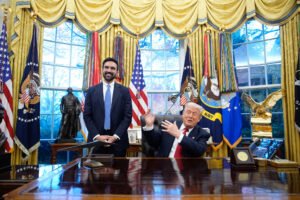
- Collins slams Trump plan to ‘politicize’ grants as defying Congress
- Big Ag and Big Oil go head-to-head over diesel export ban
- Hinson calls for end to Iran war amid soaring diesel costs
- Senior GOP appropriator pours cold water on funding Trump’s arch
- Pritzker says he’s lost 80 pounds on GLP-1 since diabetes diagnosis
-

 Politics2 years ago
Former ‘Squad’ members launching ‘Bowman and Bush’ YouTube show
-
Uncategorized2 years ago
Bob Good to step down as Freedom Caucus chair this week
-

 The Josh Fourrier Show2 years ago
DOOMSDAY: Trump won, now what?
-

 Politics2 years ago
Former Kentucky AG Daniel Cameron launches Senate bid
-

 The Dictatorship2 years ago
Luigi Mangione acknowledges public support in first official statement since arrest
-

 The Dictatorship2 years ago
Pete Hegseth’s tenure at the Pentagon goes from bad to worse
-

 Politics2 years ago
Blue Light News’s Editorial Director Ryan Hutchins speaks at Blue Light News’s 2025 Governors Summit
-

 The Dictatorship1 year ago
Mike Johnson sums up the GOP’s arrogant position on military occupation with two words