
Congress
GOP leaders eye a spending punt into 2026

Republican congressional leaders are making plans for a new spending punt as the shutdown drags on, and any new version is likely to postpone the next deadline until 2026.
House and Senate GOP leaders are debating a wide range of options for a new continuing resolution to fund the government, given that their current preferred vehicle funds the government only through Nov. 21. The most likely option would run into mid to late January, according to three people granted anonymity to describe the private conversations.
House Majority Leader Steve Scalise confirmed Wednesday that a longer stopgap is under consideration, but he insisted it wouldn’t jam lawmakers up against a holiday deadline. His comments come after GOP hard-liners warned privately that they will not accept a December deadline, preferring April or later.
“Democrats love the Christmas Eve, you know, omnibus bad deal. We’re not going to do that,” Scalise told reporters Wednesday.
President Donald Trump will have to muscle any reworked CR through Congress, and his sign-off will be key. While hard-liners want a longer horizon, appropriators who are trying to craft new full-year spending bills want a shorter deadline. Speaker Mike Johnson has criticized stopgap bills in the past, at one point saying he was presiding over his last CR, only to pass several more since.
Rep. Beth Van Duyne (R-Texas), who was critical of leadership messaging on the shutdown on a Tuesday GOP conference call, said in an interview Wednesday she is wary of voting for any additional continuing resolutions.
“As far as the CR, I was reticent to vote for it to begin with, because I don’t like the spending limits that have been set up by Democrats — I have voted against those spending limits,” Van Duyne said. “So I don’t think that the Democrats, who are voting against this, understand the gift that they were handed.”
Asked about a revised bill with a longer deadline, she said, “I can’t tell you how I’m going to vote on legislation I haven’t seen.”
House Ways and Means Chair Jason Smith (R-Mo.) in a Bloomberg interview Wednesday floated a stopgap into December 2026, an unusually long measure that would extend past the start of the next fiscal year — and the midterm elections.
GOP appropriators are certain to balk at a punt of that length and are floating their own, shorter timelines. Senate Appropriations Chair Susan Collins (R-Maine) said in an interview earlier this week she would be wary of going much past the end of this year.


A Senate Republican from Utah is asking the Senate Judiciary Committee to subpoena Donald Trump Jr. following reports that the president’s son had parts of his wedding paid for by a Russian oligarch with ties to Russian President Vladimir Putin.
Sen. John Curtis’ request, which comes following a news story by ProPublica, marks a significant break with President Donald Trump from a member of his own party.
“Questions have arisen about the relationships of President Trump’s eldest son, Donald Trump Jr., with foreign business figures and the acceptance of significant gifts. These include a lavish wedding afterparty, on a private island, provided by Russian oligarch Umar Kremlev, who reportedly traveled to China as part of a delegation accompanying Vladimir Putin shortly before giving the gift,” Curtis wrote in a letter dated Sept. 21 to Senate Judiciary Chair Chuck Grassley (R-Iowa) and the panel’s top Democrat, Sen. Dick Durbin of Illinois.
“These concerns are compounded by Donald Trump Jr.’s active promotion of family-backed cryptocurrency ventures, his continued pursuit of international real estate deals involving direct meetings with foreign heads of state, and his reported investments in defense contracting,” Curtis added.
Curtis, also noting the profits the Trump family has made through cryptocurrency deals, indicated this incident is part of a broader pattern where the relatives of U.S. presidents can improperly leverage their proximity to power.
In addition to probing Trump Jr., Curtis asked the Senate Judiciary Committee to subpoena President Joe Biden’s son, Hunter Biden, who over the years found himself enveloped in numerous self-dealing scandals. Both men, he said, should testify “regarding their past business dealings, relationships with foreign individuals and entities, gifts, or other benefits they have received, and any instances in which their relationship to the President was invoked or understood to provide value.”
“The country should not have to accept one standard for the family of a Republican president and another for the family of a Democratic president. Nor should congressional oversight begin and end when control of the White House changes hands,” Curtis said.
The White House did not immediately return a request for comment Wednesday, but it’s unlikely that Trump, who demands loyalty from the GOP, will consider the bipartisan nature of Curtis’ request to be anything other than a personal affront.
Trump said in a statement he has “no idea who Umar is” and that he has “never heard of him, and he didn’t pay for Don and Bettina’s wedding, which took place at a totally different location, and on a different day from the wedding.”
Kremlev is president of the International Boxing Association and received an Order of Friendship medal from Putin for his “contribution to international sport and his commitment to the global boxing family.” He’s also been sanctioned by the Ukrainian government for his ties to Putin.
A spokesperson for Judiciary Committee Republicans confirmed Grassley was in receipt of the letter but could not commit to investigating the matter. The spokesperson noted that hearing dates are extremely limited through the end of 2026 and investigative hearings usually take months of background work before they can be scheduled.
It’s sure to be an issue Democrats pursue if they win the majority in either chamber next year. Rep. Robert Garcia (D-Calif.), the ranking member of the House Oversight and Government Reform Committee, wrote to the White House and Donald Trump Jr. last week demanding information about the president’s son’s ties to Kremlev.
Cheyanne M. Daniels contributed to this report.
Senators dreaming of the smell of jet fumes might get their wish.
The chamber, initially scheduled to be in session until the beginning of October, is instead eyeing departure by the end of the week. To get there, though, Republicans will need to strike a time agreement with Democrats to fast-track the remainder of their work.
And while GOP members are antsy to spend more time in their states campaigning ahead of the midterms, some in their ranks are also uncomfortable that their final agenda items aren’t doing more to address issues voters increasingly care about — like the cost of living, data centers or AI safety.
For now, senators’ agenda includes: a sweeping college athletics bill, an Iran war powers resolution, a handful of nominees — including for labor secretary — and potential votes to roll back California’s stricter standards for vehicle emissions.
So far Democrats haven’t tipped their hand on whether they will agree to speed up consideration of the college sports legislation. Without a deal, the bill will drag into at least Friday evening, but Democrats first want details about the entire pre-recess agenda, according to two people granted anonymity to disclose private deliberations.
Whether the Senate will get around to doing something — anything — to address public alarm about the growing capabilities of artificial intelligence or pass permitting reform legislation remains to be seen.
Discussions are ongoing about whether the chamber will take a vote on Sen. Jon Husted’s so-called Ratepayer Protection Act, which aims to curb the energy costs associated with data centers.
Negotiators dragged past what was viewed as an unofficial deadline (over the weekend) to reach a deal to streamline energy permitting before the midterms.
Also to potentially get the boot if senators leave this week: a planned Senate Judiciary hearing next week with former special counsel Jack Smith.
Chair Chuck Grassley, asked last week, said “we gotta go ahead with that” hearing but added that he hasn’t grappled with an early dismissal: “Gosh, I haven’t thought about that.”
An aide of his chimed in saying the committee is “working on options” but that “it’s hard with the uncertainty” of the schedule.
What else we’re watching:
— SOARING DIESEL COSTS EXPOSE GOP SPLITS: Several farm state Republicans this week have all but begged President Donald Trump to do something to lower record-high diesel prices fueled by the Iran war, even if it means crossing their traditional allies in the oil and gas sector. The cacophony of outcry puts pressure on GOP leaders and exposes divisions among Republicans as members grapple with an unpopular war led by the president. Grassley posted over the weekend that high diesel prices are “KILLING FARMERS INCOME” and urged Trump to “put an embargo on diesel exports like presidents in the 70s put embargoes on ag products bc food prices were inflated.” Michigan’s GOP Senate candidate Mike Rogers on Monday also threw his support behind a “temporary embargo” on diesel exports and called for an end to the Iran war, as did Iowa Senate candidate Rep. Ashley Hinson in a Monday morning post. Reps. Zach Nunn and Mariannette Miller-Meeks also called for diesel price relief.
— JEFFRIES SNAPS BACK AT GOLDEN: Hakeem Jeffries slammed exiting Rep. Jared Golden’s endorsement of a battleground Republican Monday, showcasing a rare display of frustration by the minority leader against a member who’s bucked his party multiple times this month. Jeffries and Democratic leaders were already weighing potential punishment for Golden after he twice in recent weeks was a key vote unfreezing Republicans’ floor agendas. On Monday, Golden twisted the proverbial knife by endorsing Rep. Mike Lawler in a district Democrats are spending millions of dollars in in an effort to flip. “Mike Lawler is an unadulterated phony who has never shown bipartisan courage when it matters,” Jeffries wrote in a statement that didn’t mention Golden by name. “In desperation, he is peddling an 11th hour endorsement from a retiring Congressmember who represents an out of town district more than 400 miles away.”
Jordain Carney, James Bikales, Rachel Shin and Riley Rogerson contributed to this report.
The ranking Democrat on the House Oversight committee is demanding the White House answer questions related to President Donald Trump’s decision to ban BLN, MS NOW and Blue Light News from the White House, calling it the president’s “most blatant, assault on press freedom.”
In a letter sent Monday to White House Communications Director Steven Cheung, Rep. Robert Garcia (D-Calif.) requested that Cheung provide by Oct. 5 a detailed account of when and how he was informed of the ban, how he responded, who was consulted before the decision, the legal justification for it, the facts the White House relied on and whether the outlets had any opportunity to respond.
“The First Amendment guarantees freedom of the press, not freedom from criticism,” wrote Garcia. “The American people need to understand what consideration—if any—the White House gave to this serious and unprecedented decision to protect the President’s ego.”
Garcia also asked for all White House staff documents and communications about the ban and for any other relevant materials to be preserved.
The White House did not immediately respond to a request for comment.
Trump on Friday announced that he was seeking to block journalists from Blue Light News, MS NOW and BLN from the White House, complaining about “constant ‘reporting’” of what he called “FICTION and LIES.” The Trump administration first denied the media outlets entry into the White House grounds on Saturday morning.
The three news organizations are now jointly suing Trump, Cheung and two other top advisers in a bid to immediately restore access for their reporters, calling the ban a “direct assault on the First Amendment.”
Daniel Lippman contributed to this report.
- GOP Senator wants to subpoena Donald Trump Jr. over Russian-funded wedding
- Capitol agenda: Senate GOP eyes exit plan as trail calls
- ‘We need to stop the contagion’: GOP ramps up midterms defense in Trump states
- Abbott slaps halt on Texas data center permits
- Top House Oversight Dem demands answers to Trump’s media ban
- Mike Rogers says Iran war needs to “end quickly” amid rising prices
- The art of dealing with Trump
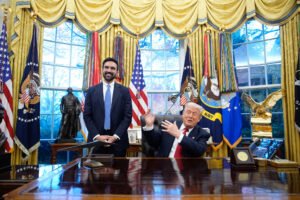
- Collins slams Trump plan to ‘politicize’ grants as defying Congress
- Big Ag and Big Oil go head-to-head over diesel export ban
- Hinson calls for end to Iran war amid soaring diesel costs
-

 Politics2 years ago
Former ‘Squad’ members launching ‘Bowman and Bush’ YouTube show
-
Uncategorized2 years ago
Bob Good to step down as Freedom Caucus chair this week
-

 The Josh Fourrier Show2 years ago
DOOMSDAY: Trump won, now what?
-

 Politics2 years ago
Former Kentucky AG Daniel Cameron launches Senate bid
-

 The Dictatorship2 years ago
Luigi Mangione acknowledges public support in first official statement since arrest
-

 The Dictatorship2 years ago
Pete Hegseth’s tenure at the Pentagon goes from bad to worse
-

 Politics2 years ago
Blue Light News’s Editorial Director Ryan Hutchins speaks at Blue Light News’s 2025 Governors Summit
-

 The Dictatorship1 year ago
Mike Johnson sums up the GOP’s arrogant position on military occupation with two words