
Congress
How Trump is protecting his priorities from a government shutdown

As Washington enters a government shutdown, the Trump administration has erected safeguards to ensure President Donald Trump’s most hardline priorities continue unscathed.
Agencies central to Trump’s agenda are shielding certain programs by declaring the federal employees who work on them essential or sheltering them under already approved funding streams — designations that will allow them to keep running through the funding lapse.
That means offices tasked with immigration enforcement and tariff negotiations, two hallmarks of Trump’s presidency, will retain significantly more staff than they have in prior shutdowns, according to a Blue Light News analysis of agency documents submitted to the White House in recent days and interviews with current and former administration officials. That’s even as hundreds of thousands of federal workers are sent home, hampering a variety of government functions including some routine food safety inspections, Social Security benefit verifications and the publication of employment numbers by the Bureau of Labor Statistics.
The split underscores how Trump hopes to punish Democrats by pinning the fallout on them while ensuring his own priorities continue unimpeded. It’s also the latest example of how his administration uses the levers of federal power in unprecedented ways to enact the president’s expansive policy agenda.
“Remember Rahm Emanuel’s great quote: ‘You should never waste a crisis,’” said former House Speaker Newt Gingrich. “Rahm Emanuel should be proud of the Trump team because they’re prepared to say, ‘Every day this is shut, we will find ways to pay for everything we want. We’ll find ways to eliminate everything you want. And we’ll do it legally.’”
Some of Trump’s pet projects, like NASA’s Artemis moonshot program, will continue during the shutdown. So will some major GOP policy priorities, such as processing Interior Department applications for permits to drill or conduct fossil fuel projects.
One first-term Trump official, granted anonymity to speak candidly, said the administration will be “strategic” in its approach on what to fund.
“If something is going to put a kink in Trump’s agenda even for a couple of days, they will find a creative way to make that work,” the official said.
Trump and his budget director, Russ Vought, have made preparations to use the shutdown to conduct yet another mass culling of the federal workforce. Democratic leaders, meanwhile, tried to use the shutdown threat to force talks on extending soon-to-expire health insurance subsidies.
“The last person that wants to shut down is us,” Trump told reporters in the Oval Office on Tuesday. “Now, with that being said, we can do things during the shutdown that are irreversible — that are bad for them and irreversible by them. Like cutting vast numbers of people out. Cutting things that they like, cutting programs that they like.”
While the party controlling Washington typically suffers politically during a shutdown, polling shows significant peril for Democrats: A new New York Times-Siena College poll found that 65 percent of respondents, including 43 percent of Democrats, think Democrats shouldn’t allow a government shutdown, even if their demands aren’t met.
White House aides are confident that their preparations will help them weather the shutdown storm while Democrats bear the brunt of the fallout from angry federal workers and constituents.
“There are already approved appropriations, some part of the One Big Beautiful Bill, that will not lapse as part of a government shutdown the way that other funding will. It’s less so that the administration is trying to somehow manipulate this,” said a White House official granted anonymity to speak candidly about the administration’s strategy. “We want everything to continue, but ultimately when there is a shutdown, some funding will lapse. And there is nothing we can do about that. That is 100 percent on the Democrats.”
All core immigration enforcement operations — from Border Patrol to Immigration and Customs Enforcement — will continue without interruption, according to two administration officials granted anonymity to discuss agency planning. Law enforcement personnel in past shutdowns have been considered essential, but ICE, for example, is further buffered by mandatory funding included in the One Big Beautiful Bill.
New agents hired under Republicans’ tax and domestic policy law will continue to be paid. But the agency is also working to ensure other law enforcement officials — who would otherwise not be paid until Congress passes a new funding bill — can get paid via OBBB funding, one of the officials said. The agency is also prepared to furlough less staff than in years past to ensure the administration’s work to implement the bill isn’t delayed.
“ICE will be fine during a shutdown,” said one of the administration officials. “Most of what ICE does will continue.”
The Department of Homeland Security’s 2025 shutdown plan calls for a higher percentage of its total employees to be retained during a shutdown than its 2023 plan — 95 percent now compared to 88 percent two years ago. DHS in its 2025 plan also expanded the number of employees it can retain by law during a shutdown by roughly 2,300.
Trump’s signature tariff agenda also stands to continue uninterrupted as his administration pushes forward high-stakes trade talks with China and India and hashes out a host of other deals, like those with Japan and South Korea. Both the Commerce Department and the U.S. Trade Representative’s Office make clear in their shutdown plans that they will continue advancing the president’s trade agenda, a departure from previous years when trade was largely deemed a non-essential function that could be put on the backburner during a shutdown.
Commerce, for instance, is allowing import licensing for steel and aluminium products, investigations around sector-based tariffs and export control activities to continue without exception, none of which were explicitly protected activities in its 2023 shutdown plan.
USTR, meanwhile, plans to continue administering tariff programs established under the International Emergency Economic Powers Act, according to a draft plan posted and removed from its website in recent days. While those tariffs are being challenged in court, the Trump administration has declared trade deficits with other countries a threat to national security, a rationale USTR is also using in its decision to continue trade talks.
USTR is also retaining 60 percent of its workforce during a shutdown, compared to just 40 percent in its 2024 plan. Last year, the agency said that only four full-time employees were required to carry out necessary duties during a shutdown compared to 118 employees that received such a designation this year, nearly half of USTR’s staff.
While Trump has indicated that his administration intends to inflict pain on Democrats, there are limits to how much it can do without hurting GOP voters.
“To hit blue states specifically, you’d want to target the federal bureaucracy — which is primarily represented by Dems. That’s what I think the mass firings are all about — max pain on Dems,” the first-term Trump official said. “Otherwise, I don’t see a lot that can be done to Dems that wouldn’t hurt [Republican] states.”
And despite instructions from Vought, the White House budget director, that agencies prepare reduction-in-force plans for a shutdown, most plans continue to detail only the number of workers it plans to furlough, not specifics for permanent firings.
While the administration worked to safeguard its favored programs, plenty of other functions across the government are frozen.The Bureau of Labor Statistics, for example, is suspending all operations — including the release of the monthly jobs report that often serves as a key indicator of the economy’s health. While such a provision has been included in previous shutdown plans, it is noteworthy in the current climate after Trump fired BLS Commissioner Erika McEntarfer following a disappointing jobs report — and as economic anxiety remains high.
The Food and Drug Administration’s Animal Drugs and Foods Program is halting pre-market safety reviews of novel animal food ingredients for livestock, and “thus be unable to ensure that the meat, milk, and eggs of livestock are safe for people to eat.”


Rep. Alexandria Ocasio-Cortez (D-N.Y.) and Sens. Bernie Sanders (I-Vt.) and Jeff Merkley (D-Ore.) on Friday released text of legislation intended to ban the use of Flock surveillance cameras and other license plate readers.
Flock has faced severe public backlash against the surveillance technology following reports that police officers misused the technology to track women, and it has the largest network of license plate readers across the U.S. Sens. Josh Hawley (R-Mo.) and Dick Durbin (D-Ill.) hosted a hearing last month probing its potential misuses, although the company’s CEO Garrett Langley did not appear.
The latest bill, unveiled Friday and named the Ban Flock Act, would bar federal agencies from using automated license plate readers or accessing data from the technology and prevent federal grants from funding states and local governments that use automated license plate readers.
“At a time of growing concern about the unchecked power of artificial intelligence, Flock is eviscerating the very notion of privacy by installing tens of thousands of cameras in communities across America without their consent,” Sanders, who has positioned himself as a leading progressive voice on AI technology, said in a statement. “We cannot allow America to become a surveillance state where a handful of AI oligarchs profit by giving the government the power to track our every movement.”
Ocasio-Cortez similarly condemned the surveillance capabilities of the technology and said the bill would “enforce our constitutional right to privacy and protect Americans from both corporate and government surveillance.”
“No one should have this unchecked surveillance power at their fingertips,” Merkley added.
Republicans have introduced similar efforts to regulate license plate readers, such as Hawley’s Stop Flock Abuse Act, which would require audits and limits on unauthorized searches.
Flock did not immediately respond to a request for comment.
Democrats watching Speaker Mike Johnson deal with a chaotically slim majority have seen enough — and they’re trying to avoid the same fate.
The party is investing in deep-red districts that could pad a future majority and strengthen the hand of Hakeem Jeffries, who’s widely favored as speaker if Democrats win the chamber in November.
“Another five-or-so-seat buffer would be a game-changer,” said one senior House Democrat, who like others in this report was granted anonymity to discuss internal party dynamics. That lawmaker added it would help Jeffries “rise above some of the incoming bullshit he’s going to have to deal with.”
Every extra seat would help Jeffries secure the speaker’s gavel without having to make concessions to the two clashing blocs within his party: progressives and moderates.
Recent spending reflects these ambitions. Since the start of August, Democratic-aligned groups and candidates have spent or committed more than $73 million in ad dollars to GOP-held districts that President Donald Trump won by at least 10 points in 2024, according to a Blue Light News review of data from AdImpact. The NewDem Action Fund, the political arm of the centrist New Democrat Coalition, is spending in some even redder districts.
“Every single endorsed candidate supports Hakeem Jeffries for speaker of the House,” said the fund’s chair, Rep. Greg Stanton. “We will be a strong governing partner with Hakeem Jeffries to make sure that his speakership is as successful as possible.”
Tight majorities are misery-makers for speakers. Before Johnson, former Speaker Kevin McCarthy gave numerous concessions to his party’s right flank to assume the role — only to later be ousted by those same lawmakers. And former Speaker Nancy Pelosi had to cut a deal with moderates to secure her post in 2018 by promising to limit her leadership term.
Even with the gavel secured, a speaker has more flexibility to manage the floor if he or she can let some party colleagues peel off on tough votes.
Progressive challengers ousted a handful of Democratic incumbents in primaries this year, and they could adopt tactics from the ultraconservative House Freedom Caucus if Democrats win just a narrow majority.
Meanwhile, newly elected moderates, particularly from rural districts that swung heavily for Trump in 2024, could end up as a bigger problem for Jeffries — as they were for Pelosi when she was speaker.
What else we’re watching:
— HAWLEY’S POPULIST AI REBELLION: Sen. Josh Hawley’s push against artificial intelligence is placing an unmistakable marker for anti-tech rhetoric in the 2028 campaign among ambitious Republicans. Hawley’s call for AI safety legislation this week — including imposing corporate liability when AI causes harm — contrasts with Trump’s favoring of voluntary standards and exposes the growing rift between Republicans on how to respond to the technology. But Hawley’s influence is poised to expand as more Republicans start to echo his tone.
— GOP ADS SPUR CORPORATE HEARTBURN: A series of TV campaign ads this midterms season has highlighted a growing reality: On the right it’s become increasingly in vogue to bash big business. The ascendancy of Trump has ushered in a new era of skepticism toward multinational corporations in a party traditionally known as corporation-friendly. That puts big financial services firms, health insurance companies and tech titans — the subjects of the hottest rhetoric — at risk for becoming high-profile political punching bags for Republican 2028 presidential hopefuls.
Andrew Howard, Meredith Lee Hill, Riley Rogerson, Jessica Piper, John Hendel, Jasper Goodman and Victoria Guida contributed to this report.
As Democrats scramble to create a viable plan to regulate artificial intelligence, one little-known lawmaker is playing a major behind-the-scenes role in shaping her party’s approach to the technology.
Rep. Valerie Foushee, a North Carolina Democrat in her second term, is one of three co-chairs of a commission tasked by Minority Leader Hakeem Jeffries to generate AI policy recommendations.
It’s a position that has given her significant power to mold Democrats’ thinking on the rapidly evolving issue, even as her fellow commission members cut more public personas through regular appearances at news conferences and in media hits: Rep. Ted Lieu of California is vice-chair of the House Democratic Caucus, while Rep. Josh Gottheimer of New Jersey has built a reputation as a self-styled moderate dealmaker.
In an interview earlier this week, Foushee said the commission has submitted a “first draft” of its much-anticipated recommendations to Jeffries. And while Jeffries will ultimately provide feedback to inform the final report, she said she would push for there to “always be a human element” in any AI regulatory framework, with civil rights and liberties at the center.
“We have seen evidence of how technology can be used for discrimination,” said Foushee. “We’ve seen how some groups have been excluded.”
A member of the Congressional Black Caucus who also associates with both the Congressional Progressive Caucus and centrist New Democrat Coalition, Foushee is representative of a broad, mainstream swath of House Democrats that has yet to stake a clear position on AI. And her vision for an AI regulatory model that keeps humans in control and builds in civil rights protections could provide a blueprint for her party.
She doesn’t want to stifle innovation, she explained; rather, “my focus is to make sure that we’re not leaving anybody behind.”
Foushee said she didn’t set out to lead on AI policy, but joined a bipartisan AI task force in the previous Congress given her seat on the House Science, Space and Technology Committee.
Since the task force released its recommendations in December 2024, House Republican leaders considered its mission complete, according to a senior GOP leadership aide granted anonymity to describe internal conversations. So when Speaker Mike Johnson opted not to reconstitute the panel in January 2025, Jeffries created his Democrat-only commission to fill that void, tapping Foushee as one of its commissioners.
“I was glad to be one of those that the leader thought might be helpful in leading us into the future,” she said. “So I don’t know if I would say that I was, you know, moved to do it, but certainly happy to do my part.”
Lieu, in a statement, called Foushee “unwavering in her commitment to ensuring AI systems don’t harm civil rights and equal opportunity.”
“I visited Val’s district earlier this year,” he continued, “and saw firsthand how effectively she works with local stakeholders to address the threats and unlock the possibilities of AI in her community.”
Foushee represents parts of the so-called Research Triangle encompassing Durham and Chapel Hill — the homes of Duke University and the University of North Carolina, where AI technologies are being studied. Her state is also a major hub for data centers powering the AI boom.
In her work with Lieu and Gottheimer, Foushee said “we’re all involved in everything” and that “you might say we’ve grown on each other.” Her main area of interest, though, has been to elevate civil rights and liberties protections.
She has introduced multiple bills to that end. One piece of legislation would require people to be told about when they are engaging with a chatbot instead of a human. Another would seek to expand participation in the AI research, education and workforce development among Historically Black Colleges and Universities and other minority-serving institutions.
Foushee’s work on the commission is also being informed by her regular engagement with each of the major AI labs. In her eyes, Anthropic has been the most receptive to regulatory measures while others have favored more “pro-innovation” policies.
She was adamant, however, that Anthropic was in no way influencing the AI policies she could soon be shopping to colleagues — even though a political action committee funded by Anthropic executives spent a little over a million dollars to support her in a competitive primary earlier this year.
“Let me just say to you that no one should be worried or concerned,” Foushee said. “My work on AI has always been focused on establishing guardrails and holding corporations accountable. There is nothing that you will see in any legislation that I have introduced, led, co-led, or co-sponsored that has not been towards holding corporations accountable and protecting the American public.”
In any event, Foushee said she has had no direct outreach from Anthropic’s CEO, Dario Amodei, since he led calls last month for a slowdown of advanced AI development amid warnings it could soon pose an imminent threat to human civilization.
“When … you’re not allowing for the engagement of members of Congress, and not even an opportunity to provide input or to be engaged in the conversation, it makes me wonder what those efforts are about,” said Foushee.
A spokesperson for Anthropic did not return a request for comment, while Nate Evans, a spokesperson for OpenAI, said the company was “deeply engaged with Congress on federal policy to advance AI safety, through dozens of meetings in recent weeks with members of both parties in both chambers.”
Representatives from Anthropic and OpenAI also briefed members of the Science Committee in mid-September.
All three commission co-chairs have been tight-lipped about what their AI recommendations could entail — especially as lawmakers in both parties are beginning to sense real urgency to rein in the technology and are desperate for legislative solutions.
It also remains to be seen whether the forthcoming agenda will unify a party that has been largely aligned on the need for regulation but deeply split on the specifics.
Some progressives, led by Progressive Caucus Chair Greg Casar of Texas, support banning highly sophisticated AI systems and pausing AI development until a government-led vetting procedure can be implemented.
Rep. Lori Trahan (D-Mass.), meanwhile, has introduced what is currently one of the only comprehensive, bipartisan bills to regulate advanced AI models — but it stops significantly short of the pauses championed by progressives and opens a thorny debate about whether to preempt state AI laws with an overarching federal framework.
Foushee said she has not signed onto Casar’s proposal to ban superintelligence, explaining she has yet to review it. She did throw cold water on another progressive-led proposal to place a moratorium on data centers, saying it should be up to local jurisdictions whether to build the controversial, energy-sucking facilities.
She has not decided whether she will co-sponsor the bill Trahan painstakingly negotiated with California Republican Rep. Jay Obernolte. Members of both parties have been cautious to associate with the package given the hyper-partisan political environment, especially in the leadup to the midterms.
But Foushee said she supports holding a committee markup of the legislation, adding that when fellow Democrats ask her about the measure, she replies, “I’m not one to say that this member should or should not say or do this, that, or the other. I’m not hell bent on any one particular approach.”
Democrats “should continue to lead but it certainly does not mean to me that there should not be a bipartisan effort to put forward a framework,” said Foushee. “When indeed we are in the majority, then that is what we plan to do.”
- Top GOP groups scale back North Carolina spending
- October
- Sanders, AOC, Merkley propose bill to ban Flock cameras
- Capitol agenda: Dems spend big to help Hakeem’s dream
- The low-profile Democrat helping shape her party’s AI agenda
- ‘A game-changer’: House Dems aim for a big majority that could ease Hakeem Jeffries’ headaches

- Adam Hamilton on faith, Trump and the fight for Kansas

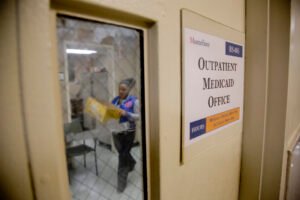
- New York grapples with kinks in $1B Medicaid system
- Top Democratic appropriator wants White House to pay for airing ‘propaganda’
- Barrage of lawsuits targets Trump’s funding cancellation
-

 Politics2 years ago
Former ‘Squad’ members launching ‘Bowman and Bush’ YouTube show
-
Uncategorized2 years ago
Bob Good to step down as Freedom Caucus chair this week
-

 The Josh Fourrier Show2 years ago
DOOMSDAY: Trump won, now what?
-

 Politics2 years ago
Former Kentucky AG Daniel Cameron launches Senate bid
-

 The Dictatorship2 years ago
Pete Hegseth’s tenure at the Pentagon goes from bad to worse
-

 The Dictatorship2 years ago
Luigi Mangione acknowledges public support in first official statement since arrest
-

 Politics2 years ago
Blue Light News’s Editorial Director Ryan Hutchins speaks at Blue Light News’s 2025 Governors Summit
-

 The Dictatorship1 year ago
Mike Johnson sums up the GOP’s arrogant position on military occupation with two words