
Politics
Why the co-chair of Trump’s transition team is raising eyebrows

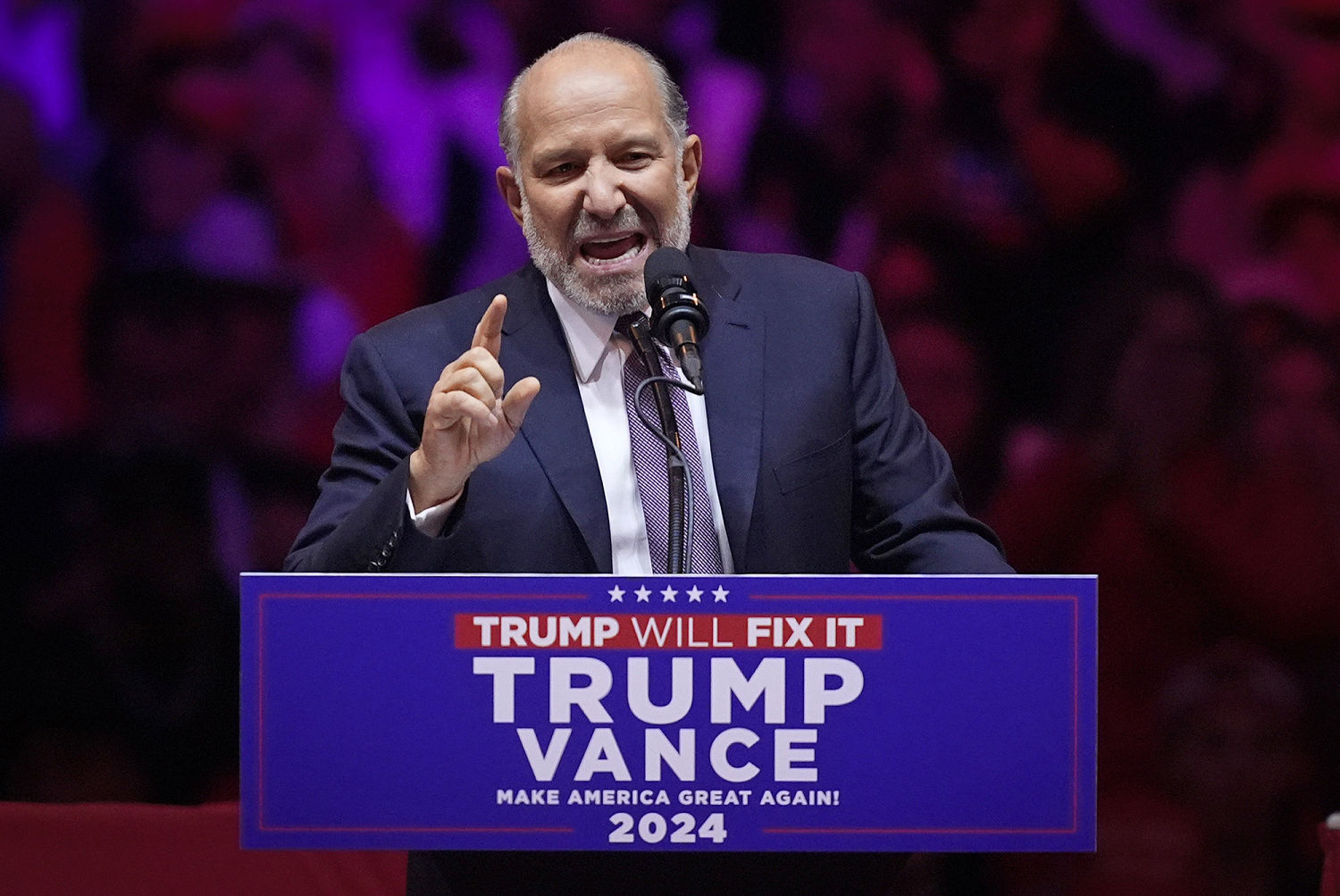

In mid-August, Donald Trump released the names of a five-member transition team, which would be responsible for helping make post-election plans in the event that he wins. The list generated headlines because of the former president’s willingness to keep matters within the family: Eric Trump and Donald Trump Jr. were part of the lineup, despite their lack of qualifications, which struck many observers as odd.
But the one person on the five-member transition team with the lowest public profile was Howard Lutnick, the CEO of a financial services firm called Cantor Fitzgerald. While the billionaire megadonor is certainly known on Wall Street, it’s likely that most Americans are not familiar with him or his message.
That might soon change.
Over the weekend, for example, Lutnick spoke to NBC News’ Vaughn Hillyard and suggested that some of Trump’s high-profile critics from his own former team — including retired Gens. John Kelly and James Mattis — might’ve committed “treason” during their tenure in the administration. Lutnick added that they were “Democrat [sic] generals.”
Soon after, the billionaire spoke at Trump’s hate-filled Madison Square Garden event, where he talked about eliminating all income taxes and touted Trump’s candidacy as necessary to “crush jihad.” (Presumably, the Republican campaign, already hoping Muslim voters will overlook Trump’s years of ugly Islamophobia and discrimination against Muslim Americans, didn’t welcome the rhetoric.)
Common sense might’ve suggested that the Trump campaign keep Lutnick away from microphones for a while, but with just days remaining before Election Day 2024, the co-chair of Trump’s transition team instead appeared on BLN — and the interview didn’t go especially well. Newsweek reported:
Donald Trump transition team co-chair Howard Lutnick questioned the safety of vaccines while speaking with BLN’s Kaitlan Collins on Wednesday night. ‘Vaccines are safe,’ Collins said, while talking about Robert F. Kennedy Jr.’s self-reported possibility of being ‘promised’ by the former president to head the Department of Health and Human Services and U.S. Department of Agriculture if Trump wins the 2024 election. ‘Why do you think vaccines are safe,’ Lutnick shot back, adding, ‘there’s no product liability anymore.’
As part of the same exchange, Lutnick added that he knows “so many more people” now that have autism, prompting the BLN host to emphasize the reality that “vaccines don’t cause autism.”
Wait, it gets worse.
Failed independent presidential candidate Robert F. Kennedy Jr. claimed this week that he received a promise from Trump about a role in his possible second term. As my BLN colleague Clarissa-Jan Lim noted, the fringe conspiracy theorist expects to have control of both the U.S. Agriculture Department and the Department of Health and Human Services and the agencies under its purview, which include the Centers for Disease Control and Prevention, the Food and Drug Administration and the National Institutes of Health.
Given Kennedy’s bizarre ideas and worldview, that’s a rather terrifying prospect — even Trump’s former surgeon general is concerned — though Lutnick defended the idea.
“[Kennedy] wants the data, so he can say, ‘These things are unsafe,’” the billionaire megadonor argued during his BLN appearance. “He says, ‘If you give me the data, all I want is the data, and I’ll take on the data and show that it’s not safe. And then if you pull the product liability, the companies will yank these vaccines right off, off of the market.’ So, that’s his point.”
That’s the plan? Trump will put an unqualified conspiracy theorist in a position of enormous power, and that — according to the handpicked co-chair of Trump’s transition team — might lead to vaccines being pulled from pharmacy shelves?
This is, as New York magazine’s Jon Chait noted, “a glimpse into a public-health nightmare.”
Every day, the stakes in the 2024 presidential race get higher.
Steve Benen is a producer for “The Rachel Maddow Show,” the editor of MaddowBlog and an BLN political contributor. He’s also the bestselling author of “Ministry of Truth: Democracy, Reality, and the Republicans’ War on the Recent Past.”



NEW YORK — A fear of losing again is already shaping how Democrats think about 2028.
Chants of “run again!” reverberated through the packed room as Kamala Harris spoke Friday at the National Action Network convention, a gathering of Black voters, lawmakers and power brokers that saw drop-ins from a steady stream of potential presidential candidates. But several Black attendees openly questioned whether anyone other than a straight, white man can win the White House.
“The Democratic Party, they’re going to have to consider … who can win? Who can win, Black, white, who can win?” the Rev. Kim Williams, 63, a New Yorker and registered independent said in an interview.
“I don’t think [the country is] ready for another different type of person,” said Annette Wilcox, a 69-year old New Yorker.
It’s an open question the party is grappling with in the wake of Harris’ decisive 2024 loss to President Donald Trump. Conversations with a dozen people on the sidelines of the Rev. Al Sharpton’s gathering found some lingering concerns that America remains too bigoted — and that as a result, the desire to diversify the highest reaches of government is in tension with the desire to win.
In interviews, several of the prospective 2028 Democrats themselves argued that anyone can win. They poured into the midtown Manhattan ballroom over the week to build their relationships with Black voters for what became a barely-hidden shadow primary.
Sen. Ruben Gallego, a first-term Democrat who won statewide in Arizona despite Harris losing the state, told Blue Light News on the sidelines of the convention that the party shouldn’t let fear narrow who ultimately runs.
“If you got stuck into this idea of what an ideal character is … you could potentially miss some really great talent,” said Gallego, who leaned intohis identity as a Latino veteran in his 2024 campaign.
Maryland Gov. Wes Moore, another possible 2028 candidate, said that he doesn’t “know many people back in 2022 who thought that an African American who had never held political office in his life was gonna be the next governor of Maryland.”
“People want to know, does your message meet a moment,” he added.
On stage with Sharpton on Friday, Harris seemed to agree. She made her most explicit overture at running again for the presidency, telling the audience she was “thinking about it” — to loud cheers and applause. Her appearance at the convention energized an otherwise largely staid event.
But even Harris, the first Black and South Asian woman to become vice president, has tacitly acknowledged the limitations of the country.
In her latest book, she divulged that former Transportation Secretary Pete Buttigieg — another 2028 contender who also made a pit-stop at NAN — was her top vice presidential pick in 2024. But she didn’t select him because she didn’t believe the country was ready for both a woman of color and a gay man in the White House.
A spokesperson for Harris declined to comment.
Some women, from former first lady Michelle Obama to various convention attendees disappointed by Harris’ 2024 loss, have said the U.S. isn’t ready for a female president.
“I believe the current climate of this country is not ready for a Black woman as president,” Aaliyah Payton, 30, a middle school teacher in the Bronx, said while waiting to see Harris speak on the third day of the convention in a line that spanned far outside the convention room.
“If Kamala Harris is running as a Democrat, and there is another white man also running as a Democrat, she would have a tough time winning,” said 60-year-old Donna Carr, who lives in New Jersey. “It’s a man’s world.”
“I’m not going to lie, it may be too soon,” said 27-year-old New Yorker Justina Peña when asked if Harris should run again.
The same handwringing roiled the 2020 Democratic presidential primary, and voters ultimately selected Joe Biden — a more moderate straight white man — to block Trump from winning a second consecutive term.
The debate within the Democratic Party over what kind of candidate is electable played out again most recently in Texas, where the Democratic Senate primary was defined by tensions over race and concerns over which candidate could unify enough Democrats, independents and disillusioned Republicans to flip the red state. Voters chose seminarian James Talarico, a white man, over political firebrand Jasmine Crockett, a Black woman, in the end.
“We saw it with the race with Crockett, and I saw a woman say she wanted to vote for Crockett, but she knew she could not win against [a] white male Republican,” said Williams, the 63-year-old reverend.
Now, those conversations are already emerging for 2028 before a single Democrat has officially announced a bid for the White House. The question over 2028 ambitions hovered over Moore, Gallego, Harris, Buttigieg, Illinois Gov. JB Pritzker, Pennsylvania Gov. Josh Shapiro and California Rep. Ro Khanna this week — and while nobody said they officially are, nobody ruled it out. Kentucky Gov. Andy Beshear and Arizona Sen. Mark Kelly are slated to speak on Saturday.
Buttigieg has dismissed concerns over his viability, including in a direct response to Harris’ revelation of why she didn’t choose him as a running mate in 2024.
“My experience in politics has been that the way that you earn trust with voters is based mostly on what they think you’re going to do for their lives, not on categories,” Buttigieg told POLITICO in a September interview.“Politics is about the results we can get for people and not about these other things.”
Some of the Black voters at the conference similarly expressed frustration with the idea that candidates’ identities should be a consideration in the looming 2028 primary.
“My concern — biggest concern — is when we get into a crisis like this in this country, people want to go to the ‘center,’ which usually is right of center in my view. A lot of people get kind of left out,” said Wilcox, the 69-year-old New York voter.
“In my experience, or history I’ve had with the Democratic Party, I feel like when that happens, Black people get tossed to the side.”
The former speaker said the sexual assault allegations “must be appropriately investigated with full transparency and accountability.”…
Read More
His support for a narrow budget reconciliation measure is a boost for Senate GOP leaders who want a tightly controlled process…
Read More
- Trump administration admits error in New York health care fraud probe

- Trump’s budget hawk is still trying to slash medical research. Congress is saying no.
- RFK Jr. has turned corporate America’s name to mud, Blue Light News Poll finds
- 2028 Democrats say anyone can win. Voters aren’t so sure.
- Jeffries, Pelosi and other Democrats call on Eric Swalwell to end governor campaign
- Trump endorses ‘focused’ immigration enforcement funding bill

- These Republican-on-Republican disputes are keeping Congress frozen
- Trump’s proposed cuts to NASA are an insult to astronauts like the Artemis crew
- Artemis II mission splashes down, returning to Earth

- Former staffer accuses Rep. Eric Swalwell of sexual assault, reports say

-

 Politics1 year ago
Former ‘Squad’ members launching ‘Bowman and Bush’ YouTube show
-

 The Dictatorship1 year ago
Luigi Mangione acknowledges public support in first official statement since arrest
-

 Politics1 year ago
Former Kentucky AG Daniel Cameron launches Senate bid
-

 The Dictatorship1 year ago
Pete Hegseth’s tenure at the Pentagon goes from bad to worse
-

 The Dictatorship7 months ago
Mike Johnson sums up the GOP’s arrogant position on military occupation with two words
-

 Politics1 year ago
Blue Light News’s Editorial Director Ryan Hutchins speaks at Blue Light News’s 2025 Governors Summit
-
Uncategorized1 year ago
Bob Good to step down as Freedom Caucus chair this week
-

 Politics12 months ago
Democrat challenging Joni Ernst: I want to ‘tear down’ party, ‘build it back up’