
Politics
Voter registration is way too complicated. But there’s a very simple solution.

While looking for a late-night coffee, my wife and I recently found ourselves at a hip new D.C. restaurant. Even though it was late on a Monday night, the host informed us that to get a table we would need to have made a reservation a week earlier at precisely 10:30 a.m. Fortunately, we were able to snag a seat that opened up at the bar, and our date night continued without further complications.
Now, I’m not complaining. It’s a tiny bistro from an award-winning chef in one of the city’s hottest neighborhoods. Of course I’m going to have to do a little advance work to get in, and if I don’t, well, there are a lot of other places in the city to get a cup of coffee.
But as a country, we’ve been applying this same model to voting, and it’s a disaster. If you want to cast a ballot in November in Arizona — to name just one crucial swing state — you need to have registered to vote by Oct. 7. If you didn’t, you’ll have to wait until the next election. (Rules vary, so you may still be able to vote in other states, and you can always request a provisional ballot.)
We have come to accept this sorry state of affairs, but it doesn’t make any sense. You can be a U.S. citizen, at least 18 years of age, with no criminal record, and in many states you won’t be allowed to cast a ballot on Election Day because you didn’t file some paperwork anywhere from eight days to a month earlier.
You didn’t even need to register to vote for the first hundred years of the nation’s history.
But this isn’t a restaurant reservation; it’s your right. The Constitution doesn’t say anything about registering to vote ahead of time. As a matter of fact, you didn’t even need to register to vote for the first hundred years of the nation’s history; you just showed up at the polling place. Even today, you don’t need to register if you live in North Dakota, the only state that still doesn’t have a voter registration law.
So why do we do it? Voter registration got its start in the late 19th century in the Northeast, as cities became too large for poll workers to either recognize voters by face or handle the crush of people showing up on Election Day. But make no mistake, such laws were designed from the very start to suppress the vote, especially votes from the immigrants arriving on American shores at the time.
Consider just a few examples from Alexander Keyssar’s comprehensive history “The Right to Vote.” An 1866 law in New Jersey required all voters to register on the preceding Thursday — a day that blue-collar immigrant workers would be unable to take off. An 1885 law in Chicago required voters to register on one of two Tuesdays just before the election. And a 1908 law clearly targeting Jewish immigrants in New York City required would-be voters to register either on a Saturday or on Yom Kippur. Many of these laws did not apply to rural voters who were less likely to be recent immigrants.
In the South, strict voter registration laws became part and parcel of a massive effort to disenfranchise Black voters in the post-Reconstruction era that included poll taxes and literacy tests.
These efforts continue today. In Georgia, a new law that Republican activists are exploiting allows people to challenge the voter registrations of people they think might be ineligible. Since the law partially took effect in July, activists have challenged more than 63,000 voter registrations, mostly in majority-Democratic counties around Atlanta, according to a survey by The Associated Press.
For now, county officials are rejecting the vast majority of the challenges, but activists are pushing for them to throw out more registrations.
Advocates for these kinds of purges argue that they are needed to “clean up” the voter rolls of people who have moved away. But there are already processes in place to remove voters who have subsequently registered in other counties, and some states even compare records to help minimize duplicate registrations. Even if a voter remains on the rolls mistakenly, that’s only a problem if they cast a ballot, and there’s no evidence that’s happening in any kind of widespread way.
I understand the concern. But if you want to remove the people from the voter rolls who shouldn’t be there without removing people who should be there, then there’s a better way.
It’s the ultimate fail-safe for voters who forgot to register before an arbitrary deadline.
It’s called same-day voter registration, and it’s already the law in 23 states plus Washington, D.C. Under these laws, people who show up to vote on Election Day but aren’t on the voter rolls can register to vote right then and there. It’s the ultimate fail-safe for voters who forgot to register before an arbitrary deadline or were mistakenly removed from the voter rolls by an overly aggressive purge.
You might think of it as the democratic equivalent of getting a seat at the bar instead of at a table. You’re still in the restaurant, and you can still get something to eat and a cup of coffee — even if you didn’t plan ahead of time.
If, as Republicans are fond of saying, they want to make it easy to vote and hard to cheat, supporting the expansion of same-day voter registration to all 50 states would make their arguments that aggressive voter roll purges are necessary a lot more convincing — and any purges a lot less damaging to legitimate voters.
Because you can always get a cup of coffee in another restaurant. But if you’re denied the right to vote on Election Day, there’s no second chance.
You can check your state’s voting laws online here.

Ryan Teague Beckwith is a newsletter editor for BLN. He has previously worked for such outlets as Time magazine, Bloomberg News and CQ Roll Call. He teaches journalism at Georgetown University’s School of Continuing Studies.


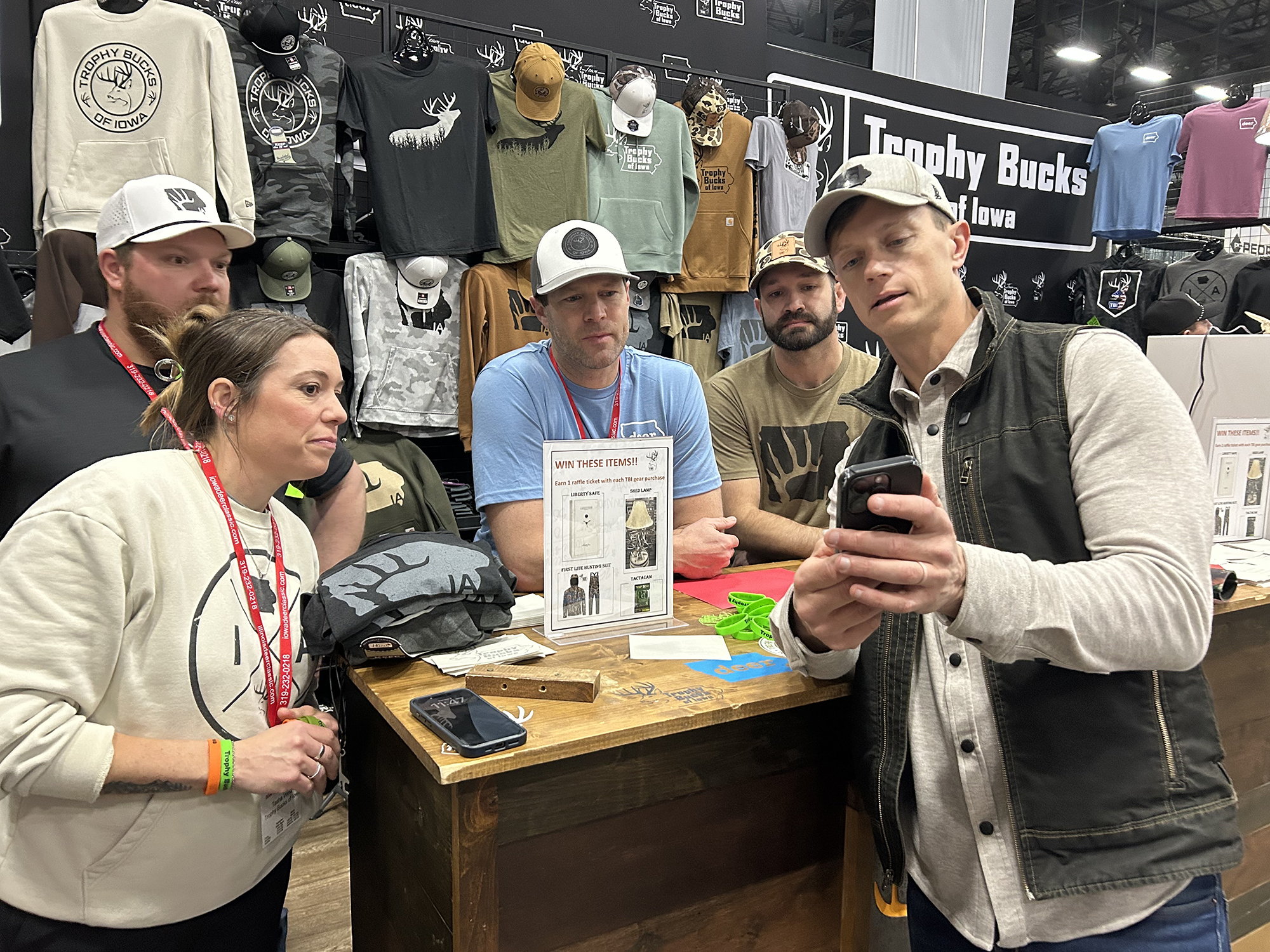
DES MOINES — Rob Sand got a hero’s welcome at a state deer hunting expo at the Iowa Events Center on a recent March weekend.
The state’s lone Democratic statewide elected official, and Democrats’ hope for flipping the governor’s mansion for the first time in 16 years, could barely make it through the Sunday morning sea of camo-wearing, venison jerky-chomping, Busch Light tallboy-nursing fellow hunters as more than a dozen people stopped and congratulated him.
But it wasn’t because of his politics. If anything, it was in spite of them.
“Rob, heckuva buck!” said one passerby.
Sand was at the annual Iowa Deer Classic to enter a Green gross-scoring 209-inch buck he’d tagged earlier this season. Photos of the deer have proliferated on Trophy Bucks of Iowa and other Facebook hunting groups across the state.
“Mr. 200!” said Levi Schmitz, a Trump-voting Republican who nonetheless plans to back Sand.
“You got me,” the 43-year-old state auditor responded with a grin.
As Democrats across the map continue to hunt for paths out of the metaphorical wilderness, Sand is betting that his own path to the governor’s mansion runs through his familiarity in the literal wilderness.
Sand represents the kind of candidate Democrats have long sought to win on tough red terrain: an inarguably of-the-place contender whose persona and bio can help sell political views that have become a tough pitch in places where many hear “Democrat” and picture coastal elites. Iowa, a swing state through 2012, moved hard right in the Trump years as Democrats increasingly struggled to connect.
Here, Republicans have taken advantage of the culture wars in a big way for years. Retiring Sen. Joni Ernst first won in 2014 by running hard on her pig-farming, military vet bio and painting her attorney opponent as an effete outsider.
Sand doesn’t run from some of his more liberal views. But like many other Democrats running this year, he’s banking that his local cultural cred will make him tougher for Republicans to caricature as a not-like-us coastal outsider.The day the expo kicked off, the avid bow hunter and fisherman’s campaign launched a “Hunting With Rob” microsite that extolls the rugged Iowa way of life. “For the first time in Iowa history, hunters, sportsmen, conservationists, and outdoor enthusiasts alike will finally have an ally in the governor’s office,” it reads.
In a state where the first day of deer season is an unofficial holiday, Sand’s strategy to center his culturally midwestern hobby rather than his Democratic brand was on full display. He dropped $30 on a glove for removing burrs, $35 on a tool that keeps hunting bows level and $69 on MAXX Step Aiders for climbing trees. And the branding appeared to be working.
“I’m super-Republican, but you got my vote,” said Tom Buckroyd, a hunter from a small community near Marshalltown wearing a “Crossbows Are Gay” T-shirt who spent roughly 20 minutes talking to Sand about hunting.
As he picked at a free sample of barbecue venison jerky on a toothpick, Sand said he wasn’t surprised by his warm reception.
“Number one, it just means I shot a huge buck this year,” he told Blue Light News. “But number two, I go back to culture. And we have this stupid, broken, two-choice political system. … And we are told stories about who can be right in either party. And when you find someone that’s in a party, but then also doesn’t fit that story, I think for a lot of people that is a sign of realness or a sign of authenticity about who they are.”
Since their bruising losses in 2024, Democrats have tried all manner of ways to rehabilitate their brand, from cursing more to growing beards to talking about sports. This cycle, they’ve redoubled their efforts to find authentically local candidates — and in some races, those candidates have emerged and caught lightning as they challenge status-quo Democratic candidates. Many are leaning hard into local culture signals.
Sand has hunting. Maine’s Senate candidate Graham Platner has his oystering and his Second Amendment creds. Texas’ Bobby Pulido has his guitar; James Talarico has the Good Book. Alaska’s Mary Peltola has fish. Democratic candidates who can win in tough places often get national buzz. And Sand happens to be from a state that — at least for now — still plays an outsized role in the presidential process. Could Sand be a surprise 2028 contender?
“If Rob wins, he will instantly be part of that conversation,” said Tommy Vietor, President Barack Obama’s former Iowa press secretary and a host of Pod Save America.
Sand is running as a hunting-loving, churchgoing, Casey’s gas station pizza-loving state auditor who has spent the past five years positioning himself as a fiscally responsible friend to the Iowa taxpayer.
There’s been little public polling of the race; the only public survey, released back in October, found Sand beating GOP Rep. Randy Feenstra by two points, 45 percent to 43 percent. But national operatives in both parties see it as one of a handful of governor’s races that could flip. Sand is unopposed in the state’s June 2 primary, though five Republicans will be on the ballot for their party’s nomination.
He entered the show room at the EMC Expo Center after attending a chapel service for expo-goers where he quietly scrolled a Contemporary English Version of the Bible on his phone, listening dutifully to the sermon about Jesus’ feeding of the 5,000. “What sort of kingdom work is He asking you to do?” the pastor asked
And what does Sand see as his kingdom work? “Talking about the evils of the two-choice system and trying to break down a system that inherently divides us and leads our leaders into the temptation of being lazy, and leads our leaders into the temptation of lying, bearing false witness against their opponents, because they know that they don’t actually have to solve our problems,” he said.
“In order to get reelected, all they got to do is convince us that they’re the lesser of two evils,” Sand continued. “And they win because we only have two realistic options on the ballot — and that entire system, to me, is just such a temptation to not serve people, to not do good, to actively lie, to spread false information.”
You’d be forgiven if you forgot Sand was running as a Democrat. That, of course, is part of the point of his campaign. Sometimes to salvage the Democratic brand in a red state you have to first savage it.

But Republicans will be sure to remind voters a few times between now and November.
“He hasn’t really had to take very many positions,” said David Kochel, a longtime Iowa Republican operative who has guided multiple presidential campaigns. ”He’s going to be forced at some point to either disavow the Democratic Party platform, which is going to piss off progressives, or he’s going to have to accept the label of being a Democrat in Iowa and defend it. And it’s gonna be hard for him to do.”
Republicans will paint some images of Sand of their own. As much as he would like to cut the figure of a rugged outdoorsman, they say, he also spent some time in college modeling in Milan and Paris — photos that may well pop up in GOP ads. “I mean, it was a part-time job I had in college,” Sand said. “Catching chickens was my first one.” Catching chickens? “Castrated male chickens,” he clarifies.
There is also the matter of his election financing: His wealthy in-laws have dumped $7 million into his campaign. “Hardworking Iowans know the value of a dollar, and don’t have the luxury of having a silver spoon feeding them their career,” Iowa Republican Chairman Jeff Kaufmann said in a statement.
Iowa Republicans are taking Sand’s candidacy seriously. In an interview, Bob Vander Plaats, the influential West Des Moines evangelical leader, called Sand “dangerous” and the “best candidate” Democrats could run.
“He’s trying to come off as a more folksy, more accomplished Tim Walz. ‘I go to church every Sunday. I hunt. I’m the taxpayers’ watchdog. I’m gonna hit all the Republican talking points, basically, that I can,’” Vander Plaats said before stressing that Sand “would be way outside of where Iowans are.”
On the Republican side, Vander Plaats endorsed Adam Steen over Rep. Randy Feenstra, the GOP establishment pick and primary frontrunner. “I just haven’t been impressed with Randy’s campaign. I don’t think he has the campaign to win a general election.”
Sand practices a judge-not-lest-ye-be-judge approach with would-be voters. When he was speaking to the man wearing a “Crossbows Are Gay” shirt, Sand didn’t bat an eye.
“I know what that shirt says, but I’m not going to assume that he literally is anti-homosexual because his T-shirt says that,” Sand said. “I’m not a believer that lecturing people is an effective way to get them to not do a thing. Now, I’m open about my support for gay marriage, for the gay community. He’s probably seen me say that. … And he’s not going to hear me back away from that. So to me, there’s probably room for someone to wear a shirt that they mean as a joke they don’t actually mean to be negative.”
Sand didn’t win the Big Buck contest he’d entered. But as he took selfies with the men who had beat him, an onlooker from Exira named Jeremy brought up a possible consolation prize.
“You’re the next governor of Iowa!” he told Sand.
As the day wrapped, the lanky state auditor pulled his buck head down off the wall and, carrying it by an antler, walked out of the convention center — its taxidermied eyes fixed in a frozen stare at Sand’s potential new voters.
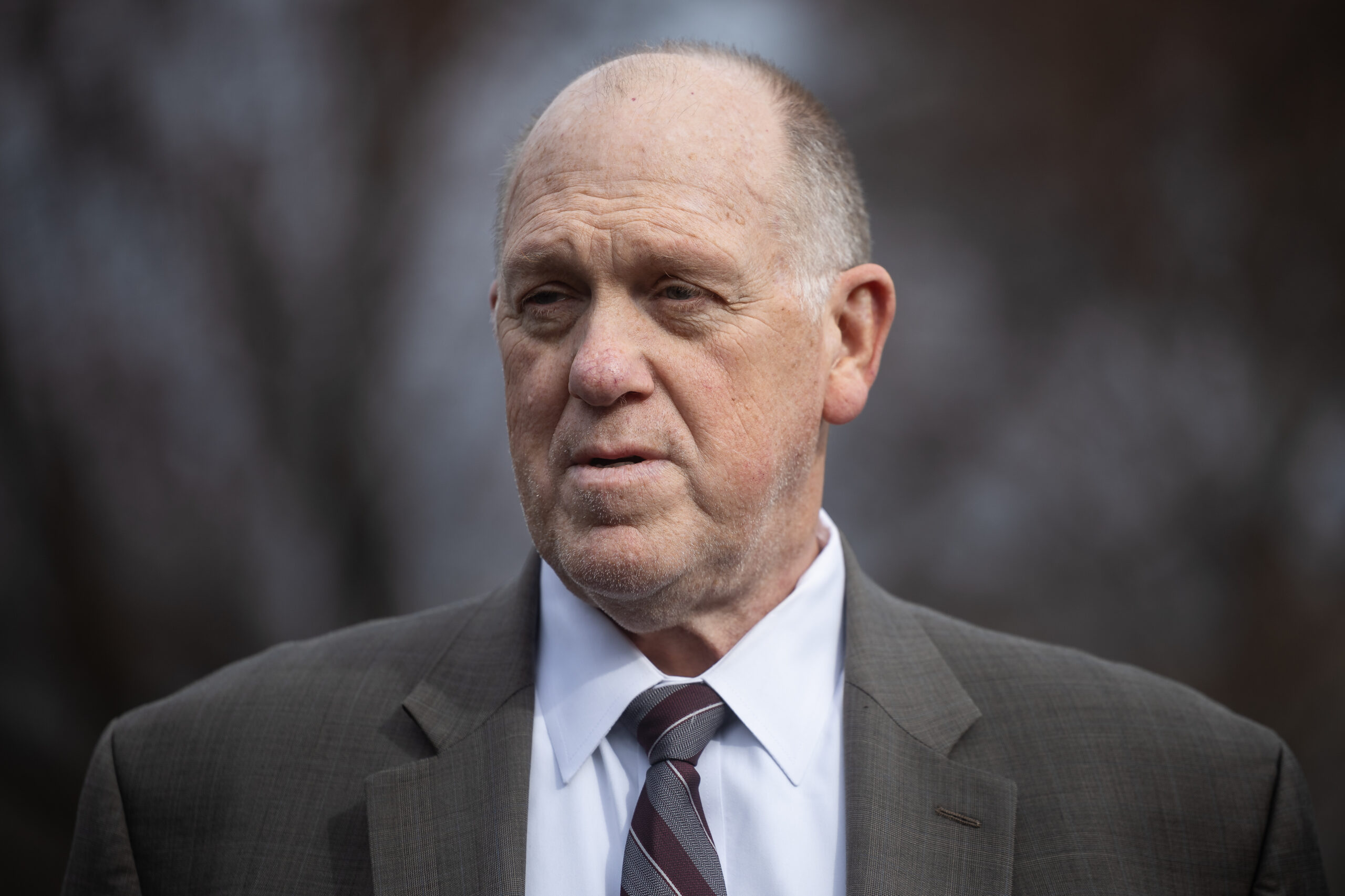
Border czar Tom Homan met again with lawmakers Friday night in the Capitol…
Read More
A meeting is now underway seeking potential paths for ending the shutdown of the Department of Homeland Security. Tom Homan, President Donald Trump’s border czar, is meeting with top Senate appropriators and other key senators. It’s the second meeting of the same group in as many days…
Read More
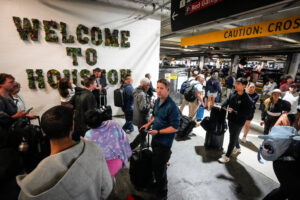
- Trump threatens to send ICE to airports amid DHS standoff
- Why Democrats are betting big on a buck hunter
- You can bet on climate disasters. Business is booming.
- ‘This is about attention’: Mike Lee’s MAGA crusade is driving his colleagues crazy

- White House revises its DHS offer as talks to end shutdown pick up
- Another DHS meeting
- Another DHS funding vote coming to House floor
- House GOP leaders punt controversial FISA vote to April

- White House sends blueprint for national AI rules to Congress

- White House revises its DHS offer as talks to end shutdown pick up
-

 The Dictatorship1 year ago
Luigi Mangione acknowledges public support in first official statement since arrest
-

 Politics1 year ago
Former ‘Squad’ members launching ‘Bowman and Bush’ YouTube show
-

 Politics1 year ago
Blue Light News’s Editorial Director Ryan Hutchins speaks at Blue Light News’s 2025 Governors Summit
-

 Politics1 year ago
Former Kentucky AG Daniel Cameron launches Senate bid
-

 The Dictatorship6 months ago
Mike Johnson sums up the GOP’s arrogant position on military occupation with two words
-

 The Dictatorship1 year ago
Pete Hegseth’s tenure at the Pentagon goes from bad to worse
-
Uncategorized1 year ago
Bob Good to step down as Freedom Caucus chair this week
-

 Politics11 months ago
Democrat challenging Joni Ernst: I want to ‘tear down’ party, ‘build it back up’