
The Dictatorship
US government on brink of first shutdown in almost 7 years amid partisan standoff

WASHINGTON (AP) — Senate Democrats have voted down a Republican bill to keep funding the government, putting it on a near certain path to a shutdown after midnight Wednesday for the first time in nearly seven years.
The Senate rejected the legislation as Democrats are making good on their threat to close the government if President Donald Trump and Republicans won’t accede to their health care demands. The 55-45 vote on a bill to extend federal funding for seven weeks fell short of the 60 needed to end a filibuster and pass the legislation.
Senate Democratic Leader Chuck Schumer, D-N.Y., said Republicans are trying to “bully” Democrats by refusing to negotiate on an extension of expanded Affordable Care Act tax credits that expire at the end of the year.
“We hope they sit down with us and talk,” Schumer said after the vote. “Otherwise, it’s the Republicans will be driving us straight towards a shutdown tonight at midnight. The American people will blame them for bringing the federal government to a halt.”
The failure of Congress to keep the government open means that hundreds of thousands of federal workers could be furloughed or laid off. After the vote, the White House’s Office of Management and Budget issued a memo saying “affected agencies should now execute their plans for an orderly shutdown.”
Threatening retribution to Democrats, Trump said Tuesday that a shutdown could include “cutting vast numbers of people out, cutting things that they like, cutting programs that they like.”
Trump and his fellow Republicans said they won’t entertain any changes to the legislation, arguing that it’s a stripped-down, “clean” bill that should be noncontroversial. Senate Majority Leader John Thune said “we can reopen it tomorrow” if enough Democrats break party lines.
The last shutdown was in Trump’s first term, from December 2018 to January 2019, when he demanded that Congress give him money for his U.S.-Mexico border wall. Trump retreated after 35 days — the longest shutdown ever — amid intensifying airport delays and missed paydays for federal workers.
Democrats take a stand against Trump, with exceptions
While partisan stalemates over government spending are a frequent occurrence in Washingtonthe current impasse comes as Democrats see a rare opportunity to use their leverage to achieve policy goals and as their base voters are spoiling for a fight with Trump. Republicans who hold a 53-47 majority in the Senate needed at least eight votes from Democrats after Republican Sen. Rand Paul of Kentucky opposed the bill.
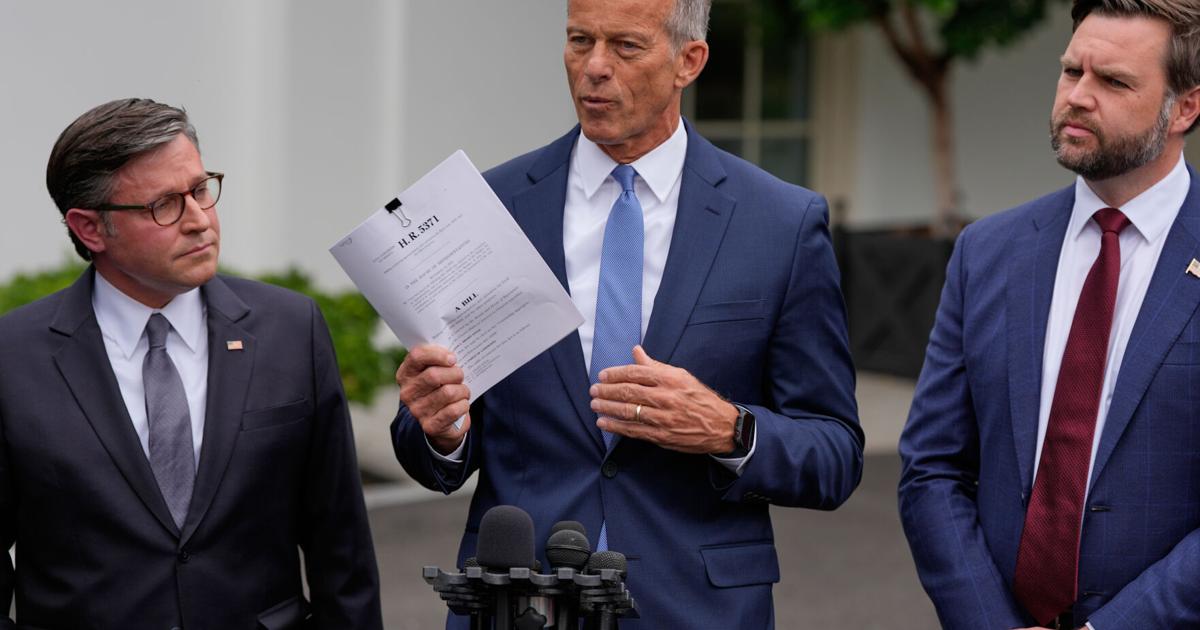
Senate Majority Leader John Thune, R-S.D., talks to reporters outside the West Wing of the White House, Monday, Sept. 29, 2025, in Washington, as House Speaker Mike Johnson of La., listens. (AP Photo/Alex Brandon)
Senate Majority Leader John Thune, R-S.D., talks to reporters outside the West Wing of the White House, Monday, Sept. 29, 2025, in Washington, as House Speaker Mike Johnson of La., listens. (AP Photo/Alex Brandon)
Democratic Sens. John Fetterman of Pennsylvania and Catherine Cortez Masto of Nevada and Independent Sen. Angus King of Maine voted with Republicans to keep the government open — giving Republicans hope that there might be five more who will eventually come around and help end a shutdown.
After the vote, King warned against “permanent damage” as Trump and his administration have threatened mass layoffs.
“Instead of fighting Trump we’re actually empowering him, which is what finally drove my decision,” King said.
Thune predicted Democratic support for the GOP bill will increase “when they realize that this is playing a losing hand.”
Shutdown preparations begin
The stakes are huge for federal workers across the country as the White House told agencies last week that they should consider “a reduction in force” for many federal programs if the government shuts down. That means that workers who are not deemed essential could be fired instead of just furloughed.
Either way, most would not get paid. The nonpartisan Congressional Budget Office estimated in a letter to Iowa Sen. Joni Ernst on Tuesday that around 750,000 federal workers could be furloughed each day once a shutdown begins.
Federal agencies were already preparing. On the home page of the Department of Housing and Urban Development, a large pop up ad reads, “The Radical Left are going to shut down the government and inflict massive pain on the American people.”
Democrats’ health care asks
Democrats want to negotiate an extension of the health subsidies immediately as people are beginning to receive notices of premium increases for the next year. Millions of people who purchase health insurance through the Affordable Care Act could face higher costs as expanded subsidies first put in place during the COVID-19 pandemic expire.
Democrats have also demanded that Republicans reverse the Medicaid cuts that were enacted as a part of Trump’s “big, beautiful bill” this summer and for the White House to promise it will not move to rescind spending passed by Congress.
“We are not going to support a partisan Republican spending bill that continues to gut the health care of everyday Americans,” House Democratic Leader Hakeem Jeffries said.
Senate Minority Leader Chuck Schumer, D-N.Y., right, and House Minority Leader Hakeem Jeffries, D-N.Y., speak to members of the media outside the West Wing at the White House in Washington, Monday, Sept. 29, 2025, in Washington. (AP Photo/Evan Vucci)
Senate Minority Leader Chuck Schumer, D-N.Y., right, and House Minority Leader Hakeem Jeffries, D-N.Y., speak to members of the media outside the West Wing at the White House in Washington, Monday, Sept. 29, 2025, in Washington. (AP Photo/Evan Vucci)
Thune pressed Democrats to vote for the funding bill and take up the debate on tax credits later. Some Republicans are open to extending the tax credits, but many are strongly opposed to it.
In rare, pointed back-and-forth with Schumer on the Senate floor Tuesday morning, Thune said Republicans “are happy to fix the ACA issue” and have offered to negotiate with Democrats — if they will vote to keep the government open until Nov. 21.
A critical, and unusual, vote for Democrats
Democrats are in an uncomfortable position for a party that has long denounced shutdowns as pointless and destructive, and it’s unclear how or when a shutdown will end. But party activists and lawmakers have argued that Democrats need to do something to stand up to Trump.
“The level of appeasement that Trump demands never ends,” said Sen. Peter Welch, D-Vt. “We’ve seen that with universities, with law firms, with prosecutors. So is there a point where you just have to stand up to him? I think there is.”
Some groups called for Schumer’s resignation in March after he and nine other Democrats voted to break a filibuster and allow a Republican-led funding bill to advance to a final vote.
Schumer said then that he voted to keep the government open because a shutdown would have made things worse as Trump’s administration was slashing government jobs. He says things have now changed, including the passage this summer of the massive GOP tax cut bill that reduced Medicaid.
Trump’s role in negotiations
A bipartisan meeting at the White House on Monday was Trump’s first with all four leaders in Congress since retaking the White House for his second term. Schumer said the group “had candid, frank discussions” about health care.
But Trump did not appear to be ready for serious talks. Hours later, he posted a fake video of Schumer and House Democratic Leader Hakeem Jeffries taken from footage of their real press conference outside of the White House after the meeting. In the altered video, a voiceover that sounds like Schumer’s voice makes fun of Democrats and Jeffries stands beside him with a cartoon sombrero and mustache. Mexican music plays in the background.
At a news conference on the Capitol steps Tuesday morning, Jeffries said it was a “racist and fake AI video.”
Schumer said that less than a day before a shutdown, Trump was trolling on the internet “like a 10-year-old.”
“It’s only the president who can do this,” Schumer said. “We know he runs the show here.”
___
Associated Press writers Seung Min Kim, Kevin Freking, Matthew Brown, Darlene Superville and Joey Cappelletti in Washington contributed to this report.


The Dictatorship
Trump’s overlapping troubles are starting to resemble a set of political Russian nesting dolls
With tariffs fueling inflation, inflation driving up prices and rising costs deepening public frustration with the White House, President Donald Trump’s troubles at home and abroad are starting to resemble a set of political Russian nesting dolls. Each overlapping challenge grows larger and swallows the next.
Now, U.S. intervention in Iran is adding another layer to Trump’s stack of challenges — a pile so large it seems increasingly impossible to unpack it all before November.
A slew of new polls underscores how compounded these issues have become. A Fox News poll released Wednesday shows that 47% of respondents disapprove of Trump’s presidency, while a Reuters/Ipsos poll released Tuesday reports his approval at a record low of 36% — down from 40% last week. Meanwhile, the latest AP-NORC poll shows that around half of U.S. adults have little to no trust in the president when it comes to foreign policy decisions, while nearly a third say they have little trust in his approach to nuclear weapons, military deployments and relationships with other nations.

Taken together, the numbers illustrate how the White House is facing a complex war beyond the borders of Iran — as well as the public’s growing skepticism of Trump’s judgment at home and abroad.
As Operation Epic Fury drags into its fifth weekTrump has scrambled to make the case that military intervention in Iran is a net positive for the American public, if only the public can withstand the short-term economic effects. But while foreign intervention has, for some presidents, distracted the public’s attention from political troubles on the home front, Trump’s maneuvers in the Middle East are having the opposite effect.
Past presidents have often benefited from the “rally around the flag” effecta concept in political science in which a leader sees a temporary uptick in support during war. President George H.W. Bush enjoyed a nearly 80% approval rating during the 1991 Persian Gulf War, while nearly three-quarters of Americans supported President George W. Bush’s initial invasion of Iraq in 2003.
But as the American electorate has changed, so has its approach to foreign intervention. Now, public support for war hinges as much on a president’s credibility and domestic management as on threats abroad.
Rather than the abstract concept of far-off battlefields, Americans are enduring the tangible and immediate consequences of Trump’s foreign agenda every time they open their wallets.
Rather than rally around, nearly 6 in 10 Americans say U.S. military action in Iran has gone “too far,” according to the AP-NORC survey. Nearly the same number of voters surveyed by Fox News say they disapprove of the president’s foreign policy agenda, while 64% disapprove of his handling of Iran.
With the conflict estimated to cost a whopping $1 billion a dayit’s also impossible for the administration to shield voters from feeling the costs of war at home. Rather than the abstract concept of far-off battlefields, Americans are enduring the tangible and immediate consequences of Trump’s foreign agenda every time they open their wallets.
Already stressed by rising grocery costs and utility bill spikes, the average American is now pulling up to the pump to find that the national gas average has jumped $1 in just a month, for AAA. Meanwhile, the labor market has taken some significant hits since January, and a partial government shutdown has only created more trouble for federal workers and travelers alike.
America’s cost concerns are only growing. The AP-NORC poll found that 45% of Americans are “extremely” or “very” concerned about affording gas in the next few months, while three-quarters of Republicans and about two-thirds of Democrats say it’s “highly important” to keep oil and gas prices from rising. Reuters/Ipsos found that just 29% of Americans approve of Trump’s leadership on economic issues.

The White House is scrambling to assuage the growing concern, just as it worked to downplay Trump’s global tariff war and rising inflation. But Trump’s bullish approach to negotiations — including his recent insistence in a Cabinet meeting that he “doesn’t care about” reaching a deal with Tehran — is far from reassuring.
Instead, it’s clear that the messaging is falling flat with voters, who were already facing economic uncertainty before Operation Epic Fury ever made headlines. Now, with pain points coming from all sides, the White House is staring down an electorate caught in a feedback loop of frustration, mistrust and a widely unpopular foreign war.
Trump has weathered bad poll numbers before and come out on top. But for now at least, the administration’s global agenda has put its own party in a precarious position as it stares down a challenging midterm cycle.
Make no mistake: While Tehran may dominate today’s headlines, it will be the crisis at American checkout counters and kitchen tables that matters most come November.
Bethany Irvine is a Washington-based political reporter who has written for Blue Light News and The Texas Tribune.

The most heartbreaking moment in the finale of “Love Story: John F. Kennedy Jr. & Carolyn Bessette” is arguably also a manufactured one. Bessette’s mother Ann Messina Freeman, played by Constance Zimmer, is having an emotional conversation with Caroline Kennedy following the death of her daughter and famous son-in-law. “She said she didn’t recognize who she had become,” Freeman tells Kennedy, played by Mamie Gummer. “And now that person will be immortalized forever. I only wish she had lived long enough to be remembered for something else.”
Freeman’s lament echoes one that Caroline Kennedy voices earlier in this last episode of the Ryan Murphy-produced FX and Hulu limited series. “The only thing he’ll be remembered for is what he could have become,” she says of her now-late brother, the son of a revered American president who also died suddenly in the prime of his life. In this fictionalized version of history, and perhaps in real life, these women wish for a more nuanced legacy for their loved ones and resent how the media flattens and distorts their existences. That’s a fair sentiment perhaps, but it’s also a disorienting thing to process while watching a series that flattens and distorts the existences of those same loved ones to ensure the main thing they will be remembered for is their tumultuous relationship and the tragic manner in which they died.

This type of hypocrisy has gotten harder to ignore over the past decade as scripted, realistic-seeming stories based on actual celebrities, crimes and scandals have become omnipresent. Murphy has been responsible for a lot of the entries in this genre and actually set the bar for it 10 years ago, with “American Crime Story: The People vs. O.J. Simpson.”
Like “Love Story,” that limited series revisits a high-profile narrative from the 1990s: the murder trial of O.J. Simpson. “The People vs. O.J. Simpson,” which was produced and partly directed by Murphy but developed for television by Scott Alexander and Larry Karaszewski, ticked all the scripted true crime boxes that subsequent shows would strive to hit. It featured strong performances from an exceptional ensemble cast. It won nine Emmy Awards. Most importantly, it revisited a story that most people felt they knew — the prosecution and acquittal of Simpson in the stabbing deaths of his former wife, Nicole Brown Simpson, and her friend Ron Goldman — but did so with an eye toward the racial and gender dynamics that affected the media coverage of the case and public perception of it.
Rather than simply rehashing old news, “The People vs. O.J. Simpson” seemed to want to help us understand this volatile chapter in modern American history from a more nuanced perspective.
Certainly there were concerns about the ghoulishness of revisiting the deaths of Brown Simpson and Goldman, particularly from their respective families. But overall, the show was sensitive and substantive enough to shake accusations of being exploitative for exploitation’s sake.
I watched all of this and wondered what, exactly, I was doing other than rubbernecking at the scene of a past tragedy.
But as these types of shows have proliferated and Murphy has added murder anthology series “Monster”to his roster, it has become harder to argue that these fictionalized versions of the truth serve a more noble purpose. Which brings us back to “Love Story,” and its final hour, “Search and Recovery.” Inevitably, the show puts us in the Piper Saratoga plane with Carolyn, Lauren Bessette and John just before it goes down off the coast of Martha’s Vineyard.
But mercifully, series creator Connor Hines, who wrote the finale, and director Anthony Hemingway, don’t actually depict the crash itself, only the moments just before, when Kennedy starts to lose control of the aircraft. “John, just breathe,” Carolyn reassures her husband in their final — and fictionalized — moments together.
I watched all of this and wondered what, exactly, I was doing other than rubbernecking at the scene of a past tragedy. Witnessing this interpretation of these terrifying scenes does not add anything to our understanding of their relationship. It just allows us to see what (allegedly) happened before their lives ended, which feels like an invasion of privacy.
Honestly, most of “Love Story” feels like an invasion of privacy. That does not mean that it was made completely without care. As is always the case in the Murphy-verse, there are some very strong performances in this series, particularly from Zimmer, Gummer and, especially, Sarah Pidgeon as Carolyn. Largely known to the public as the image of perfect bridal elegance, Bessette becomes a real flesh-and-blood person in Pidgeon’s hands. The actress captures her vibrancy, her quick wit and her allure. This is the most we’ve ever gotten to see of the real Carolyn Bessette, even though this is only a facsimile of her.

But is that enough to justify making nine episodes of a series that picks apart the arguments, pressures and therapy sessions from her complicated relationship with one of the most high-profile, frequently photographed men who ever lived?
In a recent op-ed for The New York TimesDaryl Hannah, an ex-girlfriend of Kennedy’s who is portrayed in an extremely unflattering light in “Love Story,” argued that it is not. “Many people believe what they see on TV and do not distinguish between dramatization and documented fact — and the impact is not abstract,” she wrote. “In a digital era, entertainment often becomes collective memory. Real names are not fictional tools. They belong to real lives.”
That doesn’t mean that Hollywood should never make TV shows or movies based on actual people. The industry has been doing that forever, long before Murphy came along. But I think the creators of this form of entertainment need to ask themselves what they are hoping to achieve, not just as they prepare a pitch to a network, but every single day they are working on the project.
During that moving conversation between Freeman and Caroline Kennedy, the women agree that there is no sense to be made of the deaths of these promising young Americans. As the Kennedy family has learned far too many times, life can be random and cruel for no good reason. That’s the feeling that persists as this “Love Story” ends: that what happened to Carolyn, John and Carolyn’s sister Lauren was terribly sad and there’s nothing that can be done to change it. But there is one thing that Hollywood and the public can actually do: Just let them rest in peace.
Jen Chaney is a freelance TV and film critic whose work has been published in The New York Times, TV Guide and other outlets.
The Dictatorship
The Epstein class thinks it runs America. Today, No Kings protesters send their response.
Thousands of Americans plan to gather on Saturday for No Kings protests across the country. They have a simple message: People are tired of a government that protects the powerful and abandons ordinary Americans.
They are tired of fighting costly and illegal overseas wars while we face an affordability crisis at home. They are horrified by the Trump administration’s cover-up of the Epstein files and the lack of accountability for the rich and powerful who crossed lines. And they are sick of Immigration and Customs Enforcement terrorizing our communities.
The American people are uniting to demand accountability.
As more Americans are sent to fight abroad and the survivors of abuse are silenced at home, people increasingly feel dispensable.
But we are not disposable. We are not dispensable. The American people are uniting to demand accountability.
For too long, Americans have seen our leaders fight harder for the Epstein class than for the working class. They have watched our system shield elites instead of delivering fundamentals such as affordable health care, housing and education.
The fight to release the Epstein files exposed not only a broken justice system, but also a deep economic and moral divide.

Jeffrey Epstein built a network of elite and powerful individuals, some of whom believed they could abuse young girls and women — many from working-class backgrounds — without consequences. Many survivors of Epstein’s abuses have courageously spoken outand over the past year, sparked a moral reckoning in our country. They have exposed a two-tier system of justice that protects the wealthy and powerful and fails those who have been abused.
The administration’s failure to hold accountable those involved in Epstein’s abuses has fueled deep distrust in our government and its ability to deliver for the public good.
Rebuilding faith in our system requires transparency and accountability.
That is why I led the fight with Rep. Thomas Massie, R-Ky., to release the files. The Epstein Files Transparency Act wasn’t about politics. It was about justice for the survivors and accountability for their abusers.

Since our bill was signed into law in November, the Justice Department has released some three million documents. These files expose the brazenness of the Epstein class. They show how extensive Epstein’s network was and that this wasn’t just one individual but a group of powerful people who operated within a culture of elite impunity.
While most of those powerful people aren’t accused of criminal involvement with Epstein, the emails, photos and other materials demonstrate the willingness of this well-connected group to associate with Epstein even after he was convicted of sex crimes involving minors.
While these files and survivors’ stories have shocked our national conscience, the work is far from over. Transparency is only the first step. Now we must deliver accountability for those involved in Epstein’s abuses.
That means, in part, holding the administration accountable for essentially perpetuating a cover-up. The Justice Department has failed to release millions of remaining documents, which is a flagrant violation of our law. Many of the documents that have been released are heavily redacted in some areas — including concealing the names of several powerful individuals — yet in other areas fail to redact the names of survivors.
Survivors and the public deserve answers.
When Attorney General Pam Bondi appears before the House Oversight Committee next month, I will demand an explanation under oath of why the remaining files have not been released and why the administration has not acted to hold those involved accountable.

In other countries, we have started to see steps toward accountability. Peter Mandelson was fired as Britain’s ambassador to the United States and is being investigated over information he may have passed to Epstein while holding other government positions. The former prince known as Andrew Mountbatten-Windsor was arrested last month on suspicion of misconduct in public office, also related to confidential information he may have passed to Epstein. The former prime minister of Norway was charged with aggravated corruption over his Epstein links.
All of these individuals deny wrongdoing. But the arrests and investigations show that action is possible when governments have the courage to take on powerful individuals.
So why hasn’t there been action until now?
The truth is that no one has been willing to take on powerful interests. President Franklin D. Roosevelt warned of the “economic royalists” — wealthy and connected individuals who concentrated power and sought to rig the system against the working class. The emergence of the Epstein class is not so different.
The arrests and investigations show that action is possible when governments have the courage to take on powerful individuals.
For years, the wealthy have influenced our government and political system by pouring money into elections. That is how they secured tax breaks, dragged us into foreign wars and steered policies that benefit them over the working class. This is why I have stood for banning super PACs and getting money out of politics. I don’t take a dime of PAC money.
We need to take our government back for the people. That means rooting out corruption, dismantling ICE and creating a government that is going to provide Medicare for all, universal child care and a living wage.
It also means justice for the survivors of Epstein’s abuses, putting an end to elite impunity and prosecuting those who were involved in Epstein’s crimes.
Ultimately, that is why it is so important that Americans are gathering this weekend. This show of unity should remind our country that the people, not just the wealthy few, hold the power.

Rep. Ro Khanna
Ro Khanna represents California’s 17th congressional district in the House of Representatives.
- ‘We love you!’: The MAGA base gives RFK Jr. a rousing welcome
- DHS stopgap set for quick House action after Rules Committee vote
- Rand Paul weighs a 2028 presidential bid
- Trump to send Congress his budget request April 3

- ‘Meltdown’: DHS shutdown set to drag on after House GOP rejects Senate deal

- Troop deployments test Republicans’ nerves on Capitol Hill
- Trump’s overlapping troubles are starting to resemble a set of political Russian nesting dolls
- A ‘Love Story’ that feels more like an invasion of privacy
- The Epstein class thinks it runs America. Today, No Kings protesters send their response.
- Israel says it faces an incoming missile from Yemen, the first such launch of the war

-

 The Dictatorship1 year ago
Luigi Mangione acknowledges public support in first official statement since arrest
-

 Politics1 year ago
Former ‘Squad’ members launching ‘Bowman and Bush’ YouTube show
-

 Politics1 year ago
Former Kentucky AG Daniel Cameron launches Senate bid
-

 Politics1 year ago
Blue Light News’s Editorial Director Ryan Hutchins speaks at Blue Light News’s 2025 Governors Summit
-

 The Dictatorship7 months ago
Mike Johnson sums up the GOP’s arrogant position on military occupation with two words
-

 The Dictatorship1 year ago
Pete Hegseth’s tenure at the Pentagon goes from bad to worse
-
Uncategorized1 year ago
Bob Good to step down as Freedom Caucus chair this week
-

 Politics11 months ago
Democrat challenging Joni Ernst: I want to ‘tear down’ party, ‘build it back up’