
The Dictatorship
Trump’s USAID cuts are having a devastating impact on the ‘rape capital of the world’

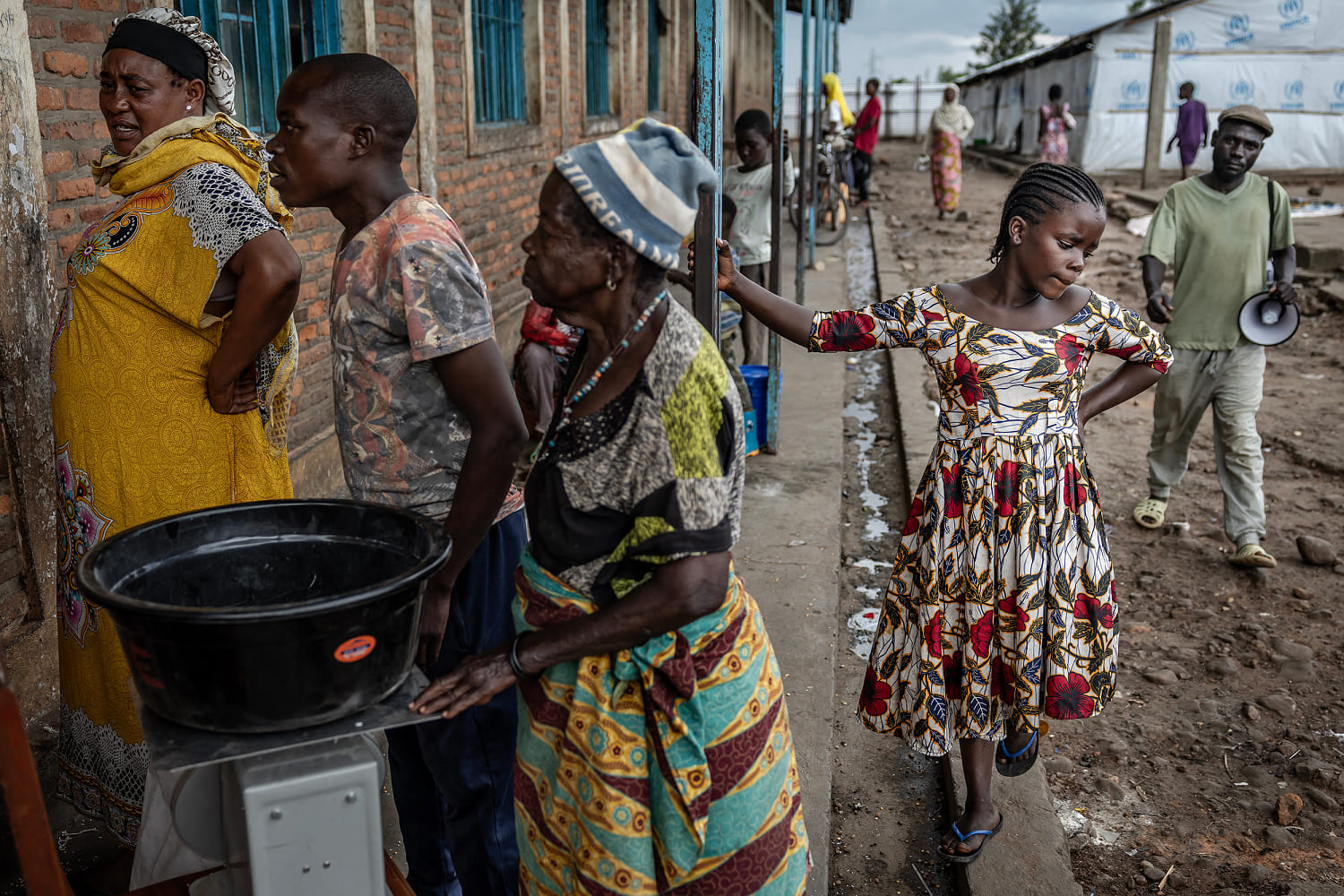
She was 17.
After armed men attacked her village in eastern Congo and raped her, she fled into the night — bloodied and alone. By morning, in late January, she reached a clinic on the outskirts of Goma.
The nurse knew exactly what she needed: a post-exposure prophylaxis (PEP) kit — a small box of medication that can prevent HIV, sexually transmitted infections and pregnancy if given within 72 hours.
“She arrived within the window,” said a local social worker in Goma, who followed the case closely and spoke to me by phone. I’ll call her Grace. “But the kit wasn’t there.”
We can blame Washington, where Elon Musk-appointed disruptors locked out USAID staff and began dismantling the 61-year-old agency.
“We’re sorry,” the nurse told her. “We have nothing.”
Three months later, after a desperate, unsafe attempt to end her pregnancy, Grace died. We shouldn’t consider her direct cause of death the assault, but rather her despair that there was no care for her after her assault.
We can blame Washington, where Elon Musk-appointed disruptors locked out U.S. Agency for International Development staff and began dismantling the 61-year-old agency that once dominated PEP kit supply in the Democratic Republic of the Congo. Dr. Esther Kitambala of Heal Africa — a Goma-based hospital on the front lines of the crisis — told me over the phone that more than 80% of those kits previously came from USAID.
At the beginning of this month, Secretary of State Marco Rubio put the finishing touches on the process Musk began in January when he declared USAID “beyond repair” and “a criminal organization.”
On June 30, NBC News reported on an analysis of USAID cuts published in the medical journal The Lancet that found:
From 2001 through 2021, USAID-funded programs prevented nearly 92 million deaths across 133 countries, including more than 25 million deaths from HIV/AIDS, around 11 million from diarrheal diseases, 8 million from malaria and nearly 5 million from tuberculosis.
Ending USAID could lead to the deaths of 14 million people over the next five yearsthe analysis predicts.
The day after that news story, Rubio, in a press release headlined “Make Foreign Aid Great Again,” said, “As of July 1st, USAID will officially cease to implement foreign assistance,” in part because “the countries that benefit the most from our generosity usually fail to reciprocate. For example, in 2023, sub-Saharan African nations voted with the United States only 29 percent of the time on essential resolutions at the UN.”
Humanitarian aid shouldn’t be pay to play.
At Heal Africaone of Goma’s few hospitals offering full support to rape survivors, the shelves once stocked with PEP kits now sit bare. Women and girls are turned away.
Her voice trembled as she described the anguish of turning away survivors in urgent need.
Kitambala, who leads reproductive health at Heal Africa, said the phrase she dreads most is now routine: “I’m sorry. We don’t have a PEP kit.” Her voice trembled over the phone as she described the anguish of turning away survivors in urgent need.
She spoke of a 3-year-old girl who’d been subjected to brutal sexual violence and a young woman, raped and pregnant, who went to her village clinic only to be turned away.
“When we receive rape victims like her, we call everywhere,” Kitambala said. “Every clinic I know. But the answer is always the same: ‘We ran out of PEP kits months ago.’”
I knew exactly what those kits meant. As a journalist, I reported from war zones like Goma. More recently, I led global media and public relations for Corus International, a humanitarian organization active in Goma and across 30 countries with fragile health systems.
A practitioner in Goma who asked to remain anonymous told me, “Survivors come clinging to hope that they’ll at least be protected from HIV. But when we turn them away … we send them back into the dark with nothing.”
“But their stories don’t end there,” that doctor said. “I see the face of that 12-year-old rape victim I had to turn away today. I think about the trauma she’s already endured — and the unimaginable challenges still ahead for her.”
Empowered by U.S. funding, facilities such as Heal Africa provided critical, compassionate care for survivors of sexual violence. The program’s success was striking — United Nations data indicates annual HIV/AIDS deaths in the DRC have fallen from 200,000 to roughly 14,000.
Then came Donald Trump and Elon Musk and Marco Rubio.
In multiple capacities across my professional career, I’ve walked through overcrowded camps filled with people carrying the weight of unspeakable loss. But what’s unfolding in Goma is unlike anything I’ve ever seen.
This is how America’s exit played out in a place long labeled the ‘rape capital of the world.’
Over 500,000 people are crammed into makeshift shelters. Children are dying of preventable disease. Health workers are exhausted and being forced to explain that even the most basic supplies, supplies once funded by about 1% of the U.S. budgetare no longer coming.
As USAID collapsed, Rwanda-backed M23 rebels surged into eastern DRC. The fallout was immediate. UNICEF reported a fivefold spike in rape cases in one week alone — children made up 30% of victims.
Back in early July, the United Nations Population Fund shared a document with Reuters revealing that only seven out of 34 health zones in North Kivu currently have even a minimal supply of post-rape kits. Fewer than 1 in 4 survivors are receiving the care they need, and shockingly, just 13% of those seeking help are receiving HIV-prevention medication within the critical 72-hour window.
This is how America’s exit played out in a place long labeled the “rape capital of the world,” where — even in relative calm — up to 80% of women and girls as young as 8 have endured sexual violence, according to front-line clinicians.
It didn’t have to happen this way. A working system existed that meant the difference between life and death. And Congress should either restore USAID or establish a replacement that reflects the generosity of the American people and not the inhumane agenda of one man and his administration.
Rubio says aid from the U.S. will now serve “American interests,” but what American interests are served by withholding a box of pills and letting a 17-year-old girl die alone in a displacement camp?
I’ve seen American power up close — not in tanks or embassies, but in quiet acts of courage:
A winter blanket handed to a shivering child in Ukraine. A solar panel powering a maternity ward in South Sudan. And in Goma, a PEP kit handed to a terrified teenager who still had a chance.
That girl is gone now. As is the system that could have saved her.
Muhammad Tahir
Muhammad Tahir is a nonresident senior fellow at The Atlantic Council’s Eurasia Center. He previously held key roles at Radio Free Europe/Radio Liberty (RFE/RL) in Washington, D.C., and Eastern Europe and served as bureau chief for IHA, the Turkish media, in Pakistan and Afghanistan. Most recently, he led media strategy at the nonprofit Corus International. His work has been published by BLN, BBC, Al Jazeera, The Washington Post and The New Atlanticist, among others.


The Dictatorship
Iran moves to take permanent control of Strait of Hormuz, a vital shipping choke point
Iran announced on Thursday that it was drafting a “protocol” that would allow it to “monitor transit” by oil tankers through the Strait of Hormuzthe strategic waterway Tehran has shut downsending oil and gas prices soaring in the U.S. and across the world.
Kazem Gharibabadi, Iran’s deputy foreign minister for legal and international affairs, said tanker traffic through the narrow route “should be supervised and coordinated” between Iran and Oman, the two countries that border the strait, according to a translation of a report from Iran’s state news agency cited by CNBC.
“Of course, these requirements will not mean restrictions, but rather to facilitate and ensure safe passage and provide better services to ships that pass through this route,” Gharibabadi said according to the report.
President Donald Trump has suggested that the U.S. may leave it to other countries to end Iran’s de facto blockade of the strait, which it enforces by firing missiles at tankers. Trump has called on European nations to do so, but experts say Europe lacks the military resources to halt Iranian attacks on tankers for the long term.
Iranian and Omani officials did not respond to requests for comment from MS NOW.
For decades, the strait has been an international waterway, controlled by no country, that ships from all nations could transit.

Gregory Brew, a senior Iran and oil analyst at the Eurasia Group, said that if Iran manages to take control of the Strait of Hormuz permanently, it would be a “colossal win” for the country.
“It’s a massive strategic win, given that Iran has demonstrated that it can close the strait,” Brew told MS NOW. “It’s a huge financial win.”
Brew added that if Iran gains long-term control of the straitit would be more powerful than it was before the Trump administration attacked it. Iran’s parliament passed a law to begin charging “tolls” of up to $2 million per ship, which could mean as much as $100 billion in annual revenue — or the equivalent of Iran’s current annual oil export earnings.
“It’s not innocuous,” Brew said, referring to the protocol announced on Thursday. “Iran has passed legislation and is now claiming to be coordinating with Oman in establishing joint management of the Strait of Hormuz.”
Brew predicted that Oman, which has less oil and wealth than other Gulf nations, may be willing to accept a temporary arrangement that could help end the conflict.
“The Omanis are probably hedging; they’ve always tried to manage their relationship with Iran, and they lose relatively little by cooperating with Iran right now to ease pressure on the strait,” Brew said. “The bigger question is whether they continue to cooperate after the war.”
Ted Singer, a former senior CIA official who oversaw the agency’s operations in the Middle East, said Iranian officials are likely trying to see what they can achieve.
“I wouldn’t see this as a fork in the road,” Singer told MS NOW.
Singer, who served as a CIA station chief in five different countries over a 35-year career, said Iranian officials could be trying to stoke division between gulf countries.
“The Iranians are good at doing more than one thing at a time,” he said. “Why not stake out a maximalist position on tolls, then toss out options to roil the waters?”
The United Arab Emirates, for example, is adamantly opposed to Iran taking control of the strait.
“The Iranians play multi-dimensional chess,” said Singer, now a senior adviser to the Chertoff Group, a security consulting firm run by Michael Chertoff, who served as secretary of Homeland Security in the George W. Bush administration.
“Try to create division between Oman and the rest of the Gulf countries,” Singer said. “Why not fiddle around with this and see if something sticks?”

David Rohde
David Rohde is the senior national security reporter for MS NOW. Previously he was the senior executive editor for national security and law for NBC News.
Ian Sherwood is the director of international newsgathering for MS NOW, a former executive editor for NBC News and a former deputy Washington bureau chief for the BBC.
Today’s edition of quick hits.
* Targeting Iranian infrastructure: “President Trump celebrated the destruction of a bridge near Tehran on Thursday, warning on social media that there was ‘much more to follow.’ The attack on the B1 bridge between Tehran and the nearby city of Karaj killed eight people and wounded 95, according to Fars, a semiofficial Iranian news agency.”
* I don’t think the speech worked: “The price of oil rose sharply and stocks wavered on Thursday after President Trump, in an address from the White House the day before, said the war against Iran was ‘nearing completion’ but failed to offer a concrete timeline and committed to more attacks. In the 19-minute address, Mr. Trump said U.S. forces would hit Iran ‘extremely hard over the next two to three weeks.’”
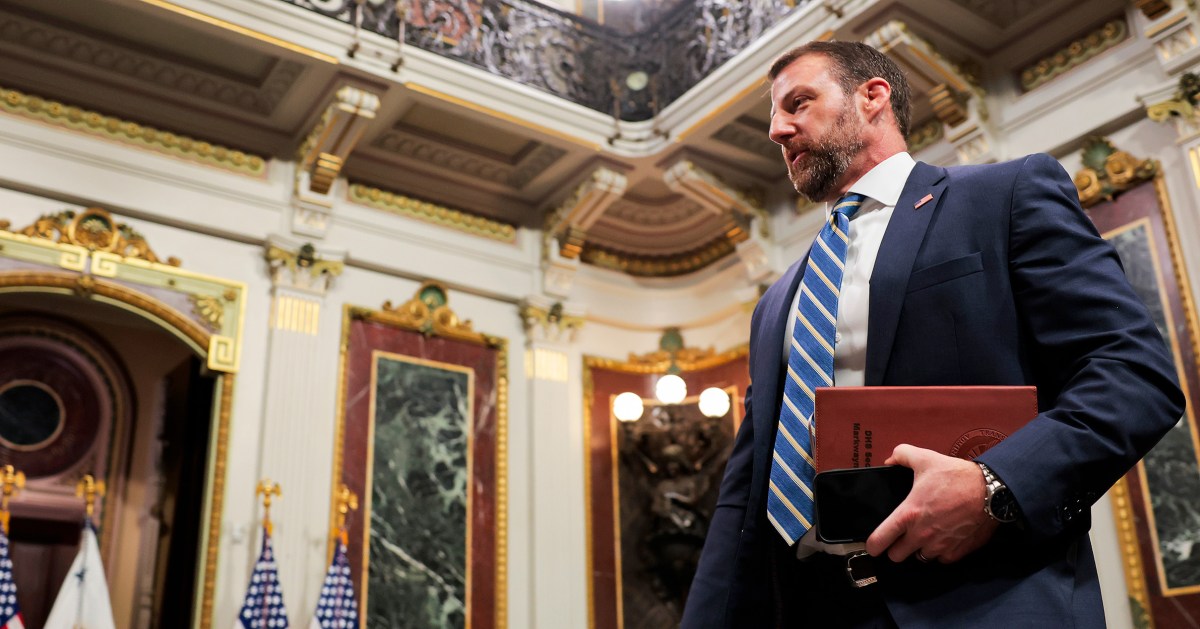
* Reversing one of Noem’s worst ideas: “Homeland Security Secretary Markwayne Mullin on Wednesday rescinded a rule that DHS expenditures over $100,000 be personally approved by his office, ending a widely criticized policy implemented by his predecessor Kristi Noem that critics said put a particular burden on the Federal Emergency Management Agency ’s work aiding disaster response and recovery.”
* The latest on the ballroom: “Donald Trump’s handpicked National Capital Planning Commission voted Thursday to authorize the president’s plan to erect a gilded 90,000-square-foot White House ballroom in place of the historic East Wing, which was destroyed last fall to make way for the ballroom.”
* Remember when Congress, by constitutional mandate, had the power of the purse? “President Donald Trump said Thursday he will soon sign an order to pay all Department of Homeland Security employees who have gone without paychecks during the record-long partial government shutdown that has reached 48 days.”
* A year after “Liberation Day,” there’s fresh tariff news: “President Donald Trump announced Thursday he will levy tariffs as high as 100 percent on some name-brand pharmaceuticals and is adjusting tariffs on products that contain steel and aluminum, the administration’s first move to expand duties since the Supreme Court dealt his trade agenda a blow in February.”
* The latest from Artemis II: “NASA’s latest update about the Artemis II moon mission shows a breathtaking view of Earth as the Orion capsule with four astronauts on board orbits tens of thousands of miles above. Hitching a ride beyond Earth’s atmosphere atop NASA’s powerful Space Launch System rocket, the three Americans and one Canadian selected for the mission are preparing to begin heading toward the moon.”
See you tomorrow.
Steve Benen is a producer for “The Rachel Maddow Show,” the editor of MaddowBlog and an MS NOW political contributor. He’s also the bestselling author of “Ministry of Truth: Democracy, Reality, and the Republicans’ War on the Recent Past.”
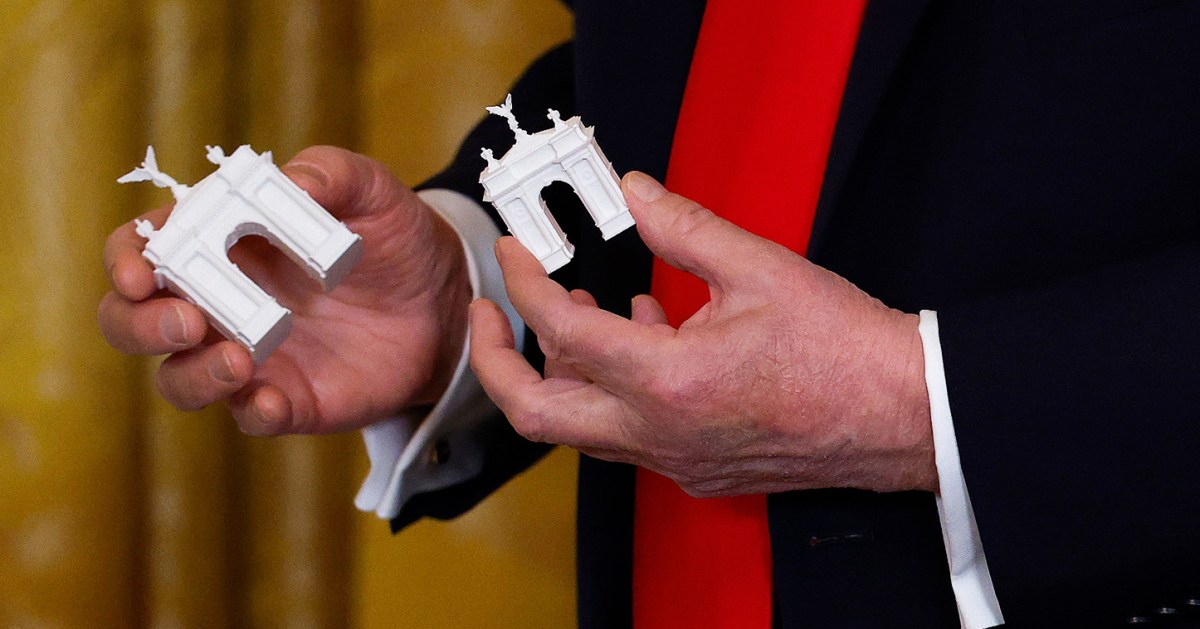
A federal judge is weighing whether the Trump administration can legally build a 250-foot arch just across the Potomac River from the Vietnam and Lincoln memorials, as three veterans who fought in Vietnam have argued the project would violate federal law and permanently alter one of the country’s most sacred landscapes.
Judge Tanya Chutkan declined on Thursday to issue a preliminary injunction, instead asking the parties to report by 5 p.m. on Friday whether they can agree to halt groundbreaking while the case proceeds. If no agreement is reached, she will ask the executive branch to provide supplemental sworn declarations disclosing any awards, grants, contracts, permits or other relevant information related to the arch’s construction.
The suit was brought by three Vietnam War veterans and an architectural historian, who argued the project would obstruct views of the Vietnam War and Lincoln memorials from Arlington National Cemetery. The plaintiffs contended the planned arch would violate federal laws governing historic sites and monuments, and the White House cannot lawfully proceed without congressional authorization.
The plaintiffs cited Trump’s various Truth Social posts and public statements to support their claim that construction is underway, pointing to design specifications, a target completion date of July 4 and renderings backed by a White House fact sheet. They also argued the National Park Service must sign off on any use of the land before construction begins.
President Donald Trump told reporters in January that his proposed arch “will be the most beautiful in the world,” and is already “being built.” He also shared renderings of the arch on his Truth Social account.
The government’s attorney, Bradley Craigmyle, argued that Trump’s media and social media statements constitute hearsay. Chutkan pushed back sharply, saying Trump’s posts are admissible as statements by a party. Throughout the hearing, Craigmyle argued the project is in the conceptual phase despite the president’s statements.
Today’s hearing comes as the National Capital Planning Commission voted 9-1, with two abstentions, to approve construction for Trump’s 90,000-square foot ballroom at the White House, clearing the final procedural hurdle for the project. Chutkan referenced the ballroom case during the hearing, saying, “If we haven’t had the whole White House ballroom situation, this might be a little more academic than it is now.”
Selena Kuznikov contributed to this article.
Peggy Helman is a desk associate at MS NOW.
- Why Republicans aren’t rushing to save Trump’s ballroom
- Why Republicans aren’t rushing to save Trump’s ballroom
- Nuclear rockets, moon bases and NASA’s Mars plan
- Florida’s budget stalemate takes on Cherfilius-McCormick probe-related twist

- House Republicans kvetch anew about DHS funding plan
- Why Republicans aren’t rushing to save Trump’s ballroom
- Artemis II astronauts rocket toward the moon after spending a day around Earth
- What to know about Todd Blanche, acting AG after Bondi firing
- Moulton: Trump ‘resorting to war crimes’ to get out of Iran war
- Massie raises Epstein files in X poll after Bondi ousted
-

 Politics1 year ago
Former ‘Squad’ members launching ‘Bowman and Bush’ YouTube show
-

 The Dictatorship1 year ago
Luigi Mangione acknowledges public support in first official statement since arrest
-

 Politics1 year ago
Former Kentucky AG Daniel Cameron launches Senate bid
-

 The Dictatorship7 months ago
Mike Johnson sums up the GOP’s arrogant position on military occupation with two words
-

 Politics1 year ago
Blue Light News’s Editorial Director Ryan Hutchins speaks at Blue Light News’s 2025 Governors Summit
-

 The Dictatorship1 year ago
Pete Hegseth’s tenure at the Pentagon goes from bad to worse
-
Uncategorized1 year ago
Bob Good to step down as Freedom Caucus chair this week
-
 Politics12 months ago
Democrat challenging Joni Ernst: I want to ‘tear down’ party, ‘build it back up’