
The Dictatorship
Trump’s efforts to secure a Nobel Peace Prize are Orwellian

This summer, President Donald Trump is rolling out the red carpet for Russian President Vladimir Putin and approving of weapon sales to Israel as it commits genocide. He’s also squeezing in time to lobby aggressively for the Nobel Peace Prize.
NBC News reports that “Trump and his aides are intensifying a public campaign to snag the award, citing a string of peace deals while making a case that snubbing him again would be an injustice.” According to NBC News, White House press secretary Karoline Leavitt has said, unprompted, at three out of her four press briefings in July that Trump deserves the prize. In fact, she’s arguing it’s overdue: “It’s well past time that President Trump was awarded the Nobel Peace Prize,” she said at one presser. Trump has also “posted about the prize a total of seven times on his social media site since his second term began, six of them in June and July,” NBC News reports.
Trump’s foreign policy has often undermined global ‘fraternity,’ not fostered it.
The Nobel Peace Prize is awarded by a five-member body appointed by Norway’s parliament. Trump has reportedly tried to influence the group through talks with the country’s government. A Norwegian news outlet reported Thursday that Trump said that he wanted the Nobel Peace Prize during a July call with Norwegian Finance Minister Jens Stoltenberg to discuss tariffs. (According to NBC News, a White House official “said that the president and Stoltenberg did speak, but could not say that the conversation was focused on the prize. Stoltenberg confirmed in a statement that he spoke to Trump about tariffs but would not go into further details of the call.”)
Trump’s Nobel Prize campaign — and his conviction that he is entitled to one — is of course absurd. Alfred Nobel called in his will for the prize to be awarded to individuals “who shall have done the most or the best work for fraternity between nations, for the abolition or reduction of standing armies and for the holding and promotion of peace congresses.” How would Trump fit the bill?
There is some truth to the Trump administration’s claim that it has played a diplomatic role in mediating the end of conflict between some nations, including between India and Pakistan and between Rwanda and the Democratic Republic of Congo. However in the case of India and Pakistan, India objects to Trump’s claim that he was responsible for the May ceasefire between India and Pakistan; the Indian government describes the resolution as something that was brokered bilaterally between only India and Pakistan, and has downplayed Trump’s role. And in the case of Rwanda and the DRC, Qatar also played a critical role that the Trump administration has conveniently left out of its narrative.
Even granting that the Trump administration has played a role in conflict resolution between some countries, the general spirit of Trump’s foreign policy has often undermined global “fraternity,” not fostered it. Under the banner of “America First,” Trump has shattered the bonds of economic cooperation by launching global trade wars, has reneged on pivotal agreements with our neighbors, and turned long-standing allies in Europe into rivals.
On a particularly surreal note, one of the mediation agreements that the Trump administration lists in its case for Trump as a “president of peace” is the recent ceasefire between Israel and Iran. Somehow Trump fails to mention that that ceasefire came after the U.S. and Israel bombed Iran. Moreover, those attacks were carried out during negotiations to secure a diplomatic agreement that would’ve brought more safety to the Middle East and served the end of nuclear nonproliferation. A nuclear deal with Iran now remains further from reach than ever.
And on two of the biggest U.S. foreign policy issues of the day, Trump should not be asking for a pat on the back. He should be asking for forgiveness. He has supported Israel as it has killed civilians en masse in Gaza and effectively encouraged its ethnic cleansing project by talking about turning Gaza into an international beach resort. And while Trump’s efforts to help end Russia’s war on Ukraine is, in the abstract, a good thing, his extraordinary deference toward Russia during negotiations reflects a pursuit of an imperialistic, autocrat-friendly “peace” in the global order.
“Trump’s desire to win the Nobel Peace Prize has become something of a joke in foreign capitals,” a former British diplomat told NBC News. “His claims to Canada, Panama, Greenland, etc., as well as tariff wars and the assaults on America’s democratic institutions, incline governments in the opposite direction.”
Trump’s demand for a Nobel Peace Prize while causing global chaos and backing imperialism is yet another stroke of Orwellian audacity from our president. I hope the committee does not repeat its past mistake of pre-emptively awarding one to a U.S. president in an ill-conceived attempt at encouraging good behavior. At a time of rampant corruption and authoritarianism, it’s important for global institutions to protect their credibility and do what they can to stand for the idea of a truly peaceful and just world order.

Zeeshan Aleem is a writer and editor for BLN Daily. Previously, he worked at Vox, HuffPost and Blue Light News, and he has also been published in, among other places, The New York Times, The Atlantic, The Nation, and The Intercept. You can sign up for his free politics newsletter here.


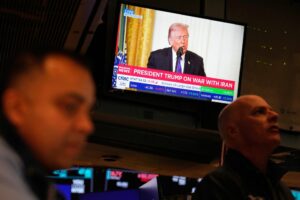
More than a month into the war in Iran, there’s still great uncertainty about why the United States launched this military offensive in the first place. There’s reason to believe, however, that the conflict has something to do with Iran’s nuclear program.
At an unrelated White House event on Tuesday, for example, Donald Trump said“I had one goal: They will have no nuclear weapon, and that goal has been attained.”
It was a curious comment, in part because by the president’s own assessmentIran didn’t have a nuclear weapon before he decided to launch the war, and in part because Secretary of State Marco Rubio this week presented the administration’s four major objectives in the conflict, none of which had anything to do with Iran’s nuclear program.
As for whether Trump’s newly manufactured “goal” has actually been “attained,” The New York Times reported“Unless something changes over the next two weeks — the target Mr. Trump set to begin withdrawing from the conflict — he will have left the Iranians with 970 pounds of highly enriched uranium, enough for 10 to a dozen bombs. The country will retain control over an even larger inventory of medium-enriched uranium that, with further enrichment, could be turned into bomb fuel, if the Iranians can rebuild that capacity after a month of steady bombing.”
The American president has acknowledged that these details are true, though he apparently no longer cares. Ahead of an Oval Office address to the nation about the war in Iran, the Republican spoke to Reuters about his perspective:
Of the enriched uranium, Trump said: ‘That’s so far underground, I don’t care about that.’
‘We’ll always be watching it by satellite,’ he added. He said Iran was ‘incapable’ of developing a weapon now.
The president’s comments definitely have a practical element: It’s been an open question for weeks as to whether Trump intends to try to seize Iran’s uranium stockpile, which would require ground troops and be profoundly dangerous for U.S. military service members.
If Trump told Reuters the truth and is prepared to let Iran keep the uranium it already has because he no longer “cares about that,” it would drastically reduce the likelihood of a ground invasion — one that would almost certainly cost lives.
But there’s another element to this worth keeping in mind as the process moves forward: Ever since the Obama administration struck the original nuclear agreement with Iran in 2015, Trump has insisted that it was wrong to allow the country to hold onto nuclear materials that might someday be used in a nuclear weapon.
A decade later, he’s suddenly indifferent to Iran’s uranium stockpile — which has only grown larger since Trump abandoned the Obama-era policy.
Trump’s goalposts, in other words, are on the move.
Indeed, if the American president’s comments reflect his true perspective (and with this guy, one never really knows), we’re due for a serious public conversation about the motives and objectives for the war. Because as things stand, before the war, Iran had a regime run by radical religious clerics and the Islamic Revolutionary Guard; the country had a significant uranium stockpile; and the Strait of Hormuz was open.
And now, Trump’s apparent vision for a successful offensive will include Iran with a regime run by radical religious clerics and the Islamic Revolutionary Guard; the country still holding a significant uranium stockpile; and the Strait of Hormuz will be open.
Mission accomplished, I guess?
Steve Benen is a producer for “The Rachel Maddow Show,” the editor of MaddowBlog and an MS NOW political contributor. He’s also the bestselling author of “Ministry of Truth: Democracy, Reality, and the Republicans’ War on the Recent Past.”
Just days after labeling the Senate deal to end the record-breaking shutdown at the Department of Homeland Security a “crap sandwich,” Speaker Mike Johnson, R-La., now appears ready to swallow it whole.
Johnson and Senate Majority Leader John Thune, R-S.D., announced Wednesday they will move forward with the two-track approach senators unanimously backed last Friday. They will pass a bill to fund most of DHS — with the exception of Immigration and Customs Enforcement and parts of Customs and Border Patrol — and then look to approve money for ICE and CBP in a separate reconciliation package.
“In following this two-track approach, the Republican Congress will fully reopen the Department, make sure all federal workers are paid, and specifically fund immigration enforcement and border security for the next three years so that those law-enforcement activities can continue uninhibited,” Johnson and Thune said in a joint statement.

The announcement amounts to a stunning reversal for Johnson, who was facing pressure from conservatives to oppose the Senate deal. Their objections centered on the lack of money for ICE, as well as the Senate’s failure to include new voter ID restrictions, championed by President Donald Trump, with the so-called SAVE America Act.
Instead, Johnson on Friday forced a House vote on an alternative measure to fund all of DHS for eight weeks. While it passed almost entirely along party linesthe stopgap measure stood no chance in the Senate, where Democrats have repeatedly rejected a similar proposal in recent weeks.
Lawmakers were back to square one.
But it turns out, all they needed was a little push from Trump.
Less than three hours before Johnson and Thune’s announcement, Trump urged Republicans — in a lengthy statement on Truth Social — to pass funding for ICE and border patrol through budget reconciliation. While that approach allows GOP lawmakers to bypass Democratic opposition, it requires near-unanimous GOP support.
Trump said he wants the legislation on his desk by June 1 — an ambitious timeline that dramatically increased pressure on Republicans.
“We are going to work as fast, and as focused, as possible to replenish funding for our Border and ICE Agents, and the Radical Left Democrats won’t be able to stop us,” Trump wrote on Truth Social. “We will not allow them to hurt the families of these Great Patriots by defunding them. I am asking that the Bill be on my desk NO LATER than June 1st.”

With Johnson suddenly on board, lawmakers appear poised to end the DHS shutdown just as soon as the House can reconvene. It’s unclear exactly when that might happen. The House isn’t due back until April 14. But Johnson could always call lawmakers back sooner — or look to pass the Senate bill while both chambers are out on recess through a special process.
Because the House never technically sent its 60-day continuing resolution to the Senate, the House could just recede from its amendment of the Senate-passed bill and immediately send the legislation to the president.
Either way, barring another sudden shift from Trump or House leadership, the longest government shutdown in U.S. history may soon be over — and Democrats are already taking a victory lap.
“Throughout this fight, Senate Democrats never wavered,” Senate Minority Leader Chuck Schumer said in a statement. “We were clear from the start: fund critical security, protect Americans, and no blank check for reckless ICE and Border Patrol enforcement.”
“We were united, held the line, and refused to let Republican chaos win,” Schumer added.
Kevin Frey is a congressional reporter for MS NOW.
Mychael Schnell is a reporter for MS NOW.
The Dictatorship
Former White House official: Trump’s Supreme Court attendance could be ‘perceived as intimidation’
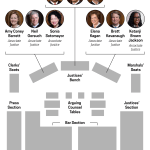
President Donald Trump became the first sitting American president to attend oral arguments at the Supreme Court on Wednesday morning when he sat in the audience to hear his administration argue to limit birthright citizenship guarantees for the children of undocumented immigrants and temporary U.S. residents.
Before arguments began, Trump entered the courtroom wearing his usual red tie and sat in the front row of the public seating area. Commerce Secretary Howard Lutnick and Attorney General Pam Bondi were also in the room.
None of the justices acknowledged Trump’s presence while he was in the courtroom.
As the justices began to question U.S. Solicitor General John Sauer, who was arguing on behalf of the administration, Trump remained focused and wore a blank expression.
After Sauer finished his arguments, Trump remained in the courtroom for a few minutes. He got up and quietly left, flanked by Secret Service agents, shortly after Cecillia Wang began her arguments for the ACLU.

Trump’s presence at the court is significant. A sitting president of the United States has never attended oral arguments at the high court before, which is widely considered a sign of respect for the balance of power between the federal government and the judiciary.
Two senior White House officials who requested anonymity to speak about the president’s internal strategy told MS NOW that Trump wanted to listen to the oral argument because “it’s an important case.” The outcome of the case will have sweeping legal implications for Trump’s sprawling immigration enforcement agenda.
“Behind closed doors there’s a realization of the tremendous legal wall this is to climb,” a former White House official familiar with Trump’s thinking who spoke on the condition of anonymity told MS NOW.
“I’m not sure of the calculation from him to go today. It will be perceived as intimidation, and some justices won’t like that,” the former official said.
Trump has shown scorn for the justices for their ruling on his aggressive tariff policy. Earlier this year, Trump said the justices who ruled against the policy were an “an embarrassment to their families.” The president has railed against the justices, including the ones he appointed in his first term, for striking down his sprawling trade agenda.
Trump has pivoted between slamming the justices on social media for the February tariff ruling and calling on them to uphold his birthright citizenship order.
Domicile, the legal term for the place where an individual maintains a permanent home, was at the heart of Sauer’s argument Wednesday. Sauer argued that parents of children born in the U.S. must be domiciled in the United States and demonstrate allegiance to the country in order for their children to be granted citizenship.
Trump left the court after his administration’s argument faced pushback from the court’s key conservative justices, Chief Justice John Roberts and Justice Neil Gorsuch, as well as the rest of the justices on the bench.
As Trump’s motorcade rolled back to the White House, droves of tourists watched and responded with positive and negative gestures. National Guard members were in the crowds, as well.
The case, Trump v. Barbara, centers on the citizenship clause of the 14th Amendment, which has long been understood to confer citizenship to almost all individuals born on U.S. soil: “All persons born or naturalized in the United States and subject to the jurisdiction thereof are citizens of the United States and of the state wherein they reside.”
Shortly after returning to the White House last year, Trump signed an executive order seeking to end that guarantee. The justices will weigh whether the executive order complies with the federal statute that codified that clause.
Trump did not stay to hear more than the first few minutes of the dissenting arguments. But after returning to the White House, he posted a response on his Truth Social platform. “We are the only Country in the World STUPID enough to allow “Birthright” Citizenship!”
Sydney Carruth is a breaking news reporter covering national politics and policy for MS NOW. You can send her tips from a non-work device on Signal at SydneyCarruth.46 or follow her work on X and Bluesky.
Jake Traylor is a White House correspondent for MS NOW.
Fallon Gallagher is a legal affairs reporter for MS NOW.
- ‘No evidence it’s real’: Officials see few signs Trump’s NATO rhetoric is turning into action
- ‘I don’t care about that’: Trump moves the goal posts on Iran’s uranium stockpile
- Mike Johnson caves to the Senate, paving the way for likely DHS shutdown deal
- Former White House official: Trump’s Supreme Court attendance could be ‘perceived as intimidation’
- The Strait of Hormuz is the U.S.’ problem now — whether Trump likes it or not
- Sen. Mark Kelly slams Pete Hegseth for injecting Christian rhetoric into Iran war

- Hill staffers brace for their boss’s ‘TMZ moment’
- Trump’s strategy to calm markets during Iran war is falling flat
- Trump’s MAGA allies have a new plan for mass deportations. It could splinter the coalition.
- Isaacman aims to reinvigorate NASA’s image, starting with the moon
-

 Politics1 year ago
Former ‘Squad’ members launching ‘Bowman and Bush’ YouTube show
-

 The Dictatorship1 year ago
Luigi Mangione acknowledges public support in first official statement since arrest
-

 Politics1 year ago
Former Kentucky AG Daniel Cameron launches Senate bid
-

 Politics1 year ago
Blue Light News’s Editorial Director Ryan Hutchins speaks at Blue Light News’s 2025 Governors Summit
-

 The Dictatorship7 months ago
Mike Johnson sums up the GOP’s arrogant position on military occupation with two words
-

 The Dictatorship1 year ago
Pete Hegseth’s tenure at the Pentagon goes from bad to worse
-
Uncategorized1 year ago
Bob Good to step down as Freedom Caucus chair this week
-

 Politics12 months ago
Democrat challenging Joni Ernst: I want to ‘tear down’ party, ‘build it back up’