
The Dictatorship
Trump’s ‘Department of War’ launch is more than just a shallow rebrand

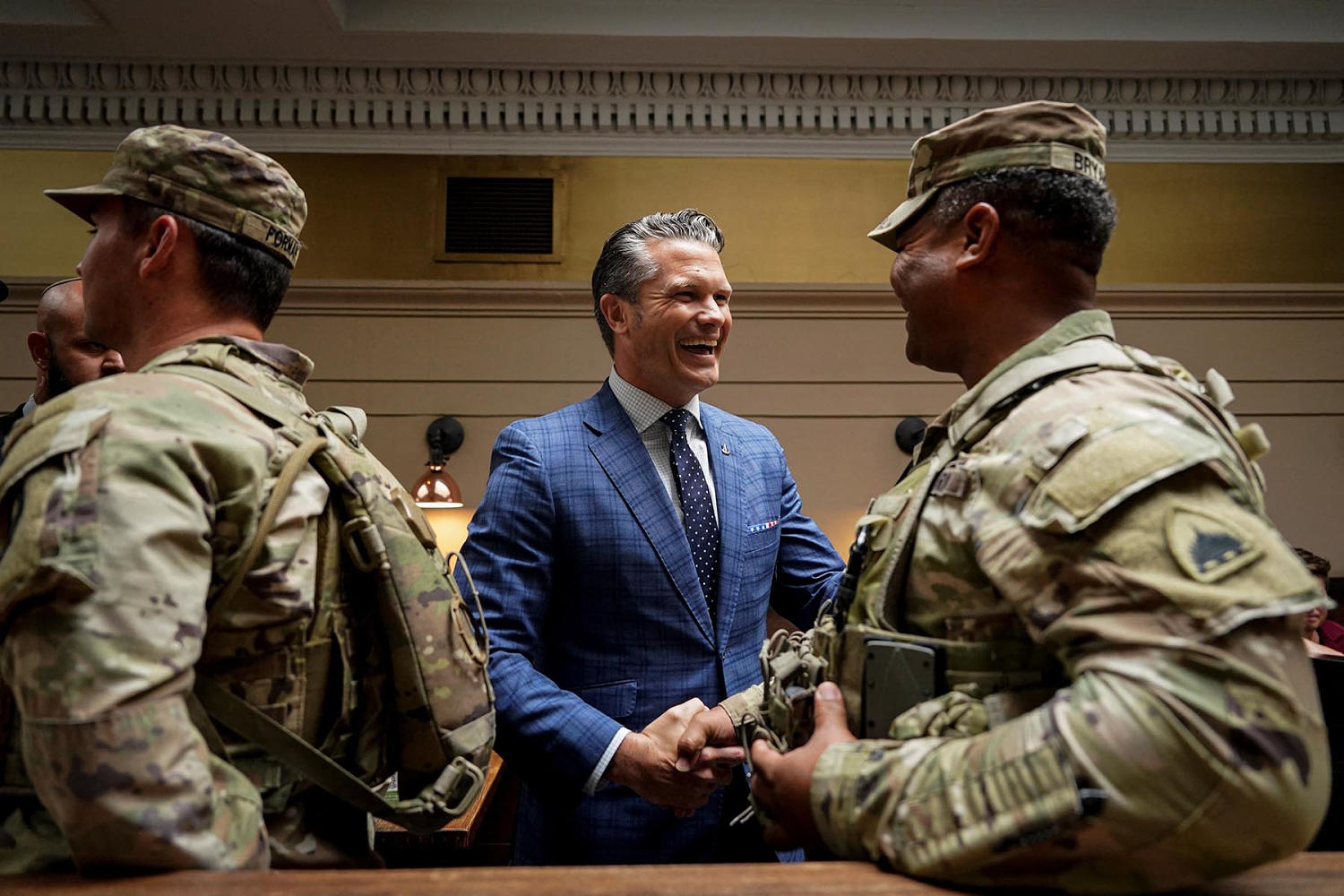
If you needed any more proof that President Donald Trump’s quest to be considered “the ultimate peace president” and secure a Nobel Peace Prize is a farce, then look no further than his executive order on Friday rebranding the Department of Defense as the Department of War.
NBC News reports that Trump’s executive order “won’t rename the Defense Department, but it will authorize Defense Secretary Pete Hegseth to use secondary titles like ‘secretary of war’ and ‘Department of War’ in official correspondence and public communications and during formal ceremonies, according to a White House preview of the order.” (Fully renaming the department would require congressional approval.) The Department of Defense website is already redirecting to war.gov.
Trump is not a student of history, but he does understand that names can telegraph meaning.
The Department of War name is a throwback — to 1789, when Congress established the War Department to oversee the operation of the new nation’s military. The department was renamed the National Military Establishment in 1947 as part of a reorganization of U.S. military services, and then amended two years later to the Department of Defense.
“Everybody likes that we had an unbelievable history of victory when it was Department of War,” Trump told reporters in August. “Then we changed it to Department of Defense.” He added, “Defense is too defensive. And we want to be defensive, but we want to be offensive too if we have to be.”
Trump is not a student of history, but he does understand that names can telegraph meaning. As David Sanger, a New York Times reporter and the author of several U.S. foreign policy books, points outthe 1949 change to the Department of Defense was an adaptation to a changing global arena — the name change took place during the Cold War, just weeks before the Soviet Union proved it could detonate a nuclear weapon. “It was a terrifying time for Americans, and the new name was intended to reflect an era in which deterrence was critical — because war, if it broke out among the superpowers, could be planet-ending,” Sanger wrote on Friday. The Cold War never got “hot” directly between the U.S. and the Soviet Union — even if the U.S. did wreak havoc across the Global South through support of murderous dictators and bloody proxy wars.
Referring to the Defense Department as the “Department of War” signals Trump’s interest in staking out a more openly aggressive posture, exploiting the United States’ position as the world’s pre-eminent military power without apology. Just as Trump considers naked power grabs and coercion as his natural right domestically, so too he considers it his natural right across the world. He delights in talking about annexing Canada, seizing the Panama Canal and taking control of Greenland. He blames Ukraine for Russia’s invasion of Ukraineand supports Israel’s ethnic cleansing of Gaza — and has floated the idea of the U.S. participating in taking over Gaza.
To be clear, the U.S. Department of Defense is plenty aggressive already. Since World War II, the U.S. has intervened militarily in other countries on hundreds of occasions and launched terrible wars under the banner of “defense” and “deterrence” or “pre-emptive attacks.” In other words, the Department of Defense is an agent of imperialism and brutality. Even so, Trump seems interested in reviving a kind of 19th-century America ethos, one in which the U.S. seized territory from other countries during war — or at least Trump wants to maintain the right to do so. And while prior to Trump, the U.S. was inconsistent about upholding a “rules-based order,” it at least paid lip service to the ideal. Trump appears inclined to explode its scaffolding.
This appetite for expanding the frontiers of U.S. war-making and domination was on display this week during Trump’s strike on what he claims was a drug-carrying vessel operated by the Venezuelan Tren de Aragua gang. According to The New York TimesTrump is “claiming the power to shift maritime counterdrug efforts from law enforcement rules to wartime rules” and “used the military in a way that had no clear legal precedent or basis, according to specialists in the laws of war and executive power.” Trump also blew up negotiations over a new Iran nuclear deal by bombing Iran and oversaw a pointless and destructive offensive bombing campaign against the Houthis in Yemen.
Despite all that, and despite his attempt to resurrect a Department of War, Trump somehow still maintains that the Nobel committee ought to laud him for helping bring about peace.

Zeeshan Aleem is a writer and editor for BLN Daily. Previously, he worked at Vox, HuffPost and Blue Light News, and he has also been published in, among other places, The New York Times, The Atlantic, The Nation, and The Intercept. You can sign up for his free politics newsletter here.


The Dictatorship
Airport lines grow longer — and Congress can’t even agree if DHS shutdown talks exist
It’s been nearly a month since thousands of Department of Homeland Security employees were forced to begin working without pay, and the negotiations to overhaul and fund the department haven’t yielded any meaningful progress.
In fact, talks have moved so slowly that lawmakers are now publicly arguing over whether negotiations even exist.
Lengthening TSA lines, dwindling disaster aid funds and rejected proposals to fund portions of the department have forced lawmakers to acknowledge they’re nowhere close to a deal.
“If Democrats won’t sit down with us, it’s showing you who’s playing you right now,” Sen. Katie Britt, R-Ala., told reporters Tuesday. “They’re playing you.”

Britt said she’s sought meetings with Sen. Patty Murray, D-Wash., the top Democrat on the Appropriations Committee, and has been rebuffed.
Murray said she’s willing to negotiate, but President Donald Trump’s White House needs to acknowledge it has to change tactics at Immigration and Customs Enforcement, as Democrats seek requirements for agents to wear body cameras, remove masks and cooperate with state and local investigations, among other things.
“I am willing to talk to people, but I’m not willing to sit in a room, have coffee, give away a few things and have Stephen Miller override whatever we all agreed to in a room,” Murray said on the Senate floor Wednesday.
Murray sought agreement on the Senate floor to pass a bill to fund most of the department, excluding funds for ICE, Customs and Border Protection and the secretary’s office, which Britt objected to.
That leaves the TSA, Federal Emergency Management Agency, Coast Guard and other agencies running on fumes, as pressure builds on lawmakers.
FEMA was projected to have about $5.9 billion left in its Disaster Relief Fund at the end of February and $2.1 billion left at the end of this month, according to its latest report. Those funds were projected to run out before the end of April.
TSA wait times have varied widely as employees work without pay. On Wednesday afternoon, the Hartsfield-Jackson Atlanta International Airport posted TSA wait times of 40 minutes at its main terminal. But Dallas Fort Worth International Airport, another major hub, posted wait times between 0 and 10 minutes at its terminals. Meanwhile, over the weekend, wait times in Houston and New Orleans were as long as three hours.

The ouster of Kristi Noem as Homeland Security secretary, and the selection of Sen. Markwayne Mullin, R-Okla., as the new nominee, hasn’t won over Democrats. Senate Minority Leader Chuck Schumer, D-N.Y., said ICE needs to be overhauled legislatively, and not just a change in personnel.
“The president has fired Kristi Noem. Good riddance,” Schumer said last week when Mullin was named as the new nominee. “But the problems at this agency, at ICE, transcend any one person. The rot is deep.”
Sen. Thom Tillis, R-N.C., a Republican who helped push Noem out of her position — citing over-the-top mass deportations, mismanagement of disaster responses and her decision to kill her dog — said he’s not sure Mullin will change the negotiations over DHS funding.
He said he expects Mullin to “have a transformative impact on FEMA.” But Tillis said he still wants answers about ICE operations in North Carolina, which Noem didn’t answer.
“I just want to demonstrate that this mass deportation idea was a bad idea because it was quantity over quality — quality of really bad people that need to be incarcerated or deported, or hopefully deported and incarcerated in whatever country they came from,” Tillis told MS NOW Wednesday.
It’s been nearly two weeks since the White House last sent Democrats an offer in the ICE negotiations. Senate Majority Leader John Thune, R-S.D., told reporters Wednesday that Democrats still hadn’t responded to the latest GOP offer.
Thune said Republicans aren’t going to agree to a funding bill that cuts out money for ICE and CBP.
“You take away border security — I can’t imagine wanting to do that,” he said. “This bill needs to move together.”
The spat over funding other agencies only highlighted the chasm between the two parties on policy changes at ICE and CBP.
“We are not going to defund the police,” Britt said of Murray’s proposal to fund other agencies. “We are not going back to Biden’s open borders.”
Murray pushed back, contending it’s “absurd” to say Democrats are defunding the police. She noted that ICE and CBP received billions of dollars in last year’s Republican reconciliation bill — money that’s still available during the shutdown.
After the tense exchange on the Senate floor Wednesday, Sen. Brian Schatz, D-Hawaii, said it’s clear lawmakers have a long way to go.
“We are not that close,” Schatz said. “And so if everybody agrees on that, that we’re not that close, that it’s not like negotiations have shut down, but they’re a little stalled.”
Jack Fitzpatrick covers Congress for MS NOW. He previously reported for Bloomberg Government, Morning Consult and National Journal. He has bachelor’s and master’s degrees from Arizona State University.

Three brothers were arrested Wednesday in a weekend bombing at the U.S. Embassy in Oslowhich Norwegian police are treating as a possible act of terrorism.
Authorities said the men, who have not been publicly identified, are Norwegian citizens “with a background from Iraq.” They are all in their 20s.
Officials earlier said Sunday’s explosion caused limited damage to the structure and no injuries. Prime Minister Jonas Store called the attack “very serious and completely unacceptable.”
Investigators said they have not determined a motive but had not ruled out terrorism.
“It’s natural to see this in the context of the current security situation and that this could be an attack deliberately targeting the U.S. Embassy,” Oslo police official Frode Larsen said shortly after the explosionreferring to the U.S.-Israel war with Iran.
U.S. embassies and consulates around the world, particularly in Gulf countries caught in the crossfire, have been on high alert since the war with Iranbegan Feb. 28. The U.S. ordered the departure of nonemergency government personnel and families from missions in Saudi Arabia, Kuwait, the United Arab Emirates, Qatar, Bahrain, Iraq and Oman. Suspected Iranian drones struck the U.S. Embassy in Riyadh, Saudi Arabiaand the U.S. Consulate in Dubailast week. The U.S. Embassy in Baghdad was also targeted in a rocket attackSaturday.
Shortly after the bombing in Oslo, shots were fired at the exterior of the U.S. Consulate in Toronto, Canada, on Tuesday.
The State Department did not immediately respond to MS NOW’s request for comment on the Oslo arrests.
Erum Salam is a breaking news reporter for MS NOW, with a focus on how global events and foreign policy shape U.S. politics. She previously was a breaking news reporter for The Guardian.

Today’s edition of quick hits.
* All eyes on the Strait of Hormuz: “Leaders from the coalition of G7 countries — which is made up of the United States, Canada, France, Germany, Italy, Japan and the United Kingdom — met virtually today to discuss how to ease the economic strain caused by the Iran war, including the possibility of escorting ships through the Strait of Hormuz with military assets.”
* In related news: “Iran’s Revolutionary Guard said it struck two ships in the Strait of Hormuz on Wednesday, as the war disrupts one of the world’s most crucial economic passageways and threatens industries across the globe.”
* A case I’ve been following: “The U.S. must keep making payments on the $16 billion New York Hudson Tunnel, after an appeals court on Wednesday rejected the Trump administration’s bid to halt paying for the project.”
* All of the latest inflation data was collected before the war: “Prices consumers pay for a broad range of goods and services rose in line with expectations for February, offering a final look at inflation pressures before an oil shock tied to the Iran war rattled the outlook. The consumer price index increased a seasonally adjusted 0.3% for the month, putting the 12-month inflation rate at 2.4%, according to Bureau of Labor Statistics data released Wednesday. Both numbers matched the Dow Jones consensus forecast.”
* The Epstein files: “On the heels of news reports that more than 40,000 files were either withheld or taken down from the Department of Justice’s site with documents related to the Jeffrey Epstein case, the DOJ late last week released documents including FBI memos related to accusations against President Donald Trump. But MS NOW has found that the released files still appear to be incomplete, missing FBI notes and memos reflecting interviews with women alleging abuse by other prominent men.”
* In related news: “The anonymous artists who have targeted President Donald Trump with satirical statues and installations in Washington struck again on the National Mall on Tuesday morning with an enormous statue of the president embracing the deceased convicted sex offender Jeffrey Epstein in a reenactment of a famous scene from the movie ‘Titanic.’”
* Bringing more guns to more convicted criminals: “The Trump administration quietly restored the gun rights to 22 people who had lost them because of felonies, indictments or other convictions this year as it prepares to revive a long-dormant program that’s expected to draw a tsunami of applications.”
* This proposal seems entirely worthwhile: “Sen. Adam Schiff (D-Calif.) is introducing new legislation Wednesday to recover federal money that’s been paid out to U.S. presidents through settlements resulting from White House coercion. Here’s a copy of his billfirst obtained by HuffPost. In case it’s not obvious, the legislation is directly aimed at President Donald Trump.”
See you tomorrow.
Steve Benen is a producer for “The Rachel Maddow Show,” the editor of MaddowBlog and an MS NOW political contributor. He’s also the bestselling author of “Ministry of Truth: Democracy, Reality, and the Republicans’ War on the Recent Past.”
- Tillis says DOJ probe of Powell ‘reaching the point of the absurd’
- House GOP eyes reconciliation process to pass Middle East war aid

- House Oversight chair moving quickly to schedule Epstein testimony with Bondi, Lutnick
- Trump’s energy ‘tiger team’ struggles to find its roar with Iran
- Republicans plan marathon debate for SAVE America Act

- Oklahoma Rep. Hern launches bid to succeed Mullin in Senate

- Tillis says DOJ probe of Powell ‘reaching the point of the absurd’
- Airport lines grow longer — and Congress can’t even agree if DHS shutdown talks exist
- Norway arrests 3 brothers in bombing at U.S. Embassy in Oslo

- Wednesday’s Mini-Report, 3.11.26

-

 The Dictatorship1 year ago
Luigi Mangione acknowledges public support in first official statement since arrest
-

 Politics1 year ago
Former ‘Squad’ members launching ‘Bowman and Bush’ YouTube show
-

 Politics1 year ago
Blue Light News’s Editorial Director Ryan Hutchins speaks at Blue Light News’s 2025 Governors Summit
-

 Politics1 year ago
Former Kentucky AG Daniel Cameron launches Senate bid
-

 The Dictatorship6 months ago
Mike Johnson sums up the GOP’s arrogant position on military occupation with two words
-

 The Dictatorship1 year ago
Pete Hegseth’s tenure at the Pentagon goes from bad to worse
-

 Politics11 months ago
Democrat challenging Joni Ernst: I want to ‘tear down’ party, ‘build it back up’
-
Uncategorized1 year ago
Bob Good to step down as Freedom Caucus chair this week