
The Dictatorship
Trump warns of ‘severe consequences’ if Putin does not agree to stop war after summit

Berlin (AP) – President Donald Trump warned Wednesday that there will be “very severe consequences” if Russian President Vladimir Putin does not agree to stop the war against Ukraine after the two leaders meet for a summit later this week in Alaska.
Trump made the comment in response to a question from a reporter after announcing this year’s Kennedy Center Honors recipients in Washington. He did not say what the consequences might be.
The remark came soon after Trump consulted with European leaders, who said the president assured them he would make a priority of trying to achieve a ceasefire in Ukraine when he speaks with Putin on Friday in Anchorage.
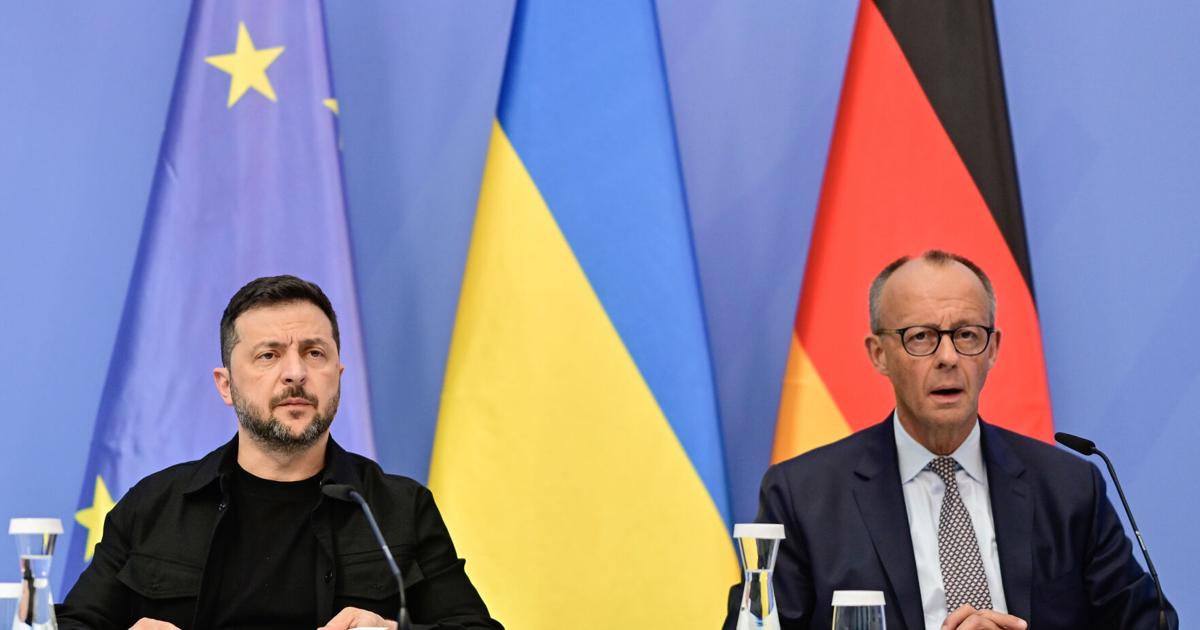
Ukrainian President Volodymyr Zelenskyy, left, and German Chancellor Friedrich Merz attend a video meeting of European leaders with US President Donald Trump on the Ukraine war in Berlin, Germany, Wednesday, Aug. 13, 2025, ahead of the summit between the US and Russian leaders. (John MacDougall/Pool Photo via AP)
Ukrainian President Volodymyr Zelenskyy, left, and German Chancellor Friedrich Merz attend a video meeting of European leaders with US President Donald Trump on the Ukraine war in Berlin, Germany, Wednesday, Aug. 13, 2025, ahead of the summit between the US and Russian leaders. (John MacDougall/Pool Photo via AP)
Ukrainian President Volodymyr Zelenskyy joined several of Kyiv’s main allies in the virtual meeting with the U.S. leader, and Zelenskyy told the group that Putin “is bluffing” ahead of the planned summit about Russia’s ability to occupy all of Ukraine and shake off sanctions.
German Chancellor Friedrich Merz said afterward that “important decisions” could be made in Alaska, but he stressed that “fundamental European and Ukrainian security interests must be protected.”
Merz convened Wednesday’s meeting in an attempt to make sure European and Ukrainian leaders are heard ahead of the summit.
He stressed that a ceasefire must come at the beginning of negotiations. He told reporters that Trump “also wants to make this one of his priorities” in the meeting with Putin.
At a separate appearance in France, French President Emmanuel Macron said Trump “was very clear” that the U.S. wants to achieve a ceasefire at the summit.
Following Friday’s summit, Macron added, Trump will “seek a future trilateral meeting” — one involving Trump, Putin and Zelenskyy. He said he hoped that it could be held in Europe “in a neutral country that is acceptable to all parties.”
French President Emmanuel Macron speaks during a statement following a video conference on Ukraine at the Fort de Bregancon in Bormes-les-Mimosas, southern France, Wednesday Aug.13, 2025. (Philippe Magoni, Pool via AP)
French President Emmanuel Macron speaks during a statement following a video conference on Ukraine at the Fort de Bregancon in Bormes-les-Mimosas, southern France, Wednesday Aug.13, 2025. (Philippe Magoni, Pool via AP)
Merz, who described Wednesday’s conversation as “constructive and good,” said the Europeans made clear that “Ukraine must sit at the table as soon as there are follow-up meetings.”
European allies have pushed for Ukraine’s involvement in any peace talks, fearful that discussions that exclude Kyiv could otherwise favor Moscow.
The Ukrainian president, who traveled to Berlin to join the meeting alongside Merz, has repeatedly cast doubt on whether Putin would negotiate in good faith. He said Wednesday that he hoped an immediate ceasefire will be “the central topic” in Alaska, but also argued that Putin “definitely does not want peace.”
Zelenskyy said Putin “is trying to apply pressure … on all sectors of the Ukrainian front” in an attempt to show that Russia is “capable of occupying all of Ukraine.” Putin is also bluffing that sanctions “do not matter to him and are ineffective,” he added. “In reality, sanctions are very helpful and are hitting Russia’s war economy hard.”
Britain’s Prime Minister Keir Starmer co-chairs a videoconference call with European leaders on Ukraine, in London, Wednesday, Aug. 13, 2025. (Jack Taylor/Pool Photo via AP)
Britain’s Prime Minister Keir Starmer co-chairs a videoconference call with European leaders on Ukraine, in London, Wednesday, Aug. 13, 2025. (Jack Taylor/Pool Photo via AP)
The stakes for Europe
Trump has said he wants to see whether Putin is serious about ending the war, now in its fourth year, describing Friday’s summit as “a feel-out meeting” where he can assess the Russian leader’s intentions.
Yet Trump has disappointed allies in Europe by saying Ukraine will have to give up some Russian-held territory. He has also said Russia must accept land swapsalthough it was unclear what Putin might be expected to surrender.
Trump on Monday ducked repeated chances to say that he would push for Zelenskyy to take part in his discussions with Putin, and the president was dismissive of Zelenskyy and his need to be part of an effort to seek peace. Trump said that following Friday’s summit, a meeting between the Russian and Ukrainian leaders could be arranged, or that it could also be a meeting with “Putin and Zelenskyy and me.”
The Europeans and Ukraine are wary that Putin, who has waged the biggest land war in Europe since 1945 and used Russia’s energy might to try to intimidate the European Union, might secure favorable concessions and set the outlines of a peace deal without them.
The overarching fear of many European countries is that Putin will set his sights on one of them next if he wins in Ukraine.
Merz said that “if there is no movement on the Russian side in Alaska, then the United States and the Europeans should and must increase the pressure” on Moscow.
A soldier of Ukraine’s 30th Mechanized Brigade prepares to fire a howitzer towards Russian positions on the front line near near Kharkiv, Ukraine, Wednesday, Aug. 13, 2025. (AP Photo/Andrii Marienko)
A soldier of Ukraine’s 30th Mechanized Brigade prepares to fire a howitzer towards Russian positions on the front line near near Kharkiv, Ukraine, Wednesday, Aug. 13, 2025. (A P Photo/Andrii Marienko)
Land concessions a non-starter for Kyiv
Zelenskyy said Tuesday that Putin wants Ukraine to withdraw from the remaining 30% of the Donetsk region that it still controls as part of a ceasefire deala proposal the Ukrainian leader categorically rejected.
Zelenskyy reiterated that Ukraine would not give up any territory it controls, saying that would be unconstitutional and would serve only as a springboard for a future Russian invasion.
He said diplomatic discussions led by the U.S. focused on ending the war have not addressed key Ukrainian demands, including security guarantees to prevent future Russian aggression and ensuring that Europe is included in negotiations.
Three weeks after Trump returned to office, his administration took the leverage of Ukraine’s NATO membership off the table — something Putin has demanded — and signaled that the EU and Ukraine must handle security in Europe now while America focuses its attention elsewhere.
Senior EU officials believe Trump may be satisfied with simply securing a ceasefire in Ukraine and that he is probably more interested in broader U.S. interests and great power politics, aiming to ramp up business with Russia and rehabilitate Putin.
Russian advances in Donbas
Russian forces on the ground in Ukraine have been closing in on a key territorial grab around the city of Pokrovskin the eastern Donbas region that comprises Ukraine’s eastern industrial heartland, which Putin has long coveted.
Military analysts using open-source information to monitor the battles have said Ukraine’s ability to fend off those advances could be critical. Losing Pokrovsk would hand Russia an important victory ahead of the summit and could complicate Ukrainian supply lines to the Donetsk region, where the Kremlin has focused the bulk of military efforts.
___
Corbet reported from Paris. Associated Press writers Annie Ma in Washington, Lorne Cook in Brussels, Samya Kullab in Kyiv, Ukraine, and Stefanie Dazio in Berlin contributed to this report.
___
Follow AP’s coverage of the war in Ukraine at https://apnews.com/hub/russia-ukraine



WASHINGTON (AP) — Citing the First Amendment, a federal judge on Tuesday agreed to permanently block the Trump administration from implementing a presidential directive to end federal funding for National Public Radio and the Public Broadcasting Service, two media entities that the White House has said are counterproductive to American priorities.
The operational impact of U.S. District Judge Randolph Moss’ decision was not immediately clear — both because it will likely be appealed and because too much damage to the public-broadcasting system has already been done, both by the president and Congress.
Moss ruled that President Donald Trump’s executive order to cease funding for NPR and PBS is unlawful and unenforceable. The judge said the First Amendment right to free speech “does not tolerate viewpoint discrimination and retaliation of this type.”
“It is difficult to conceive of clearer evidence that a government action is targeted at viewpoints that the President does not like and seeks to squelch,” wrote Moss, who was nominated to the bench by President Barack Obama, a Democrat.
White House spokesperson Abigail Jackson said Moss’ decision is “a ridiculous ruling by an activist judge attempting to undermine the law.”
“NPR and PBS have no right to receive taxpayer funds, and Congress already voted to defund them. The Trump Administration looks forward to ultimate victory on the issue,” Jackson said in a statement.
PBS, with programming ranging from “Sesame Street” and “Mister Rogers’ Neighborhood” to Ken Burns’ documentaries, has been operating for more than half a century. NPR has news programming from “All Things Considered” and cultural shows like the “Tiny Desk” concerts. For decades, the fates of both systems have been part of a philosophical debate over whether government should help fund their operations.
Punishment for ‘past speech’ cited in decision
The judge noted that Trump’s executive order simply directs that all federal agencies “cut off any and all funding” to NPR, which is based in Washington, and PBS, based in Arlington, Virginia.
“The Federal Defendants fail to cite a single case in which a court has ever upheld a statute or executive action that bars a particular person or entity from participating in any federally funded activity based on that person or entity’s past speech,” the judge wrote.
Last year, Trump, a Republican, said at a news conference he would “love to” defund NPR and PBS because he believes they’re biased in favor of Democrats.
“The message is clear: NPR and PBS need not apply for any federal benefit because the President disapproves of their ‘left wing’ coverage of the news,” Moss wrote.
NPR accused the Corporation for Public Broadcasting of violating its First Amendment free speech rights when it moved to cut off its access to grant money appropriated by Congress. NPR also claims Trump wants to punish it for the content of its journalism.
“Public media exists to serve the public interest — that of Americans — not that of any political agenda or elected official,” said Katherine Maher, NPR’s president and CEO. She called the decision a decisive affirmation of the rights of a free and independent press.
PBS chief Paula Kerger said she was thrilled with the decision. The executive order, she said, is “textbook” unconstitutional viewpoint discrimination and retaliation. “At PBS, we will continue to do what we’ve always done: serve our mission to educate and inspire all Americans as the nation’s most trusted media institution.”
Last August, CPB announced it would take steps toward closing itself down after being defunded by Congress.
A victory, though incremental, for press freedom
Plaintiffs’ attorney Theodore Boutrous said Tuesday’s ruling is “a victory for the First Amendment and for freedom of the press.”
“As the Court expressly recognized, the First Amendment draws a line, which the government may not cross, at efforts to use government power — including the power of the purse — ‘to punish or suppress disfavored expression’ by others,” Boutrous said in a statement. “The Executive Order crossed that line.”
The judge agreed with government attorneys that some of the news outlets’ legal claims are moot, partly because the CPB no longer exists.
“But that does not end the matter because the Executive Order sweeps beyond the CPB,” Moss added. “It also directs that all federal agencies refrain from funding NPR and PBS — regardless of the nature of the program or the merits of their applications or requests for funding.”
NPR and three public radio stations sued administration officials last May. While Trump was named as a defendant, the case did not include Congress — and the legislative body has played a large role in the public-broadcasting saga in the past year.
Trump’s executive order immediately cut millions of dollars in funding from the Education Department to PBS for its children’s programming, forcing the system to lay off one-third of the PBS Kids staff. The Trump order didn’t impact Congress’ vote to eliminate the overall federal appropriations for PBS and NPR, which forced the closure of the Corporation for Public Broadcasting, the entity that funneled that money to the TV and radio networks.
___
AP Media Writer David Bauder and AP writer Darlene Superville contributed to this report.
More than a month into the war in Iran, there’s still great uncertainty about why the United States launched this military offensive in the first place. There’s reason to believe, however, that the conflict has something to do with Iran’s nuclear program.
At an unrelated White House event on Tuesday, for example, Donald Trump said“I had one goal: They will have no nuclear weapon, and that goal has been attained.”
It was a curious comment, in part because by the president’s own assessmentIran didn’t have a nuclear weapon before he decided to launch the war, and in part because Secretary of State Marco Rubio this week presented the administration’s four major objectives in the conflict, none of which had anything to do with Iran’s nuclear program.
As for whether Trump’s newly manufactured “goal” has actually been “attained,” The New York Times reported“Unless something changes over the next two weeks — the target Mr. Trump set to begin withdrawing from the conflict — he will have left the Iranians with 970 pounds of highly enriched uranium, enough for 10 to a dozen bombs. The country will retain control over an even larger inventory of medium-enriched uranium that, with further enrichment, could be turned into bomb fuel, if the Iranians can rebuild that capacity after a month of steady bombing.”
The American president has acknowledged that these details are true, though he apparently no longer cares. Ahead of an Oval Office address to the nation about the war in Iran, the Republican spoke to Reuters about his perspective:
Of the enriched uranium, Trump said: ‘That’s so far underground, I don’t care about that.’
‘We’ll always be watching it by satellite,’ he added. He said Iran was ‘incapable’ of developing a weapon now.
The president’s comments definitely have a practical element: It’s been an open question for weeks as to whether Trump intends to try to seize Iran’s uranium stockpile, which would require ground troops and be profoundly dangerous for U.S. military service members.
If Trump told Reuters the truth and is prepared to let Iran keep the uranium it already has because he no longer “cares about that,” it would drastically reduce the likelihood of a ground invasion — one that would almost certainly cost lives.
But there’s another element to this worth keeping in mind as the process moves forward: Ever since the Obama administration struck the original nuclear agreement with Iran in 2015, Trump has insisted that it was wrong to allow the country to hold onto nuclear materials that might someday be used in a nuclear weapon.
A decade later, he’s suddenly indifferent to Iran’s uranium stockpile — which has only grown larger since Trump abandoned the Obama-era policy.
Trump’s goalposts, in other words, are on the move.
Indeed, if the American president’s comments reflect his true perspective (and with this guy, one never really knows), we’re due for a serious public conversation about the motives and objectives for the war. Because as things stand, before the war, Iran had a regime run by radical religious clerics and the Islamic Revolutionary Guard; the country had a significant uranium stockpile; and the Strait of Hormuz was open.
And now, Trump’s apparent vision for a successful offensive will include Iran with a regime run by radical religious clerics and the Islamic Revolutionary Guard; the country still holding a significant uranium stockpile; and the Strait of Hormuz will be open.
Mission accomplished, I guess?
Steve Benen is a producer for “The Rachel Maddow Show,” the editor of MaddowBlog and an MS NOW political contributor. He’s also the bestselling author of “Ministry of Truth: Democracy, Reality, and the Republicans’ War on the Recent Past.”
Just days after labeling the Senate deal to end the record-breaking shutdown at the Department of Homeland Security a “crap sandwich,” Speaker Mike Johnson, R-La., now appears ready to swallow it whole.
Johnson and Senate Majority Leader John Thune, R-S.D., announced Wednesday they will move forward with the two-track approach senators unanimously backed last Friday. They will pass a bill to fund most of DHS — with the exception of Immigration and Customs Enforcement and parts of Customs and Border Patrol — and then look to approve money for ICE and CBP in a separate reconciliation package.
“In following this two-track approach, the Republican Congress will fully reopen the Department, make sure all federal workers are paid, and specifically fund immigration enforcement and border security for the next three years so that those law-enforcement activities can continue uninhibited,” Johnson and Thune said in a joint statement.

The announcement amounts to a stunning reversal for Johnson, who was facing pressure from conservatives to oppose the Senate deal. Their objections centered on the lack of money for ICE, as well as the Senate’s failure to include new voter ID restrictions, championed by President Donald Trump, with the so-called SAVE America Act.
Instead, Johnson on Friday forced a House vote on an alternative measure to fund all of DHS for eight weeks. While it passed almost entirely along party linesthe stopgap measure stood no chance in the Senate, where Democrats have repeatedly rejected a similar proposal in recent weeks.
Lawmakers were back to square one.
But it turns out, all they needed was a little push from Trump.
Less than three hours before Johnson and Thune’s announcement, Trump urged Republicans — in a lengthy statement on Truth Social — to pass funding for ICE and border patrol through budget reconciliation. While that approach allows GOP lawmakers to bypass Democratic opposition, it requires near-unanimous GOP support.
Trump said he wants the legislation on his desk by June 1 — an ambitious timeline that dramatically increased pressure on Republicans.
“We are going to work as fast, and as focused, as possible to replenish funding for our Border and ICE Agents, and the Radical Left Democrats won’t be able to stop us,” Trump wrote on Truth Social. “We will not allow them to hurt the families of these Great Patriots by defunding them. I am asking that the Bill be on my desk NO LATER than June 1st.”

With Johnson suddenly on board, lawmakers appear poised to end the DHS shutdown just as soon as the House can reconvene. It’s unclear exactly when that might happen. The House isn’t due back until April 14. But Johnson could always call lawmakers back sooner — or look to pass the Senate bill while both chambers are out on recess through a special process.
Because the House never technically sent its 60-day continuing resolution to the Senate, the House could just recede from its amendment of the Senate-passed bill and immediately send the legislation to the president.
Either way, barring another sudden shift from Trump or House leadership, the longest government shutdown in U.S. history may soon be over — and Democrats are already taking a victory lap.
“Throughout this fight, Senate Democrats never wavered,” Senate Minority Leader Chuck Schumer said in a statement. “We were clear from the start: fund critical security, protect Americans, and no blank check for reckless ICE and Border Patrol enforcement.”
“We were united, held the line, and refused to let Republican chaos win,” Schumer added.
Kevin Frey is a congressional reporter for MS NOW.
Mychael Schnell is a reporter for MS NOW.
- NASA’s historic moon mission blasts into space
- Judge blocks Trump order to end funding for NPR and PBS

- ‘No evidence it’s real’: Officials see few signs Trump’s NATO rhetoric is turning into action
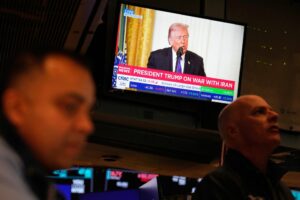
- ‘I don’t care about that’: Trump moves the goal posts on Iran’s uranium stockpile
- Mike Johnson caves to the Senate, paving the way for likely DHS shutdown deal
- Former White House official: Trump’s Supreme Court attendance could be ‘perceived as intimidation’
- The Strait of Hormuz is the U.S.’ problem now — whether Trump likes it or not
- Sen. Mark Kelly slams Pete Hegseth for injecting Christian rhetoric into Iran war

- Hill staffers brace for their boss’s ‘TMZ moment’
- Trump’s strategy to calm markets during Iran war is falling flat
-

 Politics1 year ago
Former ‘Squad’ members launching ‘Bowman and Bush’ YouTube show
-

 The Dictatorship1 year ago
Luigi Mangione acknowledges public support in first official statement since arrest
-

 Politics1 year ago
Former Kentucky AG Daniel Cameron launches Senate bid
-

 Politics1 year ago
Blue Light News’s Editorial Director Ryan Hutchins speaks at Blue Light News’s 2025 Governors Summit
-

 The Dictatorship7 months ago
Mike Johnson sums up the GOP’s arrogant position on military occupation with two words
-

 The Dictatorship1 year ago
Pete Hegseth’s tenure at the Pentagon goes from bad to worse
-
Uncategorized1 year ago
Bob Good to step down as Freedom Caucus chair this week
-

 Politics12 months ago
Democrat challenging Joni Ernst: I want to ‘tear down’ party, ‘build it back up’