
The Dictatorship
Trump signs an order to revise the Pentagon’s policy on transgender troops


WASHINGTON (AP) — President Donald Trump signed an executive order directing Defense Secretary Pete Hegseth to revise the Pentagon’s policy on transgender troops, likely setting in motion a future ban on their military service.
He also on Monday ordered troops to be reinstated who had left voluntarily or been booted for refusing COVID-19 vaccines, outlined new rollbacks in diversity programs and provided for the deployment of a space-based missile defense shield for the U.S. — all on Hegseth ‘s first day.
Trump and Hegseth had described parts of the anticipated orders throughout the day, but the exact language did not drop until late Monday.
Transgender order
A transgender ban had been widely expected, and Trump’s order largely sets the stage for a future ban — but directs Hegseth to come up with how that would be implemented in policy.
In his order, Trump claimed that service by troops who identify as a gender other than their biological one “conflicts with a soldier’s commitment to an honorable, truthful, and disciplined lifestyle, even in one’s personal life” and is harmful to military readiness, requiring a revised policy to address the matter.
Trump had tried to ban transgender troops during his first term, but it was tangled up in the courts for years before being overturned by then-President Joe Biden shortly after he took office.
Two groups, Lambda Legal and Human Rights Campaign, which represented transgender troops the first time, vowed to fight again.
“We have been here before and seven years ago were able to successfully block the earlier administration’s effort,” Lambda Legal attorney Sasha Buchert said. “Not only is such a move cruel, it compromises the safety and security of our country and is particularly dangerous and wrong. As we promised then, so do we now: we will sue.”
President Donald Trump ordered multiple revisions to the Pentagon’s policies involving transgender troops and DEI initiatives. Here’s what to know.
Space-based missile defense
During his first presidency, Trump established U.S. Space Command and the U.S. Space Force, which just marked its fifth birthday. Space continues to be a priority for the president, who has now directed the Pentagon to begin to develop the capability to shoot down missiles from space.
For years, the U.S. has cautioned that China, Russia and others were weaponizing space. It has at times declassified information about both countries’ efforts to create offensive weapons to disable critical U.S. satellites, including the capability to move satellites from orbit, temporarily blind them or potentially even destroy them.
The Space Force is building a low-orbit ring of redundant satellites that can more quickly track and detect potential missile launches.
But establishing a way to shoot missiles down from space is something the U.S. has not pursued since President Ronald Reagan announced the Strategic Defense Initiative — “Star Wars” as it was commonly known — in the 1980s. The system was never developed due to cost and technological limitations.
In his order called “an Iron Dome for America,” Trump called for a multilayer missile defense system capable of countering an array of threats to the U.S., to include development and deployment of space-based interceptors.
COVID-19 vaccination
At least 8,200 troops were forced out of the military in 2021 for refusing to obey a lawful order when they declined to get the vaccine. Notices advising them they could return were sent out in 2023, but just 113 have reenlisted.
The reinstatement process for any who now want to return requires that they meet military entry standards. Trump and Hegseth have persistently stated that the military must not reduce standards.
″We will offer full reinstatement to any service member who was expelled from the armed forces due to the COVID vaccine mandate,” Trump told a Republican crowd at the Trump National Doral Miami, a resort he owns. “And we will restore them to their former rank with full pay. ″
In addition to troops forced out for refusing the shot, the order extends the same offer to anyone who signs a sworn statement saying they left the service voluntarily to avoid the vaccine.
The order isn’t expected to have a major impact on the number of service members returning. But it could take a bite out of the budget if more do now, since it requires back pay.
AP AUDIO: Trump signs an order to revise the Pentagon’s policy on transgender troops.
AP correspondent Ed Donahue reports on an order to ban transgender troops.
To return, all would have to meet weight, fitness, medical and other requirements, and they could be refused if they now have a criminal record or other disqualifying factor. Officers would have to get recommissioned, which is a simple appointment process.
According to the services, 3,748 Marines were discharged, and 25 have opted to re-enlist; 1,903 Army soldiers were discharged, and 73 returned; 1,878 sailors were discharged and two returned; 671 airmen were discharged and 13 returned.
The Pentagon made the COVID-19 vaccine mandatory in August 2021 for all service members, including the National Guard and Reserve. Then-Defense Secretary Lloyd Austin said getting the vaccine was critical to maintaining a healthy, ready force that could be prepared to defend the nation.
The Pentagon formally dropped the mandate in January 2023.
Defense officials said then that many troops appeared to use the vaccine mandate as a way to quickly and easily to get out of their service obligations.
Of the Initiatives
Trump also, as expected, issued a sweeping order to abolish all programs, initiatives and mentions of diversity, equity and inclusion across the Defense Department and the Coast Guard, which is governed by the Department of Homeland Security.
The order looks to scrub “any vestiges” of such initiatives that seek to “promote a race-based preferences system that subverts meritocracy, perpetuates unconstitutional discrimination, and promotes divisive concepts or gender ideology.”
It prohibits the departments from promoting or following “un-American” theories that suggest that America’s founding documents are racist or sexist; that discuss gender ideology; and that promote “divisive concepts” such as “race or sex stereotyping.”
The order says the defense and homeland security secretaries must issue guidance to implement the order in 30 days. It calls for a review to find any instances of actions taken in pursuit of DEI, which will be due to the defense secretary in 90 days.
The secretaries must submit a report to the White House in six months outlining their progress.
The Pentagon had already been taking steps to comply with Trump’s initial action ending DEI programs across the U.S. government, and it has had far-reaching consequences. Without clearer direction, agencies were taking a broad approach to removing any content that seemed to run afoul of Trump’s ban.
That temporarily included videos of the storied Tuskegee Airmen and World War II Women’s Airforce Service Pilots, or WASPs, which were part of DEI training courses for the Air Force’s basic military training. Videos on both the Tuskegee Airmen and WASPs were removed as the courses were taken down last week, causing an uproar.
WASPs were vital in ferrying warplanes for the military. The Tuskegee Airmen were the nation’s first Black military pilotsserving in a segregated WWII unit, and their all-Black 332nd Fighter Group had one of the lowest loss records of all the bomber escorts in the war.
On Sunday, the Air Force clarified that the DEI courses had been removed to be edited but that the Tuskegee Airmen and WASP content would continue to be taught.
___
Follow the AP’s coverage of the U.S. Department of Defense at https://apnews.com/hub/us-department-of-defense.


The Dictatorship
Democrats say White House offer on ICE is ‘insufficient’ as Homeland Security funding set to expire
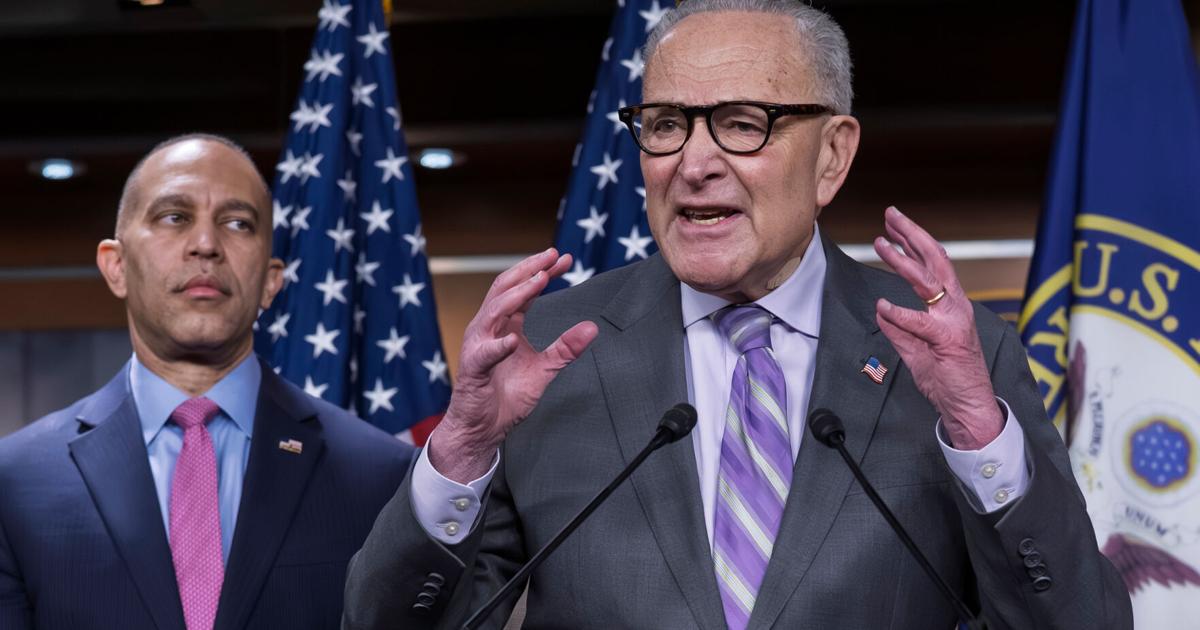
WASHINGTON (AP) — Congressional leaders said Tuesday that a deal was still possible with the White House on Homeland Security Department funding before it expires this weekend. But the two sides were still far apart as Democrats demanded new restrictions on President Donald Trump’s immigration crackdown.
After federal agents fatally shot two protesters in Minneapolis last month, Democrats say U.S. Immigration and Customs Enforcement needs to be “dramatically” reined in and are prepared to let Homeland Security shut down if their demands aren’t met. On Tuesday, Senate Democratic Leader Chuck Schumer and House Democratic Leader Hakeem Jeffries said they had rejected a White House counteroffer that “included neither details nor legislative text” and does not address “the concerns Americans have about ICE’s lawless conduct.”
“We simply want ICE to follow the same standards that most law enforcement agencies across America already follow,” Schumer said Tuesday. “Democrats await the next answer from our Republican counterparts.”
The Democrats’ rejection of the Republican counteroffer comes as time is running short, with a shutdown of the Homeland Security Department threatening to begin Saturday. Among the Democrats’ demands are a requirement for judicial warrants, better identification of DHS officers, new use-of-force standards and a stop to racial profiling.
Finding agreement on the charged, partisan issue of immigration enforcement will be exceedingly difficult. But even as lawmakers in both parties were skepticala White House official said that the administration was having constructive talks with both Republicans and Democrats. The official, granted anonymity to speak about ongoing deliberations, stressed that Trump wanted the government to remain open and for Homeland Security services to be funded.
Senate leaders also expressed some optimism.
“There’s no reason we can’t do this” by the end of the week, Senate Democratic Leader Chuck Schumer said after meeting with his caucus on Tuesday.
Senate Majority Leader John Thune, R-S.D., said there have been “some really productive conversations.”
Democratic demands
Schumer and Jeffries have said they want immigration officers to remove their masksto show identification and to better coordinate with local authorities. They have also demanded a stricter use-of-force policy for the federal officers, legal safeguards at detention centers and a prohibition on tracking protesters with body-worn cameras.
Among other asks, Democrats say Congress should end indiscriminate arrests, “improve warrant procedures and standards,” ensure the law is clear that officers cannot enter private property without a judicial warrant and require that before a person can be detained, it’s verified that the person is not a U.S. citizen.
Democrats made the demands for new restrictions on ICE and other federal law enforcement after ICU nurse Alex Pretti was shot and killed by a U.S. Border Patrol officer in Minneapolis on Jan. 24, and some Republicans suggested that new restrictions were necessary. Renee Good was shot by ICE agents on Jan. 7.
Many Democrats said they won’t vote for another penny of Homeland Security funding until enforcement is radically scaled back.
“Dramatic changes are needed at the Department of Homeland Security before a DHS funding bill moves forward,” Jeffries said. “Period. Full stop.”
Republican counterproposal
Jeffries said Tuesday that the White House’s offer “walked away from” their proposals for better identification of ICE agents, for more judicial warrants and for a prohibition on excessive use of force. Republicans also rejected their demand for an end to racial or ethnic profiling, Jeffries said.
“The White House is not serious at this moment in dramatically reforming ICE,” Jeffries said.
Republican lawmakers have also pushed back on the requests. Oklahoma Sen. Markwayne Mullin, a close ally of Trump, said Tuesday that he’s willing to discuss more body cameras and better training — both of which are already in the Homeland spending bill — but that he would reject the Democrats’ most central demands.
“They start talking about judicial warrants? No. They start talking about demasking them? No, not doing that. They want them to have a photo ID with their name on it? Absolutely not,” Mullin said.
Republicans have said ICE agents should be allowed to wear masks because they are more frequently targeted than other law enforcement officials.
“People are doxing them and targeting them,” said House Speaker Mike Johnson, R-La., on Monday. “We’ve got to talk about things that are reasonable and achievable.”
Some Republicans also have demands of their own, including the addition of legislation that would require proof of citizenship before Americans register to vote and restrictions on cities that they say do not do enough to crack down on illegal immigration.
At a House hearing on Tuesdaythe acting director of ICE, Todd Lyons, said his agency is “only getting started” and would not be intimidated as his officers carry out Trump’s mass deportation agenda.
Trump deals with Democrats
Congress is trying to renegotiate the DHS spending bill after Trump agreed to a Democratic request that it be separated out from a larger spending measure that became law last week and congressional Republicans followed his lead. That package extended Homeland Security funding at current levels only through Feb. 13, creating a brief window for action as the two parties discuss new restrictions on ICE and other federal officers.
But even as he agreed to separate the funding, Trump has not publicly responded to the Democrats’ specific asks or suggested any areas of potential compromise.
White House press secretary Karoline Leavitt said late last week that the Trump administration is willing to discuss some items on the Democrats’ list, but “others don’t seem like they are grounded in any common sense, and they are nonstarters for this administration.”
Thune said Tuesday that “there are certain red lines that I think both sides have, things they are not going to negotiate on, but there are some things they are going to negotiate on, and that’s where I think the potential deal space is here.”
It was, so far, unclear what those issues were.
“We are very committed to making sure that federal law enforcement officers are able to do their jobs and to be safe doing them,” Thune said of Republicans.
Consequences of a shutdown
In addition to ICE and U.S. Customs and Border Protection, the homeland security bill includes funding for the Federal Emergency Management Agency and the Transportation Security Administration, among other agencies. If DHS shuts down, Thune said last week, “there’s a very good chance we could see more travel problems” similar to the 43-day government closure last year.
Thune has said Republicans will try to pass a two- to four-week extension of the Homeland Security funding while negotiations continue.
Many Democrats are unlikely to vote for another extension. But Republicans could potentially win enough votes in both chambers from Democrats if they feel hopeful about negotiations.
“The ball is in the Republicans’ court,” Jeffries said Monday.
___
Associated Press writers Matt Brown, Joey Cappelletti and Lisa Mascaro contributed to this report.

WASHINGTON (AP) — President Donald Trump on Monday threatened to block the opening of a new Canadian-built bridge across the Detroit River, demanding that Canada turn over at least half of the ownership of the bridge and agree to other unspecified demands in his latest salvo over cross-border trade issues.
“We will start negotiations, IMMEDIATELY. With all that we have given them, we should own, perhaps, at least one half of this asset,” Trump said in a lengthy social media post, complaining that the United States would get nothing from the bridge and that Canada did not use U.S. steel to built it.
The Gordie Howe International Bridge, named after a Canadian hockey star who played for the Detroit Red Wings for 25 seasons, had been expected to open in early 2026, according to information on the project’s website. The project was negotiated by former Michigan Gov. Rick Snyder — a Republican — and paid for by the Canadian government to help ease congestion over the existing Ambassador Bridge and Detroit-Windsor tunnel. Work has been underway since 2018.
It’s unclear how Trump would seek to block the bridge from being opened, and the White House did not immediately return a request for comment on more details. The Canadian Embassy in Washington also did not immediately return a request for comment.
Trump’s threat comes as the relationship between the U.S. and Canada increasingly sours during the U.S. president’s second term. The United States-Mexico-Canada trade agreement is up for review this year, and Trump has been taking a hard-line position ahead of those talks, including by issuing new tariff threats.
Canadian Prime Minister Mark Carney, meanwhile, has spoken out on the world stage against economic coercion by the United States.
Sen. Elissa Slotkin, D-Mich., said the Canadian-funded project is a “huge boon” to her state and its economic future. “You’ll be able to move cargo from Montreal to Miami without ever stopping at a street light,” Slotkin told The Associated Press.
“So to shoot yourself in the foot and threaten the Gordie Howe Bridge means that this guy has completely lost the plot on what’s good for us versus just what’s spite against the Canadians,” Slotkin said.
Michigan, a swing state that Trump carried in both 2016 and 2024, has so far largely avoided the brunt of his second-term crackdown, which has targeted blue states with aggressive immigration raids and cuts to federal funding for major infrastructure projects.
Trump and Democratic Gov. Gretchen Whitmer have also maintained an unusually cordial relationship, with the president publicly praising her during an Oval Office appearance last April. The two also shared a hug last year ahead of Trump’s announcement of a new fighter jet mission for an Air National Guard base in Michigan.
While Canada paid for the project, the bridge will be operated under a joint ownership agreement between Michigan and Canada, said Stacey LaRouche, press secretary to Whitmer.
“This is the busiest trade crossing in North America,” LaRouche said, saying the bridge was “good for Michigan workers and it’s good for Michigan’s auto industry” as well as being a good example of bipartisan and international cooperation.
“It’s going to open one way or another, and the governor looks forward to attending the ribbon-cutting,” LaRouche said.
Rep. Shri Thanedar, the Democratic House representative of Detroit, said blocking the bridge would be “crazy” and said Trump’s attacks on Canada weren’t good for business or jobs. “The bridge is going to help Michigan’s economy. There’s so much commerce between Michigan and Canada. They’re one of our biggest partners,” Thanedar said.
Democratic Rep. Debbie Dingell of Ann Arbor brushed aside the president’s threat, saying she’s looking forward to the bridge’s opening later in the spring. “And I’ll be there,” Dingell said.
“That bridge is the biggest crossing in this country on the northern border. It’s jobs. It’s about protecting our economy. It was built with union jobs on both sides,” said Dingell. “It’s going to open. Canada is our ally.”
___
AP writer Ed White contributed from Detroit.
The Dictatorship
The Latest: Justice Department will allow lawmakers to see unredacted Epstein files
Olympic Sports on TV for Wednesday, Feb. 11
Sports on TV for Wednesday, Feb. 11
10-wicket wins at the men’s T20 World Cup
- Trump keeps driving online fundraising — for both parties
- The transatlantic alliance is down but not out
- Trump is Pushing Big Tech on Data Center Energy Costs
- Schumer dials up oversight pressure on Trump’s Venezuela oil fund
- Why Dems think they have the upper hand at Pam Bondi’s big Hill hearing
- From TSA lines to disaster relief, here’s how a DHS shutdown would hurt
- Democrats say White House offer on ICE is ‘insufficient’ as Homeland Security funding set to expire
- Trump threatens new bridge between Detroit and Canada

- Maxine Waters is the newest target in Democrats’ intergenerational war

- Capitol agenda: Democrats demand more from GOP on DHS
-

 The Dictatorship12 months ago
Luigi Mangione acknowledges public support in first official statement since arrest
-

 Politics12 months ago
Former ‘Squad’ members launching ‘Bowman and Bush’ YouTube show
-

 The Dictatorship5 months ago
Mike Johnson sums up the GOP’s arrogant position on military occupation with two words
-

 Politics12 months ago
Blue Light News’s Editorial Director Ryan Hutchins speaks at Blue Light News’s 2025 Governors Summit
-

 The Dictatorship12 months ago
Pete Hegseth’s tenure at the Pentagon goes from bad to worse
-

 Politics12 months ago
Former Kentucky AG Daniel Cameron launches Senate bid
-
Uncategorized1 year ago
Bob Good to step down as Freedom Caucus chair this week
-

 Politics10 months ago
Democrat challenging Joni Ernst: I want to ‘tear down’ party, ‘build it back up’