
Congress
Trump digs in on Johnson support as speaker showdown looms

Mike Johnson is heading toward a noon showdown over the fate of his speakership — even as President-elect Donald Trump doubled down on his support Friday morning.
The House will kick off the new Congress and move almost immediately to a vote for the speaker’s gavel, with Johnson likely still short of the votes to retain the gavel with just hours to go.
“Good luck today for Speaker Mike Johnson, a fine man of great ability, who is very close to having 100% support. A win for Mike today will be a big win for the Republican Party, and yet another acknowledgment of our 129 year most consequential Presidential Election!! – A BIG AFFIRMATION, INDEED. MAGA!” Trump wrote on Truth Social.
Johnson told reporters on Friday morning that he still believes he will win on the first ballot — a feat that would require him to hold the Republicans voting for another candidate to just Rep. Thomas Massie (R-Ky.), who has repeatedly pledged he won’t back Johnson.
But Johnson’s allies and critics are preparing for multiple rounds of ballots as he faces an entrenched group of hold-outs.
Johnson personally called and texted remaining GOP holdouts late into Thursday, per four Republicans who were granted anonymity to discuss the private conversations. The band of rebels is expected to meet again with Johnson on Friday morning.
The group of roughly a dozen members has a range of asks including commitments on slashing spending and angling for plum committee spots that would give them more power over what gets to the floor. And some have gone public with what deals he could cut to garner their votes — exactly the type of agreements that are already sparking early warnings of blowback from other corners of the conference.
“I do believe that Mike Johnson coming out and committing to Chip Roy being chairman of the Rules Committee would secure the vote on the first round with no significant battle,” Rep. Lauren Boebert (R-Colo.) told former Rep. Matt Gaetz (R-Fla.) on “The Matt Gaetz Show.”
Roy, Massie and Reps. Ralph Norman (R-S.C.) got seats on the Rules Committee as part of a deal cut with former Speaker Kevin McCarthy as he sought the speaker’s gavel. But the trio have emerged as a frequent roadblock for major GOP policy bills because they have enough combined sway on the panel to prevent any bill they all oppose from advancing unless Democrats step in.
Johnson allies are adamant that he won’t cut a deal to make Roy chair of the panel in order to secure his speakership, and centrists have also privately warned that he should generally avoid cutting the types of deals McCarthy did. Many of those deals ultimately paved the way for his ouster just months later.
Johnson’s headaches come even as Trump has repeatedly reiterated in recent days that he still supports the Louisiana Republican, who got battered by conservative criticism over last month’s short-term spending deal.
But Trump’s support hasn’t been enough to sway Johnson’s most adamant hold-outs — with Republicans predicting that at least a handful could oppose him on the first ballot and deprive him of a quick win for the gavel.
Massie argued Friday morning that “if he fails on the first round today, a better Speaker can be elected in a few hours or over the weekend.”


Massachusetts Sen. Elizabeth Warren is wading into Michigan’s closely contested Democratic Senate primary, backing state Sen. Mallory McMorrow over two rivals.
It’s a somewhat counterintuitive endorsement for the progressive U.S. senator who has made her backing of Medicare for All a core part of her political identity. McMorrow opposes Medicare for All, while Abdul El-Sayed, one of McMorrow’s opponents, supports it.
But the endorsement is a coup for McMorrow as she seeks to win over the progressive wing of the party in her bid to succeed retiring Democratic Sen. Gary Peters. McMorrow has now secured endorsements from four senators — with Warren joining Chris Murphy of Connecticut, Martin Heinrich of New Mexico and Peter Welch of Vermont — more than opponents El-Sayed and Rep. Haley Stevens.
Warren said in a statement her relationship with McMorrow goes back nearly a decade.
“I remember first calling Michigan State Senator McMorrow after she flipped a Republican-held seat in 2018, and I was immediately inspired by her ideas, her plans, and her fight to make a real difference,” she said. “Mallory is both a fighter and a winner, and I’m proud to endorse her because she’s the proven leader Michigan needs in the United States Senate.”
Tulsi Gabbard heads into Senate Intelligence on Wednesday facing one of the most fraught moments of her tenure as director of national intelligence.
The longtime anti-interventionist is set to be the main character at Wednesday morning’s worldwide threats hearing when she appears with other administration officials, after former top aide Joe Kent resigned as director of the National Counterterrorism Center over the Iran war.
Kent’s resignation has raised the question of how much longer Gabbard will serve in the administration. She’s largely been silent since the U.S. and Israel began striking Iran in late February, and she’s been kept out of military planning on Iran since the U.S. struck nuclear sites in the country last summer.
“Both Kent and Gabbard have had less and less influence,” one House Republican granted anonymity to speak openly said. “They’ve been sidelined.” Gabbard will appear before House Intelligence Thursday.
Gabbard’s testimony last March that downplayed Iran’s nuclear weapons program — prompting a “she’s wrong” from President Donald Trump — is poised to be revisited by senators at Wednesday morning’s hearing, as are her anti-war positions.
“The president made the right move based upon the information that we’ve all seen in classified sessions,” said South Dakota Sen. Mike Rounds, an intel committee Republican. He signaled that Gabbard could be asked about her previous assessment at the hearing.
Around the same time in Dirksen this morning, Sen. Markwayne Mullin (R-Okla.) will be in the hot seat as he testifies on his nomination to replace Kristi Noem as Homeland Security secretary.
Senate Homeland Security is expected to quickly approve the nomination Thursday, though it’s TBD to what extent Mullin will get bipartisan support beyond Sen. John Fetterman (D-Pa.).
“We actually have a pretty good working relationship, and have worked on projects together, but we do have a lot of questions,” said Arizona Sen. Ruben Gallego, a committee Democrat who has yet to say how he’ll vote. “Largely it’s like, who really is in charge of DHS? … Is it going to be Stephen Miller’s in charge?”
What else we’re watching:
— House gets a FISA briefing: Trump officials will host a classified briefing for House members at 3:30 p.m. on the administration’s push for a clean reauthorization of Section 702 of the Foreign Intelligence Surveillance Act, or FISA, due to expire April 20, as conservatives threaten to tank the effort.
Speaker Mike Johnson said he believes his members who are currently opposed to a clean, 18-month extension will ultimately vote for the party-line rule. But two House Republicans are already publicly vowing to oppose the procedural rule to tee up a clean FISA reauthorization, which leaders are aiming to put on the floor next week.
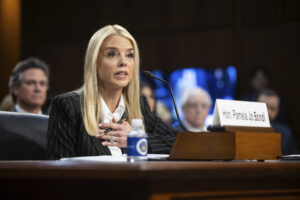
— DOJ officials brief House Oversight: Attorney General Pam Bondi and her deputy Todd Blanche will be on Capitol Hill on Wednesday to brief House Oversight Committee members on the Justice Department’s ongoing Jeffrey Epstein investigation.
It comes the day after the chair, Rep. James Comer (R-Ky.), subpoenaed Bondi to testify under oath as part of the committee’s own Epstein probe. But a GOP spokesperson for the committee said that Wednesday’s briefing, which was scheduled at DOJ’s request, won’t be a substitute for Bondi’s future testimony.
John Sakellariadis, Meredith Lee Hill, Mia McCarthy and Hailey Fuchs contributed to this report.
Senate Republicans want to use their party-line elections bill as a cudgel against Democrats. They need to stop sparring with each other first.
Republicans kicked off debate Tuesday on the SAVE America Act, a House-passed bill that would create new proof-of-citizenship and photo ID requirements in order for Americans to participate in federal elections. In a bid to pacify House and Senate conservatives, a fervent base flooding their social media mentions and even President Donald Trump — who views the legislation as his “No. 1 priority” — Senate Republicans are expected to spend days, if not weeks, discussing the legislation.
The chances the push will succeed in passing the bill, which Democrats uniformly oppose, are miniscule. And it’s not at all clear that spending two weeks on the bill will be enough to quell what has been an intense GOP-on-GOP pressure campaign that has sucked up much of the focus in the weeks leading up to Tuesday’s vote.
“We’ll find out, you know?” Senate Majority Leader John Thune said when asked if he knew if it would be enough to satisfy Trump, who has repeatedly urged Republicans to skirt the 60-vote filibuster to pass the bill. “What I promised from the very beginning is we’ll get it up and we will have a vote. I can’t guarantee the result.”
He added that Trump and others also “want us to nuke the legislative filibuster in order to do it, and that’s also something I’ve been very clear about — there just aren’t the votes.”
Spending more than a week of floor time on a bill that is all but guaranteed to fail isn’t typically how the Senate operates. Usually, to show legislation supported by their own party can’t clear the chamber’s supermajority threshold, Senate leaders quickly move to end debate and prove it can’t get 60 votes.
But Senate Republicans are under intense pressure to show that they are fighting Democrats for “election integrity” — an issue they believe polls well for them but appears to be causing little heartburn for Democrats so far. Some believe forcing a “talking filibuster” where opponents have to hold the floor indefinitely will force the opposition to cave.
Democratic senators shrugged off the strategy Tuesday, vowing that no matter how long Republicans drag out the debate, there is no way the election bill can garner 60 Senate votes.
“If MAGA Republicans want to bog down the Senate over a debate on voter suppression, Democrats are ready. We’re ready to be here all day, all night, as long as it takes,” Senate Minority Leader Chuck Schumer told reporters. “Senate Democrats will never let this rotten bill move through this body.”
Sen. Chris Murphy (D-Conn.) said in an interview that Democrats will “spend the next two weeks painting them as totally out of touch.”
The Senate is expected to stay in session late into the night and into the weekend as senators hammer each other over the bill. Thune has been careful not to outline a date certain for the end of the debate, and both parties expect the process to eat up much of the next week and a half.
Sen. Tim Kaine (D-Va.) predicted “late nights with us having folks on the floor as long as Republicans do … being ready for procedural motions that we’ll have to respond to in real time.”
Democrats have filed dozens of amendments to the bill, including requiring proof of citizenship to purchase an assault weapon, restoring lapsed Obamacare tax credits and tying the bill’s implementation date to the price of gas. But unlike a true “talking filibuster,” where they would be able to offer those amendments and force Republicans to take politically uncomfortable votes, Thune took steps Tuesday to keep tight control of the debate by calling up a series of Republican amendments.
Both parties have procedural curveballs they could throw. If no one is speaking, Republicans could try to move immediately to a final vote on the bill at a simple majority, while Democrats could try to adjourn or set the bill aside altogether. They are likely to pause the debate later this week by forcing a privileged vote on a resolution limiting Trump’s ability to take military action in Iran without congressional approval.
But those actions appear destined to fall short of the hardball tactics demanded by the party’s MAGA wing, including Sen. Mike Lee (R-Utah) — who is clamoring for the Senate to stay in session until Democrats capitulate. And even some of Lee’s allies are starting to acknowledge the bill is barreling toward a 60-vote hurdle that it can’t clear.
“If we do not act on an issue that commands this level of support … we should not be surprised when the American people lose confidence in our willingness to fight for them,” Lee told fellow Republicans from the Senate floor Tuesday night.
The initial hours of debate Tuesday were nothing out of the ordinary. Senators agreed unanimously to structure the debate, rotating which party had time to speak about the bill. There were long stretches of floor silence as the evening wore into night, and the chamber adjourned as it typically does at the end of the day. The Senate won’t come back into session until noon Wednesday.
Across the Capitol, the hardball tactics weren’t any more effective. Some House Republicans vowed to block any Senate bill to pressure their counterparts into passing the elections overhaul, but two Senate bills already cleared the chamber this week.
Senate Republicans, meanwhile, are struggling to resolve internal divisions. Some of those are tactical, but others are substantive. Sen. Lisa Murkowski of Alaska has declared her opposition to the bill as a federal overreach into traditionally state-run elections. And Trump’s push to largely ban mail-in voting is a fierce point of contention that came up during the GOP’s closed-door lunch Tuesday, according to three attendees granted anonymity to describe the private discussion.
Amid backlash from several GOP senators, Republicans reworked a mail voting amendment with the White House’s blessing to try to assuage concerned members. The change includes a state-defined “hardship” exemption from in-person voting, according to a copy of the updated proposal obtained by Blue Light News. The amendment is expected to get a vote as part of the Senate’s marathon debate, while internal discussions continue about two other Trump-requested additions: restricting trans women from competing in women’s sports and banning gender-affirming surgeries for minors.
That would still fall short of the talking filibuster demanded by Lee, an army of online supporters and Trump, who spoke with Lee Monday about the bill. The Utah Republican said Monday night, “If your senators don’t support using the talking filibuster to pass the SAVE America Act, you might need to replace them.”
Asked about Lee’s comments, Thune urged his party to redirect their fury.
“I prefer to have our fights with Democrats,” Thune said. “And I’m always someone who believes it’s far better for us to have a majority in the United States Senate.”
- Elizabeth Warren backs Mallory McMorrow in Michigan Senate primary
- Capitol agenda: Tulsi Gabbard takes the hot seat
- The Latest: Trump seeks help opening the Strait of Hormuz as Iran war chokes oil shipping

- The Senate’s marathon elections debate is dividing Republicans, not Democrats
- White House releases DHS funding offer
- Senate bills survive
- Senate launches debate on SAVE America Act with endgame uncertain

- Republicans hope Mullin will turn the page at DHS from Noem. Democrats aren’t buying it.

- Comer subpoenas Attorney General Pam Bondi over Epstein files
- AIPAC faces calls to reassess strategy after split results in Illinois
-

 The Dictatorship1 year ago
Luigi Mangione acknowledges public support in first official statement since arrest
-

 Politics1 year ago
Former ‘Squad’ members launching ‘Bowman and Bush’ YouTube show
-

 Politics1 year ago
Blue Light News’s Editorial Director Ryan Hutchins speaks at Blue Light News’s 2025 Governors Summit
-

 Politics1 year ago
Former Kentucky AG Daniel Cameron launches Senate bid
-

 The Dictatorship6 months ago
Mike Johnson sums up the GOP’s arrogant position on military occupation with two words
-

 The Dictatorship1 year ago
Pete Hegseth’s tenure at the Pentagon goes from bad to worse
-

 Politics11 months ago
Democrat challenging Joni Ernst: I want to ‘tear down’ party, ‘build it back up’
-
Uncategorized1 year ago
Bob Good to step down as Freedom Caucus chair this week