
Congress
Thune wants quick Senate vote on stopgap as House timing slips

The Senate’s top Republican leader said Monday he wants the chamber to vote on a stopgap funding bill before lawmakers leave town for a scheduled weeklong recess.
“I’d like to get it — if we can get it from the House — get it done this week before we leave,” Majority Leader John Thune told reporters.
However, getting the measure quickly from the House is in fact a big “if.” House Appropriations Chair Tom Cole (R-Okla.) told reporters Monday that his chamber might not pass the expected continuing resolution, which is expected to keep the government open through Nov. 20, until Thursday or Friday.
House leaders continued to discuss Monday how much new member security funding to add to the stopgap in light of the assassination last week of conservative activist Charlie Kirk, which has contributed to the delay.
It could take days for the Senate to get to an initial vote after House passage if all 100 senators can’t agree to move faster. Republicans will need help from Democrats there to advance the funding bill, and senators are already bracing for the possibility of weekend work.
Both chambers are scheduled to be out of Washington next week for the observance of Rosh Hashanah. If the stopgap funding bill gets delayed in the House, Senate Republicans have left the door open to returning after the holiday next week, when they will only be days from the end-of-month shutdown deadline.
Senate Minority Leader Chuck Schumer has warned that Democrats will oppose the stopgap bill unless Republicans negotiate with them, including on Affordable Care Act subsidies that are set to expire at the end of the year. Schumer hasn’t drawn a red line on what specific policy concessions Democrats would need, saying only that there needs to be a “bipartisan negotiation.”
“We want to keep the government open by engaging in bipartisan negotiation,” Schumer said Monday, adding of Republicans: “If one side refuses to negotiate they are the ones causing the shutdown.”
Republicans continued to insist Monday that the stopgap would be “clean,” without divisive policy provisions, leaving Democrats no reason to oppose it. “Nothing in there is going to cause anybody to vote ‘no’ that would otherwise vote ‘yes,’” Cole said.
Thune left the door open Monday to include new funding for member security after Speaker Mike Johnson separately told reporters that he’s still working to “build consensus” with members on a security funding plan.
Thune also suggested that legislation from Sens. Lindsey Graham (R-S.C.) and Richard Blumenthal (D-Conn.) related to Russia is unlikely to be attached to the stopgap. The legislation would impose tariffs on countries that import Russian energy and implement secondary sanctions on foreign firms that support Russian energy production
Graham and Rep. Brian Fitzpatrick (R-Pa.) issued a joint statement over the weekend, first reported by POLITICO, urging colleagues to link their bill to government funding.
Thune said he hoped the legislation is “ripe here soon” but said Republicans are continuing to wait on President Donald Trump to lay the groundwork with U.S. allies first.
“I think this needs to be everybody taking the same tack when it comes to addressing the situation,” he said.


The House Rules Committee advanced a measure Friday evening that would fund the entirety of the Homeland Security Department through May 22 — without setting up debate or a separate vote on the funding bill itself.
The panel, after a raucous meeting that devolved into shouting at multiple points, voted 8-4 on party lines to advance the measure to the floor.
The rule includes a “deem and pass” provision, a tactic that allows legislation to be passed by the House automatically once the rule itself is adopted. While there will be one hour of floor debate and a vote on the rule, there will not be a standalone House vote on the DHS spending bill.
Rep. Jim McGovern (D-Mass.) described himself as needing “a neck brace” from the whiplash of hearing Republicans argue for hours that the Senate’s early-morning voice vote on a different DHS funding measure was “shameful” for lack of transparency and accountability.
House Appropriations Chair Tom Cole (R-Okla.) accused the Senate of moving their bill “in the middle of the night, with the smell of jet fumes in the air,” lamenting that the House was left “to take it or leave it.”
House leaders, McGovern suggested, have chosen a similar path by fast-tracking the eight-week DHS stopgap.
“You’re in charge,” he told Rules Chair Virginia Foxx (R-N.C.). “You can do whatever the hell you want to do.”
Sen. Rand Paul (R-Ky.) is considering a bid for president in 2028, as Republicans jockey for the future of the GOP post-Trump.
In a “CBS Sunday Morning” interview airing Sunday, a reporter asked Paul about an article that implied he would be running for president.
“We’re thinking about it,” Paul said. “I would say fifty-fifty,” adding that he would make a final decision after the midterm elections.
Paul ran for the Republican nomination for president in 2016 with a libertarianism-focused campaign but ultimately dropped out after a poor performance in the Iowa caucuses and a shortage of cash. He instead ran for reelection to the Senate.
Paul has had a complex relationship with his own party and with President Donald Trump, often finding himself the lone Republican on certain issues. More recently, he was the only Republican to support a joint resolution that would limit Trump’s war powers in Iran.
His father, former Rep. Ron Paul, also ran for president three times: first as a Libertarian in 1988, and twice as a Republican in 2008 and 2012.
House Republicans moved Friday to further extend the six-week shutdown of the Department of Homeland Security by rejecting a Senate bill that would fund the vast majority of DHS agencies through September.
Instead, Speaker Mike Johnson proposed a temporary extension of DHS funding through May 22 — a plan that has uncertain prospects in the House and certainly won’t pass the Senate before the shutdown becomes the longest funding lapse in U.S. history Saturday.
But Johnson said House Republicans simply could not swallow the Senate bill, which omits funding for Immigration and Customs Enforcement as well as Border Patrol and some other parts of Customs and Border Protection.
“The Republicans are not going to be any part of any effort to reopen our borders or to stop immigration enforcement,” he said. “We are going to deport dangerous criminal illegal aliens because it is a basic function of the government. The Democrats fundamentally disagree.”
The move toward an eight-week stopgap creates a tactical gulf between Johnson and Senate Majority Leader John Thune, who called an end to weeks of abortive bipartisan talks Thursday and pushed through the funding bill in hopes of tacking on funding later for ICE and CBP in a party-line budget reconciliation bill.
President Donald Trump has largely stayed out of the GOP infighting on Capitol Hill, keeping his criticism trained on Democrats. He ordered DHS to pay TSA officers Thursday as long security lines snarls more U.S. airports.
Johnson played down the split with his Senate counterpart, saying the Democratic leader there bore more blame for the impasse.
“I wouldn’t call John Thune the engineer of this,” he said. “Chuck Schumer and the Democrats in the Senate have forced this upon the Senate. I have to protect the House. … Our colleagues on this side understand this is not a game. We are not playing their games.”
Thune said early Friday morning he did not speak directly to Johnson in the final hours leading up to the Senate’s voice vote, but he said they had texted. He acknowledged he did not know in advance how the House would handle the Senate bill.
“Hopefully they’ll be around, and we can get at least a lot of the government opened up again, and then we’ll go from there,” he said.
Johnson made his game plan clear with House Republicans on a private call just minutes before addressing reporters in the Capitol, according to four people granted anonymity to describe the call. He warned that a failure to advance the short-term DHS stopgap would upend GOP plans for a reconciliation bill, the people said.
He suggested the Senate could quickly clear the stopgap measure once it passes the House. Most senators have left Washington for a recess running through April 13, but Johnson said the chamber could approve the House measure by unanimous consent at a planned pro forma session Monday.
But some House Republicans on the private call, including Rep. Carlos Gimenez of Florida, aired doubts it could pass the Senate — or even the House. Some fellow GOP centrists argued that the House should just swallow the Senate bill and end the standoff.
The House plan for a 60-day stopgap won a cold reception in the Senate, with even Republicans warning it will only prolong the partial government shutdown.
The plan is instead fueling frustration among both Republicans and Democrats who view House Republicans as essentially throwing temper tantrum. Three people granted anonymity to speak candidly each described the House as having a “meltdown.”
Schumer publicly slammed the House GOP plan Friday, saying it was “dead on arrival” across the Capitol, “and Republicans know it.”
A Senate GOP aide granted anonymity to speak candidly added that the quickest way to end the shutdown is for the House to pass the Senate bill.
Five people granted anonymity to comment on Senate dynamics said there was no possibility that Democrats would let the House GOP plan pass during the Senate’s brief pro forma sessions over the next two weeks. It would only take one Democratic senator to show up and object to any attempt to pass it.
The bill, according to the five people, also can’t get 60 votes in the Senate once the chamber returns. Democrats have previously rejected even shorter stopgaps, leaving some to privately question why House Republicans would ever think their plan would work.
- Senate agrees to end shutdown for most of DHS
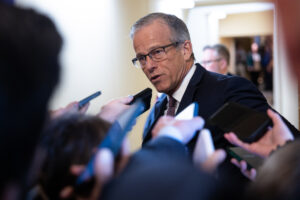
- What perks? Lawmakers play down special treatment as airport lines grow

- Joe Wilson hospitalized
- Capitol agenda: DHS despair takes hold on Blue Light News
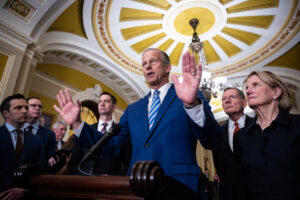
- It remains to be seen if Trump’s order to pay TSA officers shortens passenger wait times

- Embellishments, exaggerations, falsehoods…

- A month into Iran, the GOP’s political reality sinks in
- She was one of AIPAC’s top targets last election. Now she wants back in Congress.
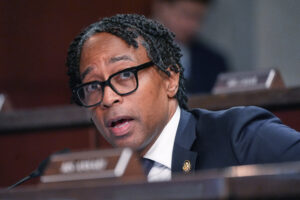
- One month into Iran, the GOP’s political reality sinks in
- ‘We love you!’: The MAGA base gives RFK Jr. a rousing welcome
-

 The Dictatorship1 year ago
Luigi Mangione acknowledges public support in first official statement since arrest
-

 Politics1 year ago
Former ‘Squad’ members launching ‘Bowman and Bush’ YouTube show
-

 Politics1 year ago
Former Kentucky AG Daniel Cameron launches Senate bid
-

 Politics1 year ago
Blue Light News’s Editorial Director Ryan Hutchins speaks at Blue Light News’s 2025 Governors Summit
-

 The Dictatorship7 months ago
Mike Johnson sums up the GOP’s arrogant position on military occupation with two words
-

 The Dictatorship1 year ago
Pete Hegseth’s tenure at the Pentagon goes from bad to worse
-
Uncategorized1 year ago
Bob Good to step down as Freedom Caucus chair this week
-

 Politics11 months ago
Democrat challenging Joni Ernst: I want to ‘tear down’ party, ‘build it back up’