Connect with us

Politics

The theme of Adams’ SOTC? He’s alive.

Published

on

New York City Mayor Eric Adams offered a message of resilience and defiance during his fourth State of the City address at the Apollo Theater in Harlem.

RISING FROM HIS GRAVE: Mayor Eric Adams’ State of the City address had a blaring message: I’m not just here — I’m thriving.

“Even dark moments are not burials, they’re plantings,” Adams said. “Allow your planting to happen and you’ll see the fruits of your labor. Mommy did it, and that’s why I’m mayor.”

The first New York City mayor in modern history to be indicted on criminal charges wants the world to know that the federal corruption indictment, the sinking poll numbers and the flurry of federal raids and mass resignations hasn’t chipped his self-belief one bit — lest there had been any doubt.

“Don’t let anyone fool you,” he said. “Don’t listen to the noise, don’t listen to the rhetoric. New York City, the state of our city is strong.”

“The ultimate measure of a man or woman is not where they stand in moments of comfort and convenience, but where they stand at times of challenges and controversy,” he also said, paraphrasing Martin Luther King Jr. as he thanked the members of his staff who hadn’t resigned.

He delivered the hourlong message of defiance after a brief 54 minutes of introduction that included a Christian prayer, a Muslim prayer, a Hindu prayer, a Sikh prayer, a Buddhist prayer, a Jewish prayer, the National anthem, God Bless America, the Black national anthem, two promotional videos, a youth drum line performance and some waiting.

The address, like all State of the City speeches, highlighted accomplishments — the City of Yes housing plan, the (partial) year-over-year drop in crime, the expansion of early childhood programs and the slowing of the city’s once unrelenting migrant crisis.

He also put two priorities for the upcoming legislative session in Albany front and center.

  • He wants fellow Democrat Gov. Kathy Hochul to adopt his version of a bill that would allow chronically homeless individuals suffering from mental illness to be involuntarily removed from the streets. (She is set to announce her own plan on involuntary removals, but has also signaled she will work with him on it.)
  • He needs the Legislature to back him in completely eliminating city income taxes for families making up to 150 percent of the federal poverty line. The “Axe the Tax” plan has the backing of Assemblymember Rodneyse Bichotte Hermelyn, who praised Adams in a pre-speech video. (Assembly Speaker Carl Heastie signaled Wednesday he might look to end state income taxes for lower-income New Yorkers.)

For the city, the mayor unveiled some key proposals:

  • He laid out his extremely ambitious plan to build 100,000 new homes in Manhattan, though the idea so far lacks some much-needed specifics. (We wrote about it this morning in New York Playbook.) 
  • He pledged $650 million to combat homelessness, including a facility to serve as a shelter and treatment center for the vulnerable population.
  • He is opening schoolyards as community parks on weekends and summers for over 10,000 New Yorkers, and he’s adding more cleaning shifts to city parks.
  • He’s expanding free internet for low-income homes in Upper Manhattan and all of the Bronx.
  • He’s adding a financial literacy teacher in every school district by 2030.
  • He’s clearing student loan debt for city employees and their families.
  • He’s allowing rent payments from thousands of low-income New Yorkers to count toward building up their credit score.

And he continued to thank Hochul for their simpatico relationship — even featuring her in his promotional video.
“There were some who said, ‘Step down,’” Adams said. “I said, ‘No, I’m gonna step up. I’m gonna step up. That’s what life presents you.’”
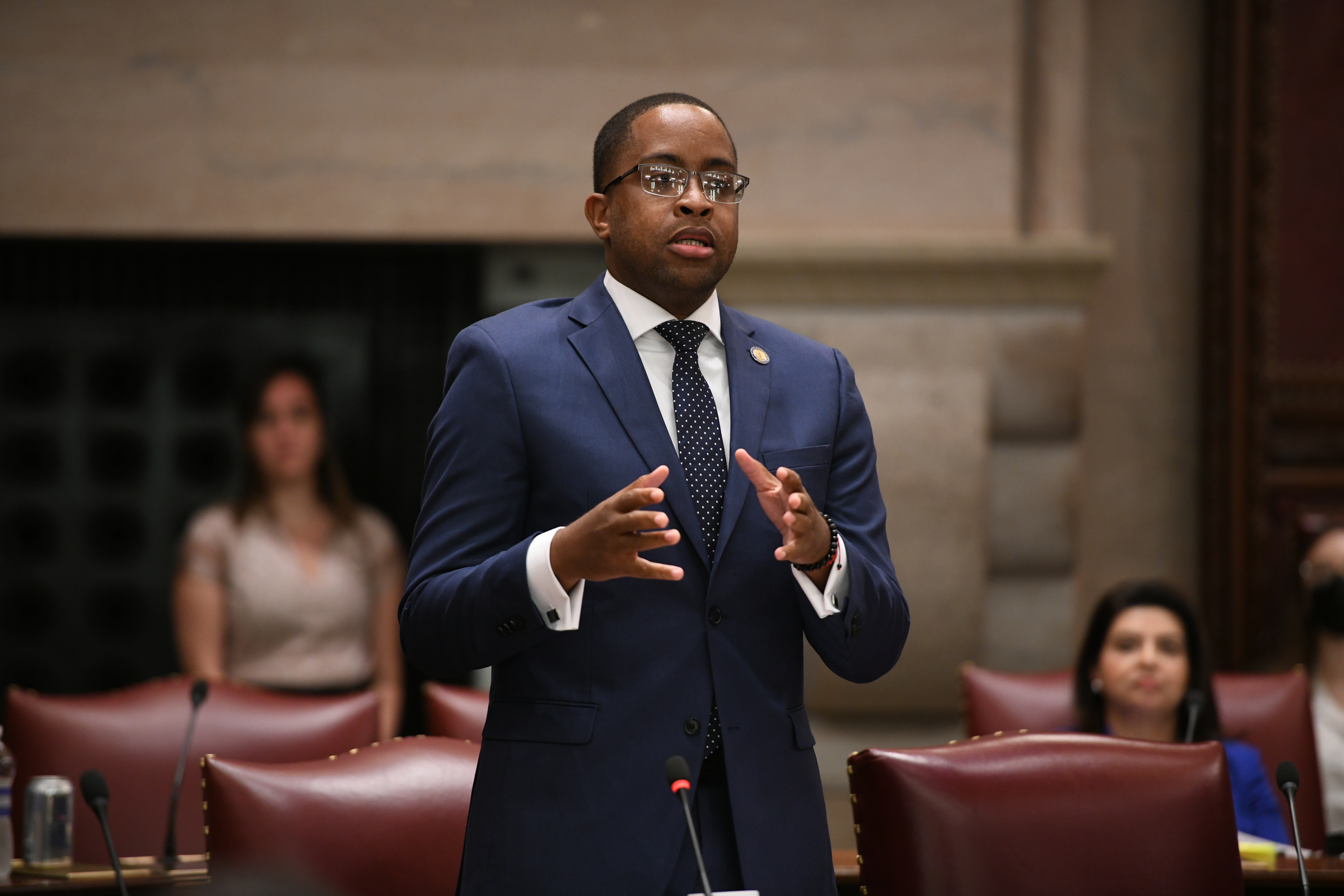
Sen. Zellnor Myrie's new position as chair of the Codes committee could bode well for him on the campaign trail.

ZELLNOR-CODED: Brooklyn state senator and mayoral candidate Zellnor Myrie has been tapped to lead the Senate Codes committee — a well-timed appointment.

As he prepares for the June primary and begins his seventh year in Albany, Myrie will have a key role in shaping criminal justice policy in Albany while he and his challengers attempt to prove their preparedness on the campaign trail.

An October Siena poll found likely New York City voters identified crime as their biggest concern. Adams has already signaled public safety will again be the crux of his mayoral campaign and he’s likely to call out any left-of-center opponents for prior votes he views as soft on crime.

“I’m grateful the leader has entrusted me to chair this committee, particularly at a time where public safety is on the minds of every New Yorker,” Myrie told Playbook. “As someone who is from New York City, who takes our subways and our buses, who talks to neighbors, I can say confidently this is an issue that is prominent in their minds.”

Myrie most recently helmed the Elections Committee, and his new spot leading Codes — which deals with all things criminal justice — has traditionally been viewed as the third most-powerful committee chair in the Senate. Nevertheless, Majority Leader Andrea Stewart-Cousins — who has a cool relationship with Adams — still wields near absolute power in the chamber, deciding with leadership what bills make it to the floor.

Sen. Jessica Ramos, another mayoral candidate, will remain chair of the Labor Committee. Zohran Mamdani, the other state lawmaker vying to lead City Hall, was not assigned a leadership position in the Assembly.

“We’re at a time where people are going to be using public safety as a political conversation, and I think that there needs to be a seriousness and sobriety in how we talk about actual solutions to this problem,” Myrie added, saying the committee will “be squarely focused on having actual solutions to city problems.” — Jason Beeferman

COMMITTEE ASSIGNMENTS ARE IN: Beyond Myrie, the Senate and Assembly announced all the other new committee leadership positions today, and that came with a host of changes, our colleague Bill Mahoney reported earlier in POLITICO Pro.
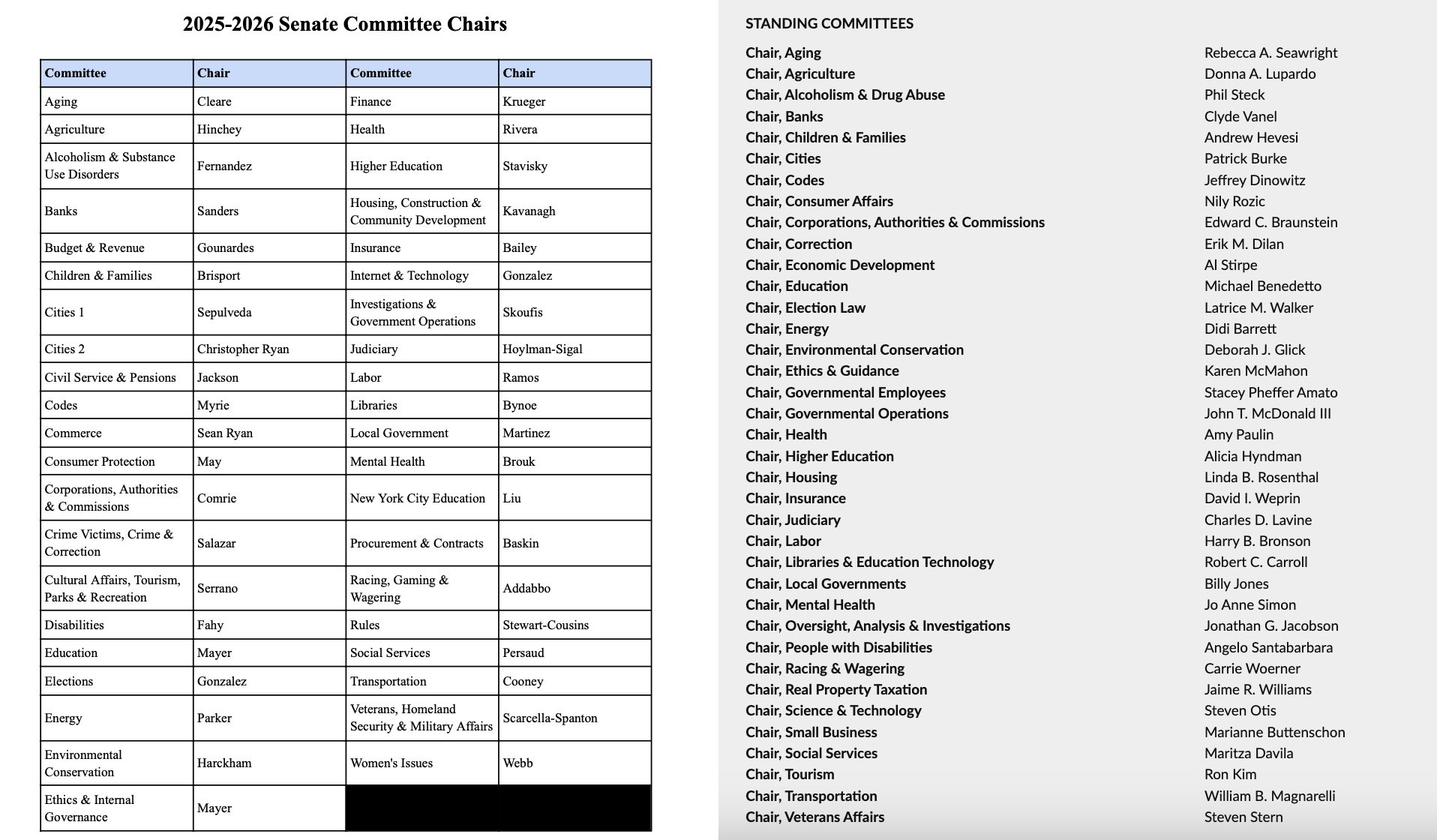
The Senate and Assembly announced their committee assignments today. | Provided by the New York State Legislature

The Assembly

  • Gary Pretlow will replace the retired Helene Weinstein as chair of the Ways and Means Committee.
  • Carrie Woerner replaces Pretlow to lead the Racing and Wagering Committee.
  • Marianne Buttenschon succeeds Woerner as chair of the Small Business Committee.
  • Ron Kim will succeed the retired Daniel O’Donnell as Tourism chair. 
  • Rebecca Seawright will take Kim’s place as chair of the Aging Committee. 
  • Angelo Santabarbara will succeed Seawright on the People With Disabilities Committee.
  • Bobby Carroll will become chair of Libraries and Education Technology, replacing Santabarbara.
  • Pamela Hunter is succeeding Jeff Aubry as speaker pro tempore. 
  • Clyde Vanel will replace Hunter as chair of the Banks Committee.
  • Jonathan Jacobson will replace Vanel on Oversight, Analysis and Investigations.
  • Ed Braunstein will become chair of Corporations, Authorities and Commissions, replacing the retired Ken Zebrowski. 
  • Pat Burke will take over the Cities Committee, succeeding Braunstein.
  • Jo Anne Simon will become Mental Health chair, following the retirement of Aileen Gunther. 
  • Karen McMahon will take Simon’s place on Ethics & Guidance.
  • Billy Jones will replace the retired Fred Thiele on Local Governments. 
  • Steve Stern will succeed the retired Kimberly Jean-Pierre on Veterans Affairs. 
  • Alicia Hyndman will become chair of Higher Education, after previous chair Pat Fahy was elected to the Senate.

The Senate

  • Jamaal Bailey will take over retired Neil Breslin’s leadership of the Insurance Committee
  • Zellnor Myrie will replace Bailey on the Codes Committee 
  • Kristen Gonzalez will take over for Myrie on the Elections Committee and remain chair of the Internet and Technology Committee.
  • Rachel May will lead the Consumer Protection Committee, which was vacated by Kevin Thomas. 
  • Freshman Christopher Ryan will succeed May as chair of Cities II, a recently added committee that deals with cities north of the Bronx.
  • Freshman Pat Fahy will chair Disabilities, formerly helmed by John Mannion.
  • Freshman Siela Bynoe will lead Libraries, which had been chaired by Iwen Chu.
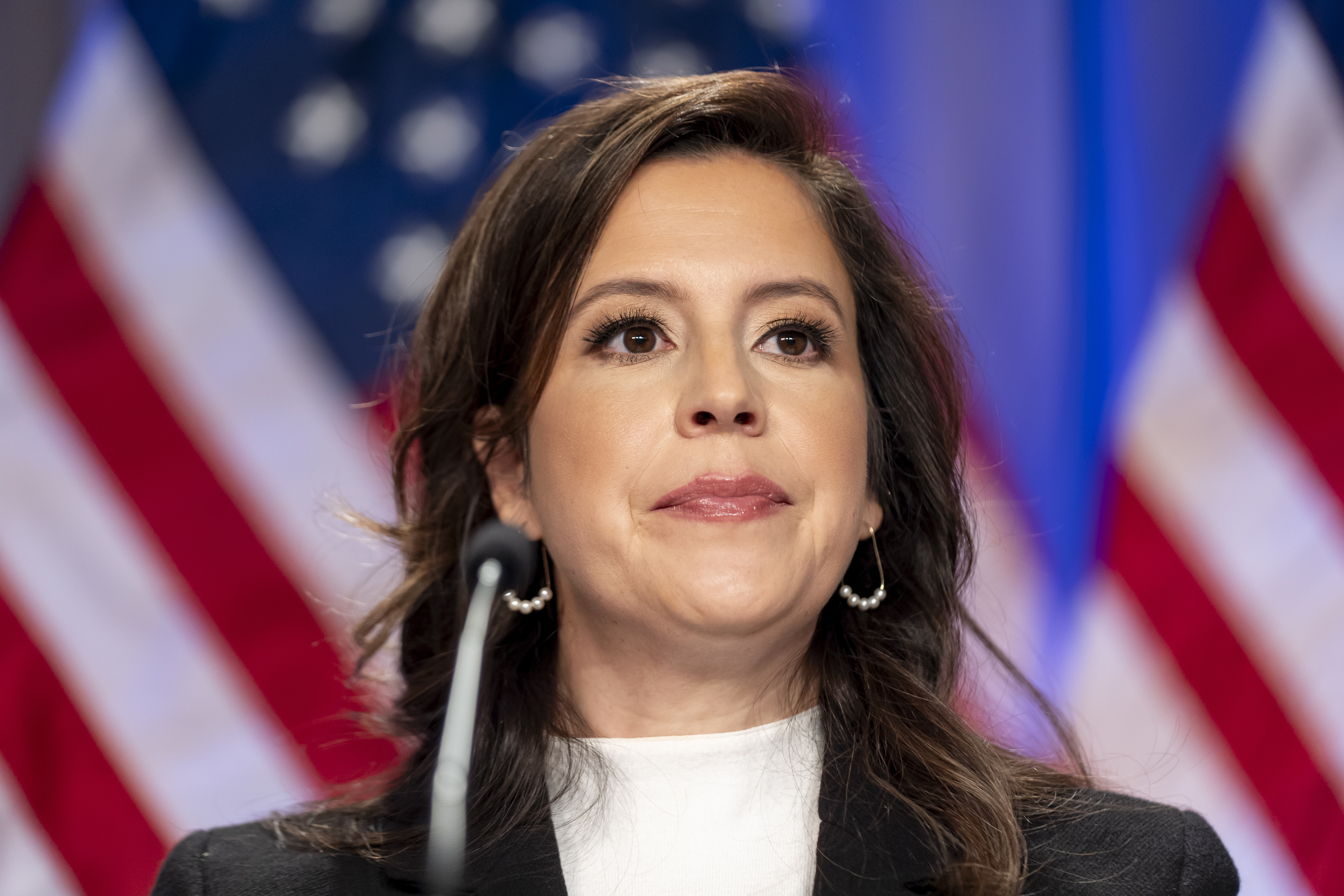
The field of potential successors to NY-21 Rep. Elise Stefanik continues to be narrowed.

THE WINNOWING: GOP leaders in the North Country House seat being vacated by Rep. Elise Stefanik will narrow the field of potential candidates by the end of the weekend, state party spokesperson David Laska said.

As Playbook reported this morning, Republican county chairs in the sprawling district met over Zoom with a dozen possible nominees. GOP officials expect to winnow that field of some 12 people to less than 10. Those preferred candidates will then advance to another round of vetting by Republican leaders.

Jockeying to replace Stefanik, President-elect Donald Trump’s nominee to serve as United Nations ambassador, has been underway for the past two months. A Republican candidate is expected to be heavily favored in a special election — likely to be scheduled for mid-April — given the party’s enrollment advantage in the largely rural seat. — Nick Reisman 

SALT SLOWDOWN: Members of New York’s GOP delegation, once promising a full repeal of the cap on State and Local Tax Deductions, are now tempering expectations as they signal a full repeal is unlikely. (NY1)

THE WHEELS ON THE TRAIN GO ROUND AND ROUND … EXCRUCIATINGLY: There’s a mysterious defect on the subway tracks of lettered train lines that’s causing subway wheels to be worn down more quickly than ever. (Daily News)

TOP NY COURT BUCKS TRUMP: The Court of Appeals denied a request to delay Trump’s sentencing in the “hush money” case. (Times Union)

Missed this morning’s New York Playbook? We forgive you. Read it here.

Continue Reading
Click to comment

Leave a Reply

Your email address will not be published. Required fields are marked *

Politics

The state of the Democratic Party is … split

Published

on

Democratic leadership’s choice to have Virginia Gov. Abigail Spanberger deliver the State of the Union rebuttal was a strategic move to keep the party’s focus on affordability. But she was just one Democrat jockeying to pave the way forward for the party.

Various Democratic factions hosting numerous competing events Tuesday night diverged on the best way to challenge President Donald Trump. Throughout the speeches, universal calls to bring down costs and crack down on ICE mixed in with more forceful and sometimes vulgar rebukes of his administration — laying bare the ideological and stylistic divides that are driving the party’s identity crisis.

Spanberger — a one-time battleground House Democrat who joined Congress during the party’s last wave election — was the headliner, calling from Williamsburg, Virgina, for Trump to focus on the needs of American families while also condemning the president for doing “what he always does: he lied, he scapegoated, and he distracted.”

But she was far from alone, with a group of Democratic-aligned organizations holding their own State of the Union events in an effort to harness rising furor against Trump.

Dozens of lawmakers spoke across several counter-programming events, including a rally hosted by MoveOn and the left-leaning media outlet MeidasTouch on the National Mall, or at another in downtown D.C. hosted by the anti-Trump activist networks Defiance and the Portland Frog Brigade along with the Courier Newsroom.

On the Mall, Rep. Summer Lee (D-Pa.) called to impeach Attorney General Pam Bondi over the Epstein files and Sen. Jeff Merkley (D-Ore.) accused Trump of “rigging” the midterms by pushing voting restrictions to “save his authoritarian control and turn the presidency into a kingship.” Rep. Becca Balint (D-Vt.) called herself a “bareknuckled brawler with a heart” and declared “that’s what we need right now.”

The dueling rallies, both timed to overlap with Trump’s speech, were accompanied by a Working Families Party rebuttal also delivered by Lee.

Some party strategists said the events — which also hosted high-profile Democrats like Robert De Niro, Joy Reid and New York congressional candidate George Conway — splintered the party’s response in a high-profile moment.

“A uniform response is much better than a cacophony of responses,” said Matt Bennett, an executive with the center-left think tank Third Way. “One narrative is better than many, and Spanberger is very talented at articulating a message that resonates broadly.”

Dueling State of the Union responses are not a new phenomenon. While the party out of power typically greenlights an English- and Spanish-language rebuttal — Sen. Alex Padilla (D-Calif.) gave Democrats’ response in Spanish this year, vowing his party would lower costs, make voting more accessible and rein in ICE — different wings have long looked to get in on the action, from Tea Party Republicans during Barack Obama’s presidency to the progressive groups on Tuesday night.

But the lack of a unified response on Tuesday comes as the Democratic Party still searches — and fights over — the best way to beat Trump, even as party members agree overall that centering the Trump administration’s struggles to boost the economy gives them the best chance in November.

Democrats were already divided in their approach to Trump’s address to Congress. Dozens of members across both chambers skipped the speech to protest the president while others said they were attending out of constitutional duty — a schism that stretched all the way up through party leadership.

Despite calls from Democratic leadership to refrain from protests inside the House chamber, Rep. Al Green (D-Texas) was escorted out of the room minutes into Trump’s speech after brandishing a sign reading “Black people aren’t apes,” a likely reference to a racist video Trump reposted earlier in the month.

Progressive Reps. Ilhan Omar (D-Minn.) and Rashida Tlaib (D-Mich.) also heckled Trump at multiple points during Trump’s speech, including in response to Trump touting his aggressive immigration enforcement.

At multiple moments during his speech, Trump appeared to relish opportunities to draw Democrats in attendance into heated exchanges.

“You people are crazy,” he said at one point, prompting some Democrats in the room to heckle him in return.

Spanberger’s aides were cognizant of the volume of competing Democratic rebuttals and built a “war room” team to boost the governor’s response on social media. And while her team insisted that she isn’t competing with other counter-programming events, her aides believed heading into Tuesday evening that Spanberger’s successful affordability-focused campaign last year gave her credibility on how to best respond to Trump.

Spanberger, whose campaign last year is viewed by some party strategists as a blueprint for Democrats to score victories in November, focused on her proposals to lower costs for Virginians, while also criticizing the president for aggressive immigration policies and blaming rising costs on Trump’s tariffs.

“Americans deserve to know that their leaders are focused on addressing the problems that keep them up at night, problems that dictate where you live, whether you can afford to start a business, or whether you have to skip a prescription in order to buy groceries,” she said in her live rebuttal. “Is the president working to make life more affordable for you and your family? We all know the answer is no.”

Several of the lawmakers who spoke at competing events echoed that affordability template, including some Democrats with possible presidential ambitions, like Sen. Ruben Gallego (D-Ariz.) and Sen. Chris Murphy (D-Conn.).

Gallego, who warned in his speech that Trump was making Americans “sicker and poorer,” told Blue Light News beforehand that “it’s fine that we have different people talking, provided the message is all the same: [that Democrats] are here to fight for everyday Americans.”

Some of those behind Democrats’ various response events Tuesday said they aimed to better capture the degree of frustration voters feel towards Trump.

“These are not the times for an institutionalist to say, ‘Well, let’s just give him his moment, and if you want to protest, protest by sitting there silently.’ That’s bullshit,” said Miles Taylor, a co-founder of Defiance and former Trump administration official-turned-Trump critic. “And I think that Hakeem Jeffries knows that his caucus feels like that doesn’t meet the moment, which is why so many of them are literally just not showing up.”

Taylor added that the plethora of Democratic responses also reflected the current political media environment, where both voters and candidates can easily find forums that align with their preferences.

Lee, who railed against Trump’s “authoritarianism” and cast his speech as an “obituary for the country working people built” in her Working Families Party rebuttal, said Democrats are at a “crossroads” and won’t win control of Congress “by electing more of the same” — which she cast as those who “speak boldly but deliver cautiously or sometimes even vote with MAGA.”

In an interview on Monday, Lee said it was critical for Democrats to promote a bigger tent after progressives scored major wins of their own in recent elections, from Zohran Mamdani being elected mayor of New York City to Analilia Mejia’s victory this month in the Democratic primary to replace moderate now-Gov. Mikie Sherrill in New Jersey.

Progressives “are always accepting of moderate places being represented well,” Lee said. But “it feels like there’s a wing of this party fighting back more against us trying to represent our own communities just as hard as somebody who is trying to represent their community in a swing district.”

Continue Reading

Politics

Trump reportedly isn’t sending a hospital ship to Greenland after all

Published

on

Early Saturday, Denmark’s Arctic Command made an important announcement: It had evacuated a crew member of a U.S. submarine in need of medical attention, transporting the sailor to Greenland for emergency care.

Soon after, instead of expressing gratitude, Donald Trump published a bizarre statement to his social media platform. According to the American president, he and his administration were deploying “a great hospital boat to Greenland to take care of the many people who are sick, and not being taken care of there.” The Republican concluded, “It’s on the way!!!”

No one seemed to have any idea what in the world he was talking about. When a BLN reporter asked the Pentagon for some kind of explanation, it referred him to U.S. Northern Command, which in turn referred him to the Navy, which in turn referred him to the White House, which didn’t want to talk about it.

Soon after, an apparent explanation for the confusion came into focus. The Wall Street Journal reported:

The Pentagon has received no orders to deploy any U.S. Navy vessels to Greenland, according to U.S. officials, despite President Trump’s claim that a hospital ship is ‘on its way’ to the self-governing Danish territory.

The U.S. has two hospital ships, the East Coast-based USNS Comfort and the West Coast-based USNS Mercy, which are designed as floating medical-treatment facilities. Both vessels are in a shipyard in Mobile, Ala., according to maritime tracking information. The Comfort is undergoing repairs that are expected to be completed in April, while the Mercy is in the middle of a one-year maintenance period that began last July.

Oh. So when Trump publicly declared that a U.S. hospital ship was “on the way” to Greenland (with three exclamation points), that apparently wasn’t true. (The Journal’s report hasn’t been independently verified by MS NOW, though several news organizations have reported in recent days that the Navy has two hospital ships, both of which appear to be in dry dock in Alabama.)

If the reporting is correct, it’s probably a good thing, for a variety of reasons, that there is no hospital ship en route to Greenland. It doesn’t appear to be necessary, and Greenland didn’t want it there anyway.

But the larger significance here is that yet again, there is no meaningful connection between what Trump says he’s going to do and what he actually does.

The incumbent president has earned his reputation as an unusually prolific liar, but this is a specific kind of mendacity. Trump isn’t merely peddling nonsense about his perceived enemies or his record; this is a kind of dishonesty rooted in a disconnect from future events: The American president keeps telling the nation and the world about steps he’s going to take, only to decide later not to bother with them, without offering any kind of explanation for the shift.

After his major defeat at the U.S. Supreme Court, for example, Trump said he’d impose global tariffs at a 15% rate. That wasn’t quite rightand when the policy was announced soon after, the actual rate was 10%.

The Republican said he was going to cap credit card interest rates, and then he didn’t. He said he was going to impose steep economic penalties on any country that does business with Iran, and then he didn’t. He even said he was going to decertify aircrafts made in Canada, and then he didn’t.

For Americans who want to know what’s likely to happen with their own government, it’s generally a good idea to pay more attention to what Trump and his team do than to what they saybecause what he says has little bearing on reality.

Steve Benen is a producer for “The Rachel Maddow Show,” the editor of MaddowBlog and an MS NOW political contributor. He’s also the bestselling author of “Ministry of Truth: Democracy, Reality, and the Republicans’ War on the Recent Past.”

Read More

Continue Reading

Politics

Trump reportedly isn’t sending a hospital ship to Greenland after all

Published

on

Early Saturday, Denmark’s Arctic Command made an important announcement: It had evacuated a crew member of a U.S. submarine in need of medical attention, transporting the sailor to Greenland for emergency care.

Soon after, instead of expressing gratitude, Donald Trump published a bizarre statement to his social media platform. According to the American president, he and his administration were deploying “a great hospital boat to Greenland to take care of the many people who are sick, and not being taken care of there.” The Republican concluded, “It’s on the way!!!”

No one seemed to have any idea what in the world he was talking about. When a BLN reporter asked the Pentagon for some kind of explanation, it referred him to U.S. Northern Command, which in turn referred him to the Navy, which in turn referred him to the White House, which didn’t want to talk about it.

Soon after, an apparent explanation for the confusion came into focus. The Wall Street Journal reported:

The Pentagon has received no orders to deploy any U.S. Navy vessels to Greenland, according to U.S. officials, despite President Trump’s claim that a hospital ship is ‘on its way’ to the self-governing Danish territory.

The U.S. has two hospital ships, the East Coast-based USNS Comfort and the West Coast-based USNS Mercy, which are designed as floating medical-treatment facilities. Both vessels are in a shipyard in Mobile, Ala., according to maritime tracking information. The Comfort is undergoing repairs that are expected to be completed in April, while the Mercy is in the middle of a one-year maintenance period that began last July.

Oh. So when Trump publicly declared that a U.S. hospital ship was “on the way” to Greenland (with three exclamation points), that apparently wasn’t true. (The Journal’s report hasn’t been independently verified by MS NOW, though several news organizations have reported in recent days that the Navy has two hospital ships, both of which appear to be in dry dock in Alabama.)

If the reporting is correct, it’s probably a good thing, for a variety of reasons, that there is no hospital ship en route to Greenland. It doesn’t appear to be necessary, and Greenland didn’t want it there anyway.

But the larger significance here is that yet again, there is no meaningful connection between what Trump says he’s going to do and what he actually does.

The incumbent president has earned his reputation as an unusually prolific liar, but this is a specific kind of mendacity. Trump isn’t merely peddling nonsense about his perceived enemies or his record; this is a kind of dishonesty rooted in a disconnect from future events: The American president keeps telling the nation and the world about steps he’s going to take, only to decide later not to bother with them, without offering any kind of explanation for the shift.

After his major defeat at the U.S. Supreme Court, for example, Trump said he’d impose global tariffs at a 15% rate. That wasn’t quite rightand when the policy was announced soon after, the actual rate was 10%.

The Republican said he was going to cap credit card interest rates, and then he didn’t. He said he was going to impose steep economic penalties on any country that does business with Iran, and then he didn’t. He even said he was going to decertify aircrafts made in Canada, and then he didn’t.

For Americans who want to know what’s likely to happen with their own government, it’s generally a good idea to pay more attention to what Trump and his team do than to what they saybecause what he says has little bearing on reality.

Steve Benen is a producer for “The Rachel Maddow Show,” the editor of MaddowBlog and an MS NOW political contributor. He’s also the bestselling author of “Ministry of Truth: Democracy, Reality, and the Republicans’ War on the Recent Past.”

Read More

Continue Reading

Trending