
The Dictatorship
Supreme Court weighs Trump’s power over independent agencies

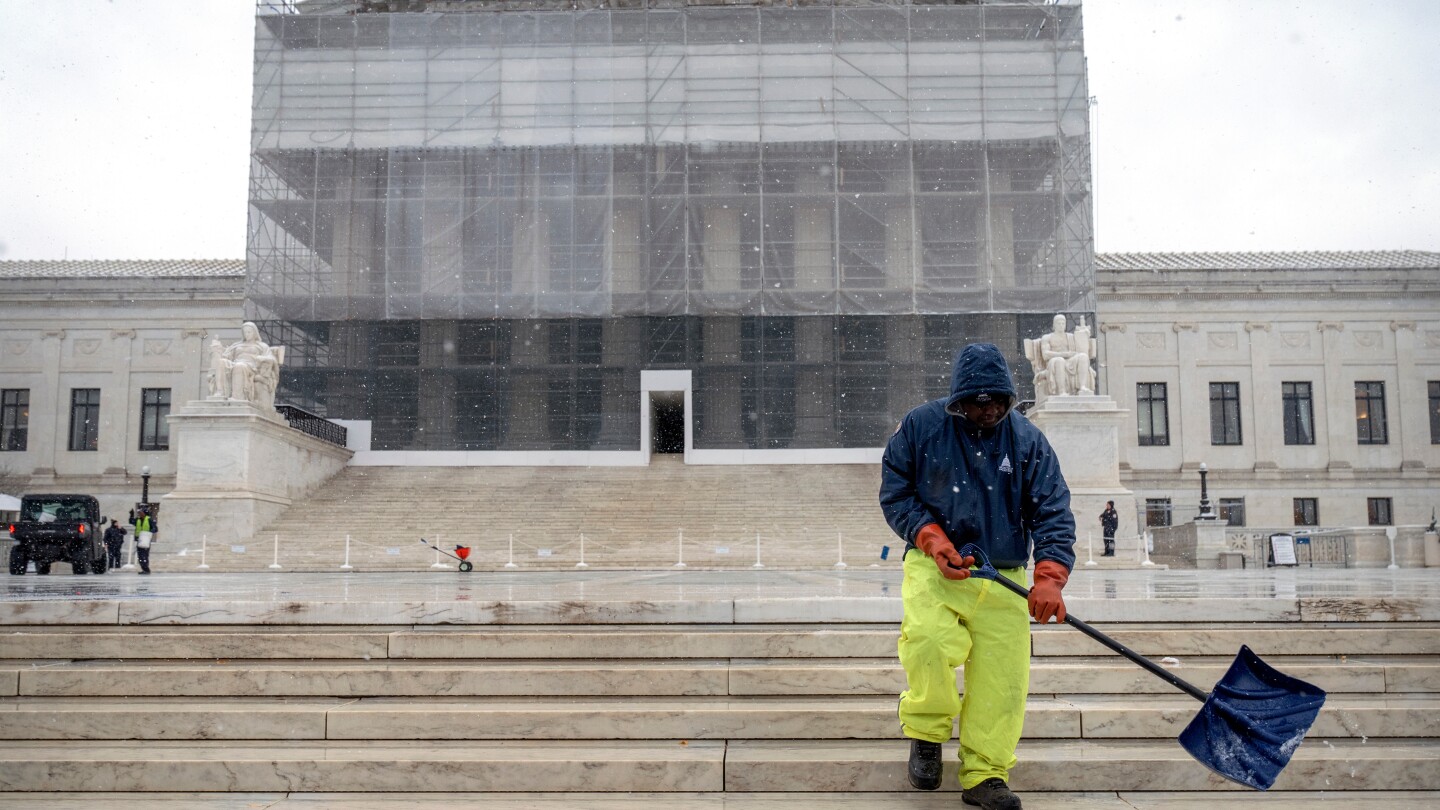
WASHINGTON (AP) — The Supreme Court on Monday seemed likely to expand presidential control over independent federal agenciessignaling support for President Donald Trump’s firing of board members.
The court’s conservative majority suggested it would overturn a unanimous 90-year-old decision that has limited when presidents can fire agencies’ board members — in part to try to ensure decision making free of political influence — or leave it with only its shell intact.
Justice Brett Kavanaugh said the crux of the issue is that the officials who direct the agencies “are exercising massive power over individual liberty and billion-dollar industries” without being accountable to anyone.
Liberal justices warned that a ruling sought by the administration to overturn the decision known as Humphrey’s Executor would give the president, as Justice Elena Kagan said, “massive unchecked, uncontrolled power.”
AP AUDIO: The Supreme Court seems likely to back Trump’s power to fire independent agency board members
AP’s Lisa Dwyer reports the Supreme Court is hearing arguments over presidential removal powers.
Agencies that have been in place for a century or more also would be robbed of their expertise, Justice Ketanji Brown Jackson said.
“So having a President come in and fire all the scientists and the doctors and the economists and the PhDs and replacing them with loyalists and people who don’t know anything is actually not in the best interest of the citizens of the United States,” Jackson said.
No president before Trump has sought to wrest control of the agencies that regulate wide swaths of American life, including nuclear energy, product safety and labor relations. But the six conservatives, including three appointed by Trump, seemed more concerned about issuing a ruling that would endure than handing too much power to Trump.
Their rhetoric was reminiscent of the presidential immunity case in 2024 that allowed Trump to avoid prosecution for his efforts to undo the 2020 election results. The court is writing a decision “for the ages,” Justice Neil Gorsuch said then.
Solicitor General D. John Sauer, who argued the immunity case for Trump, defended the president’s decision to fire Federal Trade Commission member Rebecca Slaughter without cause and called on the court to jettison Humphrey’s Executor.
Sauer said the decision “hasn’t withstood the test of time” and had enabled a “headless fourth branch” of government, the administrative state that conservatives and business interests have been taking aim at for decades.
Chief Justice John Roberts referred to Humphrey’s Executor as “a dried husk.”
The conservative side of the court already has signaled support for the administration’s position, over the liberals’ objection, by allowing Slaughter and the board members of other agencies to be removed from their jobs even as their legal challenges continue.
Members of the National Labor Relations Board, the Merit Systems Protection Board and the Consumer Product Safety Commission also have been fired by Trump.
The only officials who have so far survived efforts to remove them are Lisa Cooka Federal Reserve governor, and Shira Perlmuttera copyright official with the Library of Congress. The court has suggested that it will view the Fed differently from other independent agencies, and Trump has said he wants her out because of allegations of mortgage fraud. Cook says she did nothing wrong.
A second question in the Slaughter case could affect Cook. Even if a firing turns out to be illegal, the court wants to decide whether judges have the power to reinstate someone.
Gorsuch wrote earlier this year that fired employees who win in court can likely get back pay, but not reinstatement.
That might affect Cook’s ability to remain in her job. The justices have seemed wary about the economic uncertainty that might result if Trump can fire the leaders of the central bank. The court will hear separate arguments in January about whether Cook can remain in her job as her court challenge proceeds.
Kavanaugh signaled that he is inclined to side with Cook, describing as an “end run” the idea that an illegally fired official would only be entitled to her salary.
Under Roberts’ leadership, the court has issued a series of decisions dating back to 2010 that have steadily whittled away at laws restricting the president’s ability to fire people.
In 2020, Roberts wrote for the court that “the President’s removal power is the rule, not the exception” in a decision upholding Trump’s firing of the head of the Consumer Financial Protection Bureau despite job protections similar to those upheld in Humphrey’s case.
In the 2024 immunity decision, Roberts included the power to fire among the president’s “conclusive and preclusive” powers that Congress lacks the authority to restrict.
The court also was dealing with an FTC member who was fired, by President Franklin Roosevelt in 1935, who preferred his own choice at an agency that would have a lot to say about the New Deal.
William Humphrey refused Roosevelt’s request for his resignation. After Humphrey died the next year, the person charged with administering his estate, Humphrey’s executor, sued for back pay.
The justices unanimously upheld the law establishing the FTC and limiting the president to removing a commissioner only for “inefficiency, neglect of duty, or malfeasance in office.”


The Dictatorship
AP Explains: What impact would Trump’s order to punish countries that sell oil to Cuba have?

HAVANA (AP) — Relying on his tough narrative against Cuba, US President Donald Trump signed an executive order that would impose tariffs on countries that dare to sell or send oil to the Caribbean nation.
The threat fell like a bucket of cold water on the streets of the country where many ordinary citizens are already greatly affected by a deep economic crisis.
Some experts even warn that the measure could be internally so serious as to cause a “humanitarian crisis.”
What does Trump’s executive order say?
The document establishes the imposition of a tariff on goods from countries that “directly or indirectly” supply Cuba with “any oil,” thus blocking the island’s possibilities of obtaining the vital fuel to drive its economy.
The US president’s argument is based on the fact that the Caribbean nation “constitutes an unusual and extraordinary threat” to “the national security and foreign policy of the United States,” which is why the president declared a “national emergency” with respect to said alleged danger.
According to official figures, Cuba produces only 40% of the fuel it needs, but given the technical conditions, this can barely be used for the eight large thermoelectric plants, obsolete facilities – with more than 30 years of use; The rest is generated by smaller plants that consume diesel, which must be imported. The government has had a nascent solar energy program reinforced since last year.
International experts estimate that until the beginning of the month, when Venezuela still sent its crude oil to the island —new shipments are unknown—and by virtue of a close commercial and ideological proximity, Cuba received about 35,000 barrels per day from the South American country and 5,500 barrels per day from Mexico, adding 7,500 barrels per day from Russia.
Even so, blackouts have already occurred for the last three years with cuts lasting more than eight hours, affecting the water supply and disrupting the lives of Cubans who mostly depend on light for cooking.
Dramatic impact: a humanitarian crisis
“This is devastating because the Cuban economy has been working at a minimum and by announcing this order (Trump) is using a more lethal weapon than different forms of military action because the impact is widespread,” economist Arturo López Levy, researcher at the Institute of Comparative Regional Studies at the University of Denver, told The Associated Press.
“It is not difficult to predict a significant increase in migration and those who have advocated for this policy (must) see that a humanitarian crisis is being created here,” said López Levy, alarmed. “This path leads (the) Cuban population to conditions of hunger because if there is no oil, there is not even a way to move food to the cities.”
Cuba had a 15% drop in its Gross Domestic Product in the last six years, a multifactorial crisis produced by the paralysis of the COVID-19 pandemic. a radical increase in US sanctions and an internal financial reform that triggered inflation.
Ricardo Torres, a Cuban economist at the American University of Washington, for his part highlighted that in the end “fuel is horizontal” to all sectors of society and nothing moves without it, from transportation and locomotives, to irrigation or industry.
Help from friends.
What several experts consulted by the AP question is how long the battered economy could last without oil supplies.
“The question we have and there is no answer is the number of days that Cuba has fuel available,” said Jorge Piñon, of the Energy Institute at the University of Texas. “This is worse than a hurricane approaching Cuba,” added the specialist.
Piñon considered that after the departure of Venezuela from the supply equation and the pressure that Mexico is receiving to stop providing crude oil to the island from the United States, there is hardly any Russia left.
China, another friend of the island, is not an oil producer – and the credits would be of no use – although there are among Cuba’s historical allies – and they are producers – Algeria, Angola and eventually Brazil, which has not spoken out, Piñon reflected.
What does Cuba say?
The reaction of the authorities and media on the island was immediate and the first thing they highlighted is that there is no evidence that the small nation – of barely nine million inhabitants –, beyond its ideological distance from the American political model, is really a “threat” to the neighboring country.
“Under a mendacious pretext devoid of arguments, sold by those who engage in politics and enrich themselves at the expense of the suffering of our people, President Trump intends to suffocate the Cuban economy,” Cuban president Miguel Díaz-Canel wrote on his X account.
Furthermore, officials emphasized that Trump sought to put the governments of third countries in the position of having to choose sides.
On the streets along with some expressions of nationalism over the harm caused by a foreign country, many citizens worried about the impact on their lives.
“It is an unfair measure by this president, he is half crazy and stubborn,” Eddy Porto, a 70-year-old street vendor, told the AP. “What is our fault… for that ambition that (Trump) has for power?
________
Correspondent Dánica Coto contributed to this report
________
Follow Andrea Rodríguez on X: https://x.com/ARodriguezAP

ByRachel Simon
In the days since 26-year-old Brooklyn Beckham posted a lengthy statement on his Instagram Stories criticizing his famous parents David and Victoria for their allegedly “controlling” behavior and “countless lies,” public reaction has ranged from shock to skepticism.
And as the fallout continues from this viral celebrity schism, family, friends and strangers alike have dissected Brooklyn’s claims, with predictably differing opinions. Some of the allegations are impossible (at least for the public) to confirm. Others, such as Victoria’s attention-grabbing dance at her son’s wedding to model Nicola Peltz, involve more potential witnesses. Notably, neither of Brooklyn’s parents have commented directly on the matter. But in a sign that the story has yet to cool down, the BBC has already released a new documentary tackling the biggest claims, asking whether “brand Beckham” can possibly survive the scandal.
There may indeed be truth behind some of Brooklyn’s many passionate accusations, but plenty of people appear to be struggling to feel significant pity for a highly privileged “no baby” whose fame and financial success stem, at least originally, from the family he now publicly condemns. Even the name of Brooklyn’s hot sauce businessCloud 23, is a nod to one of his father’s jersey numbers. This lack of sympathy is likely due to a combination of factors. But there’s something deeper at play here than mere jealousy or pettiness.
Brooklyn clearly feels enough hurt and anger toward his family to cut them out of his life — at least for now. That’s a hugely difficult choice for anyone to make, regardless of their net worth. But Brooklyn’s seeming defensiveness hasn’t helped win over critics. And then there’s the fact that he’s asking for privacy in a post shared with 17 million followers.
Indeed, this sort of lose-lose situation — with its emotional complexity and global response — mirrors that of another royal couple: Prince Harry and Meghan. Although there’s no question — to many — that the Duke and Duchess of Sussex faced injustice at the hands of their fellow nobles, the couple’s complaints over the years have not always been well-received. Between Meghan’s at-times-tone-deaf instincts and Harry’s not-so-necessary awardsthe duo have struggled to shake their reputation as entitled millionaires who keep getting opportunities in business and Hollywood they don’t fully deserve.
This sort of lose-lose situation — with its emotional complexity and global response — mirrors that of another royal couple.
The eldest of the Beckhams’ four children, Brooklyn has cultivated his own eclectic collection of short-lived business ventures. As a teenager, he was hired to work on a Burberry campaign and published an infamous book of photography. In 2022, he rebranded himself as a chef with his very own cooking seriesbut a perceived lack of qualifications — again — and the show’s odd stylings seemed to doom the concept. There was also an ill-advised Uber Eats collaboration.
Undeterred, Brooklyn continues to cook across his social media channels.
The Beckham controversy is also complicated by Brooklyn’s relatively new marriage. His wife Nicola is a billionaire’s daughter and Razzie-nominated actress with her own perceived baggage, fair or not (and a controversial father to boot). The idea that Nicola could have helped drive some sort of wedge between Brooklyn and his mom has added another layer to the family drama.
Just like with Harry and Meghan, it’s obvious that wealth and fame can’t shield you from family tragedy or suffering. Nor does it give random people on the internet extra license to anonymously bully strangers online.
I don’t believe Brooklyn deserves to be vilified, and I truly hope he finds peace. If that means spending time away from his family, who am I — or anyone on the internet — to say otherwise. He’s certainly not the first adult child to find the confidence later in life to draw some much-needed healthy boundaries. Family estrangement is no longer a taboo topic, especially among young adultsand that’s not necessarily a bad thing.
“I’m standing up for myself for the first time in my life,” Brooklyn wrote in his statement. And that may very well be true. But as the divide between the haves and the have-nots also continues to widen, celebrities who seem to lack self-awareness may find their personal grievances aren’t garnering the same public support they might have even a few years ago. Instead, their problems and familial resentments — no matter how justified — are far more likely to become fuel for a culture increasingly frustrated by the brazen beneficiaries of societal inequality.

Rachel Simon
Rachel Simon is a writer and editor based in Raleigh, North Carolina. She is the author of “Pickleball for All: Everything but the ‘Kitchen’ Sink.” Her work has been published in The New York Times, Glamour, Vulture, Teen Vogue and more. You can find her at @rsimon113.
The Dictatorship
I watched the Georgia 2020 recount. Here’s what the FBI raid in Fulton County is really about.
The moment the media declared Joe Biden the winner of the 2020 presidential election, I was on a flight from Washington, D.C., to Atlanta — deployed in my role as counsel to the Biden campaign to defend the will of Georgia voters as the state ballot counting process unfolded. For most Americans, the election was over. But my work was just getting started.
Beyond a shadow of a doubt, Joe Biden won the 2020 presidential election in Georgia by nearly 12,000 votes.
Under Georgia law, the close margin required election officials to carry out not only the regular counting process, but also a “risk limiting audit” — a hand recount of all five million ballots cast. Our legal team, and that of the Trump campaign, observed as each of Georgia’s 159 counties counted the ballots, certified the count and then counted them again by hand. After all of this, the Trump campaign demanded a third count in the form of a statewide machine recount. Georgia’s dedicated election workers counted every ballot a third time, often working overnight in shifts while contending with threats of violence and an unprecedented global pandemic. Watching it unfold, I was awed by the election staff’s dedication and their commitment to the integrity of the process.
After three counts, the results remained unchanged. Beyond a shadow of a doubt, Joe Biden won the 2020 presidential election in Georgia by nearly 12,000 votes. Republican Secretary of State Brad Raffensperger and Republican Gov. Brian Kemp certified the results despite intense pressure from then-President Donald Trump. Courts rejected every attempt by the Trump campaign and the president’s allies to overturn the results.

And yet, more than five years later, President Trump has taken his most extreme step to overturn the 2020 election results in Georgia. On Wednesday, a phalanx of FBI agents descended on the Fulton County election operations center and seized hundreds of boxes of ballots, tabulator tapes, ballot images and other documents related to the 2020 vote.
Americans who believe in free and fair elections should be terrified. But not because the president and his cronies at the FBI and the Justice Department might find some “smoking gun” in those five-year-old boxes that finally validates years of lies and conspiracy theories. They won’t. It doesn’t exist. But Americans should be terrified because of what this portends for the 2026 midterms.
Americans should be terrified because of what this portends for the 2026 midterms.
The Trump administration dispatched federal officers to remove ballots and voting equipment from the hands of state election officials — where they belong — and placed them under federal control. This is a threat to the very foundation of free and fair elections: that ballots are cast and counted through impartial, statutorily mandated state election processes without interference by candidates on the ballot.
Let’s be clear about where our society could be headed. This fall, we are increasingly likely to see a president commanding the federal law enforcement apparatus to seize ballots and voting equipment, prosecute election workers, intimidate voters and election officials and interfere with the counting of ballots and the certification of election results.

Public officials cannot afford to wait until it’s too late to act or speak out. Governors, secretaries of state, attorneys general and other state and local election officials know that elections are a state function protected by the Constitution. As Georgia officials did in the face of threats and heavy criticism in 2020, they must continue to honor the law and the truth. Judges must scrutinize every federal intrusion brought before the courts.
Members of Congress swore an oath when they took office to defend the Constitution against all enemies, foreign and domestic. What threat to our Constitution is greater than the demolition of impartial elections?
The FBI raid in Fulton County is only a preview of what might come if Trump remains unchecked.
The FBI raid in Fulton County is only a preview of what might come if Trump remains unchecked. There is still time for Republicans in the U.S. House and Senate to do their duty and protect free and fair elections for future generations of Americans — but it is running short.
As a voter protection lawyer who worked on the two largest recounts in American history, I know that state processes to count ballots are thorough, secure and accurate. I also know that staying silent while the Trump administration takes matters, and ballots, into its own hands would irreparably harm our democracy.
“It’s meant to sow fear,” Fulton County Commissioner Mo Ivory said in the wake of the FBI search. “People who normally would stand up to exercise their free and fair right to vote get afraid to do that. And that’s exactly what [Trump] hopes will happen.”
She’s right. And we can’t let fear win.
Jacquelyn Lopez is a partner at Elias Law Group and served as voter protection counsel for the Biden-Harris campaign during the 2020 Georgia recount. She also helped lead the 2018 Florida recount team for Sen. Bill Nelson.
- AP Explains: What impact would Trump’s order to punish countries that sell oil to Cuba have?

- Trump endorses John E. Sununu in New Hampshire Senate race over Scott Brown
- There’s more to the Beckham family fallout than public pettiness

- I watched the Georgia 2020 recount. Here’s what the FBI raid in Fulton County is really about.
- Judge orders release of 5-year-old Liam Ramos and father from ICE detention center

- Federal judge declines Minnesota’s request to halt Trump’s immigration sweep

- Mike Johnson says House can end government shutdown ‘by Tuesday’
- Trump questions if GOP can overcome voters’ ‘psychological’ midterms hurdle
- Caught between ICE enforcement and fraud allegations, child care industry gasps for air

- Maryland Democrats barrel toward redistricting standoff
-

 The Dictatorship12 months ago
Luigi Mangione acknowledges public support in first official statement since arrest
-

 Politics12 months ago
Former ‘Squad’ members launching ‘Bowman and Bush’ YouTube show
-

 The Dictatorship5 months ago
Mike Johnson sums up the GOP’s arrogant position on military occupation with two words
-

 Politics12 months ago
Blue Light News’s Editorial Director Ryan Hutchins speaks at Blue Light News’s 2025 Governors Summit
-

 The Dictatorship12 months ago
Pete Hegseth’s tenure at the Pentagon goes from bad to worse
-

 Politics12 months ago
Former Kentucky AG Daniel Cameron launches Senate bid
-
Uncategorized1 year ago
Bob Good to step down as Freedom Caucus chair this week
-

 Politics10 months ago
Democrat challenging Joni Ernst: I want to ‘tear down’ party, ‘build it back up’