
Politics
Ron DeSantis’ political maneuvering on Trump suspect could have legal consequences

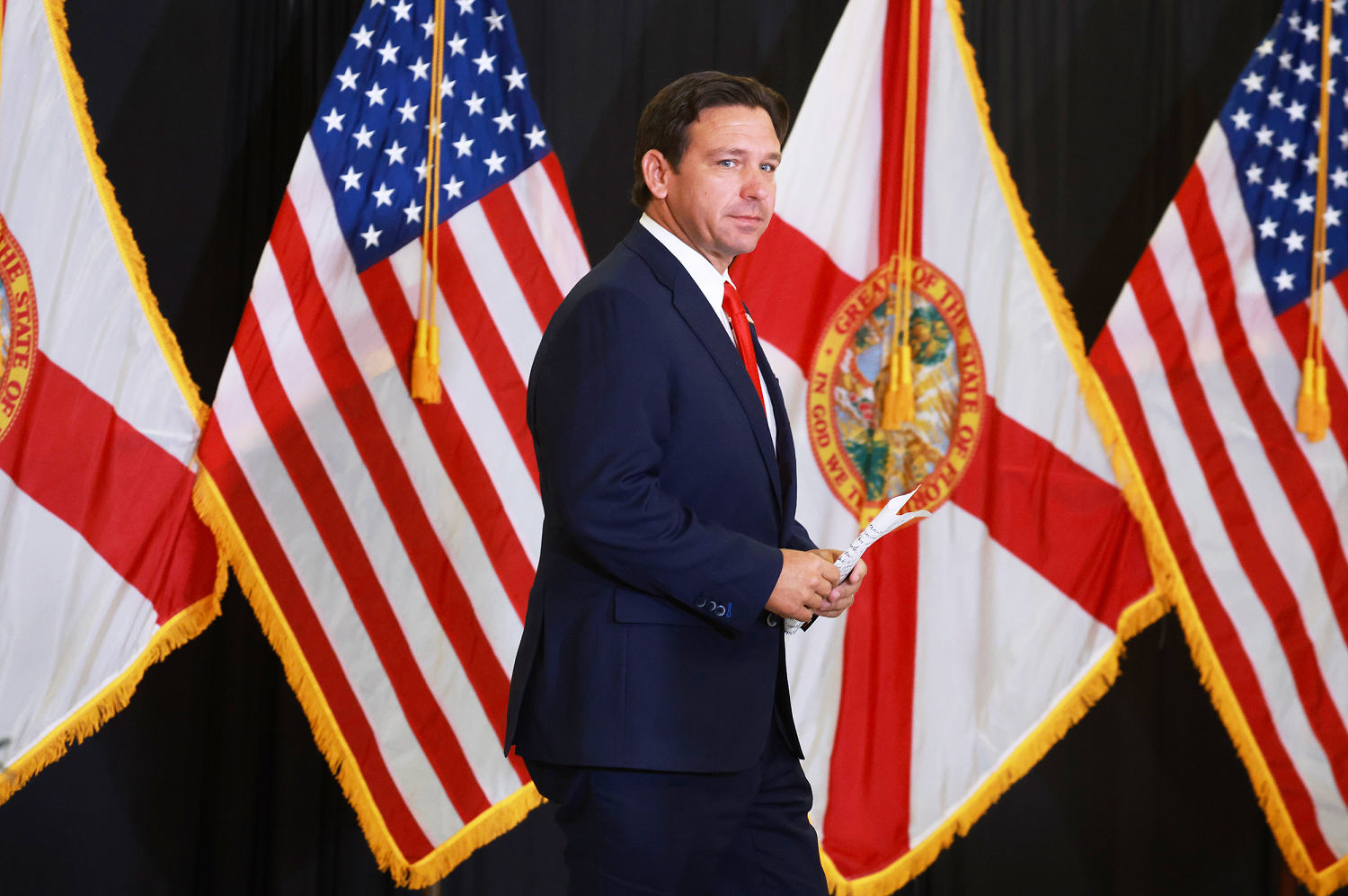

Florida Gov. Ron DeSantis issued an executive order Tuesday directing state authorities to investigate Sunday’s apparent assassination attempt on former President Donald Trump. The governor downplayed the federal charges brought Monday against suspect Ryan Routhsaying, “To say you’re going to do a couple gun charges, that is not going to be sufficient to do it.”
Routh has been charged in federal court with two gun possession counts. But as I noted at the time, those aren’t necessarily the final word on his federal charges. Those charges might have just been the simplest that federal prosecutors in Florida could bring while the government investigates in advance of potentially bringing more serious charges later.
Yet DeSantis implied that the feds have not been doing everything they could — or that whatever they could do isn’t enough. The governor’s remarks cast doubt on the federal effort generally, suggesting it would be more appropriate for state authorities to take the lead.
Of course, it’s not unusual for both state and federal law enforcement to investigate potential crimes that could be charged in their respective courts. And double jeopardy rules don’t bar the same conduct from being charged at both levels.
But it could be counterproductive for DeSantis to create a wedge between the state and the feds if the goal is to bring the strongest possible case against Routh. To the extent that state and federal authorities don’t fully cooperate with one another, that could be inefficient at the investigative stage. It could also create potential issues at any eventual trial(s) if they aren’t on the same page and each side isn’t fully aware of evidence that the other has — or if their separate evidence is at all contradictory. Relatedly, neither state nor federal prosecutors should want a situation where one or the other is rushing to be first to bring the most serious charges.
And while DeSantis suggested that more serious crimes like attempted murder couldn’t be brought federally, that’s not necessarily so. Indeed, it wouldn’t be surprising if more serious charges are brought as the case proceeds in federal court while Routh remains in custody.
To be sure, attempted murder charges could face challenges at either the state or federal level, which may be why Routh wasn’t immediately charged with such a crime federally. That Routh apparently didn’t fire any shots before allegedly fleeing the scene would not prevent him from being charged with attempted murder. For example, Nicholas Roske, who’s charged with attempting to assassinate Supreme Court Justice Brett Kavanaugh, didn’t fire a weapon, though statements he allegedly made to law enforcement admitting his intentions may have made it easier to charge him quickly.
When it comes to the charge of attempted murder, the legal question is whether the defendant took a “substantial step” toward committing the crime, as opposed to “mere preparation.” Routh allegedly was lying in wait with a rifle at Trump’s golf course, so prosecutors may be able to prove an attempt. Prosecutors may be considering whether they have enough evidence to make that argument — or they may already feel confident that they can bring such a case, but given that Routh isn’t going anywhere while he’s being held on the gun charges, they feel they can take the time to collect evidence to build the case.
Whatever comes of the charges against Routh, any discrepancies that result from different law enforcement investigations moving forward could wind up working to his benefit in the end.
Subscribe to theDeadline: Legal Newsletterfor updates and expert analysis on the top legal stories. The newsletter will return to its regular weekly schedule when the Supreme Court’s next term kicks off in October.
Jordan Rubin is the Deadline: Legal Blog writer. He was a prosecutor for the New York County District Attorney’s Office in Manhattan and is the author of “Bizarro,” a book about the secret war on synthetic drugs. Before he joined BLN, he was a legal reporter for Bloomberg Law.


Congressional Black Caucus members, after a stinging loss in the Illinois Democratic Senate primary, are training their ire on Gov. JB Pritzker — and saying it’s on him to rehabilitate the relationship.
After Pritzker’s outsized financial support for Lt. Gov. Juliana Stratton helped lift her to victory, lawmakers vented frustrations that his money unfairly tilted the race in her favor and away from their candidate, Rep. Robin Kelly, a CBC member who finished a distant third. And as Pritzker eyes a 2028 presidential bid, some members, cognizant that the path to winning the Democratic Party’s nomination will run through the caucus, signaled they won’t forget that he crossed them this round.
“He has to justify what he did,” said Rep. Bennie Thompson (D-Miss.). “I’m sure at some point if he decides to run, he’ll have to come with that justification. As to whether or not it has merit or not, remains to be seen.”
Pritzker’s money helped put Stratton on the path to becoming just the sixth Black senator in U.S. history. But by boxing out Kelly, he frayed his relationship with the caucus, which holds significant sway over which candidates break through with Black voters — a large and powerful voting bloc the billionaire governor will need if he chooses to run for the White House.
“Keep in mind, the Democratic candidate for president that prevails has to go through [the CBC],” said Rep. Joyce Beatty (D-Ohio). “The CBC is very strategic and so if there is an issue … we will lay out our framework for what it will take” to get our endorsement, she added.
Many top CBC officials are in no rush to make the first move to mend fences.
“We don’t need to reach out to the governor,” said Rep. Gregory Meeks (D-N.Y.) who chairs the Congressional Black Caucus PAC, adding that the group is focused on midterm races and delivering House Minority Leader Hakeem Jeffries the speaker’s gavel.
“Others are going to have to reach out to us,” he said of Pritzker. “Those conversations happen when those conversations happen.”
Pritzker’s political arm issued a statement in response saying he was “proud” to support Stratton, Illinois’ first Black lieutenant governor: “With only six black women having served in the U.S. Senate throughout its history, Gov. Pritzker supported his partner in governance because he’s worked side by side with her for almost a decade and knows she will deliver for the people of Illinois,” Jordan Abudayyeh, Pritzker’s spokesperson, said.
His team did not address questions about CBC members’ concerns, but did point to Rep. Jim Clyburn, the powerful South Carolina Democrat, saying ahead of the election that Pritzker was “free to support” anyone.
Clyburn on Wednesday told Blue Light News he would “expect” for Pritzker to support his No. 2 and that he was not focused on 2028.
Still, lawmakers’ veiled threats lay bare the difficulties Pritzker could face beyond Tuesday’s primary. And they underscore the duality the CBC is navigating as high-profile defeats of their members in Illinois and Texas raise questions about their political influence — even as they celebrate Stratton’s victory.
In interviews with more than a dozen CBC members on Wednesday, they made clear their irritation is not with Stratton, who many said will be welcomed into the caucus if she wins as expected in November. Their indignation rests solely with Pritzker, who they accused of playing kingmaker by pouring millions of dollars into propping up Stratton.
Tensions flared between the powerful legislative voting bloc and the billionaire governor in early March. CBC Chair Yvette Clarke lashed out at Pritzker, saying she was “beyond frustrated” with the governor for “tipping the scales” a nod to his funneling of $5 million from his super PAC to help catapult Stratton into contention with Rep. Raja Krishnamoorthi, who for much of the primary was leading in the polls and started with a massive cash advantage.
Many CBC members, and Clarke specifically, took Pritzker’s presence in the race as a snub to Kelly, who had a long-standing beef with Pritzker after he worked to oust her as chair of the Illinois Democratic Party in 2022. While both Kelly and Pritzker were said to have moved beyond it, the Senate campaign reopened old wounds.
Clarke issued a statement — some 12 hours after the Illinois Senate primary was called — to congratulate Stratton on her victory, calling it “a significant moment for Illinois and the nation that calls for unity” before pivoting to praise Kelly.
The CBC chair on Wednesday said she and Pritzker had not spoken.
“I’m sure there’ll be a moment where we’ll have a conversation,” Clarke said. When asked if she felt like she needed to initiate a conversation with the governor, she responded tersely. “No, I don’t.”
Former Illinois Sen. Carol Moseley Braun, the first Black woman elected to the body in U.S. history, endorsed Stratton in the race. She took issue with CBC members’ intense focus on the governor’s role in the process instead of the historic outcome, and said the group seemed more focused on backing its own than expanding Black representation.
“To weigh in on this race was just backwards,” she told Blue Light News. “[Kelly] was a member of the caucus and so it’s understandable on that level. But at the same time, Juliana deserved at least something from that group.”
Many current CBC members refrained from attacking Pritzker directly, however — another sign of the complex politics at play. Congressional Democrats want Pritzker’s billions to help bankroll their bid to retake control of the House and make Jeffries, the minority leader and New York Democrat, the first Black speaker. They’ve already been working him behind the scenes.
“I’ve already reached out to Governor Pritzker,” said Rep. Steven Horsford (D-Nev.), a former CBC chair. “I’ve talked to him this morning, in fact, and I’ll talk to him in the weeks and months to come, because I have one objective: to win this House, to help win the Senate, and to make sure we end the chaos that’s coming out of this administration.”
Others took pains to separate their evaluation of Pritzker’s role in propelling Stratton to victory from any campaign he may run in 2028, suggesting they were willing to reset the relationship.
“You will still have to show your bona fides, and you still will have to make your case as to why the CBC and Black people should take you into consideration. So we have reset it,” Rep. Sydney Kamlager-Dove (D-Calif.) said. “Good for him, for her, but that has no bearing on the 2028 race.”
Shia Kapos contributed to this report.

NEW YORK (AP) — A federal judge on Tuesday ordered the Trump administration to restore the government-run Voice of America’s operations after it had effectively been shut down a year ago, putting hundreds of employees who have been on administrative leave back to work.
U.S. District Court Judge Royce C. Lamberth gave the U.S. Agency for Global Media a week to put together a plan for putting Voice of America on the air. It has been operating with a skeleton staff since President Donald Trump issued an executive order to shut it down.
A week ago, Lamberth said Kari Lake, who had been Trump’s choice to lead the agency, did not have the legal authority to do what she had done at Voice of America. In Tuesday’s decision, Lamberth ruled on the actions she had taken to respond to Trump’s order, essentially shelving 1,042 of VOA’s 1,147 employees.
“Defendants have provided nothing approaching a principled basis for their decision,” Lamberth wrote.
There was no immediate comment on the decision by the agency overseeing Voice of America. Lake had denounced Lamberth’s March 7 ruling, saying it would be appealed. Since then, Trump nominated Sarah Rogers, the undersecretary of state for public diplomacy, to run USAGM. That requires Senate approval, a step that was not taken with Lake.
Patsy Widakuswara, Voice of America’s White House bureau chief and a plaintiff in the lawsuit to restore it, said she is deeply grateful for the decision.
“We are eager to begin repairing the damage Kari Lake has inflicted on our agency and our colleagues, to return to our congressional mandate, and to rebuild the trust of the global audience we have been unable to serve for the past year,” she said.
“We know the road to restoring VOA’s operations and reputation will be long and difficult,” she said. “We hope the American people will continue to support our mission to produce journalism, not propaganda.”
Voice of America has transmitted news coverage to countries around the world since its formation in World War II, often in countries with no tradition of a free press. Before Trump’s executive order, VOA had operated in 49 different languages, broadcasting to 362 million people.
NEW YORK (AP) — A federal judge on Tuesday ordered the Trump administration to restore the government-run Voice of America’s operations after it had effectively been shut down a year ago, putting hundreds of employees who have been on administrative leave back to work.
U.S. District Court Judge Royce C. Lamberth gave the U.S. Agency for Global Media a week to put together a plan for putting Voice of America on the air. It has been operating with a skeleton staff since President Donald Trump issued an executive order to shut it down.
A week ago, Lamberth said Kari Lake, who had been Trump’s choice to lead the agency, did not have the legal authority to do what she had done at Voice of America. In Tuesday’s decision, Lamberth ruled on the actions she had taken to respond to Trump’s order, essentially shelving 1,042 of VOA’s 1,147 employees.
“Defendants have provided nothing approaching a principled basis for their decision,” Lamberth wrote.
There was no immediate comment on the decision by the agency overseeing Voice of America. Lake had denounced Lamberth’s March 7 ruling, saying it would be appealed. Since then, Trump nominated Sarah Rogers, the undersecretary of state for public diplomacy, to run USAGM. That requires Senate approval, a step that was not taken with Lake.
Patsy Widakuswara, Voice of America’s White House bureau chief and a plaintiff in the lawsuit to restore it, said she is deeply grateful for the decision.
“We are eager to begin repairing the damage Kari Lake has inflicted on our agency and our colleagues, to return to our congressional mandate, and to rebuild the trust of the global audience we have been unable to serve for the past year,” she said.
“We know the road to restoring VOA’s operations and reputation will be long and difficult,” she said. “We hope the American people will continue to support our mission to produce journalism, not propaganda.”
Voice of America has transmitted news coverage to countries around the world since its formation in World War II, often in countries with no tradition of a free press. Before Trump’s executive order, VOA had operated in 49 different languages, broadcasting to 362 million people.
- Pritzker helped a Black woman become senator. Some Black leaders are still mad at him.
- Judge orders restoration of Voice of America
- Trump delays China trip to focus on war in Iran
- Judge orders restoration of Voice of America
- Judge orders restoration of Voice of America
- Democrats say Bondi won’t commit to testifying in House Epstein investigation
- Senate rejects limits on Trump as Iran war intensifies
- Why Judge Boasberg’s ruling on DOJ’s Jerome Powell investigation is bigger than one case
- Judge writes Kari Lake ‘repeatedly thumbed her nose’ at legal requirements

- In touting SAVE Act, Johnson refuses to cite any fraud it would have prevented
-

 The Dictatorship1 year ago
Luigi Mangione acknowledges public support in first official statement since arrest
-

 Politics1 year ago
Former ‘Squad’ members launching ‘Bowman and Bush’ YouTube show
-

 Politics1 year ago
Blue Light News’s Editorial Director Ryan Hutchins speaks at Blue Light News’s 2025 Governors Summit
-

 Politics1 year ago
Former Kentucky AG Daniel Cameron launches Senate bid
-

 The Dictatorship6 months ago
Mike Johnson sums up the GOP’s arrogant position on military occupation with two words
-

 The Dictatorship1 year ago
Pete Hegseth’s tenure at the Pentagon goes from bad to worse
-

 Politics11 months ago
Democrat challenging Joni Ernst: I want to ‘tear down’ party, ‘build it back up’
-
Uncategorized1 year ago
Bob Good to step down as Freedom Caucus chair this week