
Congress
Republicans tried to snag Jack Smith on technicalities. But they didn’t engage with the facts.

Republicans finally had their moment to take on the man who tried to put President Donald Trump in jail. But they didn’t land any significant blows.
During Thursday’s House Judiciary Committee hearing with Jack Smith, GOP members spent almost no time challenging the facts of the criminal case that the former special counsel brought against Trump: that he conspired to corrupt the results of the 2020 election and seize a second term he didn’t win.
Instead, Republican committee members spent much of the hearing challenging the technical aspects of Smith’s probe into Trump’s election interference, including whether the veteran federal prosecutor properly signed his oath of office as special counsel and if he was sufficiently cognizant of the Constitution’s “speech or debate” clause that protects Congress from executive branch overreach.
They questioned whether Smith was too friendly with a Justice Department official who recommended him for the special counsel position and challenged his approval of a $20,000 payment to a confidential human source for the FBI who was reviewing video and photos for the bureau.
House Judiciary Committee chair Jim Jordan pressed Smith on his view of the House’s now-defunct select committee to investigate the events of Jan. 6, 2021, which also probed Trump’s 2020 election gambit. He also questioned that panel’s reliance on former Trump White House aide Cassidy Hutchinson to implicate Trump in plans to overturn the results favoring Joe Biden.
“Democrats have been going after President Trump for 10 years. For a decade. And the country should never, ever forget what they did,” Jordan said.
This nibbling around the edges by Republicans underscores the GOP’s lingering discomfort with Trump’s bid to subvert the election — an effort that preceded a violent attack on the Capitol by a mob of the president’s supporters. Several Republicans on the Judiciary Committee were among those who fled the rioters that day and condemned the violence at the time, and none at the hearing suggested Trump actually prevailed against Biden.
The posture of committee Republicans Thursday also gave Democrats ammunition to claim that Republicans had no legitimate argument with the substance of Smith’s findings — both in the election interference case and in the case alleging mishandling of classified documents at Mar-a-Lago.
“Our Republican colleagues want to try to dirty up his investigation, but they want to try to avoid as much as possible the underlying facts, because it’s all about what is incontrovertibly true: Donald Trump’s determined plan to overthrow the 2020 presidential election,” said Rep. Jamie Raskin of Maryland, the top Democrat on the Judiciary Committee, in an interview during a break in the hours-long hearing convened to receive Smith’s first-ever public testimony.
Raskin and other Democrats feel so emboldened by Smith’s testimony Thursday that they are now asking Jordan to hold a continuation of the hearing as soon as a report is unsealed that would allow Smith to go into more detail about the classified documents charges he sought to bring up against Trump.
The most forceful attack on Smith came from Trump himself who appeared to have watched or been briefed on aspects of the hearing during his trip to Europe.
“Jack Smith is a deranged animal, who shouldn’t be allowed to practice Law,” Trump said on Truth Social. “Hopefully the Attorney General is looking at what he’s done, including some of the crooked and corrupt witnesses that he was attempting to use in his case against me.”
Smith, who later said he expected the Trump administration would pursue federal criminal charges against him “because they have been ordered to by the president,” forcefully defended his office’s work throughout the hearing Thursday. He denied that politics played any role in his team’s findings and calmly parried the attacks Republicans lobbed at him over his investigative tactics and decision to bring charges at all.
And he repeatedly suggested the failure to hold Trump accountable for his 2020 election maneuvering could invite future attacks.
“I have seen how the rule of law can erode. My feeling is that we have seen the rule of law function in our country so long that many of us have come to take it for granted,” Smith said. “The rule of law is not self-executing.”
Smith’s hearing, which came weeks after the public release of his closed-door deposition testimony to the panel late last year, also provided a venue for relitigating the events of Jan. 6 — specifically who was responsible for the violent event. Rep. Joe Neguse (D-Colo.) called the hearing “theater” for Republican lawmakers seeking to rewrite the history of the attack, noting the presence in the audience of police officers who defended the Capitol that day.
Also in attendance at the hearing was Stewart Rhodes, the founder of the Oath Keepers, who was convicted of seditious conspiracy for his role in the Jan. 6 riot and sentenced to 18 years in prison before Trump commuted his sentence last year.
“I want to see true transparency in our government,” Rhodes said in an interview, adding that it was “really kind of surreal” to be back in the Capitol complex after being banned prior to his commutation.
At some points emotions ran high, such as when former Metropolitan Police Force officer Michael Fanone coughed “Fuck yourself” when Rep. Troy Nehls (R-Texas) opined that police bore responsibility for the Jan 6. security breach at the Capitol. There was also a tense confrontation between Fanone and Ivan Raiklin, an activist and advocate for Jan. 6 defendants, that almost culminated in a physical altercation.
Throughout the day Smith remained straight-faced and measured, offering little visible reaction as the occasionally irate Republicans repeatedly condemned his work and attacked his character in deeply personal terms.
He also appeared unmoved amid the effusive praise from Democrats, who repeatedly thanked him for his service to the country and urged him not to bow to intimidation from Trump and his allies.
Democrats eagerly teed up the evidence Smith amassed in his Trump investigations that underscored their view that Trump knew he lost the election but attempted to stay in power anyway.
Smith has said Trump’s campaign of lies about election fraud fueled the Jan. 6 attack on the Capitol that resulted in hundreds of assaults on law enforcement officers. He has also said Trump exploited the violence to try and pressure Congress to block Joe Biden’s victory.
“I’m so pleased you’re here on national TV telling the American people that Trump was indicted, he was indicted lawfully and multiple grand juries secured those indictments,” said Rep. Ted Lieu (D-Calif.) said during the hearing.
But Republicans spent little time questioning that narrative: Rep. Brandon Gill (R-Texas) asked whether Smith’s subpoenas for GOP lawmakers’ phone data — revelations that reignited the party’s determination to compel Smith’s Capitol Hill testimony — violated the Constitutional speech and debate clause that protects correspondence about the legislative process.
Rep. Scott Fitzgerald (R-Wis.) suggested that Smith was appointed special counsel because of a friendship with another Justice Department staffer in the Biden administration.
Even when a handful of Republicans did question Smith’s case against Trump, they focused largely on whether Trump could be excused for his conduct if he genuinely believed he won the election — even though he was defeated and the results were certified in Biden’s favor.
“I’ve talked to Donald Trump over a period of time. Donald Trump is 100 percent certain he won that election,” said Rep. Glenn Grothman (R-Wis.). “There is zero percent chance that he believes he lost.”
Rep. Laurel Lee (R-Fla.) noted that Trump relied heavily on a team of legal advisers as he worked to reverse the election results and said Smith needed to prove Trump “knowingly” sought to subvert the outcome.
Smith, both in the indictment against Trump and his testimony Thursday, repeatedly argued that Trump knew he lost.
“He was looking for ways to stay in power,” Smith said. ”When people told him things that conflicted with staying in power, he rejected them.”


President Donald Trump met privately on Tuesday with Coinbase CEO Brian Armstrong before publicly backing the company’s position in an ongoing lobbying clash with banks that has derailed a major cryptocurrency bill, according to two people with knowledge of the matter who were granted anonymity to discuss a closed-door matter.
It is unclear what was discussed during the meeting, but it came just before Trump wrote on social media that banks “need to make a good deal with the Crypto Industry” in order to advance digital asset legislation that has stalled on Capitol Hill. He wrote that a recently adopted crypto law is “being threatened and undermined by the Banks, and that is unacceptable” — echoing Coinbase’s position.
A spokesperson for Coinbase declined to comment. The White House did not immediately respond to a request for comment.
The policy clash centers around whether crypto exchanges like Coinbase should be able to offer rewards programs that pay an annual percentage yield to customers who hold digital tokens known as stablecoins that are designed to maintain a value of $1. Wall Street groups are warning that allowing yield-like payments on stablecoins could lead customers to pull deposits from bank accounts and threaten lending that is critical to the economy.
Banks are pushing to ban any type of stablecoin yield payments as part of a sweeping crypto regulatory bill that is currently pending in the Senate. But a wide array of digital asset firms have fought back, and the rift helped derail the so-called crypto market structure legislation bill earlier this year. The legislation would establish new rules governing how crypto tokens are overseen by market regulators — a longtime lobbying goal for digital asset firms, which say they need “regulatory clarity” from Washington.
Coinbase, the largest U.S.-based crypto exchange, has played a key role in the spat. On the eve of a scheduled Senate Banking Committee markup in January, Armstrong came out against the most recent publicly released draft of the crypto bill. He warned in part against “Draft amendments that would kill rewards on stablecoins, allowing banks to ban their competition.” The markup was later postponed, and the bill has remained stalled ever since.
Since then, White House officials have sought to mediate a compromise between the two sides. The White House hosted a series of meetings with representatives from the banking and crypto sectors, but significant differences remain between the two sides and no deal has emerged.
Coinbase has become a major player in Trump’s Washington, thanks in part to massive political spending that is already beginning to shake up the 2026 midterm elections. The exchange, which was co-founded by Armstrong, is a leading backer of a crypto super PAC group known as Fairshake that is armed with a war chest of more than $190 million. Coinbase also donated to Trump’s inaugural committee and to the president’s White House ballroom renovation effort.
In his post on Truth Social Tuesday, Trump included a line that Armstrong has uttered verbatim in interviews about the stablecoin yield fight: “Americans should earn more money on their money.” Separately, on Tuesday night, Trump also posted a picture of an X post from Armstrong praising him for delivering “on his campaign promise to make America the crypto capital of the world.”
The crypto “Industry cannot be taken from the People of America when it is so close to becoming truly successful,” Trump wrote in the initial post.
Declan Harty contributed to this report.
Lawmakers given classified briefings Tuesday evening on the U.S. military conflict in Iran expect President Donald Trump will ask Congress for emergency cash to finance the war.
During the closed-door meetings on Capitol Hill, top Trump administration officials said only that they are considering a supplemental military funding request, according to lawmakers who attended the briefings. But senior intelligence and defense officials described a vast military operation that many members anticipate will require extra funding on top of the nearly $1 trillion Congress has already given the military over the last year.
“I think there will be a supplemental coming,” Sen. Lindsey Graham (R-S.C.) told reporters upon leaving his classified Senate briefing. “We’ll have to approve that.”
Sen. Chris Murphy of Connecticut, the top Democrat on the Senate committee overseeing funding for the Department of Homeland Security, said after the briefing that the military operation “feels like a multitrillion-dollar, open-ended conflict with a very confusing and constantly shifting set of goals” because top Trump administration officials “are refusing to take off the table ground operations.”
Sen. Josh Hawley (R-Mo.) also described the U.S.-Iran conflict as “a massive operation” that’s “rapidly changing.”
“It sounded very open-ended to me,” he added.
Some lawmakers typically opposed to increased spending are open to the idea of providing extra money to fuel the U.S. military’s operation against Iran. “I think it would have support of Republicans,” Sen. Ron Johnson (R-Wis.) said about a supplemental funding request Tuesday night.
“Everybody always wants money, any excuse, whether they’ll need it or not. My guess: They’ll need it,” Johnson continued. “We’re shooting off a lot of ammo. Gotta restock.”
But Democratic votes will be needed to pass any emergency funding package in the Senate, and minority party leaders say they will need far more details from the Trump administration if they are going to consider support for new Pentagon cash.
“Before you can feel satisfied about a supplemental — and I haven’t seen it — you have to know what the real goals are and what the endgame is,” Senate Minority Leader Chuck Schumer told reporters Tuesday.
Delaware Sen. Chris Coons, a senior Democratic appropriator, said he expects the Pentagon will send Congress a supplemental funding request and vowed to “make sure we are making all the investments we can” to keep U.S. troops safe.
But Coons said Trump administration officials need to testify at an open hearing so “the American people can get questions answered about the failures in planning that led to some of the challenges, losses and mistakes in this war.”
Any supplemental spending package to support the Iran war effort would come on top of the more than $150 billion the Pentagon got from the party-line tax and spending package Republicans enacted last summer and nearly $839 billion in regular funding Congress cleared last month.
The House’s lead Democratic appropriator, Connecticut Rep. Rosa DeLauro, said lawmakers have yet to receive information about how much the Pentagon has spent already.
“They’re talking about a supplemental, but we haven’t got a clue,” DeLauro told reporters after Trump administration officials briefed House lawmakers later Tuesday. “There’s no cost estimate of what they have spent so far. Is there anybody writing down what the hell they’re spending? No.”
Senate Majority Leader John Thune said Tuesday that Republicans “forward-funded” military operations with the party-line package enacted last summer but that lawmakers will be “paying attention” to any need for extra money.
“Not only do we have the resources to conduct the operations right now, but a lot of our allies in the region also have capabilities that are coming to bear now,” Thune said.
Even before the strikes on Iran, Trump was eyeing a massive hike in military spending for the upcoming fiscal year. He pledged to pursue a $1.5 trillion Pentagon budget, a roughly 50 percent increase to military spending.
The president said Tuesday, however, that U.S. military resources are far from depleted.
“We have a virtually unlimited supply of these weapons,” Trump said on social media. “Wars can be fought ‘forever,’ and very successfully, using just these supplies.”
Jordain Carney, Meredith Lee Hill, Connor O’Brien, Joe Gould and Calen Razor contributed to this report.
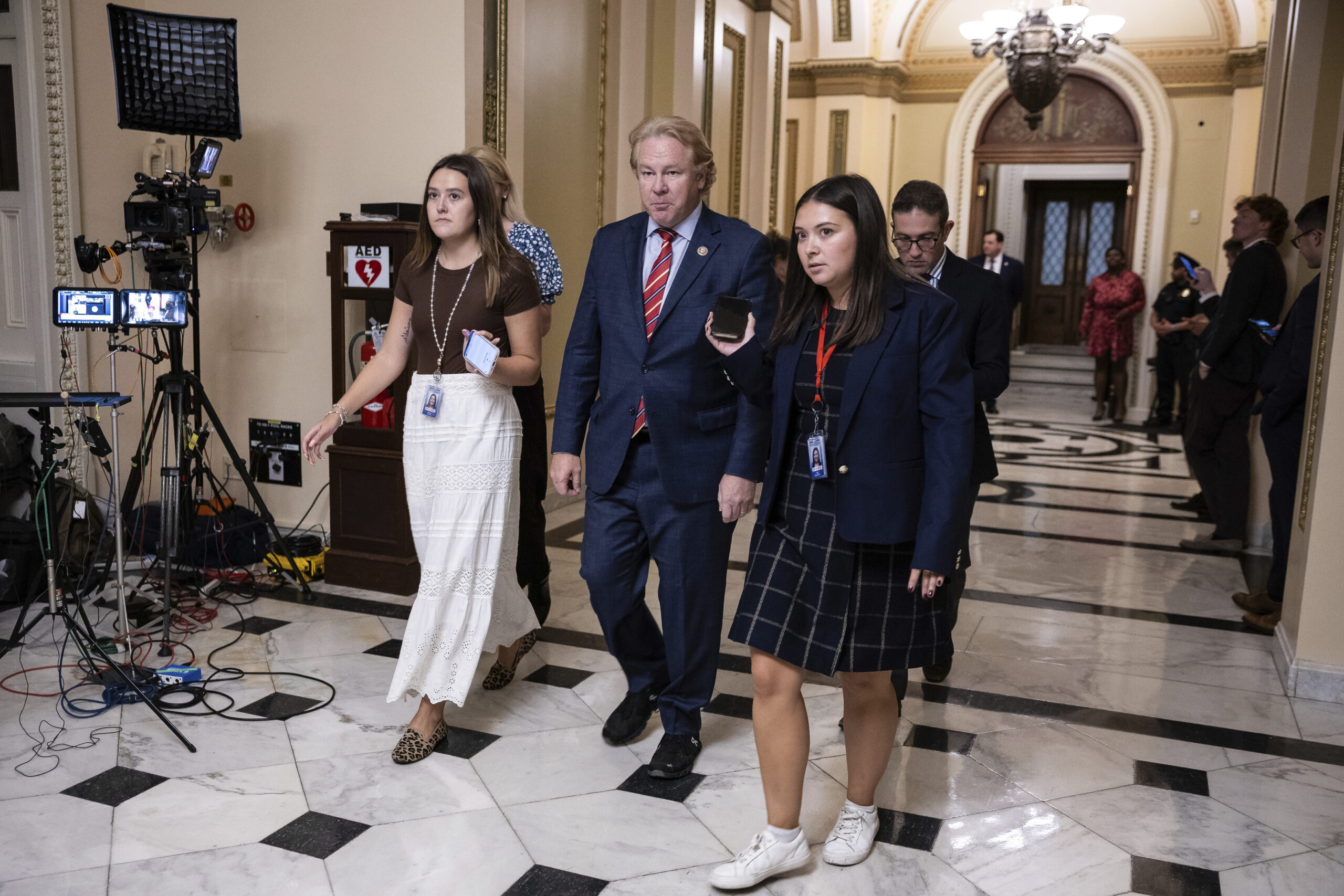
The vast majority of congressional Republicans are publicly supportive of President Donald Trump’s decision to launch a war on Iran. But many are harboring private misgivings about the risks to American troops and global stability — as well as their own political fortunes — should the military campaign drag on indefinitely.
Trump’s comments this week that the bombing could last “four to five weeks” or more, that he doesn’t care about public polling and that the U.S. will do “whatever” it takes to secure its objectives are among the factors that have put lawmakers on edge.
Some of the anxieties have started emerging publicly.
“The constitutional sequence is, you engage the public before you go to war unless an attack is imminent. And imminent means like, imminent — not like something that’s been over a 47-year period of time,” Rep. Warren Davidson (R-Ohio), a former Army ranger, said Tuesday.
Rep. Eli Crane (R-Ariz.), a combat veteran who served in the Iraq War and has cautioned in the past against regime change efforts, called it “a very dicey, a very dynamic situation right now” on the Charlie Kirk Show Monday while also making clear he would give Trump deference.
“I hope it works out,” he added. “Military operations like this can go sideways so fast, you know, it will make your head spin.”
But a wider group of House Republicans granted anonymity to speak candidly shared deeper concerns about the strikes. All said they would stand with Trump and Speaker Mike Johnson this week to oppose a largely Democratic effort to force votes on restraining the president. But they said their support was not guaranteed over the long term.
“Most Republicans want clear objectives, clearer than they are now,” said one House Republican, who added members have pressed GOP leaders and White House officials to be more consistent in articulating the administration’s military goals.
Another was troubled by Trump’s own shifting statements on when the bombing campaign might wrap up, whether he is seeking the fall of the Islamic regime and whether ground troops might ultimately be necessary.
“Sounds a little bit like President Lyndon Johnson going into Vietnam, doesn’t it?” the lawmaker said.
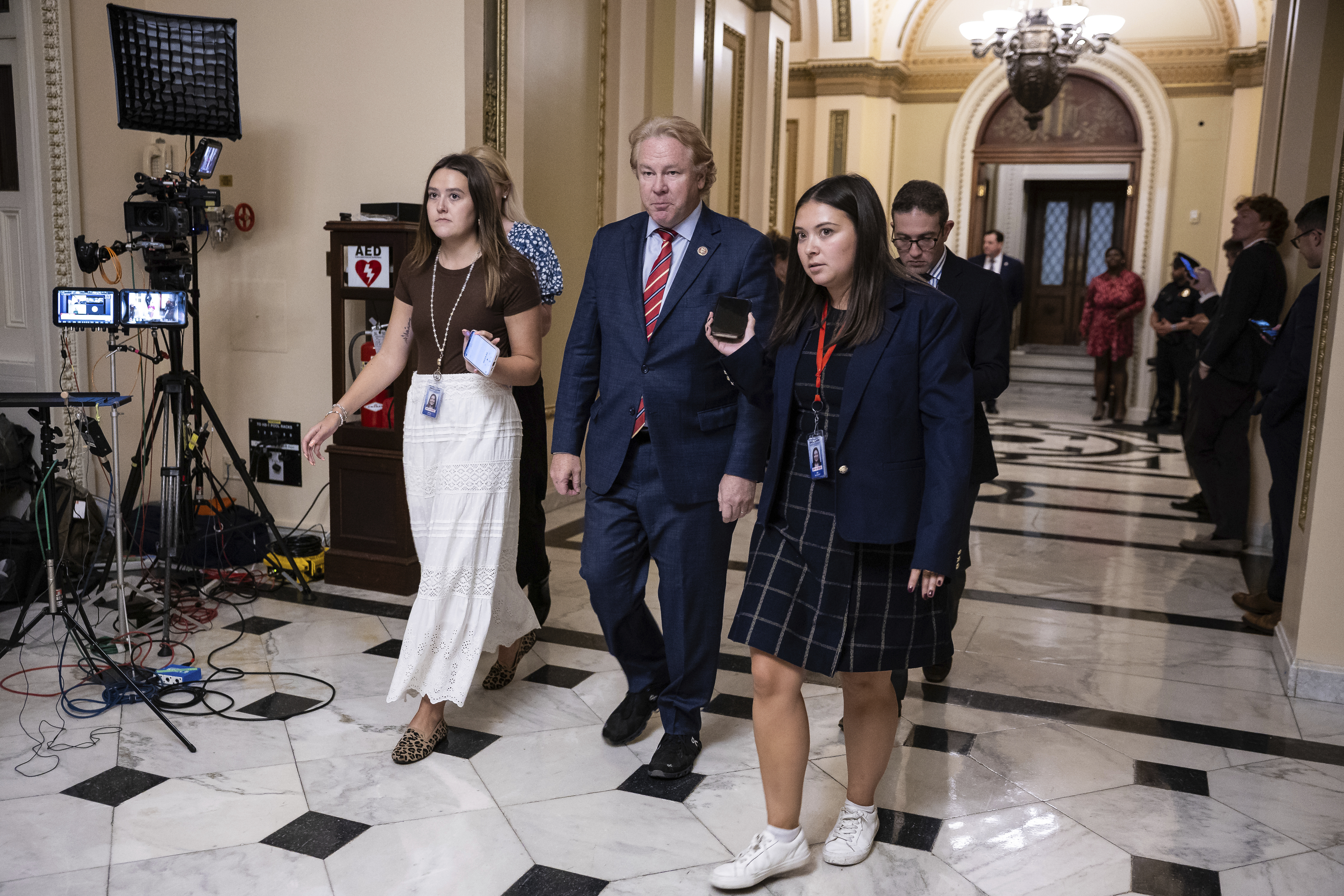
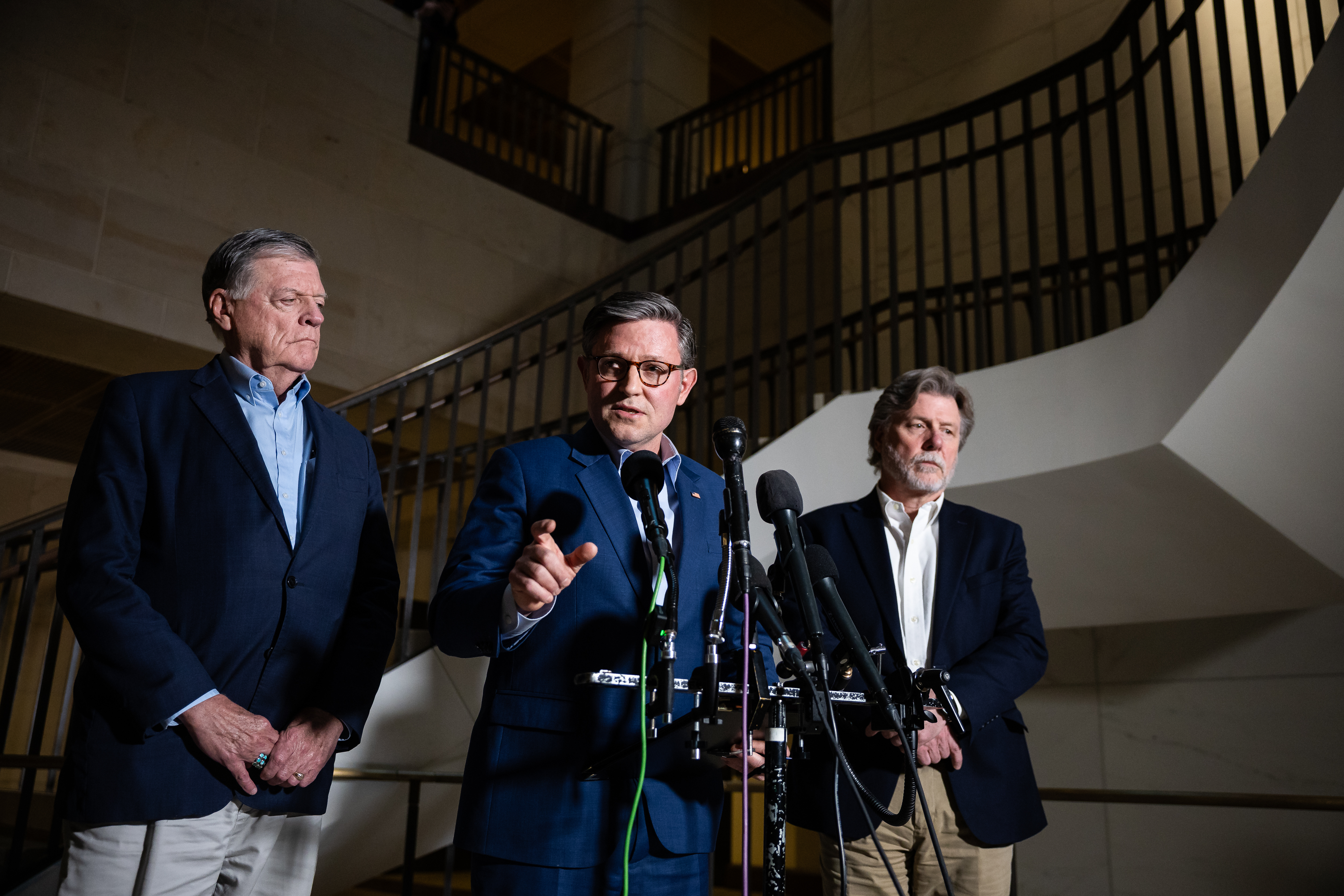
Trump officials and top House GOP leaders have already moved to ease potential member concerns. Johnson, for instance, said leaving a classified briefing Monday that “the operation will be wound up quickly, by God’s grace and will.”
“That is our prayer for everybody involved,” he added.
A White House memo sent to congressional Republicans Monday outlined several military objectives for the bombing campaign and said Trump should be “commended” for taking on a hostile state sponsor of terrorism.
But despite denying that Trump had acted in pursuit of regime change, the document also said the Iranian regime “would be defeated” and included other contradictory statements about the reasons for the strikes — while trying to sidestep the question of whether the strikes constituted a “war,” a word Trump himself has used.
Beyond the fears of a prolonged military engagement that could be costly in dollars and American lives, Republicans are also facing the prospect of a stock market tumble and rising gas prices that could fall hardest on vulnerable incumbents ahead of the midterms. Many of those members promised their constituents, much as Trump did, that they would not engage in endless war.
The planned Thursday vote on a bipartisan war powers resolution has surfaced some of the GOP discomfort, even as party leaders and White House officials whip members against it — including those most at risk of losing their seats.
Rep. Thomas Massie (R-Ky.), who is co-leading the war powers push with Rep. Ro Khanna (D-Calif.), pointed to the White House memo as further evidence of incoherence on the administration’s part.
“So they’re going to defeat a terrorist regime that rules a country of 90 million people, but that’s not war?” he said in an interview.
Also raising concerns in advance of the vote is Davidson, who has long railed against extended U.S. wars abroad. He said in a social media post Monday it was “troubling” that Secretary of State Marco Rubio said Monday that an imminent Israeli attack on Iran forced the U.S. to strike. He also raised concerns to reporters Tuesday about some of the administration’s claims.
House Intelligence Chair Rick Crawford (R-Ark.) said in an interview Tuesday he didn’t think the war powers vote was necessary and that Trump was operating within his legal authority.
The vote, he said, was “a way for individuals to sort of register their displeasure or make a political statement.”
Even if the war powers measure is defeated, some Republicans say an effort to restrain Trump could reemerge if the conflict drags on or Trump commits ground troops to the conflict. “If we’re talking months, not weeks, then you will see another vote,” said a third House Republican who added that Trump had some “leeway” for now.
Johnson, meanwhile, is channeling any intraparty concerns about Trump’s war into another vote this week on a stalled Homeland Security spending bill — an attempt to keep the focus on Democrats’ opposition to funding for TSA, FEMA and other agencies as a department shutdown approaches the three-week mark.
He is also arguing, as he told reporters after a classified briefing Monday, that the war powers vote is “dangerous” at a moment when U.S. troops were in harm’s way and that Republicans would act to “put it down.” The strikes, Johnson added, did not need advance congressional approval because they were “defensive in nature.”
Those arguments have resonated with most House Republicans, who say they’re willing to give the president time.
“I think so far, the Pentagon seems to have a good plan,” said Rep. Jeff Crank (R-Colo.), a member of the Armed Services Committee who said he would give Trump “six weeks or … eight weeks or whatever we need to accomplish the missions that we set out.”
“The worst thing we could do is go in and then … to pull back or cut short, whatever our objectives are,” he added. “We’re there. We need to get the objectives finished.”
- Trump met with Coinbase CEO before bashing banks over crypto bill
- Cornyn, Paxton head to runoff in Texas Senate GOP race
- Rep. Chip Roy headed to runoff in Texas AG race
- Democrats reject ‘ridiculous’ GOP demand to fund DHS after Iran attack
- Josh Hawley says he’ll oppose Iran war powers resolution
- House Ethics panel probing Nancy Mace over alleged improper reimbursements
- Iranian ‘regime will be defeated,’ White House tells Hill Republicans
- Lawmakers splinter on Trump administration’s case for war on Iran
- Lawmakers anticipate Trump will seek emergency funding for ‘open-ended’ Iran war
- House Republicans are publicly cheering Trump’s Iran war. Privately, many are worried.
-

 The Dictatorship1 year ago
Luigi Mangione acknowledges public support in first official statement since arrest
-

 Politics1 year ago
Former ‘Squad’ members launching ‘Bowman and Bush’ YouTube show
-

 Politics1 year ago
Blue Light News’s Editorial Director Ryan Hutchins speaks at Blue Light News’s 2025 Governors Summit
-

 The Dictatorship6 months ago
Mike Johnson sums up the GOP’s arrogant position on military occupation with two words
-

 Politics1 year ago
Former Kentucky AG Daniel Cameron launches Senate bid
-

 The Dictatorship1 year ago
Pete Hegseth’s tenure at the Pentagon goes from bad to worse
-
Uncategorized1 year ago
Bob Good to step down as Freedom Caucus chair this week
-

 Politics11 months ago
Democrat challenging Joni Ernst: I want to ‘tear down’ party, ‘build it back up’