
The Dictatorship
Pentagon announces first American casualties in Iran

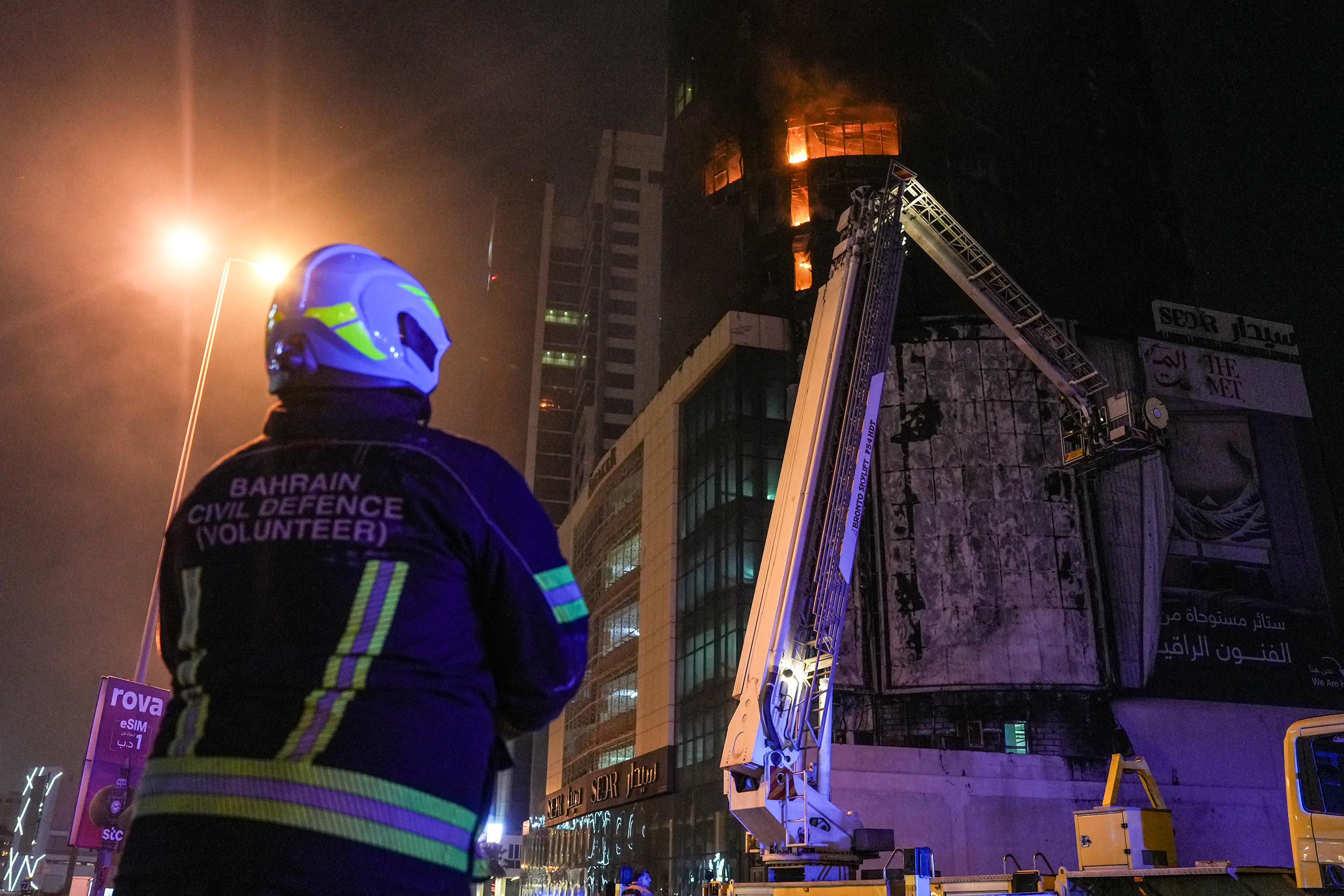
Three U.S. service members were killed and five seriously wounded as the United States and Israel launched attacks on Iran, U.S. Central Command said Sunday morning.
The three service members — the first Americans to die in the conflict — were killed in Kuwait, a U.S. official said.
Several others sustained minor injuries from shrapnel and concussions but will return to duty, the Pentagon said. The identities of the dead and wounded have not been made public.
“The situation is fluid, so out of respect for the families, we will withhold additional information, including the identities of our fallen warriors, until 24 hours after next of kin have been notified,” Central Command said in a statement.
The U.S. and Israel launched sweeping airstrikes on Iranon Saturday, killing Ayatollah Ali Khameneithe country’s supreme leader for nearly four decades. Iran has vowed retaliation and hit several U.S. military bases across the region.
According to U.S. Central Command, Iran has also attacked more than a dozen locations, including airports in Dubai, Kuwait and Iraq, and residential neighborhoods in Israel, Bahrain and Qatar.
Israel Defence Forces said Sunday that Iran fired missiles toward the neighborhood of Beit Shemesh, killing civilians. The missile hit a synagogue, killing at least nine people, according to the Associated Press.
AP reported that authorities said at least 22 people were killed and 120 others wounded when demonstrators tried to attack the U.S. Consulate in Karachi in Pakistan.
The violence came after the United States and Israel attacked Irankilling its Supreme Leader Ayatollah Ali Khamenei. Police and officials at a hospital in Karachi said that at least 50 people were also wounded in the clashes and some of them were in critical condition.
On Sunday, Israel Defence Forces said on X, “It’s official: All senior terrorist leaders of Iran’s Axis of Terror have been eliminated.”
President Donald Trump told CNBC’s Joe Kernen on Sunday that the operation in Iran is “moving along very well, very well — ahead of schedule.”
In a phone call with MS NOW late Saturday, Trump called the celebrations in the streets of Iran “fantastic” following the killing of Khamenei.
Confirming Khamenei’s death, Prime Minister Benjamin Netanyahu said Sunday: “We have eliminated the tyrant Khamenei and dozens of senior figures of the oppressive regime. Our forces are now striking at the heart of Tehran with increasing intensity, set to escalate further in the coming days.”
The exchange of hostilities comes after weeks of fragile negotiations between the U.S. and Iran over Iran’s nuclear operations.
Esmail Baghaei, a spokesperson for Iran’s foreign ministry, called the joint U.S-Israeli attack an “unprovoked, unwarranted act of aggression” in an interview with MS NOW’s Ali Velshi on Sunday. He said Iran’s nuclear program has been used a pretext for the attack.
“We have every right to defend our people because we have come under this egregious act of aggression,” Baghaei said.
Trump announced the attack early Saturday during a short video posted on his Truth Social account. He called for an end to the Iranian regime and urged Iranians to “take back the country.”
Negotiators and mediators from Oman were supposed to meet in Vienna on Monday to discuss the technical aspect of a potential nuclear deal.
Rep. Eric Swawell, D-Calif., told MS NOW’s Alex Witt on Sunday afternoon that the president’s military operation in Iran was illegal, echoing what many lawmakers have said in citing that under the U.S. Constitution only Congress can declare war.
“This is a values argument. We don’t just lob missiles into other countries when we are not provoked, attacked and have no plan for what comes next,” he said.
“We have been shown zero evidence that anything changed in Iran from last year when the president did not come to Congress and took a strike on Iran,” Swalwell said.
In June the U.S. struck three Iranian nuclear sites. Trump said the facilities had been “completely and totally obliterated.” But experts and U.S. officials said the sites were damaged but not destroyed.
Erum Salam is breaking news reporter for MS NOW, with a focus on how global events and foreign policy shape U.S. politics. She previously was a breaking news reporter for The Guardian and is a graduate of Texas A&M University and the Columbia University Graduate School of Journalism. Follow her on X, Bluesky and Instagram.
Akayla Gardner is a White House correspondent for MS NOW.


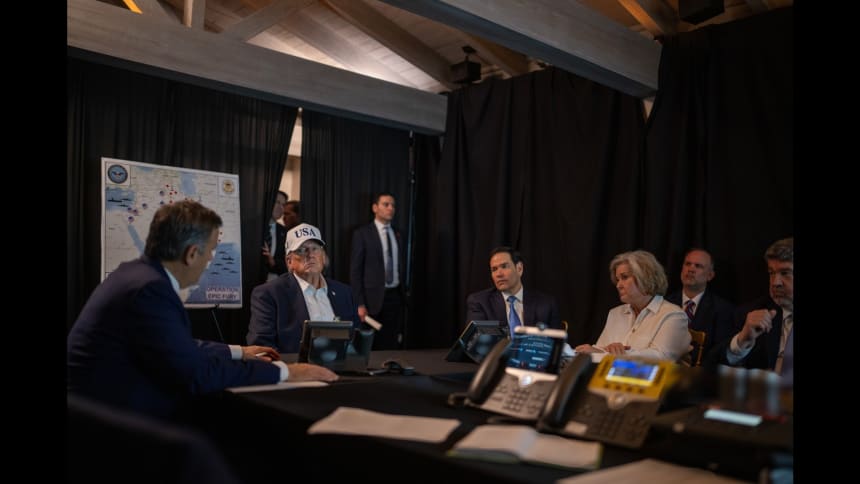
President Donald Trump called the celebrations in the streets of Iran “fantastic” following the killing of the country’s supreme leaderAyatollah Ali Khamenei, during a brief phone call with MS NOW on Saturday night.
Trump told MS NOW that he’s seen the celebrations in Iran and in parts of America, after joint U.S.-Israel airstrikes killed Khamenei.
“I think it’s fantastic,” the president said of the celebrations. “I’ve seen them in Los Angeles, also — celebrations.”
“I’ve seen them in Los Angeles, celebrations, celebrations,” Trump said, accentuating the point.
The interview took place roughly 11 hours before the Pentagon announced the first U.S.military casualties of the war. U.S. Central Command said three American service members were killed in action, and five others had been seriously wounded.
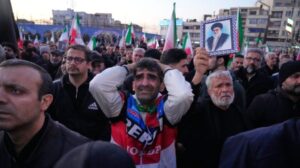
Revelry broke out in Iran, the United States and across the globe on Saturday, with Iranians cheering the death of Khamenei, who led Iran with an iron fist for more than 30 years, cracking down on dissent at home and maintaining a hostile posture with the U.S. and Israel.
Asked how he was feeling after the strike on Khamenei, whose death was confirmed just a few hours earlier, Trump said it was a positive development for the United States.
“I think it was a great thing for our country,” he said.
The call — which lasted less than a minute — came after a marathon day, which began in the wee hours of the morning with strikes on Iran and continued with retaliatory ballistic missiles from Tehran targeting Israel and countries in the Middle East region that host U.S. military bases.
The day ended with few answers from the White House to increasing questions about the long-term future of Iran, how long the U.S. will continue operations there, and the metastasizing ramifications it could have on the world stage. In fact, the president has done little to convince the public to back his Iran operation, nor to explain why the country is at war without the authorization of Congress.
On perhaps the most consequential day of his second term, Trump did not give a formal address to the public, nor did he hold a press conference. Instead, he stayed out of public view at Mar-a-Lago, his private club and residence in Palm Beach, Florida, where he attended a $1 million-per-plate fundraising dinner on Saturday evening.
But throughout the day, Trump took calls from reporters at various new outlets, including from MS NOW at around 11 p.m. ET.
The strikes, known formally as “Operation Epic Fury,” came after months of talks over Iran’s nuclear program, and warnings from Trump that he would strike Tehran if they did not agree to his often shifting conditions.
At 2:30 a.m. ET on Saturday, Trump posted a video to social media announcing the operation, which he said was designed to “defend the American people by eliminating imminent threats from the Iranian regime, a vicious group of very hard, terrible people.”
“The lives of courageous American heroes may be lost and we may have casualties. That often happens in war,” Trump said when he announced the strikes on Iran.
Mychael Schnell is a reporter for MS NOW.
Laura Barrón-López covers the White House for MS NOW.
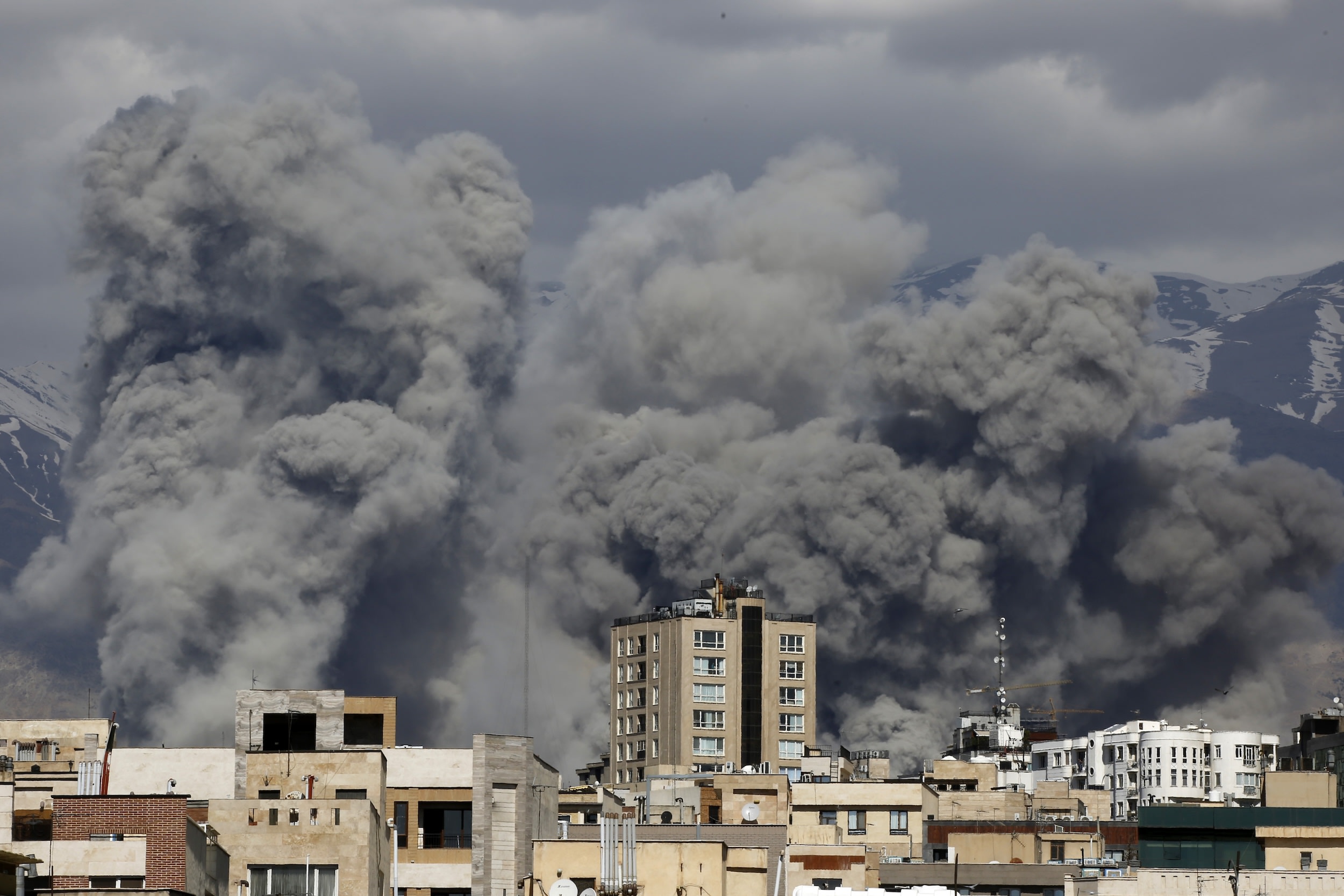
DUBAI, United Arab Emirates (AP) — Israel and Iran traded strikes Sunday as part of a widening warafter the killing of Iran’s Supreme Leader Ayatollah Ali Khameneiin a surprise U.S. and Israeli bombardment a day earlier.
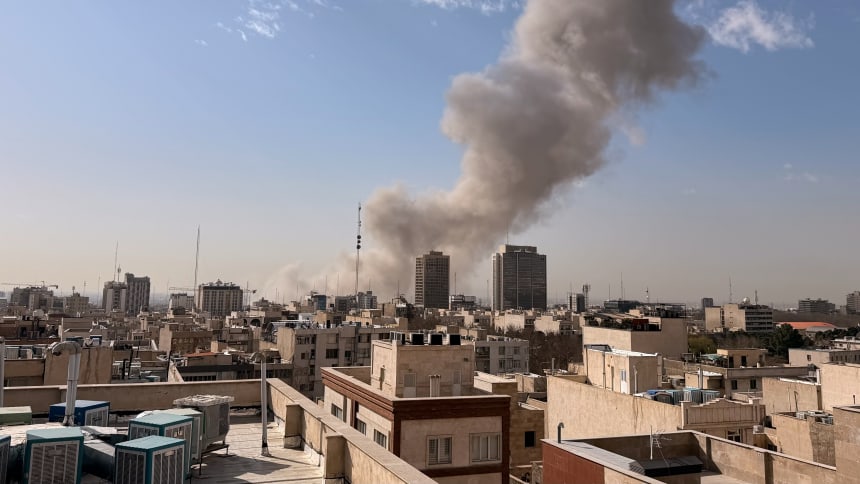
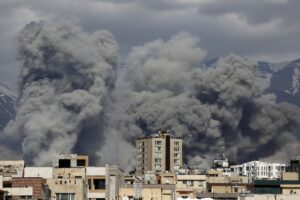
Blasts in Tehran — whose target was not immediately clear — sent a huge plume of smoke into the sky in an area where there are government buildings. Iranian authorities say more than 200 people have been killed since the start of the U.S. and Israeli strikes that killed Khamenei and other senior leaders. Earlier, Iranfired missiles at an ever-widening list of targets in Israel and Gulf Arab states in retaliation.
Loud explosionscaused by missile impacts or interceptions could be heard in Tel Aviv. Israel’s rescue services said eight people were killed and 28 wounded in a strike in the central town of Beit Shemesh, bringing the overall death toll in the country to 10.
Meanwhile, Iran’s President Masoud Pezeshkian said in a prerecorded message aired on state television that a new leadership council “has begun its work.” Iran’s Foreign Minister Abbas Araghchi told the Al Jazeera network that a new supreme leader will be chosen in “one or two days.”
The killing of Khameneiand U.S. President Donald Trump’s calls for the overthrow of the decades-old Islamic Republic, marked the start of a stunning new U.S. interventionin the Middle East and potentially a prolonged war.
It is also a startling show of military might for an American president who swept into office on an “America First” platform and vowed to keep out of “forever wars.”It was the second time in eight months that the Trump administration has joined Israel in using military force against Iran.
In a 12-day war in June, Israeli and American strikes greatly weakenedIran’s air defenses, military leadership and nuclear program. But the killing of Khamenei and several top security officials creates a leadership vacuum, increasing the risk of regional instability.
Vows of revenge
“You have crossed our red line and must pay the price,” Iran’s parliamentary speaker, Mohammad Bagher Qalibaf, said in a televised address Sunday. “We will deliver such devastating blows that you yourselves will be driven to beg.”
Trump warned that any retaliation would only lead to further escalation.
“THEY BETTER NOT DO THAT,” Trump fired back in a social media post. “IF THEY DO, WE WILL HIT THEM WITH A FORCE THAT HAS NEVER BEEN SEEN BEFORE!”
In a sign of how the attack could stoke regional unrest, hundreds of people stormed the U.S. Consulatein Pakistan’s port city of Karachi on Sunday. Police and paramilitary forces used batons and fired tear gas to disperse the crowd, and at least nine people were killed in the clashes, authorities said.
Iran retaliates
As U.S. and Israeli strikes have pounded Iran, the Islamic Republic has retaliated with missiles and drone attacks on Israel and nearby Arab Gulf countries hosting U.S. forces.
The air war could rattle global markets, particularly if Iran makes the Strait of Hormuz unsafe for commercial traffic. Around 20% of the world’s traded oilpasses through the vital waterway, and oil prices are already set for swings.
In repeated barrages across Israel, at least 10 people were killed and more than 120 injured, according to authorities. Many missiles were intercepted, the military said.
Israel’s Defense Minister Israel Katz said Sunday that Israel will have “a non-stop air train” of strikes against military and leadership targets in Iran.
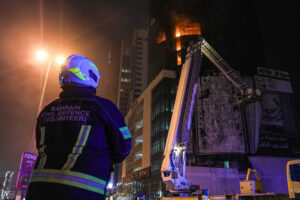
Flights across the Middle East were disruptedand air defense fire thudded over Dubai. The United Arab Emirates’ commercial capital has long drawn business and expatriates by billing itself as a safe haven in a volatile region.
Shrapnel from Iranian attacks on the Emirates’ capital of Abu Dhabi killed two people, state media said, and debris from aerial interceptions caused fires at the city’s main port and on the facade of the iconic Burj Al Arab hotel.
Attacks also extended into Oman — Iran’s longtime interlocutor with the West that hadn’t been drawn into the fray previously.
Saudi Arabia condemned Iran’s attacks on its capital, Riyadh, and eastern region, saying it had successfully intercepted them. The kingdom noted that it had not allowed its airspace or territory to be used to target Iran.
Jordan said it “dealt with” 49 drones and ballistic missiles. Kuwait, Bahrain and Qatar also said they had intercepted projectiles Sunday morning.
In Iraq, a militant group claimed responsibility for a drone attack targeting American bases in Irbil, according to the Rudaw media outlet. Smoke could be seen from an area where the U.S. has an air base there, but it was not immediately clear whether it had been hit.
Iran forms council to govern until a new supreme leader is chosen
As supreme leaderKhamenei had final say on all major policies during his decades in power. He led Iran’s clerical establishment and the Revolutionary Guard, the two main centers of power in the governing theocracy.
Though Trump called on Saturday for the Iranian people to “take over” their government, there was no sign in Tehran or elsewhere of unrest.
Iran quickly formed a council to govern the country until a new supreme leader is chosen.
An Iranian diplomat told the United Nations Security Councilthat hundreds of civilians were killed and wounded in the strikes.
In southern Iran, at least 115 people were reported killed when a girls’ school was struck, and dozens more were wounded, the local governor told Iranian state TV.
Lt Col Nadav Shoshani, an Israeli military spokesperson, said he was not aware of any Israeli or American strikes in the area of the school. U.S. Central Command spokesperson Capt. Tim Hawkins said he was aware of those reports and that officials were looking into them.
Iran’s state news agency IRNA said at least 15 people were killed in the southwest, quoting the governor of the Lamerd region, Ali Alizadeh, as saying a sports hall, two residential areas and a hall near a school were hit.
As reports trickled out about Khamenei’s death, eyewitnesses in Tehran told The Associated Press that some residents were rejoicing, cheering from rooftops, blowing whistles and letting out ululations.
Mourners raised a black flag over the Imam Reza shrine in Mashhad and the Iranian government declared 40 days of public mourning and a seven-day nationwide public holiday to commemorate Khamenei’s death.
Citing unidentified sources, the semiofficial Fars news agency reported that several relatives of Khamenei were also killed, including a daughter, son-in-law, daughter-in-law and grandchild.
Strikes were planned for months and feared for weeks
Tensions have soared in recent weeks as the Trump administration built up the largest force of American warshipsand aircraft in the Middle East in decades. The president insisted he wanted a deal to constrain Iran’s nuclear program while the country struggled with growing dissentfollowing nationwide protests.
Democrats decried that Trump had taken action without congressional authorization. The White House said it had briefed several Republican and Democratic leaders in Congress in advance.
Though Trump had pronounced the Iranian nuclear program obliterated in strikes last year, the country was rebuilding infrastructure that it had lost, according to a senior U.S. official who spoke to reporters on condition of anonymity to discuss Trump’s decision-making process. The official said intelligence showed that Iran had developed the capability to produce its own high-quality centrifuges, an important step in developing the highly enriched uranium needed for weapons.
Iran has said it has not enriched since June— though it has maintained its right to do so while saying its nuclear program is entirely peaceful. It has also blocked international inspectors from visiting the sites the U.S. bombed. Satellite photos analyzed by AP have shown new activity at two of those sitessuggesting Iran is trying to assess and potentially recover material.
___
Lidman reported from Tel Aviv, Israel; Boak from West Palm Beach, Florida; and Tucker from Washington. Associated Press writers Joe Federman in Jerusalem, Aamer Madhani and Konstantin Toropin in Washington, Sam Mednick in Tel Aviv, Israel, Farnoush Amiri in New York, David Rising in Bangkok and AP journalists around the world contributed to this report.
Now we’ve done it. The United States, under the leadership of President Donald Trump, has launched “major combat operations” in Irancould be sending us right back into the quagmire of regime change in the Middle East. Simply because he wants to and he can.
Unlike the “Coalition of the Willing,” which put ground troops into Iraq, or the NATO coalition that invaded Afghanistan after 9/11 — instances for which U.S. leaders built campaigns to get the buy-in of allies and the public — Trump has unilaterally and erratically led the U.S. into conflict. The “concept of a plan” and being “locked and loaded” — both phrases Trump has used to describe his policies — is not a strategy for toppling the regime or keeping the U.S. from being mired in foreign wars.
The “concept of a plan” and being “locked and loaded” — both phrases Trump has used to describe his policies — is not a strategy for toppling the regime or keeping the U.S. from being mired in foreign wars.
We’ve been waiting for weeks to see if Trump’s threat of strikes would become real. In January, Trump suggested he would act in support of Iranian protesters, who, despite these threats from the U.S. president, are still being jailed and killed by the Iranian regime. More recently, Trump said that targeted strikes would gain concessions from Iran in nuclear negotiations. But at no point has the American public heard their commander in chief explain why now, and to what end?
Forcing change in Iran is not a one-strike-and-done endeavor. Look no further than this past June, when the U.S. launched dramatic strikes on Iran’s Fordow nuclear facilityan act that did not end Iran’s ability to enrich uranium. While Trump said Iran’s program was obliteratedinternational inspectors have not been allowed into the country to verify such claims.
The people of Iran have certainly wanted change. Two significant protest movements have erupted in Iran in recent years: the 2022 national uprising of women across generations demanding basic freedom and the more recent protests against corruption and economic hardship. In both instances, thousands of people demanded change from a regime that remains intransigent and violent toward its own people. None of this is new or unexpected.
In some corners, Trump’s bluster has reignited a long-standing belief that the U.S. military can be a force for good in the world. The idea of a noble U.S. military intervening to save women or to free a community is not new: Women’s groups were part of the drumbeat toward U.S. strikes in Afghanistan.
On Saturday, Trump announced on Truth Social that Supreme Leader Ayatollah Khamenei had been killed in the strikes, an announcement later confirmed by Iranian state media. But the idea of “regime change” led by the U.S. military has two potent, cautionary tales for this generation of Americans: ISIS grew out of the devastation of the Iraq war and after 20 years, Afghanistan returned to Taliban brutality. And that was when the U.S. had massive support of allies and the American public.
Political solutions, negotiated by diplomats of multiple parties, is how global policy solutions have advanced in recent years. The U.N. climate change negotiations brought together more than 130 countries to reduce carbon emissions. The original Iran nuclear deal brought together European countries and Russia in a system that constrained and verified Iran’s nuclear ambitions. But Trump does not like diplomatic solutions, at least not those developed by other presidents, and has removed the United States from a variety of international agreements.
And the Trump administration was back at the negotiating table only briefly — weighed down by past broken agreements and failed military interventions. Negotiators prefer to be in the position of holding an “or else” card in their back pocket, which is the looming threat of a capable military. In Iran, though, the U.S. alone does not have the obvious military advantage; even American war hawks concede that Iran runs a very capable militaryas well as a network of terrorist assets that threatens U.S. bases and civilians across the Middle East, and has the ability to cause economic and digital havoc. So U.S. strikes necessitate coordinating with Israel and other allies, automatically making this a regional conflict.
The idea of “regime change” led by the U.S. military has two potent, cautionary tales for this generation of Americans: the failure to establish safety in Iraq and the return of Afghanistan to Taliban brutality.
Although tempers seemed to cool a few weeks agowhen negotiations toward a new nuclear deal restarted in earnest, the progress did not meet Trump’s preferred pace. Iran’s foreign minister blamed the U.S. negotiating teamsaying on Feb. 20 that the U.S. “has not asked for zero enrichment.” With the basic contours of a diplomatic discussion still under debate, strikes of this magnitude make compromise impossible. No one who gets attacked with missiles turns to negotiation as the next step; they usually want to save face and hit back hard. This means Trump’s military intervention has likely disrupted any hope of talks moving forward and instead gives Iran the excuse it’s long wanted to attack U.S. military bases and its allies, Israel and Saudi Arabia.
Which brings us to the continued challenge of Trump’s approach to Iran: While the regime in Tehran has patience, strategic coordination and zero tolerance for dissent, Trump has been impulsive and inconsistent, and has yet to settle on a long-term goal. The most immediate outcome of this strike could be to rally the Iranian people around their flag, while upping America’s economic uncertainty and moral isolation across the board.
Nayyera Haq is a global affairs journalist.
- ‘War of choice’: Trump says Iran was preparing attack but has provided no evidence
- Congressional Iran votes take on new weight after Trump strikes
- Curious what the net worth of residents in your state might be? A new report has the answer

- Apollo-era space colony dreams inspire Musk’s moon transport plan

- Live updates: Trump warns against retaliation as Iran says it will do ‘whatever it takes’
- Can you still file taxes for free after IRS changes?

- Iran names interim leadership after Khamenei killing
- ‘It’s fantastic’: Trump tells MS NOW he’s seen celebrations after Iran strikes
- Pentagon announces first American casualties in Iran
- Israeli strikes rock Tehran as Iran’s counterattacks widen
-

 The Dictatorship1 year ago
Luigi Mangione acknowledges public support in first official statement since arrest
-

 Politics1 year ago
Former ‘Squad’ members launching ‘Bowman and Bush’ YouTube show
-

 Politics1 year ago
Blue Light News’s Editorial Director Ryan Hutchins speaks at Blue Light News’s 2025 Governors Summit
-

 The Dictatorship6 months ago
Mike Johnson sums up the GOP’s arrogant position on military occupation with two words
-

 Politics1 year ago
Former Kentucky AG Daniel Cameron launches Senate bid
-

 The Dictatorship1 year ago
Pete Hegseth’s tenure at the Pentagon goes from bad to worse
-
Uncategorized1 year ago
Bob Good to step down as Freedom Caucus chair this week
-

 Politics10 months ago
Democrat challenging Joni Ernst: I want to ‘tear down’ party, ‘build it back up’