
Congress
Nominations talks heat up as Senate hopes to advance spending bills

The Senate will try to break an impasse Friday to advance three spending bills in hopes of showing progress after days of discord. A separate holdup over presidential nominations, meanwhile, could come down to direct talks between Democrats and the White House.
A patchwork of objections from senators on both sides of the aisle have held up the spending legislation for days and foiled a plan for what some had hoped would be a four-bill package. But members expressed new optimism Friday that a second, more limited attempt could move forward.
It’s one of two pieces of major business Republican leaders are hoping to wrap up before the Senate starts its traditional summer recess. In addition to the spending bills — where they are keen to show some progress ahead of the Sept. 30 government shutdown deadline — they also want to confirm a broad tranche of President Donald Trump’s nominees.
The nominee conversations appear more dicey, senators said, and Senate Majority Leader John Thune said Friday that he has put Trump officials “into conversation directly” with Minority Leader Chuck Schumer’s team. Top White House staffers were also in the Capitol on Thursday night after Thune met with Trump at the White House.
“This is how this is ultimately going to get resolved,” Thune said.
Meanwhile, GOP senators said leaders are running traps on a possible deal that would advance the smaller package of spending bills.
Under the pending proposal, leaders would seek unanimous consent to tie together the fiscal 2026 spending bills funding the Veterans Affairs and Agriculture departments, as well as military construction projects and the FDA. A third spending bill, funding Congress itself, could be voted on separately.
Senate Appropriations Chair Susan Collins said Friday morning she expects a unanimous consent request on some constellation of those three bills. The Maine Republican is eager to show progress on bipartisan spending bills before the Senate leaves for its lengthy August recess. Upon their return, members will have only a handful of session days to make further progress ahead of the shutdown deadline.
Sen. John Kennedy (R-La.) has made clear he will object to including Legislative Branch funding in the package and wants the chance to vote against the $7.1 billion bill. It’s the smallest of the 12 annual appropriations bills, but Kennedy maintains it still costs too much.
“They agreed to my proposal,” he told reporters Friday. “They’re going to have one vote on [Military Construction–VA] and [Agriculture-FDA] together and separate vote on [Legislative Branch] so I can vote no. Then they’ll marry them up later if all three pass, as they probably will.”
Coming to a nominations deal could be much trickier, given Trump’s determination to get all of his 150-plus pending nominees confirmed quickly.
Trump on Thursday said on Truth Social that the Senate “must stay in Session, taking no recess” until all of the nominees are confirmed. Even if senators stay in Washington, that goal will be all but impossible to meet absent Democratic cooperation.
Democrats under Schumer are exploring whether to quickly confirm a smaller subset of nominees in exchange for other concessions, such as the release of government funding they claim has been illegally “impounded” by the Trump administration.
Hailey Fuchs contributed to this report.


Democratic Party leaders filed suit Wednesday to block President Donald Trump’s attempt to limit voting by mail ahead of the midterm elections.
Democrats argue that an executive order Trump signed at the White House on Tuesday, which creates an approved list of absentee voters among other actions, is an unconstitutional interference in the power of states to regulate elections.
Senate Minority Leader Chuck Schumer and House Minority Leader Hakeem Jeffries joined the Democratic National Committee, the Democratic Senatorial Campaign Committee, the Democratic Congressional Campaign Committee and the Democratic Governors Association in suing to challenge the order.
“President Trump possesses no such authority to order such a sweeping change to American elections,” the suit argues.
The White House did not immediately respond to a request for a comment on the lawsuit, but Trump dismissed the possibility of legal challenges to his order at the signing ceremony for the order.
“I don’t know how it can be challenged. … You may find a rogue judge,” he told reporters in the Oval Office. “You get a lot of rogue judges, very bad, bad people, very bad judges. But that’s the only way that can be changed, and hopefully we’ll win an appeal.”
Trump’s executive order also threatens to withhold federal funds from states that don’t comply and directs the attorney general to investigate anyone who wrongfully distributes mail-in ballots.
It’s the latest escalation in Trump’s longstanding complaints about the way Americans vote as he pushes Congress to pass the GOP-backed SAVE America Act, which has cleared the House but faces an uphill battle in the Senate. He has falsely claimed on several occasions that voting by mail is uniquely vulnerable to voter fraud, despite the fact that he cast his own ballot by that method last week in a Florida congressional election.
Republican states have pushed ahead with their own plans to add citizenship requirements to voting laws, but the measures have also drawn swift legal challenges.
Democrats argued the executive order violates the First, Fourth, Fifth and Tenth Amendments and “dramatically exceeds his highly limited constitutional and statutory authority when it comes to regulating elections.” The lawsuit also argues that the Postal Service is being asked to go beyond its domain in building a list of eligible absentee voters.
Democratic attorneys general have been bracing for the possibility of the Trump administration interfering in this fall’s midterm elections, huddling in hotel conference rooms and over Zoom calls to war-game strategies to push back.
TMZ has launched an effort to shame members of Congress into ending their recess early and funding the Department of Homeland Security — and many congressional aides are quietly delighting in the celebrity gossip site’s interest in covering Congress.
“I am super stoked,” said one Hill staffer granted anonymity to speak candidly. “I think a lot of offices, particularly ones who aren’t in major media markets, are in for a rude awakening.”
“My attitude is any new press that forces members to be sharper and for comms staffers to be more nimble is a good thing,” the staffer added.
Staffers whose bosses end up splashed across the infamous website are likely feeling less stoked about the spottings. Sen. Lindsey Graham (R-S.C.) was seen by a TMZ tipster at Disney World over the weekend, and Rep. Robert Garcia (D-Calif.) was caught on camera at a Las Vegas casino.
Garcia said he was visiting his father who lives in Las Vegas, while Graham followed up Tuesday with photos of himself in his home state.
The publication has been soliciting photos of lawmakers anywhere but Washington as the DHS impasse hurtles toward day 50. Other shots the site has obtained include Sen. Ted Cruz (R-Texas) at a Florida airport, Rep. Jared Moskowitz (D-Fla.) at his son’s basketball game and a slew of House Republicans — including Reps. Derrick Van Orden (R-Wis.), John McGuire (R-Va.) and David Rouzer (R-N.C.) — roaming around Scotland.
Van Orden said in a Wednesday X post that he was participating in “high level” meetings with the Irish government.
“I would like to thank @TMZ for pointing out that even though our US Senate colleagues can’t figure out how to vote to fund our entire government, and that the House voted 4 times to do so, that I will not stop working for the 3rd congressional district of Wisconsin and every American,” Van Orden said.
A second Hill staffer, also granted anonymity to speak candidly, said “there are definitely conversations on how to engage and prepare for your boss’s TMZ moment.”
While TMZ has long had a footprint in Washington, founder and executive producer Harvey Levin said in a statement Monday he is redoubling coverage of national political players — and said the ongoing DHS shutdown was an important moment to pounce.
“Last week, we interviewed a TSA worker who is struggling to survive without a paycheck, and it outraged us so much we wanted to use our platforms to show how Congress — Dems AND Republicans — have betrayed us,” Levin said. “We spontaneously came up with the idea to juxtapose members of Congress on their Spring Break against federal workers who are losing their homes, their cars, their livelihoods.”
“Short story — our D.C. presence will sometimes be fun, sometimes intensely serious,” he added.
Lawmakers are quickly coming to a realization: Odds are, Congress is going to have to do something about booming prediction markets.
The online platforms where people can bet on the outcomes of future events like elections, sports and the Oscars had already attracted attention in Washington as the industry garnered backing from Wall Street giants, Silicon Valley investors and even Donald Trump Jr.
That scrutiny has exploded in recent weeks, however, after unusual trading patterns around markets related to the U.S.-Israel war with Iran suggested possible insider profiteering. The result has been an uptick in legislation targeting the industry amid new questions about the policing of its major players.
At the center of the fight is a debate over who should regulate and tax transactions that take place on sites like Kalshi and Polymarket, which operate as financial exchanges but have become best known as sports and political betting platforms. The clash pits states and tribes against an increasingly powerful new industry that has won over key presidential appointees.
Lawmakers of both parties are also eyeing various ways to crack down on insider trading on the platforms — including by members of Congress themselves and their staffs.
“There seems to be a growing consensus that the status quo is unsustainable,” said Rep. Ritchie Torres, a New York Democrat who was an early entrant into Congress’ prediction market debate.
The platforms, once considered niche, are poised to get new scrutiny across Capitol Hill this year. Senate Commerce Committee members have discussed holding a hearing focused on the industry, according to four people granted anonymity to discuss the private conversations. The House Agriculture Committee, which oversees commodities trading, has been holding bipartisan briefings on the issue, with more expected.
Discussions about the industry largely haven’t reached the GOP leadership level on Capitol Hill, where bigger clashes such as the Department of Homeland Security funding fight have taken precedence. Asked about banning elected officials from trading on prediction markets, Senate Majority Leader John Thune said he “hadn’t thought about that” and said he’d “take a look at it.”
House Minority Leader Hakeem Jeffries — after referencing the markets’ high odds that Democrats would win the midterms — told reporters last week it was “reasonable for us to take a look at what can be done in this space and to try to find a bipartisan path forward.”
Washington is getting a crash course on the prediction markets just as the companies have broken out from obscurity to become one of the hottest areas of investment — thanks in part to President Donald Trump, whose regulators have allowed them to offer a larger menu of wagers to their customers.
Kalshi and Polymarket, which operate the largest prediction market platforms, have recently snagged mammoth valuations and inked partnership deals with everyone from BLN and CNBC to Major League Baseball. Kalshi is federally regulated by the Commodity Futures Trading Commission, a small but powerful financial watchdog. Polymarket is best known for its larger offshore prediction market, which is not regulated by the CFTC, but the company is also pushing into the U.S. with a separate, regulated venue.
Congress’ interest is rising as the fight over industry regulation plays out in the courts. State officials from Arizona to Massachusetts have argued that the prediction markets should be subject to the same rules as traditional sportsbooks and casinos. But the companies have rejected those claims, arguing that they are exclusively overseen by the CFTC. Attorneys following the legal fight expect it to eventually reach the Supreme Court.
A bipartisan group of lawmakers is backing the states’ push to regulate the platforms. Sens. Adam Schiff (D-Calif.) and John Curtis (R-Utah) have introduced legislation that would ban CFTC-regulated entities from offering products that resemble sports betting or casino games.
They are echoing concerns from state and tribal officials who say prediction markets are threatening critical tax revenue and usurping state-level consumer protections for sports bettors. Notably, Senate Agriculture Chair John Boozman (R-Ark.), whose panel oversees the CFTC, has expressed concerns about sports betting on the sites.
“What I would like to see is an economic purpose in regulated derivatives markets,” said Rep. Bill Foster (D-Ill.). “Anything that has no economic purpose, I think, should be taxed like gambling, regulated like gambling.”
The prediction market companies are fighting back, saying that the so-called events contracts they offer are sophisticated financial products — not a form of gambling. They have key allies in the fight, including Trump’s CFTC chair, Mike Selig — who, like the companies, says the agency has “exclusive jurisdiction” over prediction markets. GOP senators including Dave McCormick of Pennsylvania and Bill Hagerty of Tennessee have applauded Selig’s posture on the issue.
But esoteric arguments about the nature of gambling have only gotten so much traction in Congress. What has instead galvanized public attention is the specter of insider trading — including possible profiteering from government officials with foreknowledge of geopolitical events such as the U.S. military intervention in Venezuela or the administration’s strikes in Iran.
Possible insider bets related to the war in Iran have spurred several new bills. Reps. Nikki Budzinski (D-Ill.) and Adrian Smith (R-Neb.) introduced bipartisan legislation last week to ban members of Congress and executive branch officials from participating in prediction markets related to policy decisions and political events.
That bill has attracted support from a handful of House Democratic and GOP lawmakers, and a bipartisan group introduced similar legislation in the Senate. The Coalition for Prediction Markets, which has Kalshi as a member, endorsed the legislation soon after introduction.
But there are even broader efforts afoot. Rep. Alexandria Ocasio-Cortez (D-N.Y.) has called for stricter regulations on prediction markets, comparing them to the tobacco industry. And Sen. Chris Murphy (D-Conn.) and Rep. Greg Casar (D-Texas) are aiming to entirely ban a wide range of prediction market trading, including anything predicated on government actions or any event “where an individual knows or controls the outcome.”
The CFTC has already promised to go after insider trading on the prediction markets, and both Kalshi and Polymarket recently unveiled new measures designed to head off the improper use of inside information on their platforms.
Kalshi also recently rolled out ads across Washington highlighting that it blocks insider trading on its platform and bans trading directly related to war and deaths. Polymarket has also expanded its presence in Washington — most notably with a pop-up bar on K Street.
“Prediction markets are an emerging technology, yes, but they’re not all the same, and we want to highlight those big distinctions,” Kalshi spokesperson Elisabeth Diana said. A Polymarket spokesperson declined to comment.
If Congress does take action on the issue, it will end up with the Agriculture panels, currently led by Boozman in the Senate and Rep. G.T. Thompson (R-Pa.) in the House. Thompson promised “bipartisan hearings and member meetings” on prediction markets in a recent interview.
“It definitely is a focus,” he said. “I don’t know what the conclusion will be.”
But Republicans could be put in a tough spot as prediction market legislation gains momentum. The Trump family has had close ties to prediction markets: Donald Trump Jr. is an adviser to Kalshi and Polymarket, and Trump’s social media company announced last year plans to create Truth-Predict, a new prediction market service.
Some Democrats are skeptical Republicans will actually move to address the issue given the Trump family’s ties and their overall friendliness to the firms.
“I don’t think the Republican-led House or Senate will seriously take this on,” Sen. Jeff Merkley of Oregon said.
Jordain Carney contributed to this report.
- MIDTERM WATCH: Executive Order Cracks Down on Voting…
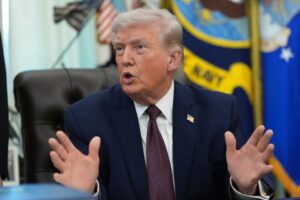
- Democrats sue Trump administration over mail-in-voting order
- Hill staffers brace for their boss’s ‘TMZ moment’

- ‘The status quo is unsustainable’: Congressional scrutiny of Kalshi, Polymarket explodes

- IrynaZarutskamural censored by leftists, mayor calls it ‘divisive’

- Ro Khanna: I hope Trump ‘just declares victory’ in Iran and ‘gets out’

- Live updates: Trump-appointed justices appear unswayed by admin’s birthright citizenship order

- ‘Call Her Daddy’ host Alex Cooper brings ‘Mormon Wives’ to her new show

- Government requests for social media user data up 770 percent in past decade: Research

- NASA’s historic moon mission blasts into space
-

 Politics1 year ago
Former ‘Squad’ members launching ‘Bowman and Bush’ YouTube show
-

 The Dictatorship1 year ago
Luigi Mangione acknowledges public support in first official statement since arrest
-

 Politics1 year ago
Former Kentucky AG Daniel Cameron launches Senate bid
-

 The Dictatorship7 months ago
Mike Johnson sums up the GOP’s arrogant position on military occupation with two words
-

 Politics1 year ago
Blue Light News’s Editorial Director Ryan Hutchins speaks at Blue Light News’s 2025 Governors Summit
-

 The Dictatorship1 year ago
Pete Hegseth’s tenure at the Pentagon goes from bad to worse
-
Uncategorized1 year ago
Bob Good to step down as Freedom Caucus chair this week
-

 Politics12 months ago
Democrat challenging Joni Ernst: I want to ‘tear down’ party, ‘build it back up’