
Politics
Montana isn’t a swing state — but it still could decide the future of the country


Vice President Kamala Harris’ surge in the polls since becoming the nominee has Democrats hopeful about their chances in down-ballot races in November. It’s support she’s going to need if she wins, as many of the policies she’s announced so far will require Congress to get on board. The GOP’s narrow hold on the House is up in the air, but a shaky Senate race in Montana might be all it takes to block any hopes for a Democratic trifecta in January.
As things stand, Democrats have a lengthy wish list in place, should Harris beat former President Donald Trump — including codifying abortion rights nationallyexpanding voting rights and reforming the Supreme Court. There’s even talk of changing or getting rid of the filibuster in the Senate, the 60-vote threshold needed to pass most legislation. That would still depend on Democrats having a majority in the Senate, which would include a 50-50 split with Tim Walz as vice president casting a tie-breaking vote.
A shaky Senate race in Montana might be all it takes to block any hopes for a Democratic trifecta in January.
Democrats currently hold 51 seats, but the Senate election map is worse for the party than it has been in decades. Twenty-three Democrat-held seats are up for re-election, in contrast to 11 for their Republican colleagues. West Virginia is already counted as a pickup for the GOPas voters will almost certainly hand retiring independent Sen. Joe Manchin’s seat to Republican Gov. Jim Justice. The majority will then come down to which party comes out on top in the race for two treacherous seats: Ohio and Montana.
For months, these two races had been seen as the toughest for their incumbents, Sen. Sherrod Brown of Ohio and Sen. Jon Tester of Montana. But the Cook Political Report on Thursday shifted its outlook on Tester’s racemoving Montana from a toss-up into its “lean Republican” column. The move follows a similar reshuffling from the University of Virginia’s Center for Politics the previous week to forecast that Montana’s GOP nominee Tim Sheehy holds a slight edge.
Tester’s race was always going to be a tough one, as Montana has gotten steadily redder since he first won his seat in 2006. Running on his background as a moderate state senator and family farmer, he ousted his GOP opponentSen. Conrad Burns, by only 3,562 votes. Tester’s first two re-election campaigns came a little easier. He outperformed Barack Obama by 7 points in 2012, winning re-election in a state the president lost. His third race saw him win more than 50% of the vote during an election season where four of his fellow incumbent red-state Democrats lost their seats.
The headwinds that Tester faces now are the toughest yet. NBC News pointed out last year that Montana is a state “where former President Donald Trump won by more than 16 percentage points in 2020 and where Republican Sen. Steve Daines defeated the once-popular Democratic Gov. Steve Bullock by 10 points the same year.” Tester has an especially large target on his back, as Daines is now leading Senate Republicans’ efforts to retake the majority.
Daines was an early backer of Sheehy, helping drive Rep. Matt Rosendale from the Republican primary a week after he’d entered it. When coupled with Trump’s quick endorsementSheehy, a former Navy SEAL and aerospace entrepreneur, is the toughest challenger that Tester has yet to square off against. The contest between the two candidates has already been brutal, as Leo Wolfson recently wrote for Cowboy State Daily: “The Tester campaign has gone to great lengths to promote his dirt farm roots, while portraying Sheehy as a wannabe ‘rhinestone cowboy.’ Conversely, Sheehy and his supporters say Tester only embraces his agricultural roots when the TV cameras are on.”
The headwinds that Tester faces now are the toughest yet.
Unlike much of the country, the shift from President Joe Biden to Harris at the top of the Democratic ticket might not have much impact on Montana’s mostly whitelargely rural population. The state has undergone a boom in growth in the last few years though, thanks to an influx of new residents in cities like Bozeman and Missoula. But Montanans, who once were more focused on state and local issues in a way that benefited Tester, are more likely to view elections through a national lens. So, while he’s tried to keep his distance from his fellow Democrats — becoming an early voice calling for Biden to drop out and avoiding the convention in Chicago this year — there’s only so far he can run from the D next to his name.
There’s still a chance that Tester pulls out a win here. A recent poll from the AARP that gives Sheehy a strong but not insurmountable lead was the tipping point for the prognosticators to say there’s a better chance for Tester to be toppled. But as Semafor’s Burgess Everett recently noted, “Montana is also hard to poll and its statewide elections can turn on just a few thousand votes, leaving plenty of potential wrinkles and unknowns to potentially tip the race.” Sheehy has had missteps, too, including being caught on tape demeaning Native American residents in comments at fundraisers.
But, it must be said, a Tester loss would almost certainly mean a much tougher political environment for Harris should she win. Without a Senate majority, her Cabinet and judicial nominees are more likely to stall out without at least one Republican crossing over to show their support — if a vote is held at all, that is. Any dreams of major legislation would falter in the face of whichever of the three GOP senators named John becomes Senate majority leader in this scenario.
In effect, we face a reality where the direction the country takes over the next few years will likely depend on how a relative handful of Montanans vote in November.

Hayes Brown is a writer and editor for BLN Daily, where he helps frame the news of the day for readers. He was previously at BuzzFeed News and holds a degree in international relations from Michigan State University.



NEW YORK (AP) — A federal judge on Tuesday ordered the Trump administration to restore the government-run Voice of America’s operations after it had effectively been shut down a year ago, putting hundreds of employees who have been on administrative leave back to work.
U.S. District Court Judge Royce C. Lamberth gave the U.S. Agency for Global Media a week to put together a plan for putting Voice of America on the air. It has been operating with a skeleton staff since President Donald Trump issued an executive order to shut it down.
A week ago, Lamberth said Kari Lake, who had been Trump’s choice to lead the agency, did not have the legal authority to do what she had done at Voice of America. In Tuesday’s decision, Lamberth ruled on the actions she had taken to respond to Trump’s order, essentially shelving 1,042 of VOA’s 1,147 employees.
“Defendants have provided nothing approaching a principled basis for their decision,” Lamberth wrote.
There was no immediate comment on the decision by the agency overseeing Voice of America. Lake had denounced Lamberth’s March 7 ruling, saying it would be appealed. Since then, Trump nominated Sarah Rogers, the undersecretary of state for public diplomacy, to run USAGM. That requires Senate approval, a step that was not taken with Lake.
Patsy Widakuswara, Voice of America’s White House bureau chief and a plaintiff in the lawsuit to restore it, said she is deeply grateful for the decision.
“We are eager to begin repairing the damage Kari Lake has inflicted on our agency and our colleagues, to return to our congressional mandate, and to rebuild the trust of the global audience we have been unable to serve for the past year,” she said.
“We know the road to restoring VOA’s operations and reputation will be long and difficult,” she said. “We hope the American people will continue to support our mission to produce journalism, not propaganda.”
Voice of America has transmitted news coverage to countries around the world since its formation in World War II, often in countries with no tradition of a free press. Before Trump’s executive order, VOA had operated in 49 different languages, broadcasting to 362 million people.
NEW YORK (AP) — A federal judge on Tuesday ordered the Trump administration to restore the government-run Voice of America’s operations after it had effectively been shut down a year ago, putting hundreds of employees who have been on administrative leave back to work.
U.S. District Court Judge Royce C. Lamberth gave the U.S. Agency for Global Media a week to put together a plan for putting Voice of America on the air. It has been operating with a skeleton staff since President Donald Trump issued an executive order to shut it down.
A week ago, Lamberth said Kari Lake, who had been Trump’s choice to lead the agency, did not have the legal authority to do what she had done at Voice of America. In Tuesday’s decision, Lamberth ruled on the actions she had taken to respond to Trump’s order, essentially shelving 1,042 of VOA’s 1,147 employees.
“Defendants have provided nothing approaching a principled basis for their decision,” Lamberth wrote.
There was no immediate comment on the decision by the agency overseeing Voice of America. Lake had denounced Lamberth’s March 7 ruling, saying it would be appealed. Since then, Trump nominated Sarah Rogers, the undersecretary of state for public diplomacy, to run USAGM. That requires Senate approval, a step that was not taken with Lake.
Patsy Widakuswara, Voice of America’s White House bureau chief and a plaintiff in the lawsuit to restore it, said she is deeply grateful for the decision.
“We are eager to begin repairing the damage Kari Lake has inflicted on our agency and our colleagues, to return to our congressional mandate, and to rebuild the trust of the global audience we have been unable to serve for the past year,” she said.
“We know the road to restoring VOA’s operations and reputation will be long and difficult,” she said. “We hope the American people will continue to support our mission to produce journalism, not propaganda.”
Voice of America has transmitted news coverage to countries around the world since its formation in World War II, often in countries with no tradition of a free press. Before Trump’s executive order, VOA had operated in 49 different languages, broadcasting to 362 million people.
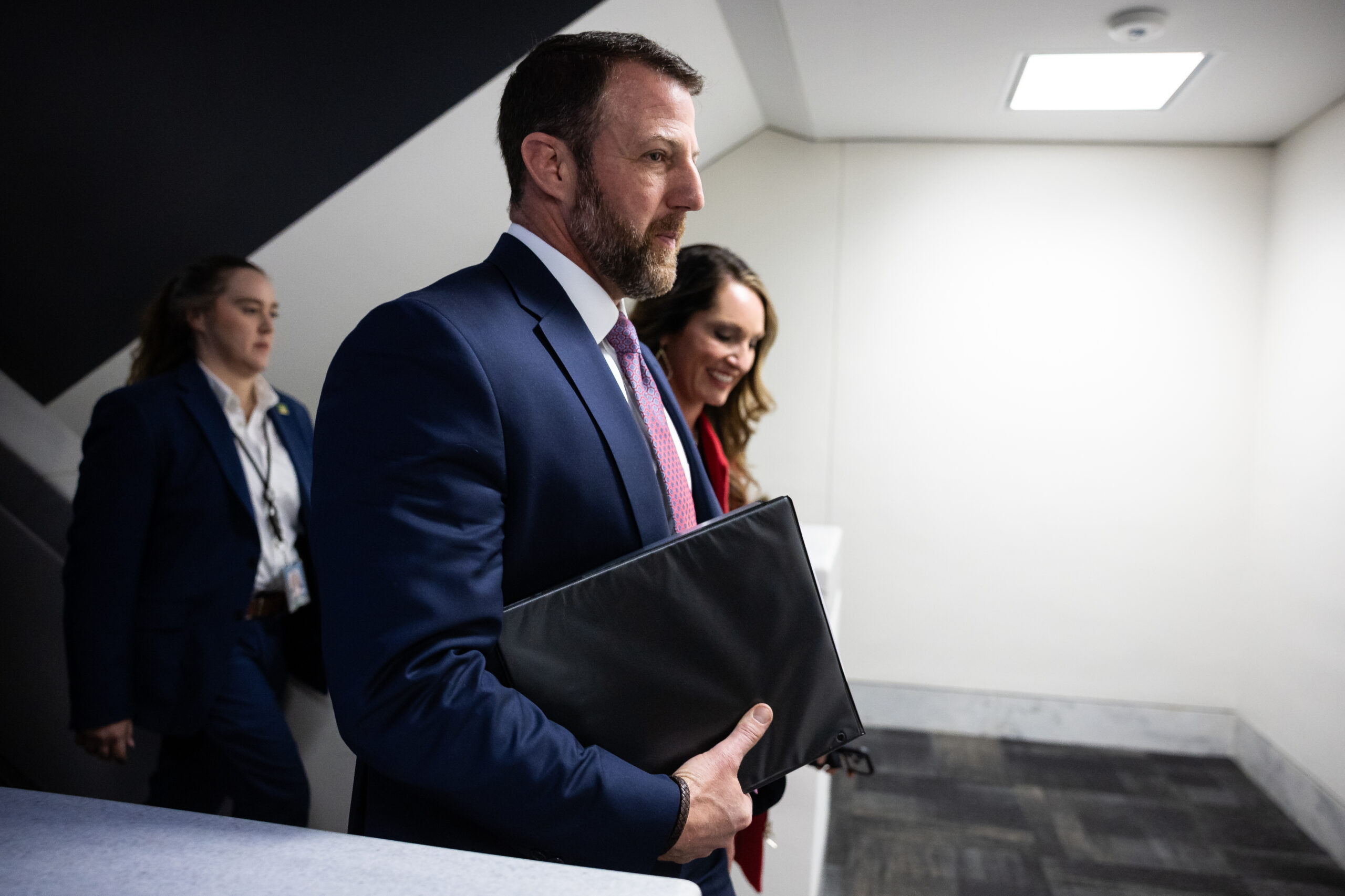
The Oklahoma senator’s secretive travel a decade ago has emerged as an issue in his confirmation…
Read More
- Judge orders restoration of Voice of America

- Trump delays China trip to focus on war in Iran

- Judge orders restoration of Voice of America
- Judge orders restoration of Voice of America
- Democrats say Bondi won’t commit to testifying in House Epstein investigation
- Senate rejects limits on Trump as Iran war intensifies
- Why Judge Boasberg’s ruling on DOJ’s Jerome Powell investigation is bigger than one case
- Judge writes Kari Lake ‘repeatedly thumbed her nose’ at legal requirements

- In touting SAVE Act, Johnson refuses to cite any fraud it would have prevented
- ‘Warrants or bust’: House hard-liners deliver ultimatum ahead of spy powers vote
-

 The Dictatorship1 year ago
Luigi Mangione acknowledges public support in first official statement since arrest
-

 Politics1 year ago
Former ‘Squad’ members launching ‘Bowman and Bush’ YouTube show
-

 Politics1 year ago
Blue Light News’s Editorial Director Ryan Hutchins speaks at Blue Light News’s 2025 Governors Summit
-

 Politics1 year ago
Former Kentucky AG Daniel Cameron launches Senate bid
-

 The Dictatorship6 months ago
Mike Johnson sums up the GOP’s arrogant position on military occupation with two words
-

 The Dictatorship1 year ago
Pete Hegseth’s tenure at the Pentagon goes from bad to worse
-

 Politics11 months ago
Democrat challenging Joni Ernst: I want to ‘tear down’ party, ‘build it back up’
-
Uncategorized1 year ago
Bob Good to step down as Freedom Caucus chair this week