
Congress
Mike Johnson races to finalize elusive GOP health care plan

Speaker Mike Johnson is racing to finalize a Republican health care plan in time to present it to his conference at their weekly meeting Tuesday, but his team still needs to decide on major contours of the plan, according to three people granted anonymity to describe internal conversations.
GOP leaders are meeting Thursday to nail down what will go in the package, according to the three people. One major decision still to be made is whether to offer up multiple individual bills for floor consideration or to assemble them into one piece of legislation. But top Republicans want to have a GOP alternative to vote on as Democrats hammer them over expiring Obamacare subsidies that will spike premiums for millions of Americans in the new year.
If Johnson and fellow GOP leaders don’t make decisions about the way forward Thursday, one senior House Republican said, “it’s going to be bad.”
The package is likely to be an assemblage of various GOP bills that have been working through House committees that are largely aimed at providing more options for health care coverage outside of the Affordable Care Act framework. One likely to be included would provide for “association health plans” allowing smaller businesses to join together to offer plans rather than going through ACA exchanges. Leaders are also likely to include options for expanding the use of health savings accounts, something President Donald Trump has endorsed but Democrats have generally opposed.
It’s also likely to include bipartisan legislation overhauling the role of pharmacy benefit managers and potentially other bills that could lower prescription drug prices — something Trump pollster Tony Fabrizio advised a group of House Republicans to focus on as Democrats seize on the expiring tax credits.
Johnson said in a brief interview that he and leaders plan to walk House Republicans through the health care plan through this weekend and then circulate the framework early next week. He also confirmed what GOP leaders have said in private — they want to vote on a health care package before the end of the year. But Majority Leader Steve Scalise, who had been coordinating the health care deliberations, wouldn’t commit to that timeline shortly after Johnson spoke.
Party leaders are facing massive pressure from GOP centrists who are assembling their own compromise plans to extend the expiring subsides with new eligibility requirements. But Johnson, Scalise and many House Republicans have no interest in continuing with the Obamacare framework.
Rep. Jen Kiggans (R-Va.), who coauthored a new plan that would provide a one-year extension of the subsidies that has been endorsed by more than two dozen members in both parties, said “we need to act on this issue.”
“To do nothing is the wrong answer,” she said.
Rep. Brian Fitzpatrick (R-Pa.), who is assembling a separate compromise bill that would include a longer subsidy extension, said his party’s leaders were not going down a path that will prevent a spike in American’s health care costs.
“Is it a Republican-only solution? That’s not a serious solution,” he said. “The million-dollar question is, is it bipartisan or not?”


Some Democrats aren’t ruling out voting for a multibillion-dollar military infusion, setting up a potential internal clash in the weeks ahead for a party whose political base is aghast at President Donald Trump’s aggression against Iran.
The Trump administration’s top defense and intelligence officials told lawmakers this week that the Pentagon could soon send an emergency supplemental funding request to Capitol Hill. They didn’t offer a timeline or dollar value, but the White House is reportedly mulling a $50 billion ask.
That’s a massive sum on top of the more than $990 billion Congress has shelled out for defense capabilities in recent months between the GOP’s “big, beautiful bill” and the latest government funding package.
To pass any new military funding measure through the Senate, the support of at least seven Democrats will be needed to overcome the filibuster. It’s far from certain the votes are there.
“Good luck. What Democrat is going to vote to fund an illegal war?” Sen. Chris Murphy (D-Conn.) said Wednesday. “I don’t think — with the exception of one Democrat — there will be any votes for it.”
He appeared to be referring to Pennsylvania Sen. John Fetterman, who was the only Democrat to oppose a separate Iran war powers resolution and has routinely broken with his colleagues on government funding votes.
Democrats also want to stay disciplined around their campaign message heading into the midterms, arguing that Trump has abandoned his central campaign promises to keep the country out of prolonged wars and bring down costs for Americans.
“I mean, you lie to us, don’t consult us and then expect us to send more taxpayer money to a war that we shouldn’t have started with no plan and no answers,” said Rep. Pat Ryan (D-N.Y.), a combat veteran of the Iraq War, in an interview. He called reports of the $50 billion request “outrageous.”
But this is not the universal position inside the party. Several Democrats on the Senate Armed Services Committee aren’t ruling out supporting more Pentagon funding. That includes the panel’s top Democrat, Sen. Jack Reed of Rhode Island, as well as Sens. Gary Peters of Michigan, Tim Kaine of Virginia and Elissa Slotkin of Michigan.
A White House emergency funding request could force Democrats to choose between rebuffing the president and turning their backs on legislation the administration deems necessary for replenishing key defensive munition stocks designed to keep U.S. troops and civilians safe.
There’s awareness among many Democrats that Trump has thrust the country into a conflict, and now Congress has no choice but to help keep things on track.
“I need to know the goals and the plan. … I don’t rule anything out,” said Slotkin. “I mean, we’re in it.”
Lawmakers in both parties are also concerned that the bombing campaign and effort to defend U.S. personnel in the Middle East could quickly deplete stockpiles of precision-guided missiles and air defense interceptors that are critical for national security priorities elsewhere around the globe. The Pentagon and defense industry have struggled to speed up production of the expensive munitions, which are in high demand in the Middle East, Ukraine and in the Pacific.
“We have to look at what they need,” said Reed, the ranking member on the Senate Armed Services Committee. “Some of it might be to fill in critical issues and other theaters of war they’ve taken things from.”
There’s a possibility a spending package for the Iran conflict could be tied to other priorities, which could make it more palatable to some Democrats. Lawmakers were talking Wednesday about attaching Ukraine aid. Others are eyeing relief for farmers — a key priority for Republicans in agriculture-heavy states — as well as wildfire disaster aid Democrats have long sought.
“I think it comes down to, you’re going to have to have a number of things in there to get a critical mass,” Sen. John Hoeven (R-N.D.) said Wednesday.
That doesn’t mean all Democrats are prepared to give Trump a blank check for military action in Iran. Many who left the door open to voting for a supplemental funding package said the administration would first have to provide Congress with more information about the offensive. That includes the rationale for striking Iran, a commitment to avoid putting boots on the ground and a plan for ending the conflict.
“Clearly, there’s going to be a cost to this war that we haven’t budgeted for. So there is going to be a need for funding, and we need some answers before we provide it,” Sen. Jeanne Shaheen of New Hampshire, the top Democrat on the Senate Foreign Relations Committee, said in an interview.
Sen. Chris Coons (D-Del.), the top Democrat on the appropriations panel overseeing Pentagon spending, is also keeping open the option of supporting an emergency military funding package but said like Shaheen that administration officials need to testify publicly about “the failures in planning” in the conflict so far.
Republican Sen. Lisa Murkowski of Alaska cautioned Wednesday that Democrats could decide to take a stand on funding — a vote where they have real leverage. That is in contrast to the doomed efforts on Blue Light News this week to put guardrails on the president’s ability to take unilateral military action, which Trump would certainly veto in any case.
“There’s a lot of people who have said, ‘Well, if you want to express your position on the war, the way to do it is … through appropriations,” she said in an interview. “We get that. So the administration should not be taking anything for granted.”
Across the Capitol, California Rep. Pete Aguilar, the No. 3 Democrat in the House and a member of the Defense appropriations funding panel, told reporters Wednesday that he’s “incredibly skeptical” of any emergency military funding request from Trump — but also that he has “a duty and a responsibility to help protect this country.”
At the same time, said Aguilar, “It’s going to be pretty hard to move me off of a ‘no.’”
Mia McCarthy, Jordain Carney, Connor O’Brien and Calen Razor contributed to this report.
Rep. Burgess Owens (R-Utah) announced Wednesday he will retire from Congress at the end of his current term after the state redrew its congressional maps ahead of the midterms.
Owens announced on social media he will not seek reelection and will instead take on “the next chapter of my mission … outside of elected office” while committing to serving out the remainder of his term.
“I will finish this term fully committed and fully accountable. My final political sprint will be here in Utah and across the country, helping my colleagues expand our Republican majority,” Owens said. “Though this chapter closes, my commitment to advancing opportunity, advocating for our children, and strengthening families will continue in new ways.”
Owens’ retirement helps Utah Republicans avoid a possible member-on-member primary after a Utah judge implemented a new congressional map that created a new Democratic-leaning seat and drew Rep. Mike Kennedy (R-Utah) and Rep. Celeste Maloy (R-Utah) into the same district. Utah’s 4th congressional district, which Owens represents, will remain a strongly Republican seat under the new map.
Owens’ decision to serve out the remainder of his term helps House Republican leadership preserve their narrow majority for the remainder of the cycle. Republicans’ four-seat House majority means they can only afford to lose one Republican on a party-line vote.
In addition to Owens leaving Congress, Reps. John James (R-Mich.) and Byron Donalds (R-Fla.) are running for governor, and Rep. Wesley Hunt (R-Tex.) launched a failed bid for Texas’ Senate seat, meaning there will likely be no Black members of the House Republican conference next year.
Owens is the latest in a wave of House Republicans looking to leave the lower chamber this cycle. Since the beginning of 2025, 35 other House Republicans have resigned, announced their retirements or launched campaigns seeking other elected positions.
Before entering politics, the former NFL player won a Super Bowl with the Oakland Raiders in 1981.
A House committee voted Wednesday to subpoena Attorney General Pam Bondi to testify about her handling of the Jeffrey Epstein files.
Five Republicans joined with all Democrats in support of a motion to call the nation’s top law enforcement official up to Capitol Hill for questioning, and the motion itself was offered by GOP Rep. Nancy Mace of South Carolina.
It underscores the increasing frustration with Bondi among members of her own party, catalyzed in part by the Epstein saga.
The Justice Department did not immediately return a request for comment.
Reps. Lauren Boebert of Colorado, Scott Perry of Pennsylvania, Tim Burchett of Tennessee and Michael Cloud of Texas were the other Republicans on the House Oversight and Government Reform Committee to break rank Wednesday afternoon.
Committee chair James Comer (R-Ky.) attempted to stave off the subpoena effort, saying Bondi’s chief of staff had told him the attorney general would be available to give member-level briefings around her department’s approach to the Epstein case.
But critics in both parties have accused Bondi of slow-walking the release of the Epstein files. It was her announcement that the DOJ would not make further information available in the Epstein matter that sparked outrage last summer, culminating in a vote by an Oversight subcommittee to force her hand.
In November, Congress passed legislation further demanding all materials in DOJ’s possession relating to the convicted sex offender be released. After a delay in publication of documents by the statutory deadline, the department announced earlier this year that it would be withholding millions of additional pages.
“We’re gonna be talking about real, substantive issues, like the 65,000 documents that are being hidden by the DOJ right now,” Mace told reporters Wednesday after the vote.
- ‘We’re in it’: Democrats won’t rule out giving Trump more money for Middle East war
- Utah Republican Burgess Owens announces he’ll retire at the end of this term
- Republicans hold their breath and hope for a quick Trump endorsement in Texas
- Senate rejects bid to scale back Trump’s Iran war
- Al Green, Menefee head to runoff in member-on-member Democratic primary
- Tim Walz accuses the Trump administration of singling out Minnesota amid fraud allegations, immigration crackdown
- John Thune urges Trump to endorse John Cornyn ‘early’
- Johnson: Congress will pass Iran war funding when ‘appropriate’
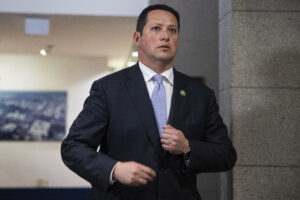
- House Ethics panel launches investigation of Tony Gonzales
- Steve Bannongets an unusual assist from Trump’s Justice Department

-

 The Dictatorship1 year ago
Luigi Mangione acknowledges public support in first official statement since arrest
-

 Politics1 year ago
Former ‘Squad’ members launching ‘Bowman and Bush’ YouTube show
-

 Politics1 year ago
Blue Light News’s Editorial Director Ryan Hutchins speaks at Blue Light News’s 2025 Governors Summit
-

 The Dictatorship6 months ago
Mike Johnson sums up the GOP’s arrogant position on military occupation with two words
-

 Politics1 year ago
Former Kentucky AG Daniel Cameron launches Senate bid
-

 The Dictatorship1 year ago
Pete Hegseth’s tenure at the Pentagon goes from bad to worse
-
Uncategorized1 year ago
Bob Good to step down as Freedom Caucus chair this week
-

 Politics11 months ago
Democrat challenging Joni Ernst: I want to ‘tear down’ party, ‘build it back up’