
The Dictatorship
Michigan fired its football coach after a shocking scandal. Its athletic director should go, too.


In less than 48 hours, Sherrone Moore went from the second-highest-paid state employee in Michigan, where he coached football games in the largest stadium in the Western Hemisphere, to a video arraignment from a jail cell.
The enormity of his fall from grace is on a scale of the 107,000-plus-seat University of Michigan colossus where he worked — its nickname, The Big Housenow dusted with cruel irony.
Details are still unclear on what all university officials knew about their former head coach’s relationship with a female football staffer and, crucially, when they knew it.
Is this just college sports now, with the quest for national titles camouflaging a school’s moral freefall into the abyss?
Whatever Moore’s misdeeds, the stench emanating from this situation is too strong for only one person to be at fault. Moore is a 39-year-old married father of three who, in the wake of being firedhas been accused of stalking his mistress, breaking into her home and threatening suicide. (He has pleaded not guilty to all charges.)
Is this just college sports now, with the quest for national titles camouflaging a school’s moral freefall into the abyss? Should we expect to see ugly and unconscionable realities if we peel back layers of more of the warped communities known as “programs” that dominate “College GameDay”?
Events of the past week, detailed in Friday’s arraignmentread like a bad Hulu screenplay. On Monday, Moore and the woman with whom he had been in a relationship broke up. That day she showed university officials texts and voicemails that confirmed the relationship. Moore was fired Wednesday and arrested hours later, after going to the woman’s home.
Moore “barged his way into that apartment,” prosecutor Kati Rezmierski told the court“then proceeded to a kitchen drawer, grabbed several butter knives and a pair of kitchen scissors and began to threaten his own life.”
Events of the past week read like a bad Hulu screenplay.
The coach said, “‘I’m going to kill myself. I’m going to make you watch. My blood is on your hands. You ruined my life,’ and a series of very, very threatening, intimidating, terrifying – quite frankly – statements and behaviors. She was terrorized,” Rezmierski went on.
Among the unanswered questions underlying all this: whether Michigan officials, who reportedly conducted an internal investigation in October that did not yield evidence of an inappropriate relationshipknew more about Moore’s behavior and relationship than they are now saying. And if so, did they wait to act until after a 9-3 season – considered subpar for a program that won the national title less than two seasons ago?
One wonders whether Moore would still be employed had his mistress not outed him and had the Wolverines qualified for the 10-team college football playoff.
If past sex and child abuse scandals at be-true-to-your-school universities are any guide – think Penn State, Michigan State – winning is the great deodorant; it covers up the stench of everything until evil can’t hide.
Michigan’s athletic director should himself be fired for cause.
Even as much remains unknown, a few things are clear, chief among them that Michigan’s athletic director, Warde Manuel, the man who fired Moore on Wednesday, should himself be fired for cause – now.
Manuel’s ratio of national titles to scandals is roughly 1-to-10 since he took the job in 2016. Beyond the 2023 sign-stealing saga that tarnished the national title season – in which Moore, then the co-offensive coordinator, was also implicated and punished – Michigan’s litany of incidents under Manuel’s watch have been as inexplicable as they are awful.
The record – summarized here – includes a 22-year-old low-level football staffer being captured in a video that went viral two Novembers ago while he allegedly attempted to meet a 13-year-old girl. He was fired. But the culture under both men’s watch was problematic.
Michigan said in a statement that it dismissed Moore for violating university policy by “engaging in an inappropriate relationship with a staff member.” Manuel reportedly fired Moore in a one-on-one conversationnotably without such standard figures in terminations as an attorney and/or a human resources officer present. This is especially salient because Moore has reportedly been battling mental health issues.
According to the criminal complaint, Moore was charged Friday with third-degree home invasion – a felony – as well as misdemeanor stalking and misdemeanor breaking and entering. He left the woman’s apartment only after she told him she was calling her attorney, the prosecutor said.
There’s another, indirect casualty in this scandal.
“The totality of the behavior is highly threatening and highly intimidating,” Rezmierski said, adding, “We consider him a risk to public safety, a risk to this victim.”
There’s actually another, indirect casualty.
Moore was one of just 16 Black head coachesin an NCAA Division I Football Bowl Subdivision (FBS) pool with more than 130 programs. While Black players make up more than 50% of big-time college rosters, Black coaches make up less than 12%. In a sport where change comes embarrassingly slow at the top, there are now just 15 Black coaches.
When a White coach has a scandal, he’s looked at as an outlier in a pool of others that look like him but aren’t thought of as monolithic. When a Black coach like Moore fails, many former and future candidates of color are at greater risk of being lumped in with him.
Moore’s next court date is Jan. 22. In the near term, Michigan’s board of regents has reportedly broadened its investigation to include Moore’s firing and the culture of its athletic department. The university is all but certain to say it didn’t see this coming and treat Moore as a pariah who abused his job and privilege until the university was forced to terminate him.
Sadly, too often in college sports now, we laud our winners and fire our losers and pretend nothing happened in between.
Mike Wise is a sports journalist whose past employers include ESPN’s The Undefeated, The Washington Post and The New York Times. He is writing a biography of Olympic gold medalist Billy Mills.



Greenland’s harsh environment, lack of key infrastructure and difficult geology have so far prevented anyone from building a mine to extract the sought-after rare earth elements that many high-tech products require. Even if President Donald Trump prevails in his effort to take control of the Arctic islandthose challenges won’t go away.
Trump has prioritized breaking China’s stranglehold on the global supply of rare earths ever since the world’s number two economy sharply restricted who could buy them after the United States imposed widespread tariffs last spring. The Trump administration has invested hundreds of millions of dollars and even taken stakes in several companies. Now the president is again pitching the idea that wresting control of Greenland away from Denmark could solve the problem.
“We are going to do something on Greenland whether they like it or not,” Trump said Friday.
But Greenland may not be able to produce rare earths for years — if ever. Some companies are trying anyway, but their efforts to unearth some of the 1.5 million tons of rare earths encased in rock in Greenland generally haven’t advanced beyond the exploratory stage. Trump’s fascination with the island nation may be more about countering Russian and Chinese influence in the Arctic than securing any of the hard-to-pronounce elements like neodymium and terbium that are used to produce the high-powered magnets needed in electric vehicles, wind turbines, robots and fighter jets among other products.
“The fixation on Greenland has always been more about geopolitical posturing — a military-strategic interest and stock-promotion narrative — than a realistic supply solution for the tech sector,” said Tracy Hughes, founder and executive director of the Critical Minerals Institute. “The hype far outstrips the hard science and economics behind these critical minerals.”
Stay up to date with the news and the best of AP by following our WhatsApp channel.

Trump confirmed those geopolitical concerns at the White House Friday.
“We don’t want Russia or China going to Greenland, which if we don’t take Greenland, you can have Russia or China as your next door neighbor. That’s not going to happen,” Trump said
A difficult place to build a mine
The main challenge to mine in Greenland is, “of course, the remoteness. Even in the south where it’s populated, there are few roads and no railways, so any mining venture would have to create these accessibilities,” said Diogo Rosa, an economic geology researcher at the Geological Survey of Denmark and Greenland. Power would also have to be generated locally, and expert manpower would have to be brought in.
Another concern is the prospect of mining rare earths in the fragile Arctic environment just as Greenland tries to build a thriving tourism industry, said Patrick Schröder, a senior fellow in the Environment and Society program at the Chatham House think-tank in London.
“Toxic chemicals needed to separate the minerals out from the rock, so that can be highly polluting and further downstream as well, the processing,” Shröder said. Plus, rare earths are often found alongside radioactive uranium.
Besides the unforgiving climate that encases much of Greenland under layers of ice and freezes the northern fjords for much of the year, the rare earths found there tend to be encased in a complex type of rock called eudialyte, and no one has ever developed a profitable process to extract rare earths from that type of rock. Elsewhere, these elements are normally found in different rock formation called carbonatites, and there are proven methods to work with that.
“If we’re in a race for resources — for critical minerals — then we should be focusing on the resources that are most easily able to get to market,” said David Abraham, a rare earths expert who has followed the industry for decades and wrote the book “The Elements of Power.”
This week, Critical Metals’ stock price more than doubled after it said it plans to build a pilot plant in Greenland this year. But that company and more than a dozen others exploring deposits on the island remain far away from actually building a mine and would still need to raise at least hundreds of millions of dollars.
Producing rare earths is a tough business
Even the most promising projects can struggle to turn a profit, particularly when China resorts to dumping extra materials onto the market to depress prices and drive competitors out of business as it has done many times in the past. And currently most critical minerals have to be processed in China.
The U.S. is scrambling to expand the supply of rare earths outside of China during the one-year reprieve from even tougher restrictions that Trump said Xi Jinping agreed to in October. A number of companies around the world are already producing rare earths or magnets and can deliver more quickly than anything in Greenland, which Trump has threatened to seize with military power if Denmark doesn’t agree to sell it.
“Everybody’s just been running to get to this endpoint. And if you go to Greenland, it’s like you’re going back to the beginning,” said Ian Lange, an economics professor who focuses on rare earths at the Colorado School of Mines.
Focusing on more promising projects elsewhere
Many in the industry, too, think America should focus on helping proven companies instead of trying to build new rare earth mines in Greenland, Ukraine, Africa or elsewhere. A number of other mining projects in the U.S. and friendly nations like Australia are farther along and in much more accessible locations.
The U.S. government has invested directly in the company that runs the only rare earths mine in the U.S., MP Materialsand a lithium miner and a company that recycles batteries and other products with rare earths.
Scott Dunn, CEO of Noveon Magnetics, said those investments should do more to reduce China’s leverage, but it’s hard to change the math quickly when more than 90% of the world’s rare earths come from China.
“There are very few folks that can rely on a track record for delivering anything in each of these instances, and that obviously should be where we start, and especially in my view if you’re the U.S. government,” said Dunn, whose company is already producing more than 2,000 metric tons of magnets each year at a plant in Texas from elements it gets outside of China.
___
Funk reported from Omaha, Nebraska, and Naishadham reported from Madrid.

Homeland Security Secretary Kristi Noem said Sunday that “hundreds more” federal officers are being sent to Minneapolis following the killing of a 37-year-old Minnesota woman by an ICE agent last week.
Noem told Fox News that the surge of federal forces are being sent “in order to allow our ICE and Border Patrol individuals working in Minneapolis to do so safely.”
The additional officers are expected to arrive on Sunday and Monday, Noem said.
The surge was announced after an Immigration and Customs Enforcement agent fatally shot Renee Good in Minneapolis on Wednesday in an incident that has drawn large protests against the Trump administration’s widespread deployment of federal agents and National Guard troops to major U.S. cities. The demonstrations continued through the weekend as thousands of people protested in Minneapolis and other cities across the country.
Local and state officials, including Minnesota Gov. Tim Walz, D, and Minneapolis Mayor Jacob FreyD, were outraged by the killing and have doubled down on demands for immigration officials to leave the city, arguing they are making the area less safe.
At a news conference after Good’s killing, Frey told immigration officials to “Get the fuck out of Minneapolis” and vowed to get justice.
Frey told NBC’s “Meet the Press” on Sunday: “I don’t want our police officers spending time working with ICE on immigration enforcement… You know what I want our police officers doing? I want them stopping murders from happening. I want them preventing car-jackings.”
Cellphone video said to have been taken by Jonathan Ross, the ICE officer who fatally shot Good, was released Friday. The new video does not clearly demonstrate that Good was attempting to hit Ross with her car, as Trump officials have claimed.
Earlier bystander footage shows the wheels turned to the right as Good’s car pulls forward, away from Ross, who then shoots Good through the car’s windshield.
Noem and other Trump administration officials have called Good a “domestic terrorist,” and repeatedly claimed that she had tried to “run over” immigration officers.
Minnesota saw a massive 30-day surge of federal agents beginning earlier this month, with roughly 1,000 additional officers deployed to Minneapolis and St. Paul, including from ICE, the Department of Homeland Security and U.S. Customs and Border Protection.
Minneapolis is one of many cities targeted by the administration in a nationwide crackdown on crime and immigration. Since President Donald Trump took office for a second term last year, immigration agencies and National Guard troops have been sent to cities including Los Angeles, Washington, D.C., Chicago, Charlotte, N.C., and Memphis.
Erum Salam is a breaking news reporter and producer for MS NOW. She previously was a breaking news reporter for The Guardian.
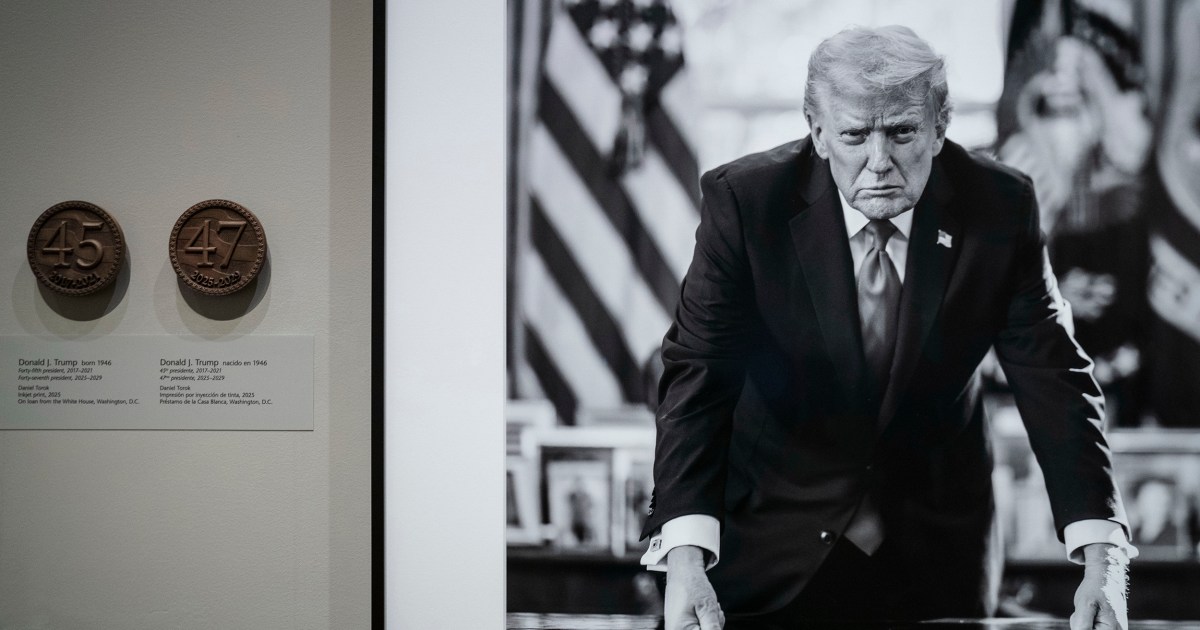
The National Portrait Gallery in Washington, D.C., has swapped out a portrait of President Donald Trump and removed text about his two impeachments and the Jan.6 insurrection at the Capitol.
The White House announced the news on Saturday, sharing a photo of the black-and-white portrait of the president in the Oval Office with his fists on the desk taken by White House photographer Daniel Torok.
The previous phototaken by Washington Post photojournalist Matt McClain, showed Trump in a red tie with text on a nearby wall that read, in part: “Impeached twice, on charges of abuse of power and incitement of insurrection after supporters attacked the U.S. Capitol on January 6, 2021, he was acquitted by the Senate in both trials.
A spokesperson for the Smithsonian told MS NOW that it is “beginning its planned update of the America’s Presidents gallery which will undergo a larger refresh this Spring” and that “the history of Presidential impeachments continues to be represented in our museums, including the National Museum of American History.”
A White House spokesperson said that “for the first time in history, the Smithsonian National Portrait Gallery has hung up an iconic photo taken by the White House honoring President Trump. His unmatched aura will be seen and felt throughout the halls of the National Portrait Gallery.”
The Colorado legislature agreed last year to remove a portrait of Trump from the state Capitol after he called the painting “the worst.” He also said his photo on the cover of Time magazine in 2025 was taken from an unflattering angel, calling it the “Worst of All Time.”
Last week, House Speaker Mike Johnson, R-Louisiana, said that a federal law requiring Congress to hang a plaque in the Capitol honoring law enforcment officers who helped protect the Capitol on Jan. 6, was “not implementable.” But senators quickly passed a resolution to “prominently display” the plaque in the Senate wing of the building.
Erum Salam is a breaking news reporter and producer for MS NOW. She previously was a breaking news reporter for The Guardian.
- Rep. Salazar touts Venezuela’s Machado before her visit

- Rand Paul: Bombing Iran ‘is not the answer’

- GOP angst grows over Powell investigation
- House GOP stock trading ban bill set for Wednesday markup
- Capitol agenda: Trump tests GOP with Fed probe
- Former Rep. Mary Peltola jumps into Alaska Senate race
- The harsh realities of Arctic mining undercut Trump’s argument to take Greenland

- Bessent says US may lift some Venezuela sanctions this week: Reuters

- U-Haul truck driven into crowd at Los Angeles anti-Iranian regime protest

- Trump says US military considering ‘strong options’ on Iran
-

 The Dictatorship11 months ago
Luigi Mangione acknowledges public support in first official statement since arrest
-

 The Dictatorship4 months ago
Mike Johnson sums up the GOP’s arrogant position on military occupation with two words
-

 Politics11 months ago
Blue Light News’s Editorial Director Ryan Hutchins speaks at Blue Light News’s 2025 Governors Summit
-

 Politics11 months ago
Former ‘Squad’ members launching ‘Bowman and Bush’ YouTube show
-

 Politics11 months ago
Former Kentucky AG Daniel Cameron launches Senate bid
-

 The Dictatorship11 months ago
Pete Hegseth’s tenure at the Pentagon goes from bad to worse
-
Uncategorized1 year ago
Bob Good to step down as Freedom Caucus chair this week
-

 Politics9 months ago
Democrat challenging Joni Ernst: I want to ‘tear down’ party, ‘build it back up’