
Congress
Meet Ken Nahigian, RFK Jr.’s guide to Congress

Robert F. Kennedy Jr., Donald Trump’s controversial pick to lead the Department of Health and Human Services, has an experienced guide to shepherd him to confirmation in the Senate.
Ken Nahigian, who led the Trump transition in 2017, is Kennedy’s liaison to senators, according to four people familiar with the matter.
Nahigian knows the Senate well. He worked for the Commerce, Science and Transportation Committee under then-Chairs John McCain (R-Ariz.) and Ted Stevens (R-Alaska). He cut his teeth in politics working advance for longtime Kansas Sen. Bob Dole’s 1996 presidential campaign.
Nahigian is currently executive vice president for policy and communications at the communications shop Nahigian Strategies.
After working on Trump’s transition in 2017, he and his firm secured hundreds of thousands of dollars in federal consulting contracts through the Centers for Medicare and Medicaid Services.
He once lobbied for health care interests, including the Israeli drugmaker Teva Pharmaceuticals and the Coalition for Access Now, which promotes cannabidiol, a marijuana derivative, for medical purposes.
Nahigian is working with Katie Miller, who was then-Vice President Mike Pence’s communications director and is married to Trump adviser Stephen Miller. She is handling the communications around Kennedy’s confirmation process.
Nahigian declined to comment. He and his brother Keith have run Nahigian Strategies since 2007, and both have done stints for GOP campaigns.
Kennedy spent Wednesday and Thursday on Capitol Hill, attempting to win the votes of Senate Republicans and Democrats who will decide whether he leads HHS.
House Democrats, the Democratic governor of Hawaii, and progressive groups are urging a no vote. On Thursday, the Committee to Protect Health Care, a physicians’ advocacy group, released an open letter signed by more than 15,000 doctors calling Kennedy, who has long questioned public health consensus about the importance of vaccination, “dangerous.”
Republicans have mostly backed Kennedy and he can win confirmation if 50 of the 53 GOP senators vote for him.
Texas Sen. John Cornyn, who sits on the Finance Committee, which will likely hold a confirmation hearing in the coming weeks, said he would vote to confirm.
“He’s not anti-vaccine,” Cornyn said. “He is pro-vaccine safety, which strikes me as a rational position to take.”
Iowa Sen. Chuck Grassley, a longtime advocate of farm interests, told reporters Kennedy’s views on farming and food production are “much more reasonable than I expected,” despite Kennedy’s past criticism of genetically modified plants and pesticides.
“The reports I read didn’t reflect what he actually believes and how he will act in those areas,” Grassley said.
Agriculture Committee Chair John Boozman of Arkansas also said he had a “good meeting” with Kennedy during which they spoke about Kennedy’s views on pesticides.
“That’s the kind of talk I like to hear,” Boozman said.
Boozman added that Kennedy would merely try to discourage consumption of ultra-processed foods, not seek to ban ingredients or manufacturing processes.
Boozman said he’d wait until Kennedy’s confirmation hearing to say if he’ll vote for him.
Sen. Bill Cassidy (R-La.), who leads the committee that oversees HHS, said he had a “frank” discussion with Kennedy Wednesday, offering a more tepid assessment than some of his fellow Republicans.
Democratic senators who sat down with Kennedy, including Elizabeth Warren and Ed Markey of Massachusetts and Maggie Hassan of New Hampshire, wouldn’t comment after meeting with him.
Sen. John Fetterman (D-Pa.) deflected on whether he would vote to confirm.
“I absolutely believe in vaccinations,” Fetterman said. “I would never argue against [vaccines].”


Rep. Kevin Kiley, the former Republican who recently registered as an Independent, said in an interview Wednesday he plans to caucus with the House GOP and will seek to regain his committee assignments.
The California lawmaker was formally removed from his panels Wednesday after giving official notice he was switching parties to serve as an Independent and run in a new district after his state redrew congressional maps.
The House GOP Steering Committee will need to approve Kiley’s effort to take back his seats on Education and the Workforce, Transportation and Infrastructure and Judiciary. Kiley told reporters this was “completely expected” and that he looked “forward to being reappointed as an Independent.”
Mia McCarthy contributed to this report.
Sen. Tim Scott (R-S.C.) will run for reelection in 2028, his campaign told Blue Light News on Wednesday, reversing a promise to serve just two full terms in the chamber.
Appointed by then-Gov. Nikki Haley to serve out the last two years of outgoing Sen. Jim DeMint’s Senate term in 2012, Scott had long said that 2022 would mark his final bid for the Senate.
He easily won reelection that year, besting Democratic state lawmaker Krystle Matthews by more than 25 percentage points. Scott then ran for president but abandoned his short-lived bid for the White House before the Iowa caucuses.
He was briefly considered to serve as now-President Donald Trump’s running mate and has since emerged as a key White House ally in the Senate.
“And I’ll say without any question that as I think about my own reelection in 2028, I think about all the lessons I’ve learned on the campaign trail for all these other candidates, and frankly, even in South Carolina,” Scott told the Charleston, South Carolina-based Post and Courier, which was first to report his reelection plans.
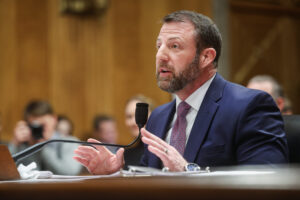
Hopes for a quick vote on Sen. Markwayne Mullin’s nomination as Homeland Security secretary hang on questions about secretive travel the Oklahoma Republican undertook as a House member a decade ago that are now being examined by his Senate colleagues.
Mullin was questioned extensively about the matter Wednesday by Sens. Rand Paul (R-Ky.) and Gary Peters (D-Mich.), the chair and ranking member, respectively, of the Senate Homeland Security and Governmental Affairs Committee.
Testifying under oath Wednesday, Mullin said he participated in what he described as “official travel” and a “classified trip” as part of a “special program inside the House” that went from 2015 to 2016. He said he was not a member of the House Intelligence Committee at the time and refused to answer further questions outside of a classified setting.
The attention on the matter came after Peters raised questions about Mullin’s past claims suggesting he had traveled to war zones and had first-hand exposure to combat environments despite his lack of a military background.
After the hearing adjourned Wednesday afternoon, Mullin joined Paul, Peters and other members of the committee in the Senate’s classified briefing facility.
“I’m one of these people who think that we silo off too much information from the public,” Paul told reporters after the hearing. “When we’re going to war, they tell eight people, it’s like, ‘Oh, we’ve notified Congress.’ So I don’t think that is adequate.”
“It makes people curious when you say, I’m doing secret missions for somebody, but I won’t tell you who, and only four people in the world know about those,” Paul added.
Mullin said only four people were “read into” the program in question and declined to say publicly what agencies or committees were involved.
“It’s a little difficult for us to go ask about a program that has no name and we have nobody that we know to talk to about it,” Peters said before Mullin agreed to the classified meeting. “So I don’t know how we would begin doing this without your cooperation.”
The questions about the shadowy travel erupted after Mullin’s nomination suddenly turned rocky after Paul questioned his temperament and fitness for office based on his past comments and behavior.
Paul later confirmed he would oppose Mullin’s nomination but said he still intended to hold a committee vote Thursday. To get through the panel with Paul opposed, Mullin will need the support of at least one Democrat.
Sen. John Fetterman (D-Pa.) has suggested he is inclined to support Mullin but declined to confirm Wednesday he would vote for him. Fetterman was among the senators spotted entering the classified meeting following the hearing.
“I’m willing to hold the vote tomorrow, but you brought this up that you were on a super secret mission,” Paul told Mullin at the hearing.
“No, I did not say super secret,” Mullin responded. “I said it was classified.”
- Kiley switches parties, loses committees
- Top counterterrorism official Kent resigns over Trump’s Iran war, says Iran posed no imminent threat
- White House applying pressure to media…
- Quick vote on Mullin’s DHS nomination hangs on classified briefing
- Markwayne Mullin’s DHS nomination not at risk from Rand Paul, Thune says
- Mullin says he regrets calling Alex Pretti ‘deranged’
- Mullin markup still on
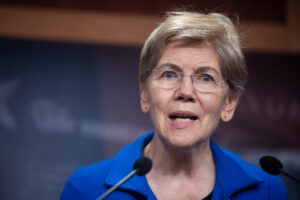
- Elizabeth Warren backs Mallory McMorrow in Michigan Senate primary
- Tim Scott to run for reelection to the Senate
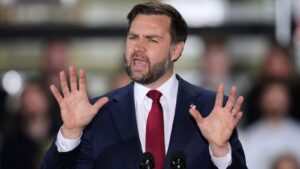
- Vance says rising gas prices a ‘temporary blip’
-

 The Dictatorship1 year ago
Luigi Mangione acknowledges public support in first official statement since arrest
-

 Politics1 year ago
Former ‘Squad’ members launching ‘Bowman and Bush’ YouTube show
-

 Politics1 year ago
Blue Light News’s Editorial Director Ryan Hutchins speaks at Blue Light News’s 2025 Governors Summit
-

 Politics1 year ago
Former Kentucky AG Daniel Cameron launches Senate bid
-

 The Dictatorship6 months ago
Mike Johnson sums up the GOP’s arrogant position on military occupation with two words
-

 The Dictatorship1 year ago
Pete Hegseth’s tenure at the Pentagon goes from bad to worse
-

 Politics11 months ago
Democrat challenging Joni Ernst: I want to ‘tear down’ party, ‘build it back up’
-
Uncategorized1 year ago
Bob Good to step down as Freedom Caucus chair this week