
Congress
How Trump is hammering Congress ‘on every issue’ — with a clear focus

President-elect Donald Trump is beginning to lean on Congress in a big way, but it’s all about next year.
Trump is focusing his efforts and expending political capital to ensure that Republican lawmakers go along with confirming his Cabinet picks and can ramp up right away on delivering on his campaign pledges in 2025.
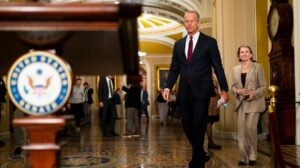
He regularly talks to senators about his nominees, ensuring they’re on a path to confirmation next year, according to a Trump adviser granted anonymity to discuss the conversations. He’s speaking with incoming Senate Majority Leader John Thune and Speaker Mike Johnson about his legislative priorities, namely how to quickly pass immigration, energy and tax policies in major party-line bills.
“Did you hear we have another member? We have 221 members,” joked Rep. Ryan Zinke (R-Mont.). “Trump’s in the House on every issue.”
But he’s been silent, at least publicly, about his preferences on the end-of-year spending bill and the Dec. 20 government shutdown deadline, despite calls from Republicans to weigh in. In a must-pass defense policy compromise, Republicans dropped certain culture-war provisions with knowledge that Trump will likely take executive action to address the issues. And Trump declined to tip the scales in Senate Republicans’ leadership elections beyond raising the specter of using recess appointments to ram through his Cabinet nominees.
“My impression is he’s been very focused on what’s happening next and what he’s about to inherit,” Sen. James Lankford of Oklahoma, an incoming member of Senate GOP leadership, said in an interview.
It shows Trump and congressional leaders are focused on moving in lockstep next year, hoping to cut down on party infighting and pass their major policy priorities quickly. Republicans have privately groused that they felt they squandered their majorities in 2017, wasting their previous Washington trifecta on unsuccessful efforts to repeal Obamacare. Intra-party divisions are already cropping up over the party’s strategy over taxes and the border, but GOP leaders are working to get everyone on the same page ahead of next year. In the meantime, they’re mostly putting Congress on autopilot in the lame duck.
Johnson, especially, has had close ties with Trump as the two GOP leaders plan out the legislative agenda next year. He’s met with the president-elect multiple times at Mar-a-Lago and speaks with Trump or members of his team every day. Johnson told reporters he will talk with Trump this weekend before the Army-Navy game in Maryland about the party’s budget reconciliation strategy, which is sparking early division among House and Senate Republicans as some push to pass border priorities more quickly and take more time to write a sweeping tax bill. The budget reconciliation process allows Republicans to skirt a Senate filibuster and pass priorities on a party-line basis.
Thune has also traveled to Mar-a-Lago to strategize with Trump and his team about next year’s legislative agenda, according to a person granted anonymity to discuss the private meeting. And he regularly talks with Trump regarding the status of his nominees, according to another person granted anonymity to discuss the conversations.
Trump’s largely passive attitude toward Congress’ end-of-term business echoes how Trump handled the post-2016 lame duck period, when the president-elect mostly eschewed wading into legislative fights on Capitol Hill before assuming office. And, if past is prologue, his hands-off approach is unlikely to last. Just look at his allies’ current attempts to both pressure Republicans into approving Trump’s most controversial Cabinet picks and bully them into going along with their federal budget-slashing plans.
Trump stayed mostly quiet as the 2016 lame-duck Congress passed a short-term government funding patch into April, approved the defense bill, greenlit hundreds of millions of dollars for Flint, Mich. to deal with its water crisis and enacted a sweeping bill meant to speed drugs and medical devices onto the market.
The president-elect’s team at the time ultimately agreed with the congressional legislative maneuvering, though Trump largely avoided using his then near-ubiquitous Twitter account to intervene. He posted on social media just once mentioning Congress from November 2016 until Inauguration Day, questioning a House Republican move to eviscerate an ethics office (they abandoned the push). He also urged the cancellation of a contract for a new Air Force One.
But upon taking office, Trump — often volleying out invectives through social media — would frequently weigh in on legislative priorities or urge the confirmation of his nominees and judicial picks, sometimes throwing a curveball at lawmakers at the last minute. And a similar pattern could play out next year.
“He’ll get involved once he gets in. There’s no reason for him to” before then, said Sen. Tommy Tuberville (R-Ala.).
Trump’s allies on Blue Light News, members of Republican leadership and GOP strategists defended Trump’s hands-off approach to the lame-duck in interviews. Doug Heye, a Republican strategist and Hill alum, said it’s “smart [for Trump] to stay out” and focus on building his administration in the short window he has before Jan. 20.
“Obviously, he’s pretty busy with nominations and filling out his Cabinet and all that,” echoed Sen. Shelley Moore Capito (R-W.Va.), a member of Senate GOP leadership.
And Trump will have a full plate as soon as he comes into office. Congress is only set to patch spending into March, meaning negotiations over new spending levels will begin in earnest once he takes office. He’ll also have to contend with raising the debt limit early next year, in addition to the massive, party-line budget reconciliation bills that Republicans want to pass.
All of those priorities will test the GOP’s unity — with any potential fights impeding swift progress on some of Trump’s biggest priorities.
“There’s a lot he’s got to deal with,” Rep. Chip Roy (R-Texas) said. And these early machinations “are [a] pretty good exposing of what he’s going to have to deal with [in] the Republican Conference.”
Jordain Carney, Olivia Beavers, Ursula Perano and Meridith McGraw contributed to this report.


The White House on Tuesday released a letter detailing changes it is willing to make to the Department of Homeland Security as it looks to secure a deal with Democrats to end the nearly five-week long partial government shutdown.
The move is the Trump administration’s attempt to show it is making a good faith effort after Democrats derided their proposal as unserious and comes as staffing issues at the Transportation Security Administration grow more acute — leading to longer wait times at airports across the country.
The White House, in five points, said it was willing to codify a number of policy changes, including an expansion of the use of body cameras for federal immigration agents; the limit of enforcement in certain sensitive locations, including hospitals and schools; greater oversight of DHS detention facilities; the enforcement of visible officer identification and the adherence to existing law prohibiting the deportation or detention of U.S. citizens.
“We feel that this offer is serious — that it is a good faith attempt to continue to try to come to a reasonable and expeditious conclusion to the shutdown, which we are now seeing is becoming ever more disruptive on Americans’ travel plans, as well as the security mission at the department,” said a senior White House official granted anonymity to describe the private talks.
The White House offer includes some public safety exceptions for the policy changes. For sensitive locations, there is a carve-out for “national security, flight risks and public safety,” and undercover officers would not have to display identification. Undercover officers would also not be required to wear body cameras.
The proposal also doesn’t address two of Democrats main concerns: requiring officials to obtain a judicial warrant before entering private property and prohibiting federal agents from wearing masks. Administration officials have previously said the warrants are a redline.
“We’re trying to move a little bit, but they’ve got to get serious. They are not getting serious,” Senate Minority Leader Chuck Schumer said Tuesday. “The key issues of warrants when you bust in someone’s house. The key issue of identity, of police and no masks. They haven’t budged on that.”
Spokespeople for Schumer did not immediately respond to a request for comment on the White House letter.
It’s the first time in the monthslong negotiation that the White House has released details about its proposal. Republicans have been eager for the White House to share details of its offers to validate their view that the administration had moved toward Democrats on some issues.
The White House letter argued that the majority of Democrats’ demands would “make it impossible to fully protect American citizens from dangerous criminal aliens and expose law enforcement and their families to increasing threats of violence.”
The senior White House official said that at this time, there are no plans for President Donald Trump to meet with Schumer or Democrats to discuss the impasse. The president has tapped border czar Tom Homan — who co-signed the letter with James Braid, the White House director of the Office of Legislative Affairs — to take the lead on working on the policy changes to end the government shutdown.
“There are a lot of technical issues that have to be worked out” for a White House meeting to be a “productive exercise,” the senior official said. “Although, of course, the president is going to make that decision, and at any time, that could be something that does occur.”
Threats from some hard-right House Republicans to block any Senate bill until the SAVE America Act passes appear to be falling flat.
A bill from Sen. Joni Ernst (R-Iowa) to reauthorize small business grant programs passed 345-41 Tuesday, a day after another Senate bill, aimed at recovering Nazi-looted art, passed on a voice vote.
Senate Republicans voted Tuesday to launch debate on a GOP elections bill President Donald Trump called his “No. 1 priority” in Congress. They are preparing to keep it on the floor at least into next week.
Senators voted 51-48 to take up the House-passed SAVE America Act that would institute new citizenship and photo ID requirements in order to participate in elections. Sen. Lisa Murkowski (R-Alaska) voted against opening debate, and Rep. Thom Tillis (R-N.C.) did not vote. Both had aired concerns about the process.
The Senate is expected to spend days, and potentially weeks, debating the bill in a bid to pacify conservatives and corner Democrats who oppose the new election restrictions. The debate is expected to include some late-night and weekend sessions.
But in the lead-up to Tuesday’s vote, discussions of the bill devolved into an increasingly contentious GOP-on-GOP fight over how far the party should go to try to pass it.
Conservative hard-liners, led by Sen. Mike Lee (R-Utah), want to force a “talking filibuster,” which they argue can overcome the usual 60-vote legislative threshold by requiring Democrats to hold the floor in order to block the bill.
But after weeks of internal conversations, Republicans have rejected that effort, which they fear could tie up the floor indefinitely and potentially let Democrats hijack the Senate agenda by forcing amendment votes on their own priorities.
Instead, Senate Majority Leader John Thune is expected to call up several amendments, including a proposal to expand the bill to include Trump-backed restrictions on mail voting, on transgender women participating in women’s sports and on gender-affirming surgeries for minors.
Thune’s move will limit Democrats’ ability to call up their own amendments and try to sidetrack the bill. Democrats have other options to frustrate the GOP, however, such as moving to adjourn the Senate or killing the bill.
Lee continues to advocate for a more aggressive approach: “If your senators don’t support using the talking filibuster to pass the SAVE America Act, you might need to replace them,” he wrote on X late Monday night.
- Lawsuit alleges breakup of federal climate lab was tied to Trump’s feud with Colorado

- TSA official: ‘Not hyperbole’ to suggest airports may close if shutdown persists

- Sununu on TSA workers, DHS shutdown: ‘I don’t think there’s abreakingpoint’

- Senate votes to begin marathon debate on SAVE America Act
- Watch live: Trump participates in annual Shamrock Bowl presentation

- White House releases DHS funding offer
- Senate bills survive
- Senate launches debate on SAVE America Act with endgame uncertain
- Pentagon says lethal boat strikes are ‘just the beginning’ in South, Central America
- Republicans hope Mullin will turn the page at DHS from Noem. Democrats aren’t buying it.
-

 The Dictatorship1 year ago
Luigi Mangione acknowledges public support in first official statement since arrest
-

 Politics1 year ago
Former ‘Squad’ members launching ‘Bowman and Bush’ YouTube show
-

 Politics1 year ago
Blue Light News’s Editorial Director Ryan Hutchins speaks at Blue Light News’s 2025 Governors Summit
-

 Politics1 year ago
Former Kentucky AG Daniel Cameron launches Senate bid
-

 The Dictatorship6 months ago
Mike Johnson sums up the GOP’s arrogant position on military occupation with two words
-

 The Dictatorship1 year ago
Pete Hegseth’s tenure at the Pentagon goes from bad to worse
-

 Politics11 months ago
Democrat challenging Joni Ernst: I want to ‘tear down’ party, ‘build it back up’
-
Uncategorized1 year ago
Bob Good to step down as Freedom Caucus chair this week