
Politics
How Beyonce, Springsteen and Trump could help rewrite copyright law

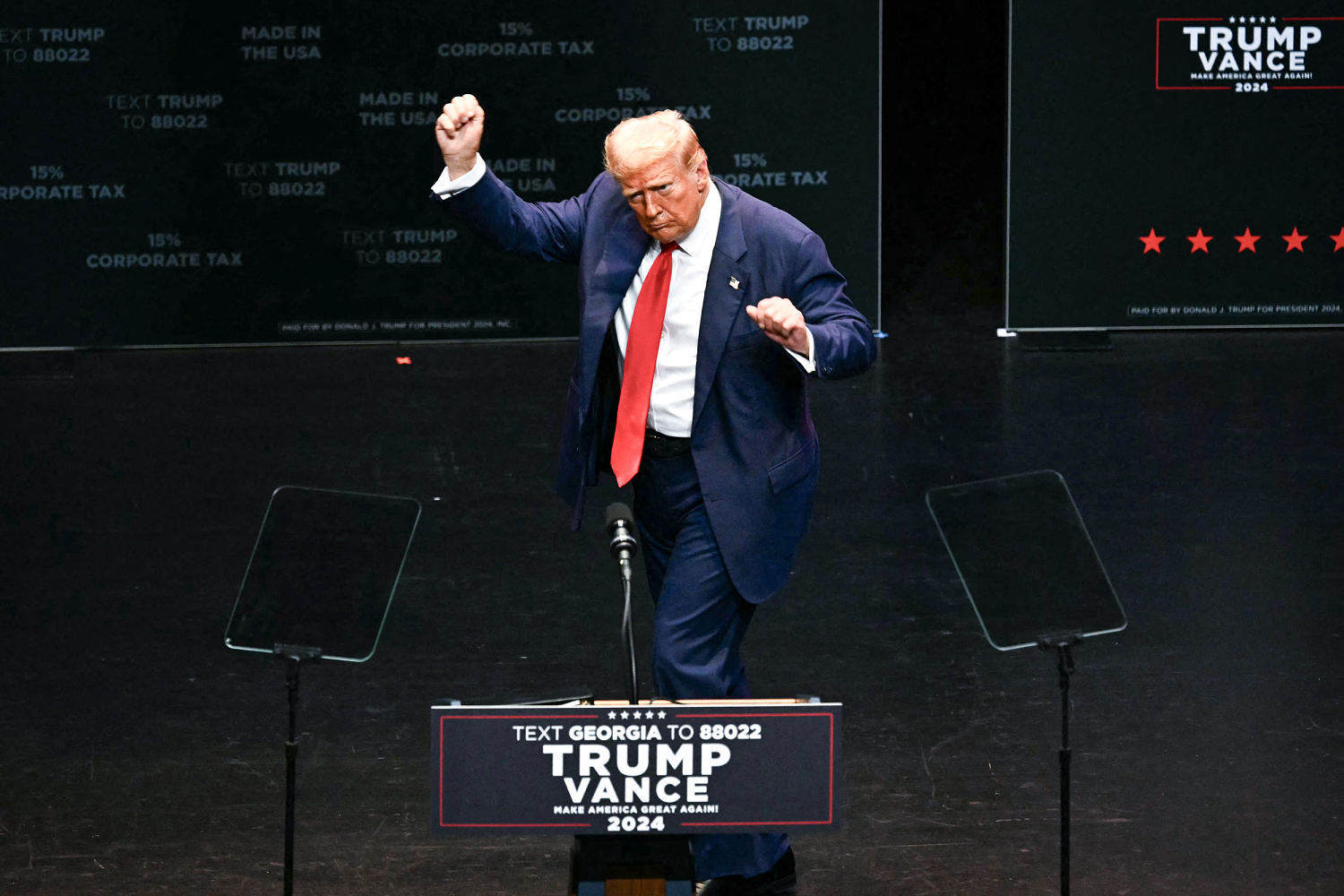
Former President Donald Trump’s machinations to avoid accountability have prompted new legislation not just in criminal law, but also in copyright law — where his taste in playlists may have a far more expansive legal effect.
While Trump is frequently described as a force of divisiveness, his choice of music for his rallies and campaign commercials has brought together a wide coalition of artists from multiple genres and eras in complaining about the allegedly unauthorized use of their material. An only partial list of artists includes Neil Young, BeyoncéFoo Fighters, ABBA, the White Stripes, Celine Dion and, most recently, the estate of Isaac Hayes.
As one noted legal expert puts it: “Trump is the greatest abuser of musical property rights, ever, in terms of people running for president.”
Trump’s choice of music for his rallies has brought together a wide coalition of musical artists from multiple genres and eras in complaining about his allegedly unauthorized use.
Trump is a recidivist offender, having also drawn objections in 2016 from artists including Bruce Springsteen, who objected to Trump playing “Born in the USA.” Rather than taking legal action against Trump, the “Boss” publicly endorsed Trump’s opponent — Hillary Clinton — which resulted in Trump’s attendees booing every time the song was played. Trump’s 2016 campaign use of “Start Me Up” also drew threats of legal action by the Rolling Stones.
But despite all these complaints, lawsuits have been rare. Guyanese-British singer songwriter Eddie Grant sued Trump in 2020 for using Grant’s 1983 hit song “Electric Avenue” in a Twitter video mocking Trump’s then-opponent Joe Biden, seeking damages and attorney’s fees for unauthorized use of the song. This September, following a lawsuit filed by the estate of Isaac Hayes against Trump for unauthorized use of his song “Hold On, I’m Coming,” a federal judge granted an emergency injunction against Trump’s further use of the song as the litigation continues.
The relative paucity of lawsuits versus the number of complaints may be explained by the legal complexities involved.
Artists who want to stop Trump from using their music typically start with a cease-and-desist letter, which puts the offender on notice of legal action if they don’t stop using the song. If the letter doesn’t work, then the artist must file suit — and that’s where it gets tricky, because of music licensing agreements as well as the much misunderstood legal doctrine of “fair use.”
At first glance, it seems easy enough for campaigns to get legal authorization to use particular songs. That is because performing rights organizations like ASCAP and BMI sell licensing packages offering access to millions of songs. While most large venues have bought such packages, a lawsuit against Newt Gingrich’s use of Survivor’s “Eye of the Tiger” (made famous in “Rocky III”) found a hole in this protection by specifically targeting use of the music at small venues, not large ones.
But even when the campaign obtains a licensing package, the artists can complain to the organization if they object to the use of their song, and the organization will then contact the campaign asking them to stop. If the campaign refuses to stop using the song, the artist may bring several different types of claims — most typically copyright infringement but also claims under the Lanham Act for trademark infringement. The latter is often premised on the idea that using the artist’s music may imply the artist endorses the candidate.
The use of music played at rallies is a far more straightforward legal issue than it is in the digital world.
As a defense to the copyright claim, defendants may adopt the tactic the Trump campaign used with the lawsuit filed by Isaac Hayes’ estate, in which Trump argued he had a blanket license from BMI and also claimed use of the song was allowed under the fair use doctrine. Trump also tried to argue that Hayes did not own enough of the copyright.
The fair use doctrine grants an exception to copyright protections when taking into account four factors: the purpose and character of the use, the nature of the copyrighted work, the amount of substantiality of the portion used, and the effect of the use on the potential market value or value of the work. It doesn’t take a legal scholar to see how much wiggle room exists in these factors.
It’s obvious that the above process is complicated, lengthy and expensive for the artists to bring. However, the trend for suits has been on the upswing since 2008, when Jackson Browne sued John McCain and the Ohio Republican Party for use of his song “Running on Empty.” Browne won damages, and McCain apologized. Two years later, Talking Heads’ front man David Byrne sued then-Florida Gov. Charlie Crist; he won damages and forced Crist to make a public apology. These two suits were critical to make campaigns realize they could be forced to pay damages, and some experts believe they opened the way for more legal action by artists against campaigns. In 2010, Mitt Romney and Newt Gingrich were both forced to stop using music by Survivor and K’Nann, and in 2011 Don Henley stopped former Rep. Michelle Bachmann’s use of his music with only a letter.
The use of music at rallies is a far more straightforward legal issue than it is in the digital world. The case of Grant v. Trump brought by Eddie Grant involved use of the song with animation in a video posted on Twitter. The suit started in 2020 and only just concluded in Grant’s favor.
With digital and online use, it is far easier for content creators to argue under the fair use doctrine that the way in which the music is being used escapes copyright infringement claims — think YouTube reaction videos. And the increasing sophistication of AI generated content in images and video will complicate this even further.
Most campaigns may not want to be dragged into legal suits and possibly face damages. Trump does not seem to care. So his litigious tendencies are likely to break new ground as copyright law faces technological advances.
Most campaigns may not want to be dragged into legal suits and possibly face damages. Trump does not seem to care.
Campaigns want to use popular music for the same reason we like to listen to it — it moves people — and that reaction is how artists make a living from their work. But the challenge posed by the speed and reach of the digital age is how the law can evolve to protect the original work and how much of the artist’s own beliefs matter.
Tom Morello, of Rage Against the Machine, once wrote in his criticism of former Speaker of the House Paul Ryan’s use of the group’s music: “Paul Ryan is the embodiment of the machine our music rages against.” That sentiment and the risks of distortion posed by our age resonates perfectly with Taylor Swift’s endorsement of Kamala Harris right after her debate with Trump.
The law provides one tool for artists to prevent their work and beliefs from being hijacked. Another — and perhaps even more powerful one — is to use their voices and platforms to directly speak out and leave no doubt as to how they view the purpose of their art.
Shan Wu is a legal analyst and former federal prosecutor who served as counsel to then-Attorney General Janet Reno.


BRUNSWICK, Maine — The fireplace crackled as Democratic Gov. Janet Mills laid out her vision for beating Susan Collins to a room of supporters in late January. Then came the questions about her primary opponent, Graham Platner.
Platner, one attendee noted, was very successful on social media. A second pointed to his support among young people and asked Mills whether she would support him if he became the party’s nominee.
“I am a Democrat,” Mills answered, before pivoting to how she sought as governor to make the state more affordable for young Mainers.
Mills’ Democratic primary opponent isn’t her favorite subject. She would rather talk about how she expanded Medicaid, bolstered protections for reproductive rights, and, most recently, challenged President Donald Trump over the surge of immigration enforcement in the state — issues that conveniently allow the governor to draw contrast with Collins, the five-term Republican who Democrats must unseat in order to take back control of the Senate.
But Platner, a political newcomer, has made himself all but unavoidable in conversations about the Maine Senate race. The 41-year-old oyster farmer and combat veteran is unlike any other recent popular candidate the state has seen: He is brash. He is progressive. He has drawn crowds of hundreds of people, national attention and millions in campaign dollars.
Platner’s meteoric rise reflects a growing frustration with the Democratic establishment and voters’ interest in a new generation of leaders. He is campaigning not just against Collins but against a “billionaire class,” running a campaign in the style of Sen. Bernie Sanders (I-Vt.), who endorsed him.
His battle with Mills comes at a moment when the stakes for Democrats could hardly be higher. Though the Maine Democratic Party doesn’t take positions in primaries, some establishment figures like Senate Minority Leader Chuck Schumer have backed the moderate governor, who they believe is their best shot at defeating Collins to win back the Senate in 2026.
The challenge for Platner is that he is running on a vision of disruptive progressivism and generational change in Maine, the oldest state in the nation and one with a long track record electing senators perceived as moderates within their parties. Mills would largely fit that image; Platner would blow it up entirely. But he is betting that voters now want what he is offering — and his early support makes it hard to ignore the possibility.
“If you look at everyone from Bill Cohen to Angus King to George Mitchell to Susan Collins and Olympia Snowe, there’s a strong, moderate streak there when it hits November,” said Adam Cote, a Maine lawyer and veteran who ran for governor in 2018, coming in second to Mills in the Democratic primary. “In the primary, I don’t know.”
While public polling in the race has been relatively scarce, an internal poll released by Platner’s campaign last month had him up by double digits over Mills. He has 283,000 followers on Instagram compared to 61,000 for Mills and 25,000 for Collins. His campaign boasts of a 15,000-person strong volunteer network. Through the end of December, he raised $7.8 million to $2.7 million for Mills, enough to begin running TV ads more than four months in advance of the June primary.
“My wife makes this joke. I’ve been just saying the same bullshit for years, ranting on about structural inequality, ranting on about, like, American history and how we need to reconnect with things. Nobody cared about me because I was a random dude in Sullivan, Maine,” Platner said in an interview. “I’m now running for United States Senate, and I get to have this conversation at a national level.”
Both in style and substance, Platner is unlike any candidate who has risen to the highest levels of Maine politics in recent decades. Even before he faced a litany of controversies in the fall — including a series of offensive old Reddit posts for which he apologized and a tattoo of a Nazi symbol that he had covered up — the Sullivan oysterman was building an operation different from any Maine Democrat.
Platner does not like the label of progressive, but where he differs with Mills on policy, his positions are largely to her left. He has backed progressive priorities like Medicare for All, described Israel’s military actions in Gaza as a genocide, and favors abolishing Immigration and Customs Enforcement.
Asked whether progressives can win in Maine, Platner pointed to polling showing Sanders’ popularity despite his finishing narrowly behind Joe Biden in the 2020 presidential primary.
Although more progressive state lawmakers have been elected from southern Maine over the past few election cycles, further-left candidates finished far behind the more moderate ones in statewide primaries for governor in 2018 and Senate in 2020.
“There’s a reason why [Rep. Chellie] Pingree never ran for governor,” said Mark Brewer, a political science professor at the University of Maine. “She recognizes it would be very difficult for someone that’s as far to the left as she is to win statewide in Maine. And when we look at the Democrats who do win statewide, they look like Janet Mills.”
Some of Platner’s appeal may come less from his specific progressive stances than from his ability to capture the energy of Democratic voters upset about the state of the country — and at their own party for not doing enough to stand up to it. Trump’s second term led even people who were not previously politically active to show up for protests, with many aligned with Platner’s style of economic populism, said Andy O’Brien, a Maine writer and activist supporting Platner.
“The Trump administration has just been so extreme that I think it’s really radicalized average, ‘normie’ voters,” O’Brien said.
In an interview, Platner recalled going to a local Democratic party meeting in early 2025 and coming away frustrated that attendees were talking about bylaws, not Trump. In his view, there was pent up grassroots energy to fight the administration — shown, for example, by large No Kings protests in the state — but few organized outlets to turn it into action.
His campaign proved one outlet for that energy. Following a surge in ICE activity in Maine in January, Platner led a protest at Collins’ offices in Portland and Bangor, calling on the senator to cut funding to the agency. Dozens of supporters showed up in single-degree temperatures.
“I’m a supporter of Graham Platner because we need a U.S. senator to represent Maine who will be honest with us, who will be truthful with us, and will work for us,” said Laura Neal, a Bar Harbor resident who attended the protest with a sign reading “My Cat Hates ICE.”
Like many Platner backers, Neal doesn’t dislike Mills, but thinks it is time to move on. “I think Governor Mills has done a great job, and it’s time for new energy,” she said.
In much of the national conversation about the Maine Senate race, Mills has been the less talked about candidate. It’s an odd position for a well-vetted two-term governor.
Her diagnosis for why Maine Democrats have not been able to knock off Collins is straightforward: Past nominees have been “untested.” The GOP senator has never had to face a Democrat who has won statewide before. If Collins has won in part because of her deep history in the state, Mills matches her.
“Each of us probably knows everybody in Maine, one way or other,” Mills said in an interview.
Mills started as district attorney in rural, more conservative western Maine before being elected to the state legislature, then served as attorney general for much of Republican Paul LePage’s tenure as governor, frequently clashing with him. In 2018, she became the first gubernatorial candidate in Maine in 20 years to win the general election with at least 50 percent of the vote, as well as the state’s first female governor. Four years later, when LePage attempted a comeback, she beat him by 13 percentage points.
Governing with a Democratic trifecta, Mills expanded Medicaid and enacted a string of other priorities, including free community college, universal school meals and expanded abortion access following the Dobbs decision.
Since Trump’s return to office, Mills has faced off with him several times. In a White House confrontation last year, the president threatened to withhold funding from Maine over the state’s continued allowance of transgender participation in youth sports, Mills fired back: “See you in court.” The Trump administration paused certain agriculture department funding to Maine; the state sued and the money was restored.
The episode provided a theme that underlies the governor’s Senate campaign: Collins has not stood up to the president, but Mills will. Her latest TV ad describes her as “the one who took on Donald Trump and won.”
“Susan Collins is formidable,” said Trish Riley, a retired health policy expert who hosted Mills in her Brunswick home last month. “And the only person who can beat a formidable candidate is another formidable candidate, and that’s Janet.”
Mills’ tenure as governor has not been free from conflict with other Democrats. She at times disagreed with progressives in the legislature, issuing more than 50 vetoes, with the most prominent conflicts around labor and tribal sovereignty. That created openings for Platner to hit her record from the left, and his prominent endorsers have included several labor unions.
The bigger challenge for her in the primary may be the support from national Democrats like Schumer. Sara Gideon’s 2020 loss to Collins, despite strong national Democratic support which helped her far outspend the Republican, led to a sense in the state that the national Democratic actors did not use money wisely and did not understand Maine. For some, that distrust has only compounded since Trump returned to office.
“There’s a reaction among a lot of Democrats to what they see as the weakness of the establishment leaders in Washington,” said Amy Fried, a retired political science professor from the University of Maine and longtime Collins critic. “The fact that Chuck Schumer is the one who recruited Mills — maybe she would have run anyway, but he’s definitely associated with her. And then you have a lot of people who are on the Left who are really unhappy with what Democratic leadership has done when it comes to pushing back on Trump.”
Mills maintains that she made no promises to Schumer, and the decision to run was hers. She bristles at the idea that she would be considered part of the political establishment.
“I got elected to the legislature, not because somebody said, ‘You should be anointed to his job.’ I worked for it, I ran for it, and I won,” she said in an interview. “When I ran for district attorney, I defeated three guys for the primary, and then another guy for the general. Nobody ever gave it to me on a silver platter. Again, when I ran for governor: Seven-way primary. And I won. I’m used to that. Bring it on.”
Republicans have been gleeful at the prospect of a grueling primary.
“Maine Democrats are in a race of extreme vs more extreme — the only question is which of their candidates will run farther to the left to claim victory in this messy primary,” Republican National Committee spokesperson Kristen Cianci said in a statement.
Whoever prevails in June will have to take on the electorally resilient Collins. If Democrats fail to knock off the GOP senator, there will be recriminations from whichever side loses the primary that their candidate would have been able to defeat her.
Most supporters of Platner and Mills say they would back the eventual Democratic nominee regardless, with defeating Collins the most important priority. But a nasty primary could still risk alienating some voters, when every vote will count in November.
“The differences are really pretty big between the two candidates, and I think it’s probably going to get strongly oppositional towards the end,” said Cote, the former gubernatorial candidate. “And how the victor is going to unite the party afterwards is going to be a huge challenge.”
Politics
Data centers are a growing political issue. Voters — and candidates — are still figuring them out.
Data centers are quickly becoming the next big political issue. And neither party has figured out how to run on them.
Major political figures on both sides have struggled to figure out their positions, and in-depth results from The POLITICO Poll help explain why: Americans don’t know much about data centers, they don’t really know how to feel about them and they’re not yet sure where the political battle lines lie.
But they do know they matter. A bipartisan majority of Americans said they expect data centers to become a campaign issue in their area eventually, the poll found, with nearly half saying it would become one within the next five years.
“If you had asked me about data centers five months ago, I would have said: ‘What’s a data center?’” Republican Oklahoma City Mayor David Holt said in an interview. “Now it’s everywhere. So that’s a short amount of time to fully formulate what you think about it.”
The survey reveals the early contours of an evolving political battle — and the opportunity and risk for politicians hoping to seize on the nascent power of an issue that touches on AI and tech, infrastructure and development, environmental resources, jobs and energy costs.
Republicans appear to have an early edge on the issue, though public opinion is so largely unformed that it’s unclear how that may change.
Pluralities — but not majorities — of voters in both parties said they support the construction of data centers, with Americans who say they plan to vote for the GOP in November about 8 points more likely than Democratic voters, according to the survey conducted by independent London-based firm Public First.
Republicans’ appetite for data centers may be driven in part by President Donald Trump, who has been bullish on artificial intelligence and data center expansion and who has been combative against both blue and red states aiming to restrict that growth. He wrote on social media last month that “Data Centers are key” to ensuring that the U.S. dominates on AI.
His position is most clearly reflected among his strongest supporters. Asked at the start of the poll for their position, before additional information had been provided, a 55 percent majority of voters who both backed Trump in 2024 and self-identified as “MAGA Republicans” said they support a new data center being built in their local area.
Support was markedly lower among Trump voters who did not consider themselves MAGA Republicans, at 38 percent, and Kamala Harris voters, at 36 percent.
Democrats expressed worry about the water supply and electricity bills — concerns that have already emerged in recent elections.
With public opinion on data centers still fluid, candidates are beginning to experiment with whether — and how — to embrace data centers as a campaign issue.
Democrats saw early success in highlighting backlash to data centers in the off-year elections, when Mikie Sherrill in New Jersey and Abigail Spanberger in Virginia won their gubernatorial elections by wide margins with pledges to better regulate data centers and their energy consumption. In Georgia, Democrats beat two Republican incumbent state regulators in part by supporting guardrails around data center growth.
The issue has only spiraled since. It has fueled intraparty rifts, with progressives splitting over whether to temporarily ban new warehouse construction and Republicans who want more guardrails for artificial intelligence diverging from a president who’s trying to cut red tape.
It has also created unusual crossover: Governors in both parties are racing to regulate the booming industry, where regulation has often lagged growth. Conservative Florida Gov. Ron DeSantis rolled out a “bill of rights” to protect consumers and residents last year, and moderate Democratic Gov. Josh Shapiro of Pennsylvania proposed new safeguards for ratepayers and resources earlier this month.
The Blue Light News Poll found that voters’ top concerns about data centers center around household costs. Asked about the drawbacks to building data centers in the U.S., 29 percent of Americans said it would mean higher electricity bills, 24 percent said an increased risk of blackouts and 23 percent said the projects would cost the taxpayer money.
Data centers are now rocketing to the forefront of Democrats’ messy Senate primary in Michigan. The race in a perennial battleground with some 70 data centers will serve as a key test of their potency in swing states heading into 2028.
Progressive candidate Abdul El-Sayed, in an interview, said voters’ perspectives are “very quickly evolving” and that “it’s unsurprising” that Democratic voters are more skeptical of them — which gives the party an “opportunity to lead” on the issue.
He has emerged as the most vocal critic of data centers in the three-way race, outlining “terms of engagement” last month that would prevent tech companies from passing energy costs on to ratepayers and protect water resources and jobs.
State Sen. Mallory McMorrow, who is straddling the line between moderate and progressive, has taken a more measured tone. In public appearances and in statements, McMorrow has said she opposes any project that “raises residential [electricity] rates, hurts our water, does not use union labor and doesn’t actually create revenue for the state” but also that “done right, data centers are a transformational opportunity.”
And centrist Democratic Rep. Haley Stevens said “AI and data infrastructure require a clear, responsible policy framework to ensure these technologies are developed safely and securely,” in a statement. She said AI policy should boost productivity and user experience, while protecting taxpayers, strengthening the workforce, and safeguarding “good-paying union jobs.”
Democratic candidates who find themselves out of step with their voters on data centers could pay a real electoral price, The Blue Light News Poll found.
Just 7 percent of Democrats said they would be less likely to support a Democratic candidate who opposes a data center — but 20 percent said they would be less likely to back one who supports it.
Divisions over data centers are emerging within the GOP as well, with some Republicans breaking from Trump — a sign of the issue’s rapidly evolving political terrain.
DeSantis, for instance, has become a vocal data center critic, while lawmakers from states experiencing a rise of data centers are walking a more delicate line, supportive of AI development, but insistent that the states should be the ones regulating data center construction. Most Republicans, however, remain aligned with Trump, bullish on AI development and seeing it as crucial to competing with China.
Party operatives say data centers could quickly climb up voters’ list of concerns as more of them are proposed and built, but that they’re not yet a dominant electoral issue.
Americans agree.
Right now, the construction of data centers ranked last when survey respondents were asked to rank up to three of the top issues facing the U.S. at the moment. But nearly a third of respondents — 30 percent — living within a mile of data centers say the issue will play a role in the November elections, a significantly higher share than the 17 percent who say the same among Americans overall.
“The only people that are particularly exercised are the ones that are navigating [data centers] in their communities,” said Michigan-based GOP strategist Jason Roe. “I don’t think it’s yet broadly an issue that people have wrapped their heads around enough to have an opinion.”
Still, most voters expect the issue to rise, though they’re split on when that will happen. Just one in four Americans said they “don’t think data centers will ever play a role in elections in my area.”
“This is a political bomb waiting to go off,” said Jared Leopold, a Democratic strategist and co-founder of the clean-energy group Evergreen Action. “You’ve seen data centers go from a third-tier issue to a top-tier issue in politics in the span of a year. … And there are some people who are going to have success riding that wave politically.”

New York is relaxing its liquor laws to allow bars and restaurants in some parts of the state to open early for the U.S. men’s hockey team’s gold medal game against Canada on Sunday. Gov. Kathy Hochul (D) announced Saturday that she directed the State Liquor Authority to suspend enforcement between 6 a.m…
Read More
- Maine has a long track record of electing moderates. Enter Graham Platner.
- Data centers are a growing political issue. Voters — and candidates — are still figuring them out.
- Businesses face uncertainty as Supreme Court strikes down Trump tariffs

- The Supreme Court struck down Trump’s tariffs. Now comes the hard work of issuing refunds

- Hochul relaxes NY liquor laws during US-Canada hockey gold medal game

- Trump calls for Netflix to fire Susan Rice after she warned corporations for bending ‘a knee’

- State of Texas: GOP AG hopefuls agree on policy but clash over records in Dallas debate

- Schiff to boycott Trump’s State of the Union, speak at alternative event
- DHS suspending 2 travel programs amid shutdown

- Democrats warn Trump ‘must consult with Congress’ before striking Iran
-

 The Dictatorship1 year ago
Luigi Mangione acknowledges public support in first official statement since arrest
-

 Politics1 year ago
Former ‘Squad’ members launching ‘Bowman and Bush’ YouTube show
-

 The Dictatorship5 months ago
Mike Johnson sums up the GOP’s arrogant position on military occupation with two words
-

 Politics1 year ago
Blue Light News’s Editorial Director Ryan Hutchins speaks at Blue Light News’s 2025 Governors Summit
-

 Politics1 year ago
Former Kentucky AG Daniel Cameron launches Senate bid
-

 The Dictatorship1 year ago
Pete Hegseth’s tenure at the Pentagon goes from bad to worse
-
Uncategorized1 year ago
Bob Good to step down as Freedom Caucus chair this week
-

 Politics10 months ago
Democrat challenging Joni Ernst: I want to ‘tear down’ party, ‘build it back up’