
Congress
Here Are the GOP Senators Who Could Take Down Trump’s Cabinet Picks

President-elect Donald Trump’s rapid-fire cabinet appointments have made clear what he values: loyalty to Donald Trump and a demonstrated ability to articulate that loyalty on television.
The response to The Trump Show’s casting call will be even more clarifying. In short: Will the Senate remain the Senate?
While much of the GOP has become a Trump subsidiary, there are still some Senate Republicans who consider themselves members of a co-equal branch of government and take their Advise and Consent duty seriously.
Not that this is the Hollywood version of the Senate. Most of the 53 Republican lawmakers in the incoming Senate want to support their party’s president, who just won a decisive victory and enjoys diehard support from the bulk of their voters. They’d much rather air their concerns about Trump’s picks privately and avoid having to cast a vote in opposition to any of them. No need to do any “Mr. Smith Goes to Washington” impressions on the Senate floor when the oppo research can work its will.
Yet it’s that lack of appetite for a public showdown with Trump that will make the first months of the new Congress so telling. The fates of the fringe appointees who come up for a confirmation vote will reveal one of the most important new power centers in Washington, and perhaps one of the few checks on Trump II: the lame duck caucus.
Yes, it’s those senators who may never have to face Republican primary voters again and are therefore immune from Trump’s greatest power — his control of the GOP base.
These are the lawmakers for which freedom — to borrow from the great and recently departed Kris Kristofferson — is just another word for nothing left to lose.
This is not to say that every Republican senator who opposes a Trump appointment is headed for the exits. Some are independent minded, and their political strength flows partly from that identity (looking at you, senior senators from Maine and Alaska).
However, to examine those GOP senators whose terms are up in 2026 and 2028 is to grasp how some of Trump’s most provocative picks could be blocked, provided the 47 Democrats and independents vote in unified opposition.
The challenge will not just be how willing they are to thwart Trump, but whether they will be willing to do so with more than one nominee. It’s one thing to rise up with safety in numbers and block, say, Matt Gaetz’s nomination as attorney general should it reach the floor. It’s quite another to torpedo Gaetz and then take down another, let alone two or three, more Trump appointees.
It’s worth watching, though, because this same bloc of Republican lawmakers would also be the most likely to reemerge later in Trump’s term to selectively challenge him on issues (tariffs or foreign policy come to mind) or an inevitable power grab.
So who’s in this latest Senate gang, one most would deny being part of?
Let’s begin with those senators who are up in 2026.
Sen. Mitch McConnell (Ky.): The longest-serving Senate leader in American history tops the list because he is the most likely retiree. McConnell is the consummate partisan — look no further than his return to Trump after prematurely consigning him to history’s ash heap. He’s also a team player who will not want to make life unduly difficult for his successor as leader, Sen. John Thune (R-S.D.).
However, McConnell has also made clear he wants to use the end of his 40-plus years in the Senate to steer his party away from isolationism. How committed he is to that task could be determined early next year should he have to consider Pete Hegseth as Defense Secretary and Tulsi Gabbard as intelligence chief.
Sen. John Cornyn (Texas): Equally liberated could be the man who fell a few votes short of becoming McConnell’s successor. In the immediate wake of his defeat, Cornyn, who turns 73 in February, said he still planned to run for reelection. Yet after not realizing his years-long goal of becoming Senate GOP leader, does Cornyn really want to spend the next 16 months racing between Texas and Washington to fend off a right-wing primary so he can serve in the rank-and-file until he’s 80? If not, he’s free to act, and vote, like the Bush Republican he is.
Sen. Susan Collins (Maine): Finally poised to claim the Appropriations gavel she’s long coveted, Collins has also indicated she intends to run for reelection in two years. I don’t doubt it. But what sort of a primary and general election could loom in her bifurcated state? There’s a reason why the dexterous Collins is the last sitting GOP senator to carry a state that her party’s presidential nominee lost. Striking that balance of keeping core Republicans from her native rural Maine happy without angering moderate Mainers closer to Portland will be on her mind with every contentious vote.
Sen. Bill Cassidy (La.): Like Collins, Cassidy voted to convict Trump of impeachment charges nearly four years ago. Unlike Collins, Cassidy hails from a deeply pro-Trump state. Even more ominous for the Louisiana lawmaker, his state’s famous jungle primary — in which all candidates for office appear on a single ballot open to all voters — is no more for federal races. Now chairing the HELP Committee, Cassidy, a physician, may not want to walk away. But if he concludes he will lose a Republican primary, he’ll be free to vote as boldly as he did when he was one of only seven Senate Republicans to convict Trump.
Sen. Thom Tillis (N.C.): Tillis’ most vexing potential primary opponent, Lt. Gov. Mark Robinson, is no more thanks to, well, you know what. But like Collins, Tillis is staring at the prospect of more conservative Republicans eager to pounce should he break from Trump. And Tillis could have one of the most hard-fought general elections in the country should outgoing Gov. Roy Cooper be tempted to run. (Expect Senate Democratic Leader Chuck Schumer to have memorized Cooper’s number by the first of the year.)
More than the hassle of an expensive primary and general election two years on may be the more immediate question of whether a dealmaker like Tillis can find satisfaction in the Senate during another time of Trump. Will he make his peace with MAGA, as he did under Trump I? Or will he follow the course of his neighbor to the west, former Senator Bob Corker, and decide after two terms he’s had quite enough of the “adult day care center” that is the Trump White House.
Sen. Joni Ernst (Iowa): Ernst has been sounding Trumpier lately. Perhaps she’ll be tapped for an administration post. Army Secretary or Defense Secretary, if Hegseth is derailed, could be alluring for a military veteran like Ernst. But, as with Cornyn, she lost a leadership race and is now something of a free agent. And like McConnell, she doesn’t hide her more hawkish national security views.
I’m tempted to include Sen. Shelley Moore Capito (R-W.V.), a pre-Trump Republican if there ever was one. Capito turns 71 next week and may not want to spend most of her 70s in the Senate. Yet she’ll be mindful of voting in a way that, in a state where the primary is now tantamount to election, won’t undermine her son or nephew from becoming the third generation of Moores elected statewide.
Okay, onto those up in 2028.
Sen. Lisa Murkowski (Ark.): Murkowski is the other remaining GOP senator who voted to convict Trump of impeachment charges in the aftermath of the attack on the Capitol. She has already won one primary as a write-in candidate. And she may prevail again should she run again in four years if Alaska’s ranked-choice system survives repeal efforts. But that Anchorage to D.C. commute doesn’t get any shorter. Regardless of her ultimate plans, there may be no more liberated Republican senator in the body next year.
Sen. Charles Grassley (Iowa): Grassley has been in elected office since the Eisenhower administration and I’m reluctant to ever assume he’s on the verge of retirement. But at 91, perhaps the Iowan will start considering his retirement years. Seriously, though, the Judiciary Committee chair has not shown much interest in challenging Trump previously. But if ever there was a GOP lawmaker without political considerations to weigh, it’s the hog farmer and Twitter maven from New Hartford, Iowa.
Sen. Todd Young (Ind.): It got remarkably little attention, but Young didn’t endorse Trump’s candidacy this year. Which puts him in league with Collins and Murkowski. That’s no small thing for a 52-year-old from deep-red (crimson?) Indiana with years ahead of him in elected office. If he wants as much. That may depend on the state of party.
Regardless, Young, a Naval Academy graduate and Marine, is in the internationalist tradition of his long-ago boss, Sen. Richard Lugar. And his deafening silence this year toward Trump’s candidacy suggests he’s not afraid to go his own way.
Sen. Jerry Moran (Kansas): The low-key former House member — he and Thune arrived in the same class to that chamber — has avoided tangling with Trump. But Moran is a Republican traditionalist who could be in his last term. He’s 70 and, like Cornyn, may not want to remain in the Senate until he’s 80.
Sen. To Be Named Later (Ohio): The successor to Vice-President-elect JD Vance is a mystery but the person who will decide who fills the seat is not. It’s Gov. Mike DeWine, an old school Republican nearing, presumably, his final two years in elected office. Will DeWine pick a placeholder in his image, somebody who may defy Trump, or a more MAGA-friendly figure who can survive a primary?
That’s it for the 2028 class. I’ll resist the temptation to scout those GOP senators up in 2030 — except to note this may be Armed Services Chair and national security hawk Sen. Roger Wicker’s (R-Miss.) last term.
Not that he or most any other GOP senator will want to break from Trump. But as the once and future president has proven for nearly a decade, and is proving anew since the election, the only thing more vexing than being a Trump critic is being a Trump ally.


Congressional Republicans are confronting serious doubts they can pass Iran war funding on their own, especially as the potential price tag balloons into the hundreds of billions of dollars.
The alternative — relying on a handful of Democrats to push it through the Senate — doesn’t look any more likely as Middle East hostilities expand, energy prices rise and more Democratic lawmakers dig in against an unpopular war.
In recent weeks, some in the GOP floated using the party-line budget reconciliation process to give the Pentagon a slug of new money without needing to gather 60 votes in the Senate. But the revelation that a war funding request could reach $200 billion has quickly cooled those hopes, given the political complications of finding offsets for the spending and the procedural gyrations it would require.
“It’s such a contortion to make things fit in reconciliation that there’s probably a preference for regular order,” Senate Armed Services Chair Roger Wicker (R-Miss.) said in an interview.
The fresh doubts come on top of long-running warnings from at-risk Republican lawmakers that pursuing another party-line bill could force them into a politically painful position in the months ahead of the midterms. Spending tens or hundreds of billions of dollars on the war could lead Republicans to further slash safety-net programs as they did in last year’s “big, beautiful bill” — creating a messaging bonanza for Democrats.
“It’s not going to happen,” one House Republican, granted anonymity to speak candidly, said of a second reconciliation bill. “Certain people have to talk about it as a possibility and keep the issue alive.”
But many House Republicans argue that a party-line bill is the only viable option to deliver the war funding President Donald Trump wants.
As they quietly consider whether to send more U.S. troops to the Middle East, Trump and Defense Secretary Pete Hegseth each declined Thursday to dispute reports that the Pentagon is seeking a $200 billion request after it was first reported by the Washington Post.
“It’s a small price to pay to make sure that we stay tippy-top,” the president said in the Oval Office, adding that the military needs “vast amounts of ammunition” to fulfill its mission in Iran and elsewhere around the globe.
House GOP leaders and committee chairs discussed the possibility of adding military funding to a potential party-line bill during a closed-door meeting at their policy retreat in Florida last week.
“Can we accomplish his priorities in regular order in appropriations? I think it would be unlikely, because I don’t think Democrats are interested in supporting military spending right now,” House Budget Chair Jodey Arrington (R-Texas), a longtime reconciliation cheerleader, said in an interview this week.
At the moment, “unlikely” is underselling the depth of Democrats’ aversion to funding the war. Even those senators who aren’t summarily ruling out support for an emergency funding bill say they would not possibly entertain it under the current circumstances.
“I’ve got to see the details,” said Maine Sen. Angus King, an independent who caucuses with Democrats. “To be honest, it’s going to be hard for me to support it because I think this war was a mistake, wasn’t justified, hasn’t been supported by the Congress.”
The sky-high $200 billion figure — which exceeds the Pentagon funding in last year’s GOP reconciliation bill and is higher than any supplemental funding bill enacted in the post-9/11 era — has some Republican hard-liners eager to pursue another budget reconciliation bill. Many argue it would pave the way for big cuts to domestic spending they oppose, including potentially Medicaid and other social programs.
“It would be very difficult to pass a very large supplemental without it being paid for,” said Rep. Andy Harris (R-Md.), chair of the House Freedom Caucus. “There are hundreds of billions of dollars we can still save in fraud, waste and abuse in reconciliation.”
Senate GOP appropriators are hoping to build bipartisan buy-in for Pentagon funding and see disaster aid and farm assistance as potential sweeteners for Democrats. Others are now floating attaching Ukraine aid, something with broad Democratic support and uneven GOP buy-in.
Still others, including Sen. Lindsey Graham (R-S.C.), simply want to dare Democrats to vote against funding the military. “I’d hate to be the senator who denied the request … because you’ve got troops in harm’s way,” he said.
So far, most Democrats do not appear to be cowed by the threats or interested in horse-trading.
“Look, pinning us against our own interests isn’t something I’ll support,” said Rep. Mike Quigley (D-Ill.), a strong advocate for Ukraine aid.
House GOP leaders declined to tip their hand Thursday as they awaited a formal request from the White House, as well as Trump’s fiscal 2027 budget plan. House Majority Leader Steve Scalise said war funding would be a matter of “negotiation” at some point, “but it hasn’t started yet.”
House Appropriations Chair Tom Cole (R-Okla.) cautioned that the discussions are “all speculative” for the time being while acknowledging reconciliation “might be the only way” to get Pentagon money through the Senate.
Across the Capitol, top Senate Republicans aren’t yet seriously considering trying to pass war funding on party lines — underscoring the longstanding split between House and Senate GOP leaders over how far they should go to pursue an election-year reconciliation bill.
The reticence among some Senate Republicans, according to three people granted anonymity to disclose private thinking, is that there isn’t yet a clear proposal that could get 50 GOP votes. Conservatives, they say, are floating an array of proposals that don’t have broader buy-in and could run afoul of the Senate’s strict reconciliation guidelines. And they expect a second bill would reopen the party’s old wounds over offsetting spending cuts.
“I’ll try and insist that we pay for it,” said Sen. Ron Johnson (R-Wis.), one of the party’s loudest deficit hawks.
But without a party-line package, Senate Republicans will have to convince enough Democrats to reach the 60-vote threshold, and they appear to be nowhere close.
“This administration needs to tell Congress definitely what they’re doing and how long this is going to take,” said Sen. Patty Murray of Washington, the top Appropriations Democrat. “We’re not going to write them a blank check.”
Katherine Tully-McManus and Jennifer Scholtes contributed to this report.
A group of lawmakers are set to introduce legislation Thursday to examine the use of artificial intelligence in federal courts, according to bill text obtained by Blue Light News.
Sens. Roger Wicker (R-Miss.) and Peter Welch (D-Vt.), along with Rep. Harriet Hageman (R-Wyo.), are preparing to unveil the bipartisan, bicameral Research and Oversight of Artificial Intelligence in Courts Act of 2026. The bill would establish a 15-member task force to study the use of AI-powered speech-to-text and speech recognition tools, with a focus on privacy, civil liberties and accuracy.
The panel would include federal judges, prosecutors, court clerks and other judicial experts and would be required to report its findings to Congress and the attorney general within 18 months.
Clear federal guidelines for AI use in U.S. courts have yet to be established, as broader concerns about the technology grow on Capitol Hill. Last year, Reuters reported that two federal judges withdrew rulings in separate cases after lawyers flagged factual inaccuracies and other serious errors. In one New Jersey case, a draft decision that included AI-generated research was mistakenly posted to the public docket before undergoing review, according to the report. In response to questions from Senate Judiciary Chair Chuck Grassley (R-Iowa), the judges attributed the snafus to court staffers using generative AI tools for drafting and research.
“As the Senate’s only former public defender, I know it firsthand: Court reporters and captioners are irreplaceable,” Welch said in a statement. “When it comes to the use of AI in the courtroom, there are still substantial privacy and civil liberty concerns that need to be addressed.” Wicker said, “Ensuring accuracy is critical to fair justice.”
Technology-related privacy and civil rights concerns are currently top of mind for lawmakers in Congress, as Speaker Mike Johnson seeks to put an 18-month extension of Section 702 of the Foreign Intelligence Surveillance Act on the House floor next week.
Senate Majority Leader John Thune suggested Thursday the Senate will not go on recess as planned at the end of next week if the Department of Homeland Security isn’t funded by then.
“We need to get this resolved and it needs to get resolved, you know, by the end of next week,” Thune said. “I can’t see us taking a break if the [department’s] still shut down.”
Thune’s comments to reporters come as a bipartisan group of senators, including members of the Appropriations Committee and a clutch of Democrats that helped negotiate the end to the last shutdown, meet privately in the Capitol with Tom Homan, Trump’s border czar.
The meeting — coming as TSA staffing issues create long lines at some airports — is the first sign in weeks of potential momentum in the DHS funding.
- Congress moves to scrutinize AI use in federal court

- Garcia explains why lawmakers walked out of ‘fake’ Bondi hearing

- As Epstein’s longtime lawyer testifies, questions remain about what he knew

- Garcia explains why lawmakers walked out of ‘fake’ Bondi hearing
- Republicans balk at going it alone on Iran war funding
- Joe Scarborough slams GOP for ‘screwing their own constituents’ to protect ICE

- The years I spent defending César Chávez make me feel like a fool

- Fired FBI agents claim ‘improper acts of political retribution’ by Trump administration
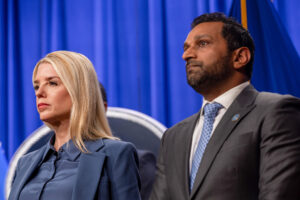
- Garcia explains why lawmakers walked out of ‘fake’ Bondi hearing
- US clears the way for Venezuela to sell more oil as Iran war boosts prices

-

 The Dictatorship1 year ago
Luigi Mangione acknowledges public support in first official statement since arrest
-

 Politics1 year ago
Former ‘Squad’ members launching ‘Bowman and Bush’ YouTube show
-

 Politics1 year ago
Blue Light News’s Editorial Director Ryan Hutchins speaks at Blue Light News’s 2025 Governors Summit
-

 Politics1 year ago
Former Kentucky AG Daniel Cameron launches Senate bid
-

 The Dictatorship6 months ago
Mike Johnson sums up the GOP’s arrogant position on military occupation with two words
-

 The Dictatorship1 year ago
Pete Hegseth’s tenure at the Pentagon goes from bad to worse
-
Uncategorized1 year ago
Bob Good to step down as Freedom Caucus chair this week
-

 Politics11 months ago
Democrat challenging Joni Ernst: I want to ‘tear down’ party, ‘build it back up’