
Congress
Graham vows to plow ahead with reconciliation for defense, homeland funding

Sen. Lindsey Graham said Wednesday that his panel is moving “expeditiously” to unlock Senate Republicans’ ability to fund defense and homeland security priorities without Democrats’ help.
“The purpose of the second reconciliation bill is to make sure there is adequate funding to secure our homeland and to support our men and women in the military who are fighting so bravely,” Graham said in a statement. “More funding will mean they can complete the task assigned and keep America safe – which is money well spent.”
Graham added that a second reconciliation bill could also be used to “improve voter integrity,” a nod to Republicans’ plan to try to get parts of their election bill, known as the SAVE America Act, included to appease Trump.
The announcement came as some Republicans proposed this week using the budget reconciliation process, which allows a united majority to avoid the 60-vote filibuster threshold, to pass immigration enforcement funding Democrats oppose. It also comes as GOP leaders strategize over how to potentially pass a new slug of Pentagon funding as the war in Iran nears the one-month mark.
Graham’s comments Wednesday morning come after he met with Budget Committee Republicans Tuesday on what senators said afterward was a preliminary meeting to “touch gloves” about pursuing another reconciliation bill. Graham subsequently met with Senate Majority Leader John Thune to brief him on the closed-door discussion.
“Lindsey is moving down that path. And my expectation is if he does end up drafting a budget resolution it would be with a lot of input from members of the conference and something that I think we would be confident we could support on the floor,” Thune said.
The Senate needs to adopt a budget resolution before Senate Republicans can bring a filibuster-skirting policy bill to the floor. The budget resolution outlines which committees will have the drafting pen for the eventual bill and lays out broad fiscal targets the eventual bill will need to comply with.
Budget Committee Republicans discussed trying to get parts of the SAVE America Act, like incentivizing states to implement voter ID, and funding for ICE into a party line bill. Graham did not specify a timeline for when he will have a budget resolution ready.
Even as Graham is vowing to push forward, it’s still uncertain that congressional Republicans will actually be able to pass another reconciliation bill.


House GOP leaders announced in a closed-door meeting Wednesday that the election to fill the vacant leadership role of policy chair will be the morning of April 16. Republicans will hold a candidate forum the afternoon of April 15, according to four people granted anonymity to discuss the plan.
Congress
Lawmakers introduce bill to prohibit members of congress, president from prediction market trading
Lawmakers are introducing bipartisan legislation to prohibit members of Congress, the president and others in the executive branch from trading in certain prediction markets, according to bill text shared exclusively with POLITICO.
Reps. Nikki Budzinski (D-Ill.) and Adrian Smith (R-Neb.) will introduce the Preventing Real-time Exploitation and Deceptive Insider Congressional Trading Act, or PREDICT Act, Tuesday to ban members of Congress from participating in prediction markets related to political events or policy decisions. The ban would also extend to dependents and spouses of lawmakers, senior congressional staff, political appointees, the president, vice president and all senior executive branch employees, including special government employees.
“The American people are tired of politicians using their influence for personal gain, and the rise of prediction markets has made those concerns even more relevant,” Budzinski said in a statement. “In recent months, we’ve seen instances of little-known traders making massive profits on events ranging from war with Iran to how long a government shutdown will last, raising necessary questions about the use of inside information.”
The bill comes amid an uptick of bipartisan legislation focused on prediction markets like Polymarket and Kalshi. Sens. John Curtis (R-Utah) and Adam Schiff (D-Calif.) introduced a bill in the Senate earlier this week to ban sports betting contracts on prediction markets.
Polymarket and Kalshi, the largest prediction market platforms, on Monday unveiled new measures intended to thwart insider trading on its platforms. Polymarket said it was updating its rulebook to clearly state that users cannot trade on events that they could influence or have confidential information on. Kalshi, meanwhile, launched a tool to prevent political candidates from trading on their own campaigns.
Last month, Kalshi banned a California politician who wagered $200 on his own gubernatorial bid.
“Serving the American people is a privilege, not a pathway to profit,” Smith said in a statement. “Our commonsense, bipartisan bill will give Americans confidence that the decisions of their elected officials are guided by merit, not personal profit.”
The legislative rush comes alongside a rapid expansion in the prediction markets that has attracted some of Wall Street’s and Silicon Valley’s biggest investors.
President Donald Trump’s family has jumped in, too. Donald Trump Jr. is an adviser to Kalshi and Polymarket and a partner in venture capital firm 1789 Capital, which is also an investor in Polymarket. The president’s social media startup, Trump Media & Technology Group, last fall announced plans to launch a prediction-market service called Truth Predict.
The legislation would implement a fine to violators of 10 percent of the value of violating transactions, plus force any profits from those transactions to go to the U.S. Treasury.
Declan Harty contributed to this report.
Donald Trump has a big speaking engagement Wednesday night — and there’s no telling whether he’ll help or hurt the GOP’s Capitol Hill agenda.
The president is slated to address House Republicans at the NRCC’s annual dinner — the day after Democrats flipped a Florida statehouse seat that includes his home at Mar-a-Lago.
The last time Trump addressed the GOP conference, earlier this month in Florida, he sparked a slew of headaches for his party by insisting on passage of a partisan elections bill that has little chance of becoming law.
This time could be no different. Trump has so far hardly delivered a ringing public endorsement of a potential deal to end the DHS shutdown he reportedly signed off on, and which congressional Republican leaders need him to back if it has a chance of passing in the coming days. He also has yet to intervene in a standoff between the two chambers over a housing affordability package Republicans want to use as a centerpiece of their midterm messaging.
Here’s what we’ll be listening for:
— DHS deal or no deal?: Trump could make or break a potential agreement to end the DHS shutdown, which got a cool reception Tuesday on Capitol Hill across the board even ahead of Democrats’ expected counteroffer Wednesday.
Part of the proposal Republicans brokered with the White House includes attempts to morph sections of the SAVE America Act into a party-line budget reconciliation bill. But many conservatives see that a cop out from having to pass the full GOP elections overhaul bill, which does not currently have the votes to overcome the Senate filibuster. The House Freedom Caucus called it “gaslighting.”
Republicans are also getting a reality check on whether pursuing another reconciliation effort is even feasible. While Republicans are vowing to plow ahead, many predict the treacherous process will ultimately fail.
Sen. Rick Scott (R-Fla.), a Budget Committee member who chairs the Republican Steering Committee, predicted it would be “very difficult” to get the votes for reconciliation and compared it to a “pipe dream.”
— Housing stalemate: For weeks, Republicans have wanted the president to help resolve the impasse between the House and Senate over their competing housing proposals.
The stalemate doesn’t appear close to resolution, especially if Trump continues to stay out of the fight. House Republicans on Tuesday shot down one idea the Senate floated to get the House to accept its legislation. It would have attached a slate of community bank deregulatory bills to a separate cryptocurrency package.
“So our good stuff for their bad stuff — not sure I buy that,” said Rep. Bill Huizenga (R-Mich.), who serves as vice chair of House Financial Services.
Despite Trump insisting earlier that Republicans don’t need to show they’re committed to lowering costs of everyday goods and services to win elections in November, plenty of GOP lawmakers worry about the political price of failing to enact a unified vision for making housing more affordable.
What else we’re watching:
— No polymarket for politicians?: Reps. Nikki Budzinski (D-Ill.) and Adrian Smith (R-Neb.) will introduce bipartisan legislation Wednesday morning to prohibit members of Congress, the president, the vice president and others in the executive branch from trading in certain prediction markets, according to bill text shared exclusively with Blue Light News.
The Preventing Real-time Exploitation and Deceptive Insider Congressional Trading Act, or PREDICT Act, would also extend to dependents and spouses of lawmakers, senior congressional staff, political appointees and senior executive branch employees, including special government employees.
— Bipartisan energy in tax policy: The House Ways and Means Committee will mark up five bills with cross-party appeal Wednesday morning as Hill taxwriters consider what policies might be included in a year-end bipartisan tax package. Among the items on a docket is a measure that would allow taxpayers to temporarily write off disaster-related losses without itemizing their deductions.
Katherine Tully-McManus, Jennifer Scholtes, Jordain Carney, Meredith Lee Hill, Jasper Goodman and Bernie Becker contributed to this report.
- GOP policy chair election April 16
- Graham vows to plow ahead with reconciliation for defense, homeland funding
- Lawmakers introduce bill to prohibit members of congress, president from prediction market trading
- Capitol agenda: Trump to bring headaches or harmony to Blue Light News
- GOP’s reconciliation hopes are easier dreamt than done
- DHS funding proposal falls flat as Democrats, conservatives and Trump raise doubts

- Rick Scott sues contractor over leaked tax returns
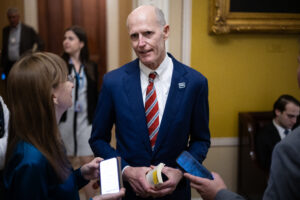
- How Jack Smith connected the dots between GOP lawmakers, Trump aides in 2020 election probe

- Trump: Unlikely to be happy with ‘any deal’ on DHS

- Introducing Sen. Alan Armstrong
-

 The Dictatorship1 year ago
Luigi Mangione acknowledges public support in first official statement since arrest
-

 Politics1 year ago
Former ‘Squad’ members launching ‘Bowman and Bush’ YouTube show
-

 Politics1 year ago
Former Kentucky AG Daniel Cameron launches Senate bid
-

 Politics1 year ago
Blue Light News’s Editorial Director Ryan Hutchins speaks at Blue Light News’s 2025 Governors Summit
-

 The Dictatorship7 months ago
Mike Johnson sums up the GOP’s arrogant position on military occupation with two words
-

 The Dictatorship1 year ago
Pete Hegseth’s tenure at the Pentagon goes from bad to worse
-
Uncategorized1 year ago
Bob Good to step down as Freedom Caucus chair this week
-

 Politics11 months ago
Democrat challenging Joni Ernst: I want to ‘tear down’ party, ‘build it back up’