
Congress
Elon Musk brings all the deregulation hype to X

Elon Musk’s role in Donald Trump’s administration hasn’t been announced, but the billionaire and Tesla CEO is already sharing some of his enthusiasm for the incoming president and his deregulatory desires on social media.
Musk, who owns the social media platform X, has been posting regularly about politics, deregulation and incoming Trump administration personnel. The prominent Trump ally appears poised to play a significant role advising the incoming administration, and some social media posts indicate he is spending time at Mar-a-Lago advising the president-elect during the early transition.
His public posts indicate how he might seek to shape Trump’s policies.
Musk’s biography line on X currently reads: “The people voted for major government reform.”
“Government Efficiency FTW!!” he posted Monday in response to a Republican lawmaker’s suggestion that a GOP-led Congress should have bills to “shrink government overreach” on Trump’s desk by the first day of his term.
Musk recently has posted criticism of the Education Department, weighed in on the next Senate majority leader and celebrated Trump for selecting Tom Homan as his White House “border czar.”
He welcomed broad deregulation and government spending cuts and reposted a comment from Trump ally Vivek Ramaswamy saying that, “A band of small-government revolutionaries will save our nation. It’s the only way.”
Musk said of Ramaswamy’s remarks, “Absolutely! Would be interesting to hear recommendations for roles in the new administration for consideration by the President.”
Musk also called for “maniacally dedicated small-government revolutionaries” to join the incoming Trump administration.
Trump said in September that Musk had agreed to lead a “government efficiency commission tasked with conducting a complete financial and performance audit of the entire federal government.”
Musk wouldn’t officially serve in the Cabinet, Trump told Fox News in October. “He doesn’t want to be in the Cabinet. He just wants to be in charge of cost-cutting.”
The Trump transition team declined to share the details of Musk’s expected role with the incoming administration.
“Elon Musk is a once-in-a-generation business leader and our federal bureaucracy will certainly benefit from his ideas and efficiency. His specific role will be announced when that decision is formalized,” said Karoline Leavitt, a spokesperson for the Trump-Vance transition team.


House GOP leaders postponed a Wednesday procedural vote on an extension of a key federal spy powers program as they scramble to land a deal with hard-liners around changes — acknowledging the truly “clean” extension that President Donald Trump is demanding is currently DOA in the chamber.
There are ongoing discussions around modifying the clean, 18-month extension of the surveillance authority known as Section 702 of the Foreign Intelligence Surveillance Act, or FISA, that Trump is ordering. GOP leaders acknowledged in private conversations Tuesday night and publicly Wednesday morning that at least some tweaks are necessary to quell a GOP rebellion that could lead to Section 702’s expiration April 20.
Republican leaders are still hoping to hold a procedural vote later Wednesday to pave the way for floor consideration of the measure, if they can strike an agreement with hold-outs around some changes. A final vote would then happen around 10 p.m. Wednesday. But Speaker Mike Johnson was noncommittal in an interview late Wednesday morning if all that could still happen. “We’ll see,” he said.
Conversations around potential changes picked up Tuesday night, as Blue Light News first reported. Holdouts are asking for guardrails on the program, including warrant requirements; the White House is open to making changes in this regard but likely in a more watered-down capacity than what hard-liners have been seeking.
Ultraconservatives are also pushing House GOP leaders and the White House to follow through on a previous promise to advance a ban on a central bank digital currency, known as CBDC. House GOP leadership and the White House are pushing for a longer Section 702 extension in exchange for advancing that policy or other reforms, while some hard-liners want the promised CBDC ban passed as a standalone rather than attached to the FISA bill.
Majority Leader Steve Scalise said in an interview that White House officials, GOP leaders and Republican holdouts are discussing some “potential amendments.” He added, “We’re still negotiating.” He maintained GOP leaders and White House officials won’t incorporate any changes that undermine the underlying government surveillance program.
Nothing has been agreed to. And Scalise said in an earlier interview leaders would likely incorporate “minor tweaks” into the procedural rule governing floor debate on the underlying bill — if the White House approves.
So far, however, conversations have not sufficiently moved the needle. Hard-liners aren’t budging, continuing resisting renewed calls from Trump and an increasingly aggressive pressure campaign from the administration. That includes a detailed presentation from CIA Director John Ratcliffe at Wednesday morning’s closed-door House GOP Conference meeting on the need for a clean extension.
“Look, he’s the executive, we’re the legislative, and we’re going to see a little bit of conflict between those two today,” Freedom Caucus Chair Andy Harris (R-Md.) said Wednesday, referring to the president.
GOP Reps. Michael Cloud of Texas, Andrew Clyde of Georgia and other hard-liners stood up in the GOP Conference meeting to raise their concerns about a clean reauthorization and continued push for overhauling the program. Some Republicans grew irritated that Ratcliffe “filibustered” until close to the end of the meeting’s scheduled conclusion to avoid taking challenging questions, according to four people in the meeting.
Even before the rule vote was postponed, several rank-and-file members said they were not confident the rule would be adopted.
“There are some who will vote against the rule for sure,” said one House Republican granted anonymity to speak candidly. “It’s a math issue.”
Democrats aren’t expected to help Republicans overcome the procedural rule, even though some of them support a reauthorization without policy changes at this time. The top Democrats on the House Intelligence and Judiciary Committees — Reps. Jim Himes of Connecticut and Jamie Raskin of Maryland, respectively — discussed a joint proposal for a package of FISA overhaul provisions at their party’s weekly caucus meeting Monday morning, which they plan to attempt to advance if the Republicans’ rule fails, according to two people in the meeting.
A fail safe option, if negotiations don’t yield results soon, is to pursue a very short term clean extension — possibly a few months — to buy more time for talks. White House officials and GOP leaders are trying to avoid that scenario.
Riley Rogerson contributed to this report.
A group of AIDS activists and former USAID employees disrupted White House budget director Russ Vought’s testimony before the House Budget Committee on Wednesday.
Capitol police officers escorted the protesters out of the room as the group chanted “PEPFAR saves lives — spend the money” and held signs that read statement such as “Protect PEPFAR from Vought,” forcing the director to pause his opening statement for several minutes.
The Trump administration has tried to slash funding for the program that seeks to reduce HIV and AIDS in developing nations. But Congress rejected those proposals earlier this year, clearing $4.6 billion for the program for the current fiscal year, down from $4.8 billion enacted for the prior fiscal year.
Republicans also bucked the Trump administration’s request last summer to claw back $400 million Congress had already approved for the AIDS-fighting program, nixing that reduction from the $9 billion rescissions package Congress cleared in July.
In August, Secretary of State Marco Rubio handed off the reins of the U.S. Agency for International Development to Vought, to “oversee the closeout” of the agency Trump moved to dismantle after he was inaugurated last year.
Carmen Paun contributed to this report.
President Donald Trump is ramping up pressure for Republicans to “unify” behind a clean, 18-month extension of a key spy power — making a last minute plea to GOP holdouts refusing to bend without certain amendments.
In a Truth Social post on Wednesday, Trump echoed past calls to House Republicans urging them to “UNIFY, and vote together on the test vote” for a bill reauthorizing Section 702 of the Foreign Intelligence Surveillance Act, which contains a controversial provision that allows for warrantless surveillance of non-U.S. citizens and has divided lawmakers over privacy concerns.
A procedural vote teeing up final passage for a FISA extension was scheduled for Wednesday. House leaders postponed it, but Republicans are still hopeful it can still be held later Wednesday. The spy authority, which has for years triggered fights on Capitol Hill, has concerned some lawmakers for creating a backdoor that allows the government to also search Americans’ data.
Trump asked the GOP “stick together when this Bill comes before the House Rules Committee” as several Republicans raised concerns about the bill’s surveillance powers and sought to amend sections of FISA containing a loophole that allows intelligence agencies to collect warrantless information from third-party brokers with data from phone apps and web activity.
“Passing a clean Section 702 reauthorization without any reforms to protect the Fourth Amendment right to privacy would be a major disservice to the American people,” Rep. Warren Davidson (R-Ohio) said Tuesday. “We live in a digital age, and cell phones are now extensions of our homes; they store our personal conversations, location data, banking information, and health records. Our personal devices deserve the same constitutional protections as our homes.”
Trump said he’s been working with Speaker Mike Johnson, House Intelligence Chair Rick Crawford (R-Ark.) and House Judiciary Chair Jim Jordan (R-Ohio) to pass a clean extension through the House ahead of the April 20 expiration date.
House GOP leaders have backed the White House’s request of a clean extension.
- House Budget chair to brief Senate GOP
- Trump makes last-minute plea for GOP to ‘stick together’ on key surveillance powers vote
- AIDS activists disrupt Vought’s testimony on Trump’s budget
- GOP leaders delay FISA vote amid GOP rebellion
- Mike Johnson faces FISA mayhem
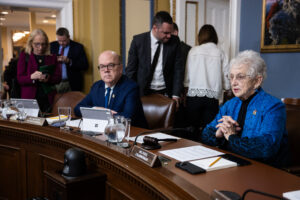
- Fuller sworn in on House floor
- Himes pushes amendment seeking judicial review on searches under key spy program
- Mark Kelly keeps cashing in on Trump’s ‘Seditious Six’ attacks
- Senate Democratic candidates are posting some huge fundraising hauls
- The AI threat undercutting the White House’s FISA push
-

 Politics1 year ago
Former ‘Squad’ members launching ‘Bowman and Bush’ YouTube show
-

 The Dictatorship1 year ago
Luigi Mangione acknowledges public support in first official statement since arrest
-

 Politics1 year ago
Former Kentucky AG Daniel Cameron launches Senate bid
-

 The Dictatorship1 year ago
Pete Hegseth’s tenure at the Pentagon goes from bad to worse
-

 The Dictatorship7 months ago
Mike Johnson sums up the GOP’s arrogant position on military occupation with two words
-

 Politics1 year ago
Blue Light News’s Editorial Director Ryan Hutchins speaks at Blue Light News’s 2025 Governors Summit
-
Uncategorized1 year ago
Bob Good to step down as Freedom Caucus chair this week
-

 The Josh Fourrier Show1 year ago
DOOMSDAY: Trump won, now what?