
Congress
Dems brace to bail out Johnson on stopgap spending package

House Democrats are once again likely to bail out Speaker Mike Johnson on a stopgap spending bill, as conservatives largely vow to oppose it on the floor.
“I expect we’re going to pass the CR,” said Connecticut Rep. Rosa DeLauro, the top Democrat on the Appropriations Committee.
“Because Republicans can’t pass this on their own, we were able to have a lot of that leverage to make sure that significant Democratic priorities are part of this resolution,” said Rep. Debbie Wasserman Schultz (D-Fla.).
Democratic lawmakers emerged from a closed-door leadership meeting Wednesday without taking a formal position on whether to support or oppose the stopgap bill, and they’re unlikely to whip on it. But Democratic lawmakers on Wednesday were touting the wins for their side in the legislation, including $100 billion in disaster aid, childcare funding and health care provisions.
Congressional leaders released the bill text Tuesday evening, which would fund the government through March 14 and includes a handful of unrelated policy bills, including legislation to renew expiring health care programs, another measure that would restrict U.S. investments in China and a one-year extension of the farm bill, which sets agriculture and food policy.
Dozens of Republicans are expected to oppose the legislation when it comes to a vote this week, and conservatives are signaling they would even block it in the Rules Committees, which determines what legislation makes it to the floor. That means Johnson likely would have to pass it under a process known as suspension, which requires a two-thirds majority in the House. Conservatives are fuming about the legislation arguing the package is a “bad deal.”
That means Johnson would need a huge number of Democrats to back it on the floor to avoid a shutdown that would kick in on Friday night. He’s likely to get it, though some Republicans won’t be thrilled that he’s once again relying on the opposing party to pass major legislation.
“We’re at that point primarily because the Republicans hate themselves and they can’t get anything to pass on the floor,” said Rep. Sean Casten (D-Ill.)
There are still some Democrats who might oppose the stopgap bill, known as a continuing resolution or a CR, namely over a provision that could result in a cost-of-living pay increase for members of Congress. Lawmakers haven’t gotten a raise since 2009, amid fears that voters might punish them for approving salary increases for themselves.
“Mainers can’t wave a wand and give themselves a raise, and Congress shouldn’t either — especially when most voters would tell you our job performance is poor at best,” purple-district Rep. Jared Golden (D-Maine) said in a statement. “Until the pay freeze is reinstated, I will not vote for this CR.”
It’s a concern that senior Democrats, including those who had long pushed for the cost-of-living increase, brushed aside.
“We don’t change the law. We’re following the law. It’s a very small part,” said Rep. Steny Hoyer (D-Md.).


CHICAGO — Illinois state Rep. La Shawn Ford won a crowded and contentious Democratic primary Tuesday to succeed longtime Rep. Danny Davis, who backed him as his successor.
The primary battle drew national attention and a flood of outside spending as 13 candidates sought the Democratic nomination following Davis’ retirement announcement. The contest became increasingly hostile in its final weeks with the involvement of five outside political action committees, including a group affiliated with the American Israel Public Affairs Committee and the crypto-funded super PAC Fairshake.
The crypto group spent nearly $2.5 million against Ford, targeting him for backing state legislation that puts restrictions on the industry. Ford, who said the TV ads and mailers spread misinformation about him, sent Fairshake a cease and desist letter a week before the primary.
Davis knocked on doors, rallied supporters and circulated a “Dear Colleague” letter to members of the Congressional Black Caucus on behalf of Ford.
The historically Black seat in the state’s 7th district represents racially and economically diverse communities, from downtown Chicago to areas of the city’s South and West sides and then west to suburban communities.
Ford, a state legislator who ran for Chicago mayor in 2019, currently represents the city’s Austin neighborhood and nearby suburbs. On the campaign trail, he told voters he would continue Davis’ legacy and work to seek federal funding to boost health services and college test-prep programs in the district.
Other candidates in the race included City of Chicago Treasurer Melissa Conyears-Ervin — the AIPAC-aligned group’s preferred candidate — real estate executive Jason Friedman, emergency room physician Thomas Fisher, labor leader Anthony Driver Jr., former Cook County Commissioner Richard Boykin and progressive activist Kina Collins.
The White House on Tuesday released a letter detailing changes it is willing to make to the Department of Homeland Security as it looks to secure a deal with Democrats to end the nearly five-week long partial government shutdown.
The move is the Trump administration’s attempt to show it is making a good faith effort after Democrats derided their proposal as unserious and comes as staffing issues at the Transportation Security Administration grow more acute — leading to longer wait times at airports across the country.
The White House, in five points, said it was willing to codify a number of policy changes, including an expansion of the use of body cameras for federal immigration agents; the limit of enforcement in certain sensitive locations, including hospitals and schools; greater oversight of DHS detention facilities; the enforcement of visible officer identification and the adherence to existing law prohibiting the deportation or detention of U.S. citizens.
“We feel that this offer is serious — that it is a good faith attempt to continue to try to come to a reasonable and expeditious conclusion to the shutdown, which we are now seeing is becoming ever more disruptive on Americans’ travel plans, as well as the security mission at the department,” said a senior White House official granted anonymity to describe the private talks.
The White House offer includes some public safety exceptions for the policy changes. For sensitive locations, there is a carve-out for “national security, flight risks and public safety,” and undercover officers would not have to display identification. Undercover officers would also not be required to wear body cameras.
The proposal also doesn’t address two of Democrats main concerns: requiring officials to obtain a judicial warrant before entering private property and prohibiting federal agents from wearing masks. Administration officials have previously said the warrants are a redline.
“We’re trying to move a little bit, but they’ve got to get serious. They are not getting serious,” Senate Minority Leader Chuck Schumer said Tuesday. “The key issues of warrants when you bust in someone’s house. The key issue of identity, of police and no masks. They haven’t budged on that.”
Spokespeople for Schumer did not immediately respond to a request for comment on the White House letter.
It’s the first time in the monthslong negotiation that the White House has released details about its proposal. Republicans have been eager for the White House to share details of its offers to validate their view that the administration had moved toward Democrats on some issues.
The White House letter argued that the majority of Democrats’ demands would “make it impossible to fully protect American citizens from dangerous criminal aliens and expose law enforcement and their families to increasing threats of violence.”
The senior White House official said that at this time, there are no plans for President Donald Trump to meet with Schumer or Democrats to discuss the impasse. The president has tapped border czar Tom Homan — who co-signed the letter with James Braid, the White House director of the Office of Legislative Affairs — to take the lead on working on the policy changes to end the government shutdown.
“There are a lot of technical issues that have to be worked out” for a White House meeting to be a “productive exercise,” the senior official said. “Although, of course, the president is going to make that decision, and at any time, that could be something that does occur.”
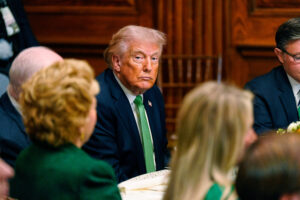
Threats from some hard-right House Republicans to block any Senate bill until the SAVE America Act passes appear to be falling flat.
A bill from Sen. Joni Ernst (R-Iowa) to reauthorize small business grant programs passed 345-41 Tuesday, a day after another Senate bill, aimed at recovering Nazi-looted art, passed on a voice vote.
- White House releases DHS funding offer
- Senate bills survive
- Senate launches debate on SAVE America Act with endgame uncertain
- Republicans hope Mullin will turn the page at DHS from Noem. Democrats aren’t buying it.

- Comer subpoenas Attorney General Pam Bondi over Epstein files
- AIPAC faces calls to reassess strategy after split results in Illinois
- BBC asks a court to dismiss Trump’s $10 billion lawsuit

- King of Illinois: Pritzker swings senate race as he targets Trump

- White House releases DHS funding offer
- La Shawn Ford wins Dem primary to succeed Illinois Rep. Danny Davis
-

 The Dictatorship1 year ago
Luigi Mangione acknowledges public support in first official statement since arrest
-

 Politics1 year ago
Former ‘Squad’ members launching ‘Bowman and Bush’ YouTube show
-

 Politics1 year ago
Blue Light News’s Editorial Director Ryan Hutchins speaks at Blue Light News’s 2025 Governors Summit
-

 Politics1 year ago
Former Kentucky AG Daniel Cameron launches Senate bid
-

 The Dictatorship6 months ago
Mike Johnson sums up the GOP’s arrogant position on military occupation with two words
-

 The Dictatorship1 year ago
Pete Hegseth’s tenure at the Pentagon goes from bad to worse
-

 Politics11 months ago
Democrat challenging Joni Ernst: I want to ‘tear down’ party, ‘build it back up’
-
Uncategorized1 year ago
Bob Good to step down as Freedom Caucus chair this week