
Congress
Democrats’ new year’s resolution: Reclaim upper hand on the economy and trash the ‘billionaire boys club’

NEW YORK — The Democratic Party’s top two congressional leaders — both New Yorkers — agree: The party lost big in the election over voters’ economic fears and must now overhaul its pocketbook messaging to win again.
“Promises to help working people sound nice, but they mean nothing without real results,” Senate Minority Leader Chuck Schumer said in kicking off the new Congress.
“House Democrats will fight hard to protect working-class Americans and the things that matter to them, not the wealthy, the well-off and the well-connected,” House Minority Leader Hakeem Jeffries vowed in his own floor speech.
But other New York Democrats in Congress aren’t as sure.
Interviews with nearly every New York House Democrat reveal variations on where they believe their party’s push against incoming President Donald Trump should start, underscoring Jeffries’ challenge in leading a big-tent caucus that ranges from socialists to Blue Dogs. Some House members are less humbled by their party’s election drubbing than others, some blame messaging and others blame culture wars — even if the most consistent theme emerging is the urgent need to wrestle back the economic narrative from the Republicans.
The Empire State will have an outsized role in that mission with Schumer and Jeffries as the highest-ranking Democrats in Washington, Sen. Kirsten Gillibrand leading the Senate Dems’ campaign arm, several House New Yorkers as ranking members and caucus chairs and Rep. Alexandria Ocasio-Cortez as a national progressive standard-bearer. New York was one of the few bright spots in last year’s election for Democrats, too — with the party picking up three House seats there.
Some of those Democrats are now beginning to build out the case on cost of living. In the two months since Republicans won the White House, Senate and House, Trump has stacked his administration picks with at least 13 billionaires and enabled Musk to meddle with a government shutdown deal with misinformation that dismissed the tangible implications of such an action.
As the House session ended last month, Jeffries flicked at this as his Republican counterparts struggled from self-inflicted wounds, namely Trump and Musk’s 11th-hour torpedoing of a bipartisanship shutdown package and last-minute hedging from House conservatives on supporting Mike Johnson (R-La.) for speaker.
“House Democrats have successfully stopped the billionaire boys club,” the minority leader told reporters.
And while kitchen-table economics will drive the narrative for Democrats, the messaging won’t be a one-size-fits-all approach.
Several of Jeffries’ fellow members from New York say he’s granted them the latitude to approach Trump 2.0 in a way that’s best for them and their districts.
Rep. Tom Suozzi, one of 48 House Democrats who recently voted for the Laken Riley Act cracking down on illegal immigration, commended the leader as “not very heavy handed” and said he believes the border is a key starting point for his party as it prepares for Trump 2.0.
“If you want to actually do something effectively, and not just do it for political purposes … which is to secure the border, which is to fix the broken asylum system, which is to modernize the legal immigration system, you should really be doing it on a bipartisan basis,” Suozzi said in an interview.
Rep. Yvette Clarke, who chairs the Congressional Black Caucus, said more broadly it’s about combating misinformation: “The bottom line to it is that we have to create an ecosystem of truth.”
Still, others, including Reps. Greg Meeks, Nydia Velázquez and Pat Ryan, said in interviews that Democrats should begin with the economy.
“If there’s one takeaway, in my view, of this last set of elections, it’s us clearly reasserting we are for middle class and working-class people and against big corporations and billionaires,” Ryan, a frontline Democrat in the Hudson Valley, told Blue Light News.
In the Senate, Schumer has argued it’s Republicans — not Democrats — who are the party of the privileged as he used the waning weeks of 2024 to speedily confirm Biden-appointed judges. He led the outgoing majority in confirming 235 of them — more than any administration this century.
“For a very long time, the norm was to prioritize judicial nominees who came from a privileged pool. Most of them were prosecutors or from large, corporate law firms. Most were male, most were white,” the 74-year-old Brooklynite said in a floor speech. “But when Senate Democrats entered the majority, we cast a wider net.”
For Schumer, who was also minority leader when Trump first took office in 2017, the next task ahead will involve determining which of Trump’s Cabinet appointees Democrats should reject and confirm. He has yet to offer specifics publicly about the president-elect’s picks, but he told his majority leader replacement Sen. John Thune (R-S.D.) that Democrats plan to fully vet each nominee and signaled Republicans should do the same.
The confirmation hearings set to begin this month will present the next big opportunity for Democrats to show where Republicans’ winning approach to the economy could be more perception than reality, especially because Trump has tapped several billionaires with limited qualifications to join his Cabinet.
Perhaps the biggest chance Democrats will have this year to put the GOP on the defensive about the economy will be the yearlong fight over Trump’s signature tax cuts, which expire in December. Rep. Pramila Jayapal (D-Wash.), former chair of the Congressional Progressive Caucus, believes the party’s resources should be focused on that legislation.
“The starting point is the biggest proposals that Trump is going to push that showcase the difference between them and us,” Jayapal said in an interview. “So I think of the Trump tax scam as being No. 1, because I think that when you have a Cabinet full of billionaires, this is an opportunity for Democrats to show how we want the economy to work for poor people and working people.”
Newly reelected GOP Rep. Mike Lawler of New York has said he would work with Democrats, including on restoring the state and local tax deduction, or SALT, but he cautioned: “I do encourage my Democratic colleagues not to do the Resistance 2.0.”
Indeed, a full-time resistance is not Democrats’ plan. Stressing areas primed for bipartisanship, like immigration, and areas where they will stand their ground, like Medicare, is much closer to how their strategy is shaping up.
Jeffries and Schumer, who have a solid working relationship as fellow Brooklynites, albeit from different generations, were unanimously reelected as conference leaders. Jeffries is the son of a social worker and substance abuse counselor. Schumer is the son of an exterminator and homemaker. Meeks said in an interview that their backgrounds will help convince voters ahead of the midterms that Democrats understand their economic struggles “because they have lived it themselves.”
But the two New Yorkers are also members of the political establishment.
“People understand that the Democratic Party and Republican Party, a lot of them get money from a lot of the same people, and the money in our politics is corrupting,” said New York Working Families Party co-director Jasmine Gripper. “So it feels like people are fighting for the billionaires, but not fighting for the everyday voter and the everyday American.”
Despite such perceptions, Democratic Party leaders say they’re better positioned to face off against Trump than when he first occupied the White House. Jeffries has sought to underscore that his minority isn’t all that minor. The government shutdown chaos of last month proved that Johnson needs some Democrats to bail him out on key legislative fights. And Jeffries has repeatedly noted that the GOP’s five-seat advantage is far narrower than their margin of 47, when Trump took office in 2017.
“My prediction is that House Democrats under Leader Jeffries are going to be the most powerful minority that we’ve seen in recent history, because the Republican margin of control is so vanishingly small,” Rep. Ritchie Torres (D-N.Y.) said in an interview. “It is unlikely that the Republicans will be able to get anything major done without the buy-in of Leader Jeffries and House Democrats.”


Rep. Kevin Kiley, the former Republican who recently registered as an Independent, said in an interview Wednesday he plans to caucus with the House GOP and will seek to regain his committee assignments.
The California lawmaker was formally removed from his panels Wednesday after giving official notice he was switching parties to serve as an Independent and run in a new district after his state redrew congressional maps.
The House GOP Steering Committee will need to approve Kiley’s effort to take back his seats on Education and the Workforce, Transportation and Infrastructure and Judiciary. Kiley told reporters this was “completely expected” and that he looked “forward to being reappointed as an Independent.”
Mia McCarthy contributed to this report.
Sen. Tim Scott (R-S.C.) will run for reelection in 2028, his campaign told Blue Light News on Wednesday, reversing a promise to serve just two full terms in the chamber.
Appointed by then-Gov. Nikki Haley to serve out the last two years of outgoing Sen. Jim DeMint’s Senate term in 2012, Scott had long said that 2022 would mark his final bid for the Senate.
He easily won reelection that year, besting Democratic state lawmaker Krystle Matthews by more than 25 percentage points. Scott then ran for president but abandoned his short-lived bid for the White House before the Iowa caucuses.
He was briefly considered to serve as now-President Donald Trump’s running mate and has since emerged as a key White House ally in the Senate.
“And I’ll say without any question that as I think about my own reelection in 2028, I think about all the lessons I’ve learned on the campaign trail for all these other candidates, and frankly, even in South Carolina,” Scott told the Charleston, South Carolina-based Post and Courier, which was first to report his reelection plans.
Hopes for a quick vote on Sen. Markwayne Mullin’s nomination as Homeland Security secretary hang on questions about secretive travel the Oklahoma Republican undertook as a House member a decade ago that are now being examined by his Senate colleagues.
Mullin was questioned extensively about the matter Wednesday by Sens. Rand Paul (R-Ky.) and Gary Peters (D-Mich.), the chair and ranking member, respectively, of the Senate Homeland Security and Governmental Affairs Committee.
Testifying under oath Wednesday, Mullin said he participated in what he described as “official travel” and a “classified trip” as part of a “special program inside the House” that went from 2015 to 2016. He said he was not a member of the House Intelligence Committee at the time and refused to answer further questions outside of a classified setting.
The attention on the matter came after Peters raised questions about Mullin’s past claims suggesting he had traveled to war zones and had first-hand exposure to combat environments despite his lack of a military background.
After the hearing adjourned Wednesday afternoon, Mullin joined Paul, Peters and other members of the committee in the Senate’s classified briefing facility.
“I’m one of these people who think that we silo off too much information from the public,” Paul told reporters after the hearing. “When we’re going to war, they tell eight people, it’s like, ‘Oh, we’ve notified Congress.’ So I don’t think that is adequate.”
“It makes people curious when you say, I’m doing secret missions for somebody, but I won’t tell you who, and only four people in the world know about those,” Paul added.
Mullin said only four people were “read into” the program in question and declined to say publicly what agencies or committees were involved.
“It’s a little difficult for us to go ask about a program that has no name and we have nobody that we know to talk to about it,” Peters said before Mullin agreed to the classified meeting. “So I don’t know how we would begin doing this without your cooperation.”
The questions about the shadowy travel erupted after Mullin’s nomination suddenly turned rocky after Paul questioned his temperament and fitness for office based on his past comments and behavior.
Paul later confirmed he would oppose Mullin’s nomination but said he still intended to hold a committee vote Thursday. To get through the panel with Paul opposed, Mullin will need the support of at least one Democrat.
Sen. John Fetterman (D-Pa.) has suggested he is inclined to support Mullin but declined to confirm Wednesday he would vote for him. Fetterman was among the senators spotted entering the classified meeting following the hearing.
“I’m willing to hold the vote tomorrow, but you brought this up that you were on a super secret mission,” Paul told Mullin at the hearing.
“No, I did not say super secret,” Mullin responded. “I said it was classified.”
- Kiley switches parties, loses committees
- Top counterterrorism official Kent resigns over Trump’s Iran war, says Iran posed no imminent threat

- White House applying pressure to media…

- Quick vote on Mullin’s DHS nomination hangs on classified briefing

- Markwayne Mullin’s DHS nomination not at risk from Rand Paul, Thune says
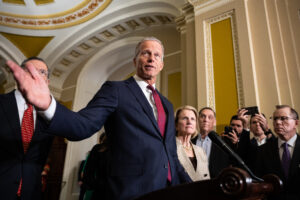
- Mullin says he regrets calling Alex Pretti ‘deranged’
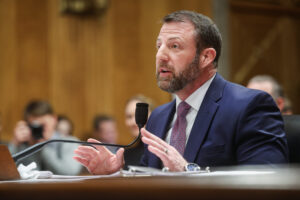
- Mullin markup still on
- Elizabeth Warren backs Mallory McMorrow in Michigan Senate primary

- Tim Scott to run for reelection to the Senate
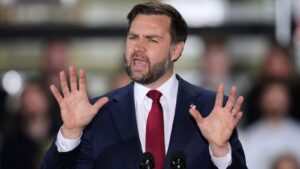
- Vance says rising gas prices a ‘temporary blip’
-

 The Dictatorship1 year ago
Luigi Mangione acknowledges public support in first official statement since arrest
-

 Politics1 year ago
Former ‘Squad’ members launching ‘Bowman and Bush’ YouTube show
-

 Politics1 year ago
Blue Light News’s Editorial Director Ryan Hutchins speaks at Blue Light News’s 2025 Governors Summit
-

 Politics1 year ago
Former Kentucky AG Daniel Cameron launches Senate bid
-

 The Dictatorship6 months ago
Mike Johnson sums up the GOP’s arrogant position on military occupation with two words
-

 The Dictatorship1 year ago
Pete Hegseth’s tenure at the Pentagon goes from bad to worse
-
 Politics11 months ago
Democrat challenging Joni Ernst: I want to ‘tear down’ party, ‘build it back up’
-
Uncategorized1 year ago
Bob Good to step down as Freedom Caucus chair this week