
Politics
Democrats are united in bashing GOP on Obamacare. Medicare for All could reopen a rift.

Progressives are pushing Medicare for All in some of the Democratic Party’s most competitive Senate primaries next year, threatening the unity the party has found on attacking Republicans over expiring Obamacare subsidies.
In Maine, Graham Platner said he’s making Medicare for All a “core part” of his platform in his race against Gov. Janet Mills, the establishment pick who’s called for a universal health care program. In Illinois, Lt. Gov. Juliana Stratton and Rep. Robin Kelly are both championing the concept — and calling out rival Rep. Raja Krishnamoorthi for not fully embracing it.
In Minnesota, Medicare for All has emerged as a key distinction between progressive Lt. Gov. Peggy Flanagan and moderate Rep. Angie Craig, who supports adding a public option to the Affordable Care Act rather than Medicare for All. Flanagan said she “absolutely” expects the policy to define the primary because “it doesn’t matter if I’m in the urban core, the suburbs or greater Minnesota — when I say I’m a supporter of Medicare for All, the room erupts.”
And it’s become a flashpoint in Michigan, where physician Abdul El-Sayed, who wrote a book called Medicare for All: A Citizen’s Guide, is using his signature issue to draw a contrast with Rep. Haley Stevens and state Sen. Mallory McMorrow, who favor other approaches.
Medicare for All — government-funded health coverage for every American — is “where we need to point to,” El-Sayed said in an interview. “And I think you can galvanize a winning coalition around this issue.”
But some more moderate Democrats worry that progressives’ renewed push for Medicare for All would undermine the party’s recent united front in fighting for an extension of the Obamacare subsidies that are set to expire at the end of the year, leading to a significant spike in insurance costs for millions of Americans. Their effort initially failed in the Senate, but with the help of four vulnerable Republicans who crossed party lines this week, Democrats have now secured a House vote on an extension in January.
“We have a singular message, which is: ‘Don’t let these tax credits go.’ We have Republicans on the ropes,” said a national Democratic strategist who works on Senate races and was granted anonymity to speak candidly. “I don’t think introducing ‘we need MFA’ is the right strategy right now. I think it would be unhelpful.”
Several Democratic consultants pointed to recent public polling showing Americans like having individual insurance coverage, despite being dissatisfied with health care companies. An NBC News poll found 82 percent of Americans were satisfied with their plans, both private and government-sponsored. Based on that data, these consultants said allowing Americans to buy into a government-offered plan, known as a “public option,” is more politically palatable.
Centrists have long dismissed Medicare for All as both a policy pipedream and political albatross for their party — a rallying cry for the left that serves as catnip for Republican admakers looking to broad brush Democrats as socialists. They argue that surveys often fail to present voters with the full picture of how Medicare for All would work, and therefore fail to capture its electoral toxicity.
“What we need to accept is there’s a deeply held skepticism among Americans about going zero to 60 that’s entirely government run, even though they don’t love the current system,” said Adam Jentleson, a Democratic strategist and president of the Searchlight Institute. “In isolation, this thing does okay. But it’s not how it plays out in real life, and the totality will crush us.”
The once-fringe policy that Sen. Bernie Sanders (I-Vt.) mainstreamed during his presidential campaigns has become a rallying cry for his favored candidates and other progressives across battleground primaries, as Democrats work to make health care costs central to next year’s midterms and as the party base clamors for fighters willing to disrupt the status quo. The push for Medicare for All, which receded during the more moderate Biden era, comes as Democrats have otherwise been unified on their health care messaging, forcing Republicans onto defense over their refusal to extend expiring Affordable Care Act subsidies.
“Do I think every single swing-seat candidate is going to come out for Medicare for All? No,” said Jess Morales Rocketto, a Democratic strategist and board member for the nonprofit Care in Action. “But if you want to signal that you’re unafraid and bold right now, and you want to say you’re not beholden to the status quo, it’s a perfect position for that.”
Progressives are emboldened by partisan and independent polling that shows most Democrats and a majority of independents support Medicare for All. A recent survey commissioned by Rep. Pramila Jayapal’s (D-Wash.) leadership PAC and first reported by Blue Light News showed 90 percent of Democrats back Medicare for All and found most independents and one in five Republicans back a “government-provided system.”
Jayapal, the former chair of the Congressional Progressive Caucus, plans to push her colleagues to start promoting Medicare for All again in the new year. She predicted in an interview that support for the system will be a “defining factor” in the party’s primaries next year and an electoral winner in battleground House seats.
But proponents of Medicare for All argue that a government-provided system would lessen the pinch of rising health care costs. They say pushing to extend the ACA subsidies and promoting Medicare for All as an end goal are not mutually exclusive. And they point to several 2018 candidates who won tough seats while supporting the measure, including former Rep. Katie Porter in California to retiring Rep. Jared Golden of Maine.
“You can know that there are short-term stopgaps that must be taken to protect working people while also thinking that long term, we need a better system,” said Platner, who is vying against Mills to unseat GOP Sen. Susan Collins in Maine.
Platner has been extolling Medicare for All from the start of his campaign and said it gets the “most raucous” response at his events across Maine, where a recent Pan Atlantic Research poll found 63 percent support for the system (and Platner trailing Mills by 10 points).
He argued in an interview that Mills isn’t as steadfast in her support for the concept because she “doesn’t talk about it all that often” and uses “vague language” when she does. Mills has said “it is time” for universal health care and that she’s “committed to finding a way to get there” if elected. Her campaign echoed that sentiment in response to a request for comment for this story, and cited her efforts to expand Mainers access to Medicaid.
In Minnesota, Flanagan said embracing Medicare for All has been a “journey” during her Senate campaign, as she heard from Minnesotans that the “cost of health care is the thing that comes over and over and over again.” Of Craig’s support for a public option, Flanagan said voters don’t want a nominee who “nibbles around the edges” instead of being “bold and audacious.”
Craig calls the public option a “big, bold reform,” but emphasizes that it’s a policy “we could actually accomplish in this country in a fairly short time period,” she said in a video this week.
In Illinois, Stratton and Kelly, two of the three leading Democrats vying to replace retiring Sen. Dick Durbin, are jockeying for position as Medicare for All’s biggest champion in the race while their campaigns knock Krishnamoorthi for couching his support for the system. Krishnamoorthi said in a statement that while it’s “a noble goal, and I’m fighting to get us to universal coverage” his focus is on extending the ACA subsidies and reversing Republicans’ cuts to Medicaid.
And in Michigan, El-Sayed has slammed McMorrow’s call for universal health care with a public option as “incoherent” and ill-informed as the two compete for the same slice of progressive voters. McMorrow has knocked the idea of a single-payer system run by President Donald Trump and his controversial health secretary, Robert F. Kennedy Jr. And she’s promoted a public option so people who like their private insurance can keep it. Stevens’ campaign says she supports strengthening Obamacare, including through a public option, without endorsing Medicare for All.
The issue is also becoming a flashpoint in Democratic primaries for some of the most competitive House seats in the country, driven in part by Sanders-backed candidates running from California’s Central Valley to Pennsylvania’s Lehigh Valley.
“There’s immense hostility and anger toward the way the insurance industry functions, doubled up with health care itself being one of the biggest affordability issues,” said Mark Longabaugh, a progressive strategist who worked on Sanders’ 2016 presidential bid. “Progressives are smart to push the case.”


Democrats celebrated Kristi Noem’s firing as the Homeland Security secretary on Thursday, while calling for more heads to roll among President Donald Trump’s more controversial aides and advisers.
“Kristi Noem will go down as the most shamelessly incompetent and cruel Homeland Security Secretary in U.S. history,” California Gov. Gavin Newsom wrote on X. “Firing her is not enough. NOEM, GREG BOVINO, and STEPHEN MILLER all must be held accountable for terrorizing and endangering the American people.”
Several other potential 2028 presidential candidates were quick to join the chorus applauding the move, seizing on the opportunity to push for further personnel changes at the highest levels of the Trump administration.
Illinois Gov. JB Pritzker also warned in a video posted to social media that Noem would still “be held accountable.”
“Hey, Kristi Noem, don’t let the door hit you on the way out,” he said. “Here’s your legacy: corruption and chaos, parents and children were teargassed. Moms and nurses, U.S. citizens, getting shot in the face. Now that you’re gone, don’t think you get to just walk away.”
Noem’s impending departure — Trump wrote Thursday on Truth Social that she’ll soon become the inaugural “Special Envoy for The Shield of the Americas” — brings to a close a tumultuous yearlong stint at the agency. Trump also announced that he intends to tap Sen. Markwayne Mullin (R-Okla.) to replace Noem atop the department.
Noem is the most senior administration official to depart thus far in Trump’s second term.
But Democrats were quick to signal they were not satisfied with her exit, swiftly calling for Trump to axe other Cabinet-level officials. Both House Minority Leader Hakeem Jeffries and Rep. Pete Aguilar (D-Calif.) urged Trump to fire embattled Attorney General Pam Bondi.
Sen. Raphael Warnock (D-Ga.), meanwhile, said Trump should cut loose Defense Secretary Pete Hegseth and Health Secretary Robert F. Kennedy Jr. next. Maryland Gov. Wes Moore also celebrated Noem’s ouster.
Noem came under bipartisan fire for her alleged relationship with Trump ally Corey Lewandowski, which she denies, and for labeling two Minnesota protesters killed by federal law enforcement in January “domestic terrorists.”
The former South Dakota governor also faced questions about a $220 million DHS ad campaign, testifying during a Tuesday congressional hearing that Trump approved the spending — a claim he later denied in an interview with Reuters.
“Time and time again, Secretary Noem failed the American people and her duty to the Constitution,” Sen. Elissa Slotkin (D-Mich.) wrote on X. “This was particularly true in how she oversaw ICE. Her departure demonstrates that if you don’t uphold the most basic American values, the American public wants you gone.”
Several Democratic lawmakers also indicated that Noem’s departure does not change their demands surrounding funding for DHS and for reforms at Immigration and Customs Enforcement amid an ongoing partial government shutdown.
Senate Minority Leader Chuck Schumer said Thursday that ICE faces deeper problems that cannot be addressed with a single personnel change.
“The problems at ICE transcend any one individual. … It goes beyond any one person,” he said Thursday. “You need to straighten out the whole agency. The rot there is deep.”
Republicans, meanwhile, largely fell in lockstep behind Mullin — who said Thursday he was “excited about the opportunity” — and he will likely face a smooth confirmation process. Some Republican lawmakers acknowledged that a leadership shakeup at DHS was overdue.
“It was time for a change,” Sen. Lindsey Graham (R-S.C.) wrote in a social media post, while Sen. Thom Tillis (R-N.C.) said the decision was “good for the president and his legacy on border and deportation.”
Cheyanne M. Daniels contributed to this report.
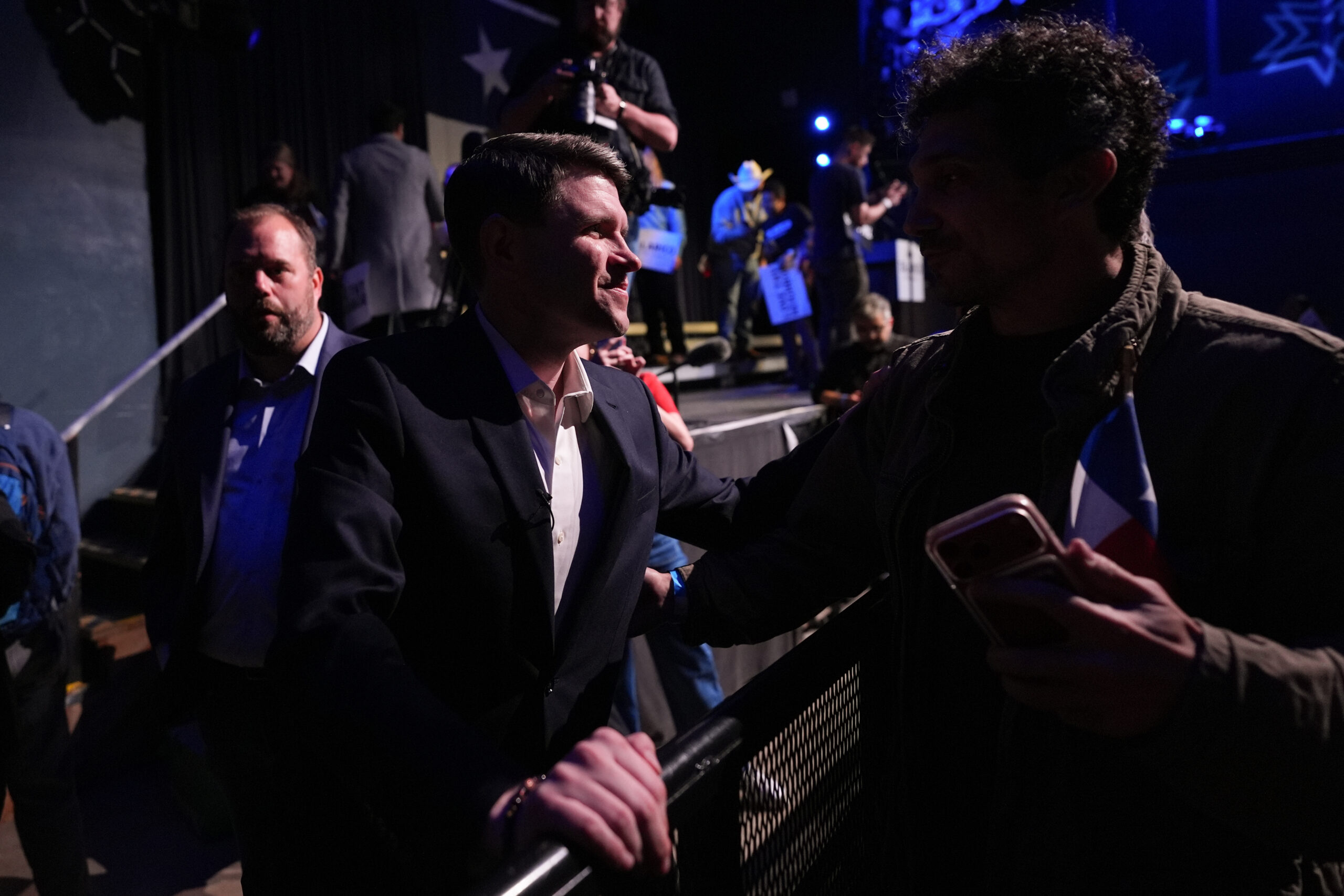
Black Democratic strategists, lawmakers and activists are frustrated that Texas Democrats rejected Jasmine Crockett as their Senate nominee Tuesday night — but they also saw it coming.
Following Crockett’s single-digit loss, they recounted a laundry list of why she fell to state Rep. James Talarico: Her campaign was unfocused; she had an insufficient campaign infrastructure to challenge Talarico, even though she earned the backing of former Vice President Kamala Harris. They also said her media strategy relied too heavily on social media rather than television ad buys — typically seen as critical in a sprawling state like Texas and its nearly two dozen media markets.
“People who don’t understand politics will be upset because Jasmine was their hero,” said Texas state Rep. Jolanda Jones, a Democrat. “But for people who understand politics, [Crockett] literally had no ground game.”
She added: “This L is on her.”
Taken together, Crockett’s campaign shortcomings doomed the upstart Senate bid of the two-term congressmember who entered the contest with broad name recognition and hopes of showcasing her firebrand personality and penchant for viral moments to help Texas Democrats end their nearly 40-year winless streak in Senate races.
Still, Black strategists and activists warn Crockett’s loss will have ripple effects.
They say the party rejected an established star in favor of an untested, white state lawmaker over style — the two candidates did not substantively disagree on policy — raising concerns that Black voters, especially women, will not turn out when the party needs them the most.
“A lot of Black women who work in the Democratic Party, vote for Democrats, organize for Democrats, have always had a sense of this,” said Houston-based political strategist and social media influencer Tayhlor Coleman. “It is a lot more apparent now: A lot of people in the Democratic Party want our labor, they do not want our leadership.”
A spokesperson for Crockett’s campaign pushed back on the criticism of her campaign, saying it came from “Monday morning quarterbacks.”
“This was the most expensive Democratic primary ever in Texas with the overwhelming majority of those dollars being spent on attacks against the Congresswoman,” former deputy campaign manager Karrol Rimal said in a text message Wednesday afternoon. “Despite being outspent, she held our own and excited an untapped base of support for Democrats with record numbers of first time primary voters. There was also the intentional voter suppression of voters in Dallas and Williamson counties. That can not be ignored.”
After Crockett conceded, she tweeted her support for Talarico, saying, “Democrats must rally around our nominees and win.”
Democrats for years have praised Black women as the “backbone of the party.” And Crockett, a former civil rights and criminal defense lawyer, rose to prominence in part by viral moments from House hearings. Just last month, she garnered praise from party insiders for her sharp criticism of Attorney General Pam Bondi during a House Judiciary hearing over the Justice Department’s handling of Jeffrey Epstein documents.
Heading into Tuesday’s primary election — the first of the 2026 midterm cycle — there was optimism Crockett could harness her star power to beat Talarico, a seminary student and former teacher who drew national attention when Texas Democrats fled the state to try to block a major redistricting effort.
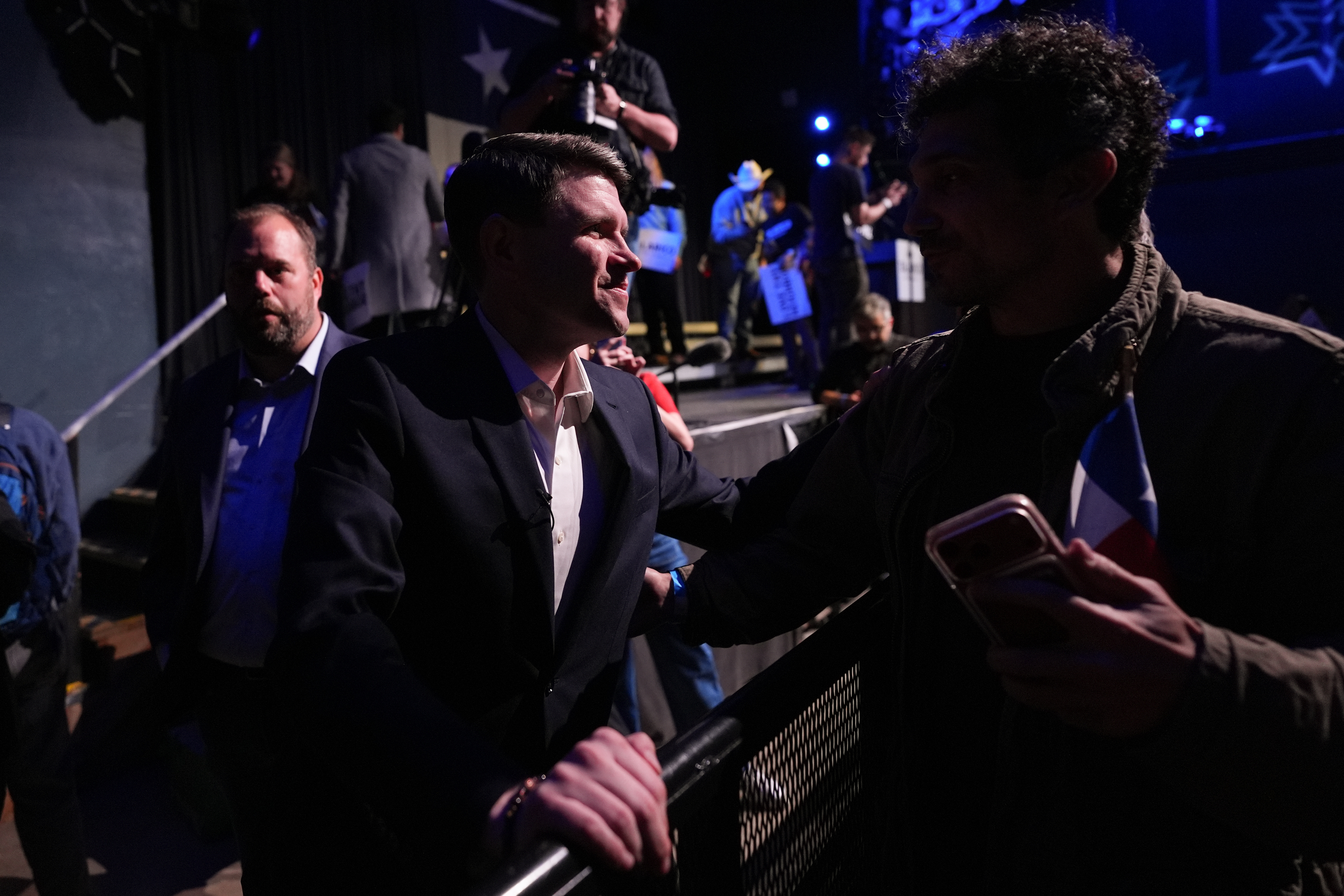
Talarico also built his national name with a sitdown on the nation’s top podcast, “The Joe Rogan Experience” where the show’s host urged him to run for president — weeks before he officially launched his Senate bid, and later turned an online interview with the late night host Stephen Colbert into a fundraising boon.
Throughout the primary, Crockett faced constant questions about her viability and campaign decisions, including whether she hired enough staff. She also faced criticism that the get-out-the-vote efforts were virtually nonexistent.
“She ran a fucking terrible campaign that many will question if she’s running a campaign at all,” said one Black national Democratic operative granted anonymity to give a candid assessment of Crockett’s campaign.
Crockett staked much of her political campaign on her ability to connect with young voters and rebuked her party for trying to win Republicans instead of wooing hard-to-reach Democrats that have grown frustrated with the party. By contrast, Talarico was praised by many Democrats for the way he leaned into his seminarian background as a way to appeal to progressives, independents and disillusioned Republicans.
“In many ways, she has been and has felt like a woman on an island,” said Stefanie Brown James, co-founder of the Collective PAC, which works to elect Black candidates to local, state and federal offices.
“Even though she has substance, not everybody likes her style,” she added. “And I think that sometimes her style is one that is not appealing, especially to the old guard Democrats, whose fighting style is antiquated and outdated.”
State and national Democrats acknowledged Talarico built a strong campaign that shored up grassroots support and built a statewide infrastructure long before Crockett entered the primary in December, just months before voters began casting their ballots. He was able to raise money quickly, establish a field and digital plan and craft a message that cast him as a fighter and someone who would bring down high costs.
Some Democrats anticipate Talarico’s victory is going to ignite a fresh round of uncomfortable conversations among insiders about the importance race, gender and identity politics will play in Democratic political circles moving forward.
“The way that we have seen people rally around new, more untested white male candidates” is troubling, said Maya Rupert, a Democratic strategist who served as the campaign manager of Julian Castro’s 2020 presidential campaign.
While she is excited about Talarico’s nomination against what she called “a very weak Republican field,” Rupert said Crockett’s loss will continue to “sting” for months to come, especially with few opportunities beyond Texas for Black women candidates to win in statewide contests.
“There are a lot of people who see this and see a very qualified, very popular Black woman — that, once again — feels like people fail to appreciate the strength of,” Rupert adds. “And that is a very dangerous position for the party to be in.”
President Donald Trump is signaling he will soon endorse someone in the Texas primary. Key Republican players are scrambling to make the case for incumbent John Cornyn — and hoping Trump acts fast.
“I hope it’s going to be soon,” Senate Majority Leader John Thune told reporters Wednesday, just hours after making his latest plea on Cornyn’s behalf to the president.
At stake is $100 million or more in Republican donor money that many in D.C. party circles believe could be burned in the 12-week runoff showdown with Texas Attorney General Ken Paxton, who finished closely behind Cornyn in Tuesday’s GOP primary.
Beyond the money that stands to be incinerated, party operatives fear the scorched-earth campaign will give a further leg up to Democratic candidate James Talarico, the state lawmaker who won his party’s primary outright Tuesday.
In a lengthy Truth Social post Wednesday, Trump spelled out that he was mindful of a costly internecine fight.
“I will be making my Endorsement soon,” he wrote, as he called on the candidate he doesn’t endorse to “DROP OUT OF THE RACE,” stressing that Republicans must “TOTALLY FOCUS” on beating the “Radical Left Opponent.”
Cornyn’s Senate colleagues delivered a succession of public and private entreaties to the president throughout the day Wednesday.
Sen. Katie Britt (R-Ala.) said in an exclusive interview for Blue Light News’s “The Conversation” that Cornyn was “without a doubt the candidate to win in November.” The episode is set for publication Friday.
“There’s nothing more powerful than President Trump’s endorsement,” Britt added, speaking before she traveled to the White House for a roundtable event with Trump.
Multiple Republicans delivered a similar message directly to Trump, according to three people granted anonymity to describe the private conversations — sharing their concerns that a Senate seat that has been in GOP hands since 1961 could be at risk of flipping in November if the scandal-dogged Paxton is the top of the ticket.
Senate Republicans were told during their closed-door lunch Wednesday that Trump will soon endorse in the race, two attendees said, but not whom the president will back.
But there was a palpable sense of hope among some of Cornyn’s allies Wednesday, who believe that things are aligning in the incumbent’s favor as he appears on track to win a plurality in Tuesday’s voting.
As of Wednesday evening Cornyn led Paxton by about 25,000 votes with more than 95 percent of ballots counted, according to the Associated Press. That represented an overperformance, some Cornyn allies argued, given that several pre-election polls had him soundly trailing Paxton.
A Cornyn campaign aide said there is “new momentum” and “new support coming” after Tuesday’s results.
“The case got stronger because of last night — that’s undeniable,” the aide said about Trump endorsing Cornyn. “There certainly are lots of conversations happening, lots of people who are seeing the bigger picture.”
Arriving in the Senate Wednesday evening, Cornyn declined to answer questions about the possibility of an endorsement — or anything else — as his colleagues warmly welcomed him back to Washington.
“Big John,” said No. 2 Senate GOP leader John Barrasso of Wyoming, greeting Cornyn as he rushed into the Capitol after a flight from Texas.
Several former Trump campaign aides are now associated with Cornyn’s campaign and are thought to be lobbying on his behalf. But Trump has long been personally fond of Paxton, a MAGA firebrand who eagerly joined his effort to overturn the 2020 presidential contest that elected Joe Biden.
A Republican close to the Paxton campaign, granted anonymity to speak candidly before Trump sent his Truth Social message, said Trump “knows that the base despises Cornyn” and would not risk alienating them by endorsing the sitting senator.
“He knows Cornyn is a squish and RINO,” he said. “But he’s got to make a pragmatic decision. It just kind of depends on what folks are telling him.”
Hopes for a quick endorsement for Cornyn could be on hold as the final votes are counted and his lead over Paxton is confirmed.
“Any president would prefer to be positioned with the winning campaign,” said one GOP donor, granted anonymity to speak candidly about the endorsement dynamics.
The White House did not respond to requests for comment on when the president will endorse and which candidate.
Talarico clinching the nomination while two well-financed Republicans beat each other up is exactly the scenario Washington Republicans were hoping to avoid ahead of Tuesday’s election. Internal polling released earlier this month by the Senate GOP’s campaign arm showed Paxton would lose the general election to Talarico by 3 points while Cornyn could beat him by 3 points.
The Republican close to the Paxton campaign said the attorney general is well positioned to win a runoff given that the primary electorate tends to be more conservative — and that Talarico is more beatable than Washington Republicans believe, given his past comments on transgender rights and his liberal view of the Bible. The person said Paxton’s data modeling showed a Cornyn plurality “was a possibility.”
“I guess it’s fair to say he was a little bit stronger than expected, but again it wasn’t too far up from our data,” the person said.
Still, the strong showing gave Cornyn’s colleagues a prime opportunity to argue that it was time to bring the rivalry to an end.
“John Cornyn is the best bet to win the November election,” said Sen. Lindsey Graham (R-S.C.), a close Trump ally known to have the president’s ear.
Barrasso added that he, too, would encourage Trump to back his Texas colleague, adding that it’s “critically important for John Cornyn to be the nominee.”
“We need to hold that seat which means we need to nominate someone who is going to win in November,” Barrasso added. “The person that will win in November is John Cornyn.”
Dasha Burns and Adam Wren contributed to this report.
- ‘Good riddance’: Dems cheer Noem’s ouster — and call for more departures
- House committee advances kids’ online safety and privacy proposals
- Kristi Noem’s ouster isn’t moving Democrats off their Homeland Security funding demands
- Fed panel delays vote but ready to rumba over Trump’s ballroom
- House GOP leaders ask Tony Gonzales to drop reelection bid
- Why one of the world’s biggest animal rights group is praising Trump
- Congress taking first votes on Iran war as debate rages about US goals

- Capitol agenda: Nervous GOP waits for Trump’s Texas pick
- Trump Keeps Gambling With the Economy — And Getting Away With It
- ‘This L is on her’: Black lawmakers and strategists dump on Crockett

-

 The Dictatorship1 year ago
Luigi Mangione acknowledges public support in first official statement since arrest
-

 Politics1 year ago
Former ‘Squad’ members launching ‘Bowman and Bush’ YouTube show
-

 Politics1 year ago
Blue Light News’s Editorial Director Ryan Hutchins speaks at Blue Light News’s 2025 Governors Summit
-

 The Dictatorship6 months ago
Mike Johnson sums up the GOP’s arrogant position on military occupation with two words
-

 Politics1 year ago
Former Kentucky AG Daniel Cameron launches Senate bid
-

 The Dictatorship1 year ago
Pete Hegseth’s tenure at the Pentagon goes from bad to worse
-
Uncategorized1 year ago
Bob Good to step down as Freedom Caucus chair this week
-

 Politics11 months ago
Democrat challenging Joni Ernst: I want to ‘tear down’ party, ‘build it back up’