
The Dictatorship
California voters approve new US House map to boost Democrats in 2026

LOS ANGELES (AP) — California voters approved new congressional district boundaries Tuesday, delivering a victory for Democrats in the state-by-state redistricting battle that will help determine which party wins control of the U.S. House in 2026 and, with it, the power to thwart or advance President Donald Trump’s agenda.
The approval of Proposition 50 gives Democrats a shot at winning as many as five additional seats, just enough to blunt Texas Republicans’ move to redraw their own maps to pick up five GOP seats at Trump’s urging. Texas’ move and California’s response have kicked off a flurry of redistricting efforts around the country, with Republican states appearing to have an edge. Deeply blue California is Democrats’ best opportunity to make up seats.
Midterm elections typically punish the party in the White House, and Trump is fighting to maintain his party’s slim House majority. Republicans hold 219 seats to Democrats’ 213.
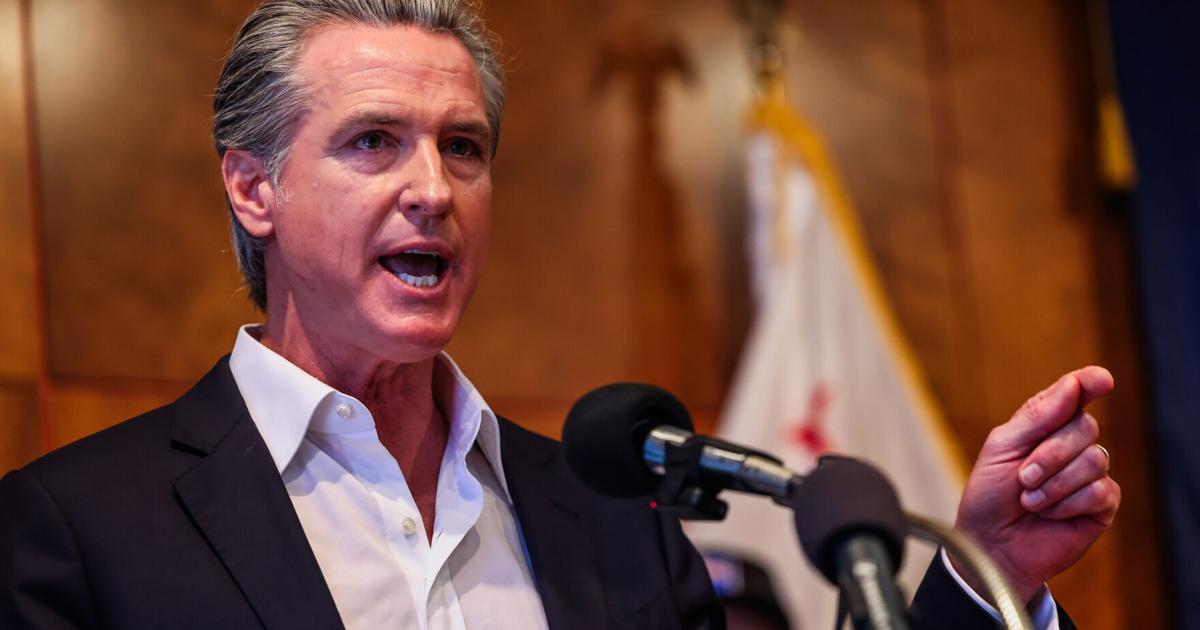
Tuesday’s results mark a political victory for Democratic Gov. Gavin Newsom, who cast the measure as an essential tool to fight back against Trump and protect American democracy.
Speaking to reporters in Sacramento, Newsom cast the California vote as part of a broader national rejection of Trump’s policies that saw Democratic governors elevated in New Jersey and Virginia. But he warned the more consequential battle would come next year.
If Democrats win the House majority, they can “end Donald Trump’s presidency as we know it,” Newsom said. “It is all on the line, a bright line, in 2026.”
Measure supported by Newsom and Obama
California’s Proposition 50 asked voters to suspend House maps drawn by an independent commission and replace them with rejiggered districts adopted by the Democratic-controlled Legislature. Those new districts would be in place for the 2026, 2028 and 2030 elections.
The recast districts aim to dilute Republican voters’ power, in one case by uniting rural, conservative-leaning parts of far northern California with Marin County, a famously liberal coastal stronghold across the Golden Gate Bridge from San Francisco.
The measure was spearheaded by Newsom, who threw the weight of his political operation behind it in a major test of his mettle ahead of a potential 2028 presidential campaign. Former President Barack Obama urged voters to pass it as well.

Gov. Gavin Newsom arrives at a campaign event on Proposition 50 in San Francisco, Monday, Nov. 3, 2025. (AP Photo/Jeff Chiu)
Gov. Gavin Newsom arrives at a campaign event on Proposition 50 in San Francisco, Monday, Nov. 3, 2025. (AP Photo/Jeff Chiu)
“Republicans want to steal enough seats in Congress to rig the next election and wield unchecked power for two more years,” Obama said in one ad. “You can stop Republicans in their tracks.”
Critics said two wrongs don’t make a right. They urged Californians to reject the measure, even if they have misgivings about Trump’s moves elsewhere.
Among the most prominent critics was Arnold Schwarzenegger, the movie star and former Republican governor who pushed for the creation of the independent commission, which voters approved in 2008 and 2010. It makes no sense to fight Trump by becoming him, Schwarzenegger said in Septemberarguing that the proposal would “take the power away from the people.”
“I don’t want Newsom to have control,” said Rebecca Fleshman, a 63-year-old retired medical assistant from Southern California, who voted against the measure. “I don’t want the state to be blue. I want it to be red.”
A lopsided campaign foreshadowed the vote
After an early burst of TV advertising, opponents of the plan struggled to raise cash in a state with some of the nation’s most expensive media markets.
The campaign followed an unusual trajectory. A handful of Republican congressmen who will see their districts dramatically reshaped – and their jobs endangered — mostly stayed away from the campaign spotlight. With opponents short on cash, Newsom and his supporters dominated TV screens in the critical closing weeks.
Voters form a line at a polling station on the UCLA campus Tuesday, Nov. 4, 2025, in Los Angeles. (AP Photo/Jae C. Hong)
Voters form a line at a polling station on the UCLA campus Tuesday, Nov. 4, 2025, in Los Angeles. (AP Photo/Jae C. Hong)
Total spending on broadcast and cable ads topped $100 million, with more than two-thirds of it coming from supporters. Newsom told people to stop donating in the race’s final weeks.
The GOP congressmen — Reps. Ken Calvert, Darrell Issa, Kevin Kiley, David Valadao and Doug LaMalfa — will see right-leaning voters reduced and left-leaning voters boosted in their respective districts in a shift that would make it likely a Democratic candidate would prevail in each race.
Issa issued a defiant statement, saying: “I’m not going anywhere. I’ll continue to represent the people of California regardless of their party or where they live.”
Calvert said Newsom engineered a “power grab” while housing costs, gas prices and taxes continue to strain family budgets. “I am determined to keep fighting for the families I represent,” he said in an email.
AP poll finds voters motivated by political reasons
Proposition 50 won a swift and decisive victory, as the AP declared a winner when polls closed statewide. Early returns were strongly in favor of the measure, as were preliminary results from the AP Voter Poll, an expansive survey of more than 4,000 voters in California.
Roughly 7 in 10 California voters said party control of Congress was “very important” to them, and those voters overwhelmingly supported the measure, according to the AP Voter Poll.
About 8 in 10 California voters who supported the ballot measure said it was necessary to counter the changes made by Republicans in other states, while only about 2 in 10 said they supported it because it was the best way to draw maps, AP Voter Poll found.
Trump, who overwhelmingly lost California in his three presidential campaigns, largely stayed out of the fray. A week before the election, he urged voters in a social media post not to vote early or by mail — messaging that conflicted with that of top Republicans in the state who urged people to get their ballots in as soon as possible.
In a post Tuesday on his social media platform, the president called the state’s voting process “RIGGED” and warned that it was “under very serious legal and criminal review. STAY TUNED!” Secretary of State Shirley Weber called that “another baseless claim.”
The national House map is in flux
Congressional district boundaries are typically redrawn every 10 years to reflect population shifts documented in the census. Mid-decade redistricting is unusual, absent a court order finding fault with the maps in place.
Beyond Texas, Republicans expect to gain one seat each from new maps in Missouri and North Carolina, and potentially two more in Ohio. Five other GOP-led states are also considering new maps: Florida, Indiana, Kansas, Louisiana and Nebraska.
On the Democratic side, Colorado, Illinois, Maryland, New York and Virginia have proposals to redraw maps, but major hurdles remain.
A court has ordered new boundaries be drawn in Utah, where all four House districts are represented by Republicans, but it remains to be seen if the state will approve a map that makes any of them winnable for Democrats.
Here’s what to know about Election Night 2025:
- Down the ballot in some states, voters approved Democrat ballot measures, except in deep-red Texas: In Maine, voters rejected changes to voting that would have shortened the early voting period and required photo ID—something Trump called for in a social media post Tuesday night. Voters in the state also approved a red flag law gun control measure. In Colorado, voters opted to raise taxes on higher-earning households to pay for public school student meals. While Maine remains competitive for Republicans, Colorado has shifted left. In Texas, meanwhile, votes approved amendments to the state constitution that require U.S. citizenship to vote there and to affirm that parents are the primary decision-makers for their children.
- Impact on national politics next year and beyond: The one conte st on Tuesday that may do the most to shape national politics going forward is a measure on the ballot in Californiawhere voters will decide whether to approve a new congressional map that could flip as many as five Republican-held U.S. House seats to Democratic control in the 2026 midterm elections. California’s Proposition 50 is a response to Trump’s gerrymandering push to keep the U.S. House under Republican control in the 2026 midterms.
- How the AP calls races: The AP takes a careful and thorough analysis of the latest available vote tallies and a variety of other election datawith the goal of answering this question: Is there any circumstance in which the trailing candidate can catch up? If the answer is no, then the leading candidate has won. Read more here about how it is done.
Siddhartha Deb, 52, has lived in the U.S. since he was 7 years old but he just became a citizen Tuesday. Immediately afterward he registered to vote at San Francisco City Hall and cast his ballot in favor of Newsom’s measure.
“I don’t like the way the Republican Party is basically trying to rig elections by gerrymandering,” Deb said. “And this is the only way, to fight fire with fire.”
___
Cooper reported from Phoenix and Nguyen from Sacramento, California. Associated Press writers Amy Taxin in Norco, California, and Terry Chea in San Francisco contributed.


WASHINGTON (AP) — President Donald Trump’s decision to order federal immigration agents to U.S. airports to help with security during a budget impasse is drawing concerns that their presence may escalate tensions among air travelers frustrated over hourslong waits and screeners angry about missed paychecks.
Trump made clear on Sunday that he was going ahead with the plan to have immigration enforcement officers assist the Transportation Security Administration by guarding exit lanes or checking passenger IDs unless Democrats agreed to fund the Department of Homeland Security. Democrats are demanding major changes to federal immigration operations and showing no sign of backing down.
Hundreds of thousands of homeland security workersincluding from the TSA, U.S. Secret Service and Coast Guard, have worked without pay since Congress failed to renew DHS funding last month.
“Bad idea,” said Sen. Lisa Murkowski, R-Alaska, about the new airport security plan, which Trump said would start Monday.
“What we need to do is, we need to get the DHS issues resolved, we need to get the TSA agents paid,” she told reporters at the Capitol, where the Senate held a rare weekend session. “Do you really want to have even additional tensions on top of what we are already facing?”

Sen. Lisa Murkowski, R-Alaska, chairman of the Senate Committee on Indian Affairs speaks at the oversight hearings to examine federal policies governing Indian water rights settlements, including S.953, to provide for the settlement of the water rights claims of the Navajo Nation, the Hopi Tribe, and the San Juan Southern Paiute Tribe on Capitol Hill, Wednesday, March 11, 2026, in Washington, (AP Photo/Jose Luis Magana)
Sen. Lisa Murkowski, R-Alaska, chairman of the Senate Committee on Indian Affairs speaks at the oversight hearings to examine federal policies governing Indian water rights settlements, including S.953, to provide for the settlement of the water rights claims of the Navajo Nation, the Hopi Tribe, and the San Juan Southern Paiute Tribe on Capitol Hill, Wednesday, March 11, 2026, in Washington, (AP Photo/Jose Luis Magana)
Senators advanced the nomination of Sen. Markwayne MullinR-Okla., to be Trump’s next homeland security secretary by a largely party-line vote, 54-37, with two Democrats joining most Republicans. A vote on the confirmation could come as early as Monday. Mullin has tried to make the case that he would be a steady hand after the tumultuous tenure of Kristi Noem, Trump’s first DHS secretary.
Border czar heads up airport security effort
White House border czar Tom Homan, named by Trump to lead the new airport security effort, has also been meeting with a bipartisan group of senators over the partial shutdown. While he characterized those sessions as “good conversations,” he said they were “not at a point yet where we’re in total agreement.”
Meanwhile, Homan said in Sunday news show interviews that the increased role of U.S. Immigration and Customs Enforcement at airports — its specific duties and numbers — was subject to discussions with the leadership of TSA and ICE. DHS spokeswoman Lauren Bis said “hundreds” of ICE officers would be deployed, but she would not disclose the airports where they would go, citing security reasons.
“It’s a work in progress,” Homan said. The priority, he said, was “the large airports where there’s a long wait, like three hours.”

White House border czar Tom Homan enters the U.S. Senate on Capitol Hill on Friday, March 20, 2026, in Washington. (AP Photo/Tom Brenner)
White House border czar Tom Homan enters the U.S. Senate on Capitol Hill on Friday, March 20, 2026, in Washington. (AP Photo/Tom Brenner)
Atlanta Mayor Andre Dickens issued a statement Sunday night saying officers from ICE and Homeland Security Investigations would be deployed to the Hartsfield-Jackson Atlanta International Airport starting Monday morning.
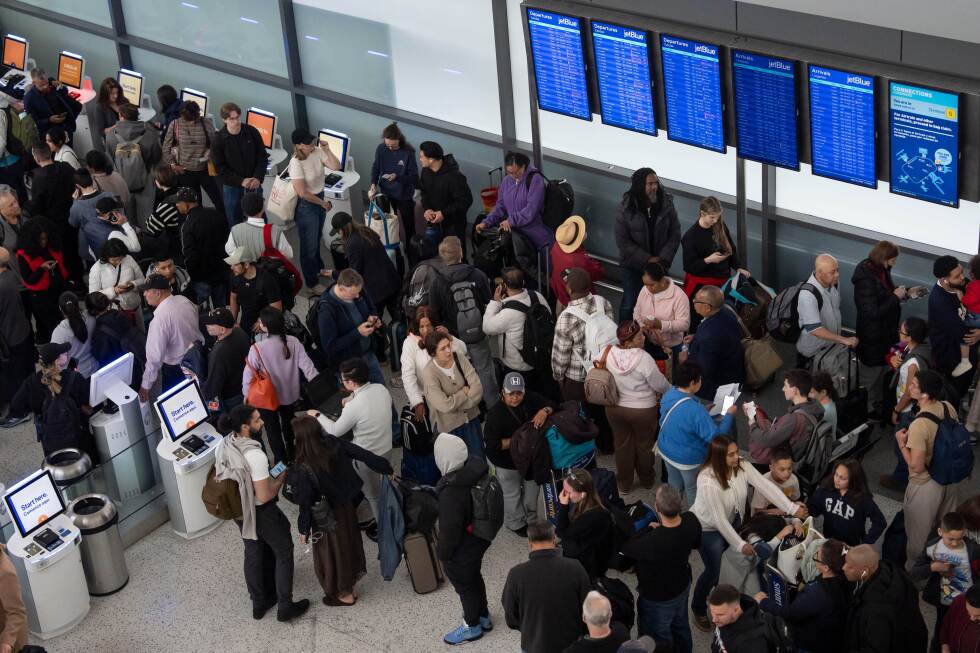
At the airport on Sunday, some travelers waited in line for nearly six hours at the main security checkpoint, where only two TSA agents were on hand midafternoon to check IDs. Many missed their flights and scrambled to book later flights or add themselves to standby lists that were already dozens of names long.
Dickens said all federal personnel would report to TSA and be assigned tasks such as line management and crowd control. “Federal officials have indicated that this deployment is not intended to conduct immigration enforcement activities,” his statement said.
Homan said immigration officers, as an example, could cover exits currently monitored by TSA agents, freeing them to work screening lines. Another option, he said, was having ICE agents check identification before people enter screenings areas.
“We’re going to be a force multiplier,” Homan said, while also acknowledging there were limits.
“I don’t see an ICE agent looking at an X-ray machine, because we’re not trained in that,” he said. He pledged to have “a plan by the end of today, where we’re sending — what airports we’re starting with and where we’re sending them.”
But Everett Kelley, president of the American Federation of Government Employees, which represents more than 50,000 TSA employees, condemned Trump’s plan, saying in a statement that ICE agents are not trained or certified in aviation security.
“Our members at TSA have been showing up every day, without a paycheck, because they believe in the mission of keeping the flying public safe,” Kelley said Sunday. “They deserve to be paid, not replaced by untrained, armed agents who have shown how dangerous they can be.”
People wait in a TSA line at the John F. Kennedy International Airport, Sunday, March 22, 2026, in New York. (AP Photo/Yuki Iwamura)
People wait in a TSA line at the John F. Kennedy International Airport, Sunday, March 22, 2026, in New York. (AP Photo/Yuki Iwamura)
Budget talks stall as airport worries worsen
Democrats have said they are willing to fund TSA and most other parts of DHS as they press for changes to immigration operations after the deaths of two U.S. citizens at the hands of federal agents in Minneapolis during an immigration enforcement operation. ICE officers are largely being paid during the partial shutdown, thanks to an influx of cash from Trump’s big tax breaks bill last year.
“There are lots of ideas swirling right now,” said Senate Majority Leader John Thune, R-S.D. “The good news in all that is people realizing this has to get fixed, it has to get solved.”
As budget talks stayed behind closed doors Sunday, senators said they had few details of which airports or how many immigration officers were being dispatched. Some welcomed the effort.
“I don’t think it can hurt,” said Sen. Mike Rounds, R-S.D. “They can help relieve some of the pressure.”
Trump said in a social media post that on Monday, “ICE will be going to airports to help our wonderful TSA Agents who have stayed on the job” despite the partial government shutdown. He further criticized Democrats.
Travelers at some airports worried about reaching their gates Sunday.
At Atlanta’s airport, lines wrapped from one end of the airport to the other.
The scene appeared more chaotic at John F. Kennedy International Airport in New York. Large crowds of anxious travelers piled toward security checkpoints, and TSA staff shouted through megaphones to tell people not to push one another.
For Transportation Secretary Sean Duffy, one concern is the uncertainty that passengers are facing over possible wait times at any airport on any given day.
“Do I have to come an hour and a half early? Do I have to come four hours early? They d on’t know until the day of or the afternoon of their flight,” he said. “So if we can alleviate that, again, the president wants to take away that leverage point for Democrats and make travel easier for the American people.”
Homan appeared on BLN’s “State of the Union” and “Fox News Sunday,” while Duffy was interviewed on ABC’s “This Week.’ ___
Associated Press writers Collin Binkley in West Palm Beach, Fla., Anthony Izaguirre in Lindenhurst, N.Y., Yuki Iwamura in New York, Nicholas Riccardi in Denver, Kate Brumback in Atlanta, Margery Beck in Omaha, Neb. and Rebecca Santana in Washington contributed to this report.

WEST PALM BEACH, Fla. (AP) — At war with Iran, President Donald Trump is cycling through an increasingly desperate list of options as he searches for a solution to the crisis in the Strait of Hormuz. He has jumped from calls to secure the waterway through diplomatic means to lifting sanctions and now escalating to a direct threat against civilian infrastructure in the Islamic Republic.
Trump and his allies insist they were always prepared for Iran to block the strait, yet the Republican president’s erratic strategy has fueled criticism that he is grasping for answers after going to war without a clear exit plan. On Saturday came his latest attempt, via an ultimatum to Iran: Open the strait within 48 hours or the United States will “obliterate” the country’s power plants.
Trump’s aides defended the threat as a hard-edged tactic to press Iran into submission. Opponents framed it as the failure of a president who miscalculated what it would take to get out of a geopolitical mire.
“Trump has no plan to reopen the Strait of Hormuz, so he is threatening to attack Iran’s civil power plants,” said Sen. Ed Markey, D-Mass, adding: “This would be a war crime.”
“He’s lost control of the war and he is panicking,” said Sen. Chris Murphy, D-Conn., responding to Trump’s post.
Over the course of about a week, Trump has repeatedly shifted his approach on the crucial waterway for global oil and gas transport. There is growing urgency for Trump as soaring oil prices rattle global markets and pinch American consumers months before pivotal midterm elections.
Trump and diplomacy
Trump tried his hand at a diplomatic solution last weekend when he called for a new international coalition to send warships to the strait.
Allies turned him down. Trump then said the U.S. could manage on its own. On Friday he suggested other countries would have to take over as the U.S. eyes an exit. Hours later he indicated the waterway would somehow “open itself.”
“You can’t all of a sudden walk away after you’ve kind of created the event and expect other people to pick it up,” Sen. Thom Tillis, R-N.C. told ABC’s “This Week.”
Trump’s Treasury Department on Friday made its latest attempt to get a handle on soaring gas prices, by lifting sanctions on some Iranian oil for the first time in decades. That relieved some of the pressure that Washington traditionally has used as leverage against Tehran.
The goal was to send millions more barrels of oil into the global market. It is not clear, however, how much of a dent that would make in lowering pump prices or how the administration could prevent Iran from cashing in on the renewed sales.
The administration earlier temporarily lifted sanctions on some Russian oil.
An ultimatum to Iran
Trump’s ultimatum, conveyed while he spent the weekend in Florida, carries a threat of remarkable aggression. His previous messaging mostly focused on U.S. success in hitting Iran’s air force, navy and missile production. This time, the threatened target is the energy infrastructure that powers hospitals, homes and more.
His social media post — 51 words, much of it in capital letters — did not have the appearance of a message that underwent the careful legal scrutiny needed to justify an attack on civilian infrastructure, said Geoffrey Corn, a law professor at Texas Tech University and a retired lieutenant colonel in the Army who served as a military lawyer.
“It certainly has a feeling of ready, fire, aim,” Corn said of Trump’s moving strategy.
“He overestimated his ability to control the events once he unleashed this torrent of violence.”
That type of widespread attack would probably be a war crime, Corn said. For military leaders, it could force a choice between obeying an order to carry out a war crime or refusing and facing criminal sanction for willful disobedience, he said.
Laws governing warfare do not explicitly forbid attacks on power plants, but the tactic is allowed only if an analysis finds that the military advantages outweigh the civilian harm, legal scholars say. It is seen as a high bar to clear because the rules of war are, at their core, designed to separate civilian and military targets.
Iran’s U.N. ambassador, in a letter to the Security Council, warned that the deliberate targeting of power plants would be inherently indiscriminate and a war crime, according to the state-run IRNA news agency.
The White House has already faced intense backlash after the U.S. was blamed for a missile strike on an Iranian elementary school that killed more than 165 people.
Trump aides justify latest attempt to rein in the crisis
Trump provided scant detail on which plants might be targeted and how. He gave Iran until Monday to reopen the strait or else the U.S. will strike “various POWER PLANTS, STARTING WITH THE BIGGEST ONE FIRST!”
Trump’s team came to his defense Sunday, offering justification for striking Iran’s energy grid.
Mike Waltz, the U.S. ambassador to the United Nations, said Iran’s Revolutionary Guard controls much of the country’s infrastructure and is using it to power the war effort. He said potential targets include “gas-fired thermal power plants and other types of plants.”
Speaking on Fox News, Waltz said he wanted to get ahead of “hand-wringing” from the global community, calling the Revolutionary Guard a terrorist organization. “The president is not messing around,” he said.
NATO’s secretary-general, Mark Rutte, who has allied himself closely to Trump, tried to calm tensions. He said he understood Trump’s anger and stressed that more than 20 countries are “coming together to implement his vision” of making the strait navigable as soon as possible.
Israel’s ambassador to Washington, Yechiel Leiter, cautioned against an all-out attack like the one Trump threatened. “We want to leave everything in the country intact, so that the people who come after this regime are going to be able to rebuild and reconstitute,” he told BLN’s ”State of the Union.”
Trump’s threat could prove counterproductive: If it’s carried out, Iranian leaders said they would completely close the strait and retaliate against U.S. and Israeli infrastructure.
___
Associated Press writer Seung Min Kim in Washington contributed to this report.
President Donald Trump and top administration officials said Sunday that Immigration and Customs Enforcement agents will arrive at the nation’s airports on Monday to handle security at exceedingly long lines driven by a shortage of TSA workers.
“I look forward to moving ICE in on Monday, and have already told them to, ‘GET READY.’ NO MORE WAITING, NO MORE GAMES!” Trump said on Truth Social.
Tom Homan, the White House border czar who will lead the effort, provided few details but confirmed the plan on BLN’s “State of the Union,” saying, “It’s a work in progress, but we will be at airports tomorrow.” DHS spokesperson Lauren Bis said later that “hundreds of ICE officers” would be deployed to airports “adversely impacted,” but she did not specify which airports.
It was unclear whether ICE officers would be conducting pat-down procedures but Homan suggested their focus would be on security instead of screening. “A highly-trained ICE law enforcement officer can cover an exit, that relieves TSA to go to screening,” he said, adding that the priority will be on “those large airports where there’s a long wait, like three hours.”
DHS and ICE did not immediately respond to MS NOW’s request for comment on whether officers will be wearing masks at the airports to which they are deployed. But Transportation Secretary Sean Duffy suggested Sunday that Democrats are the reason why federal immigration and border officers wear masks.
“Democrats want ICE to take off their face masks. The problem with that is we know the Democrats are going to want to dox those ICE agents, go to their homes, harass their kids,” he said on ABC News.

The ongoing partial government shutdown, which began after funding for the Department of Homeland Security lapsedon Feb. 14, has forced Transportation and Security Administration workers to go unpaid —with hundreds of them quitting or not showing up for work, severely disrupting air travel.
Duffy said security lines will “get much worse” this week. He predicted more TSA agents will quit by Friday, when they’ll go without another paycheck unless lawmakers reach a deal.
Trump said on Saturday that ICE agents would “do Security like no one has ever seen before, including the immediate arrest of all Illegal Immigrants who have come into our Country, with heavy emphasis on those from Somalia.”
Minneapolis Mayor Jacob Frey, whose city has been ground zero for the Trump administration’s immigration crackdown, said Sunday on MS NOW’s “The Weekend” that Trump “doesn’t actually mean that he’s going to keep people secure.”
“We all know that’s not the goal. The goal is to terrorize people,” Frey said. When asked if he thought the president was racist for his targeting of Somalis, the mayor said, “I think the answer is yes.”
Speaking on the Senate floor during a rare weekend session on Sunday, Minority Leader Chuck Schumer, D-N.Y., lambasted Trump’s plan to send ICE agents to airports, calling it “really disturbing.”
“It’s a plan that has no planning. It’s another impulsive action from Donald Trump,” Schumer said. “When he acts impulsively there’s usually trouble. Whenever Donald Trump acts impulsively with no follow through, there’s trouble.”
Republican Sen. Lisa Murkowski of Alaska also criticized Trump’s plan, saying that “air dropping” agents to airports is “not a fix.”
The Association of Flight Attendants said ICE officers lack the kind of specialized training that the TSA’s transportation security officers get. “Furthermore, the introduction of ICE agents into airports creates contradictory missions, as attempts to question passengers about immigration status may distract them from ensuring airport security,” the union said.
And Everett Kelley, president of the American Federation of Government Employeesthe largest federal workers’ union, said, “More than 50,000 TSA employees have worked without pay for over five weeks. Hundreds have quit. And Washington’s answer isn’t to pay them. It’s to send ICE agents to do their jobs.”
Congress remains gridlocked over DHS funding, with Democrats demanding reforms to ICE operations after the fatal shooting of two U.S. citizens — Renee Good and Alex Pretti— in Minneapolis. Republicans have rejected proposalsto reopen much of Homeland Security, which includes TSA and ICE.
Airline executives from United Airlines, American Airlines, Southwest Airlines and others last week called on Congress to end the shutdownwriting in a joint letter that federal employees working without pay is “simply unacceptable.”
“This problem is solvable, and there are solutions on the table,” they wrote. “Now it’s up to you, Congress, to move forward on bipartisan proposals that will get federal aviation workers—including TSA officers, U.S. Customs clearance officers at airports and air
traffic controllers—paid during shutdowns.”
Mychael Schnell and Emily Hung contributed to this report.
Erum Salam is a breaking news reporter for MS NOW, with a focus on how global events and foreign policy shape U.S. politics. She previously was a breaking news reporter for The Guardian.
- Biden-era DOJ memo: Trump hoarded classified documents relevant his businesses
- GOP framework still ‘best landing spot’ for DHS funding, Thune says
- GOP policy chair election April 16
- Graham vows to plow ahead with reconciliation for defense, homeland funding
- Lawmakers introduce bill to prohibit members of congress, president from prediction market trading
- Capitol agenda: Trump to bring headaches or harmony to Blue Light News
- GOP’s reconciliation hopes are easier dreamt than done
- DHS funding proposal falls flat as Democrats, conservatives and Trump raise doubts
- Rick Scott sues contractor over leaked tax returns
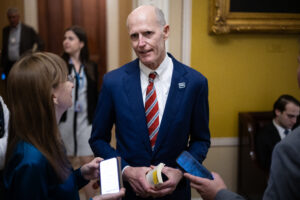
- How Jack Smith connected the dots between GOP lawmakers, Trump aides in 2020 election probe

-

 The Dictatorship1 year ago
Luigi Mangione acknowledges public support in first official statement since arrest
-

 Politics1 year ago
Former ‘Squad’ members launching ‘Bowman and Bush’ YouTube show
-

 Politics1 year ago
Former Kentucky AG Daniel Cameron launches Senate bid
-

 Politics1 year ago
Blue Light News’s Editorial Director Ryan Hutchins speaks at Blue Light News’s 2025 Governors Summit
-

 The Dictatorship7 months ago
Mike Johnson sums up the GOP’s arrogant position on military occupation with two words
-

 The Dictatorship1 year ago
Pete Hegseth’s tenure at the Pentagon goes from bad to worse
-
Uncategorized1 year ago
Bob Good to step down as Freedom Caucus chair this week
-

 Politics11 months ago
Democrat challenging Joni Ernst: I want to ‘tear down’ party, ‘build it back up’