
Congress
‘Bobby may play nice; I won’t’: RFK Jr.’s former running mate threatens senators with primaries

Nicole Shanahan, the philanthropist who was Robert F. Kennedy Jr.’s running mate last year, warned senators that a vote against his nomination as Health and Human Services secretary will result in a campaign to get them booted from office.
“While Bobby may be willing to play nice, I won’t if you vote against him,” Shanahan said in a video posted to X Tuesday evening. “I will personally fund challengers to primary you in your next election, and I will enlist hundreds of thousands to join me.”
Shanahan name-dropped both Democratic and Republican senators in her message, including Sens. Mitch McConnell (R-Ky.) and Lisa Murkowski (R-Alaska), who voted against Pete Hegseth’s nomination as Defense secretary.
She also called out Democratic Sens. Raphael Warnock and Jon Ossoff, saying she “cut big checks” to get the Georgia senators elected and will be watching their “votes very closely.”
Her message also tasked her followers to call and urge their senators to confirm Kennedy.
Shanahan was the founder of a patent management firm. Her wealth reportedly stems from her marriage to billionaire Google co-founder Serget Brin and the pair divorced in 2022.
She became Kennedy’s running mate for his failed independent presidential bid after funneling millions into a pro-Kennedy Super PAC that helped fund a February Super Bowl advertisement last year. In the past, she has donated to notable Democratic politicians like Hillary Clinton in 2016 and former President Joe Biden in 2020.
Kennedy, who is appearing before the Senate Finance Committee — with his confirmation uncertain — has faced overwhelming scrutiny over his anti-vaccine history and other unconventional health views since announced as Trump’s health secretary pick. His cousin, Caroline Kennedy, also recently referred to him as a “predator.”


The chair of the House committee overseeing elections is circulating a list of proposals to include in a budget reconciliation bill as Senate Republicans and the White House move to rev up the party-line process to pass pieces of a contentious GOP voting bill in the coming months.
The list from House Administration Chair Bryan Steil (R-Wis.) is a peek at what sort of provisions Republicans could try to pass under reconciliation, which is strictly reserved for legislation with a direct fiscal impact. The party-line effort is likely to rule out big portions of the SAVE America Act, the bill President Donald Trump has called his “No. 1 priority” for the year.
Steil’s proposals would mandate or financially incentivize states to implement voter ID laws, require proof of citizenship for voter registration, share voter data with federal agencies for verification and conduct post-election audits, among other items, according to a document obtained by POLITICO being circulated with GOP leaders and several Republican offices. It’s an effort to try to secure major pieces of Trump’s election-related demands.
In some cases, states would lose funding under the 2002 Help America Vote Act, a law passed in the aftermath of the 2000 presidential election that provides federal money to help administer elections, if they fail to comply.
It’s not clear if parts of Steil’s proposals would in fact pass muster under the party-line reconciliation process. The Senate parliamentarian’s guidance typically determines what is and isn’t included.
Three people granted anonymity to discuss the brewing deal Senate Republicans and Trump discussed Monday evening, to pass Homeland Security funding now and SAVE America Act provisions later, say the most likely outcome for a new reconciliation bill is adding money for ballot security measures and potentially incentivizing more states to enact voter ID requirements. Steil’s list includes some of those pieces.
Under Steil’s proposal, states using noncompliant IDs would be ineligible to receive HAVA funding — consistent with Steil’s bill, the Make Elections Great Again Act, which overlaps with the SAVE America Act but also has no current path to passage in the Senate.
His effort to mandate proof-of-citizenship requirements would appropriate funds to the U.S. Election Assistance Commission to amend the national voter registration form to require “Documentary Proof of Citizenship” such as a passport or military ID. States would have to forfeit HAVA funds if they fail to share data with federal agencies to verify voter registration data, a move officials in several states have refused to make.
Besides the Senate parliamentarian, any effort to pass elections provisions on party lines will face other obstacles. The decision to pursue a new reconciliation bill in lieu of trying to pass the SAVE America Act in full is already generating major pushback from conservative hard-liners.
The House Freedom Caucus took a shot at Senate Republicans Tuesday, arguing the brewing DHS deal means Senate Republicans are opting for “failure theater” and “gaslighting” instead of fighting to pass the bill Trump has endorsed. Even GOP senators and senior aides are privately cautioning the fresh reconciliation push could fall apart, stranding the elections overhaul and other GOP priorities.
England’s King Charles III will make his first state visit to Washington next month.
As part of his visit, the king will address Congress in a joint meeting the week of April 27, according to two people familiar with the matter granted anonymity to discuss plans ahead of a formal announcement.
The visit was first reported by Punchbowl News.
It will be the first time a British royal has addressed Congress since 1991, when Charles’ mother, Queen Elizabeth II, became the first British monarch to speak before a packed House chamber.
President Donald Trump visited London in September, and House Speaker Mike Johnson visited in January as part of America’s 250th anniversary celebrations. Johnson addressed Parliament during his visit, becoming the first House speaker to do so.
Charles’ visit comes as Trump continues to pressure Prime Minister Keir Starmer for assistance in the U.S.-Israel war with Iran.
Starmer has distanced himself from the war, previously stating, “This is not our war, and we are not getting dragged into this war.”
Oklahoma Gov. Kevin Stitt tapped energy executive Alan Armstrong to replace incoming DHS Secretary Markwayne Mullin in the Senate, he announced in a press conference Tuesday.
Armstrong is the executive chair of Williams Companies, an energy company headquartered in Tulsa, Oklahoma. Stitt called him a “strong business leader” who values “free markets and limited government.”
“Alan’s story, as you guys get to know him, reflects the very best of Oklahoma,” he said. “Our values, our work ethic, and our pursuit of the American dream that is alive and well in the state of Oklahoma.”
Armstrong will serve until a successor is elected in November. Rep. Kevin Hern (R-Okla.) is the heavy favorite to win a full term.
- These House GOP election proposals could end up in a reconciliation bill
- King Charles to make first US state visit, address Congress next month
- Stitt picks energy executive Alan Armstrong as next Oklahoma senator
- Emerging DHS deal ‘acceptable,’ White House official says
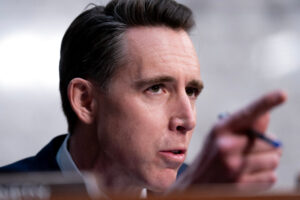
- Hawley investigates FICO for mortgage credit scoring
- No DHS meeting today
- Capitol agenda: Trump muddies DHS talks

- Quadruple amputee cornhole player Dayton Webber accused of shooting, killing man in Maryland

- Pfizer’s Lyme disease vaccine candidate shows promising results

- More than 300 children killed in Iran, Lebanon since war started: UNICEF

-

 The Dictatorship1 year ago
Luigi Mangione acknowledges public support in first official statement since arrest
-

 Politics1 year ago
Former ‘Squad’ members launching ‘Bowman and Bush’ YouTube show
-

 Politics1 year ago
Blue Light News’s Editorial Director Ryan Hutchins speaks at Blue Light News’s 2025 Governors Summit
-

 Politics1 year ago
Former Kentucky AG Daniel Cameron launches Senate bid
-

 The Dictatorship7 months ago
Mike Johnson sums up the GOP’s arrogant position on military occupation with two words
-

 The Dictatorship1 year ago
Pete Hegseth’s tenure at the Pentagon goes from bad to worse
-
Uncategorized1 year ago
Bob Good to step down as Freedom Caucus chair this week
-

 Politics11 months ago
Democrat challenging Joni Ernst: I want to ‘tear down’ party, ‘build it back up’