
The Dictatorship
Americans are in need of third spaces. Starbucks just took itself off the list.

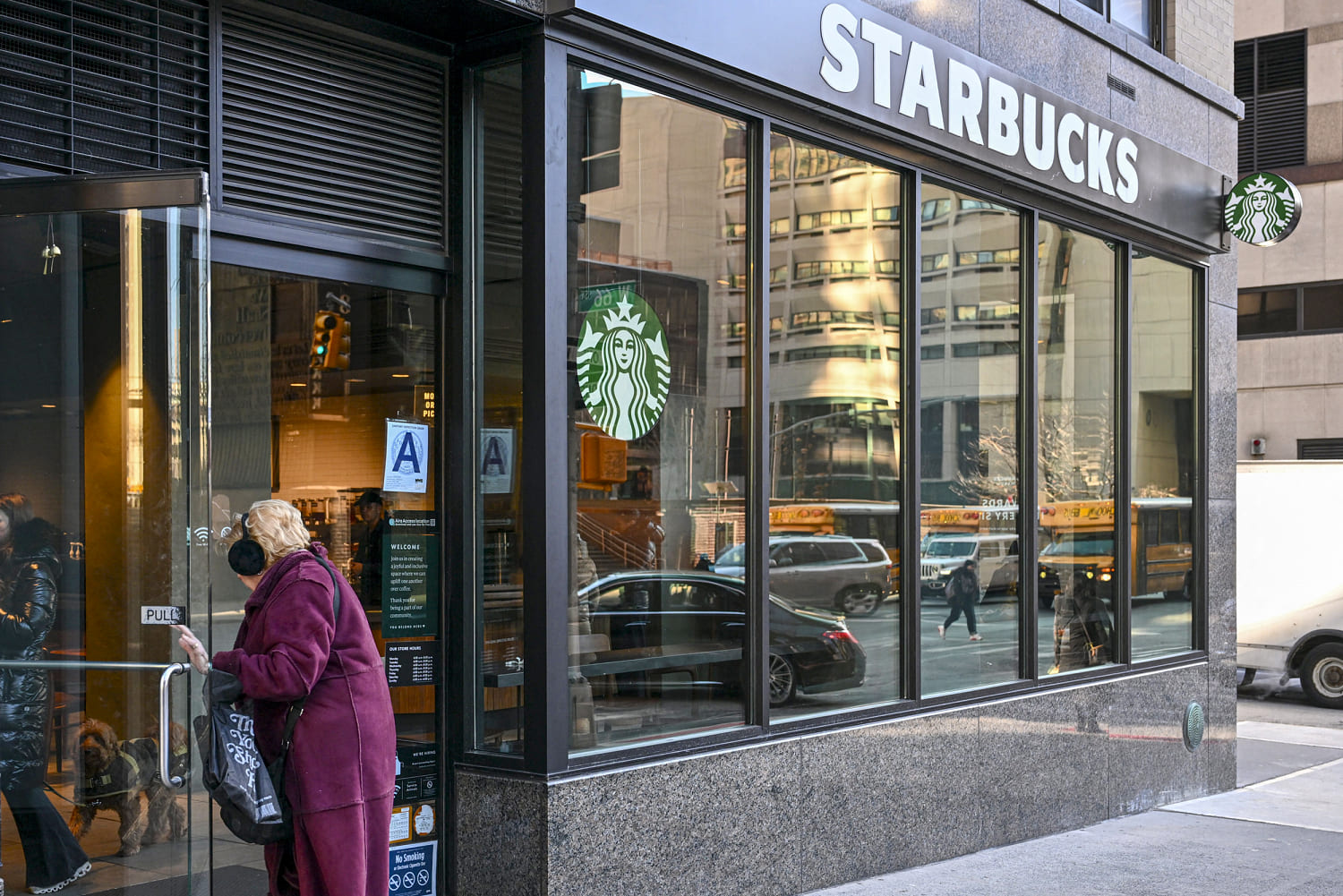
Starbucks, which said this week that it’s ending free bathroom access and requiring people to make a purchase to occupy its stores, revealed the new policy around the same time Walgreens acknowledged that its profits suffered after locking down the items on its shelves. In other words, one company is admitting it’s bad business to treat those who enter as potential ne’er-do-wells while the other is embracing the idea. Starbucks says its policy allowing everyone to enter and sit has led to disruptive behavior, including drug use.
One company is admitting it’s bad business to treat those who enter as potential ne’er-do-wells while the other is embracing the idea
It was only a few months ago Starbucks reported that traffic to its U.S. stores had dropped 10%, and its new CEO described a plan that included the return of cozy furniture and ceramic mugs and the company ordering 200,000 Sharpies to re-create the nostalgia of baristas misspelling customers’ names on the side of their cups. All those plans were, according to CEO Brian Niccol, in service to making the chain a more welcoming “third space” again.
Americans, young and old, are in desperate need of such places away from home and away from the office (or school) where they can linger and be around other people. The surgeon general, Dr. Vivek H. Murthy, said in a 2023 report that “loneliness and isolation represent profound threats to our health and well-being” and that the “mortality impact of being socially disconnected is similar to that caused by smoking up to 15 cigarettes a day.” Even if it isn’t as bad as all that, the problem still needs to be called out and recognized.
Referring to lonely people, The Beatles ask in “Eleanor Rigby,” “Where do they all come from?” But the better question in that song is “Where do they all belong?”
Narae Leewho analyzes the health impacts of physical and social environments, told NBC’s “TODAY” that even indirect social contact can do wonders for someone’s psychological well-being: “Some people go to third places to be surrounded by other peoplewatch them and rest while just enjoying the ambience and white noise.”
Outside of libraries (where verbal socializing isn’t always appreciated), public parks (which can get too hot, too cold or too wet), and malls (which are being rapidly replaced with Amazon distribution centers), there aren’t that many places people can leisurely hang out without feeling rushed to get back to the responsibilities waiting for them at home or at work.
The coffee shop is one of the cheapest third-space options there is, and, for a little while, Starbucks made it free. The new policy treats people as freeloading loiterers until they prove otherwise and says staff “may ask for help from law enforcement” to have them removed. It’s difficult to cultivate a third space when you’re adopting a policy that makes baristas narcs.
It’s difficult to cultivate a third space when you’re adopting a policy that makes baristas narcs.
After arguing that the Starbucks experience had gotten to the point where it “can feel transactional,” Niccol promised in an open letter in September that “our stores will be inviting places to lingerwith comfortable seating, thoughtful design and a clear distinction between ‘to-go’ and ‘for-here’ service.”
The pay-or-go policy is the epitome of a transactional experience.
Though it’s not in my nature to camp out in coffee shops without buying anything, I have, at times, made my first order of business answering nature’s call. And if I’m meeting someone, I may wait for their arrival before ordering. If I’m in Starbucks going forward, will I now be rushed to order or told to leave the premises?
In Philadelphia in 2018, two men, Black like me, attempted to use a Starbucks restroom ahead of the arrival of a third person, but they ended up being detained for eight hours after a white barista accused them of trespassing and called the police. It was after that embarrassing episode that Starbucks said it was changing its policy to allow people to sit in the store without making a purchase.
Now, it’s saying that you’ve got to buy something or leave — because of danger.
Given the way the frequency of shoplifting appears to have been exaggerated to justify places like Walgreens locking up deodorant and mouthwash and even closing storesit’s probably wise to be a bit skeptical of Starbucks’ claim that too many people are out of control. In 2022, when the company announced it was shuttering 16 stores because of threats to its staff, some workers suspected that the move was a response to a Starbucks unionization effort spreading across the country.
It’s probably wise to be a bit skeptical of Starbucks’ claim that too many people are out of control.
It was mere coincidence, Starbucks wanted us to believe, that the stores it deemed too dangerous to operate included two that had voted to unionize and another that had petitioned for a union vote.
The Walgreens CEO said, “When you lock things up … you don’t sell as many of them. We’ve kind of proven that pretty conclusively.” And that seems like a lesson Starbucks could learn: When you adopt policies that scream “We don’t trust you” to everybody who enters, you’re discouraging them from returning.
I don’t know if the new policy will hurt Starbucks’ bottom line. And I can’t even profess to care. But we should all worry that in a country that has so few places that allow people to just sit and be, this policy heralds the loss of one more.



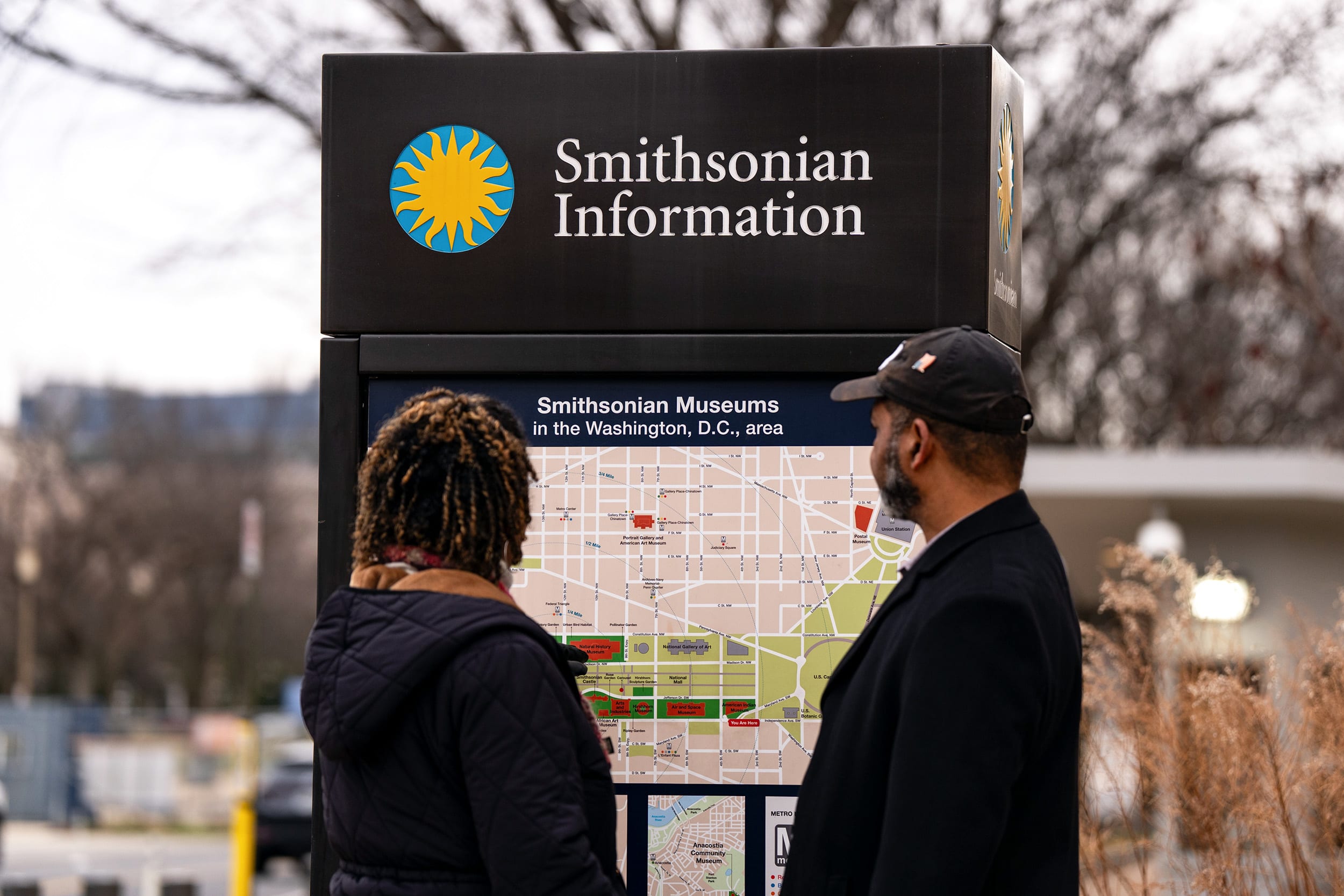
President Donald Trump has sought to remake Smithsonian institutions in his image during his term in office.
Now, House Republicans are setting their sights on another museum Trump has targeted — and it’s one that is still years away from being built.
This week, a group of House Republicans used a committee vote on a bill intended to establish a location for the forthcoming Smithsonian American Women’s History Museum to pass an amendment stipulating that the museum must not include transgender women in its exhibitions or content.
“The Museum shall be dedicated to preserving, researching, and presenting the history, achievements, and lived experiences of biological women in the United States,” the new amendment states, in a section called “scope of mission.”
“The Museum may not identify, present, describe, or otherwise depict any biological male as a female,” it continues.
Sponsored by Rep. Mary Miller, R-Ill., — who Trump has endorsed for re-election — the amendment furthers an executive order the president signed last Marchin which he demanded the forthcoming museum “not recognize men as women in any respect.”
“The accomplishments of real women should never be overshadowed by biological men pretending to be women,” Miller said Wednesday at the committee markup of the bill.
The proposal comes as the latest effort from Trump and his allies to erase trans people from public life. It’s also their latest attempt to exert greater control over the Smithsonian, an independent, public-private partnership established by Congress and overseen by a Board of Regents that includes the chief justice of the Supreme Court and the vice president.
If passed, Miller’s amendment would also give Trump the final say on the museum’s location if he doesn’t approve of the one proposed by the Smithsonian and Congress, which is the lot across from the National Museum of African American History and Culture.
The top Democrat on the House Administration Committee, Rep. Joe Morelle, D-N.Y., said he was “extremely disappointed” that Miller and Republicans had “needlessly politicized” what has otherwise been a bipartisan process to kowtow to Trump, whom the Democrat said is trying to “regulate” and “whitewash” history.
The amendment ultimately passed the committee 7 to 4 along party lines.
Rep. Nicole Malliotakis, R-N.Y., a sponsor of the bill amended by Miller, said she was “pleased” to see it pass out of committee but disappointed that Democrats opposed it.
It will now head to a floor vote, where it is likely to pass under the Republican majority. Spokespeople for Miller; House Speaker Mike Johnson, R-La.; and House Majority Leader Steve Scalise, R-La., did not respond to MS NOW’s questions, including when it could come up for a floor vote.
Congress authorized the building of both the women’s history museum and another museum dedicated to American Latinos in 2020. Sen. Alex Padilla, D-Calif., introduced a separate bill last year allocating a location for the Latino museum, which has yet to make it out of committee. In an interview with NBC News earlier this year, Malliotakis blamed Johnson for the holdup on the passage of the bill, which she introduced in February of last year.
She also said she hoped to pass the bill — which has more than 230 bipartisan cosponsors — during Women’s History Month in March.
While the Smithsonian originally offered a decade-long timeline for the museums openings, the process has been slower-moving over the past six years. A spokesperson for the Smithsonian told MS NOW there is currently no planned opening date and the institution does not comment on pending legislation in Congress.
Democrats may have little power to stop the amendment, but they are not staying quiet about it.
Members of the Democratic Women’s Caucus called the amendment a “poison pill” that would give the president undue power over site.
“A museum about women, fought for and supported by women, should not be controlled by one man,” the group’s leaders said.
Rep. Mark Takano, D-Calif., chair of the Congressional Equality Caucus, pointed out that the original bill that authorized the museum’s creation in 2020 did not address the specific content of its programming, other than requiring it to portray “the diverse range of experiences and viewpoints of all women” in the U.S. However, Takano also noted, “the Museum should highlight the experiences of all women, including transgender women.”
The Smithsonian spokesperson said it’s “too early for us to discuss exhibitions in a museum that hasn’t been built yet.”
If the bill passes with the anti-trans amendment, the Smithsonian would likely have leeway on how to interpret it, or whether to follow it, given that the institution has insisted on its independence even in the face of Trump’s threats. However, Congress controls the majority of its funding and could threaten to withhold money if officials wanted to force the museum to comply.
A source with knowledge of the planning process for the museum also told MS NOW that they believe Smithsonian leadership is “concerned about blowback and escalation” given recent events.
In last year’s executive orderTrump alleged the Smithsonian had “come under the influence of a divisive, race-centered ideology” and demanded Vice President JD Vance take a greater role in overseeing funding for the institute’s programming. As part of a subsequent content review, the Smithsonian’s National Museum of American History removed references to Trump’s two impeachments from an exhibit before restoring them days later following a public outcry. In December, the White House also issued a letter to Smithsonian leadership demanding extensive documentation on planned programming and threatening to withhold federal funds if those demands were not fulfilled.
“I think the museum leadership sees our historical moment as one of existential crisis for the Smithsonian,” the source familiar with the planning told MS NOW. “And their deepest commitment is to the survival of the institution.”
Julianne McShane is a breaking news reporter for MS NOW who also covers the politics of abortion and reproductive rights. You can send her tips from a non-work device on Signal at jmcshane.19 or follow her on X or Bluesky.
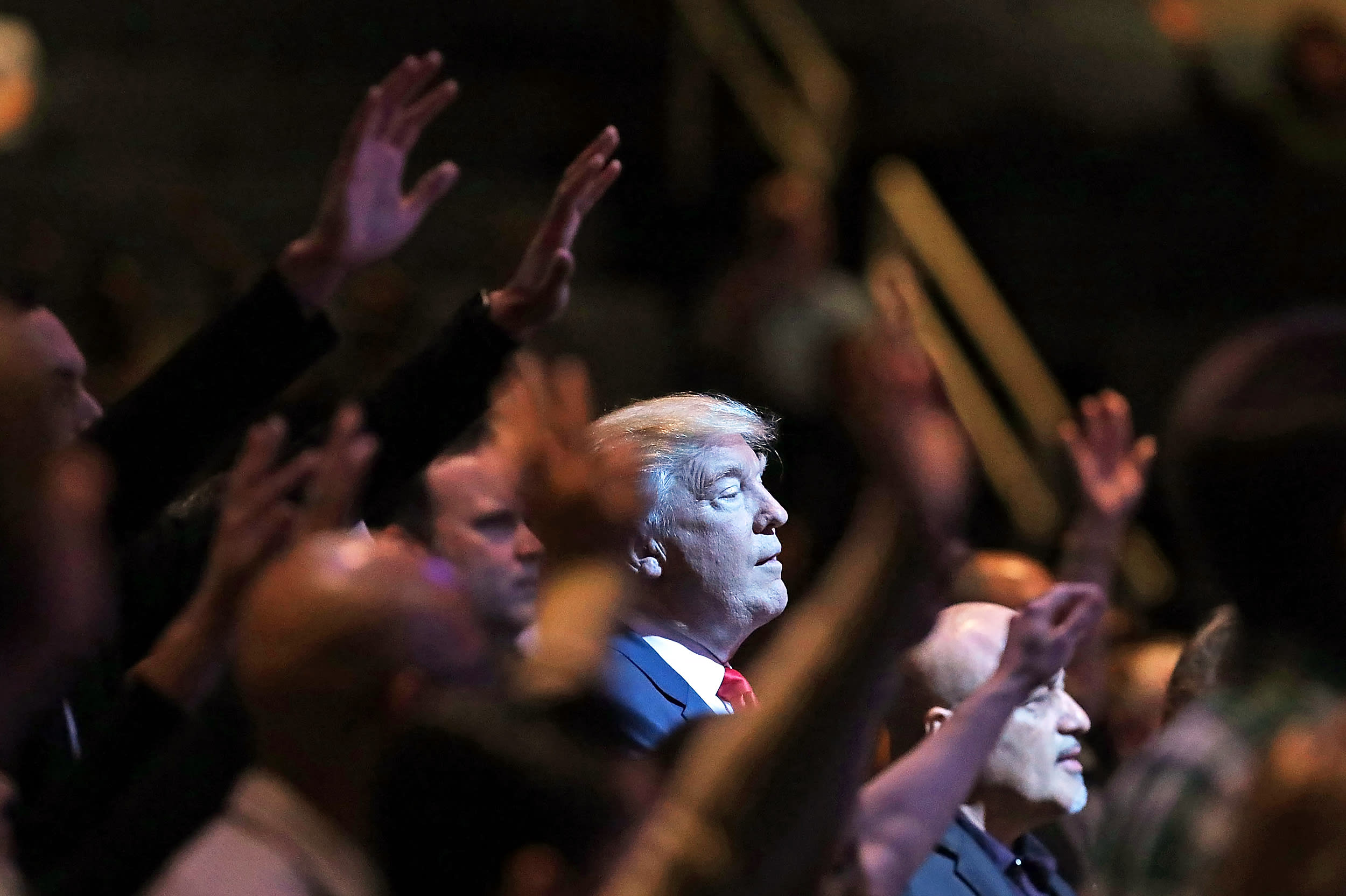
The Trump administration’s plans to celebrate the country’s upcoming 250th anniversary are shaping up to be an exhibition of Christian nationalist extremism.
The president — who has been found liable for fraud and sexual abuse and who has upset some in his own movement with his suggestion that he isn’t bound for heaven — has eagerly wrapped himself in Scripture and packed his administration with religious zealots who wish to erode the constitutionally mandated separation of church and state.
And a new report from The New York Times spotlights the cadre of right-wing evangelicals who joined an event last month to plan a slate of explicitly Christian-centered programming in the lead-up to the 250th anniversary celebrations. One of the people in attendance was Eric Metaxas, the far-right media figure and promoter of election conspiracy theories who has touted his belief that Christians should “infiltrate” government.
What we know of the programming thus far suggests it will serve to reinforce the view that the country’s laws and customs have always been, and must be, rooted in Christianity — or at least the conservative movement’s interpretation of its teachings.
The Times’ report spotlighted an event called “Rededicate 250,” which is scheduled for May 17. The White House says it will feature a “large-scale revival” on the National Mall.
One of the people apparently helping plan the programming is a self-described Christian nationalist named Sean Feucht, who has portrayed himself as an informal adviser of sorts to Trump officials. He has been a fixture alongside Scott Turner, secretary of Trump’s Department of Housing and Urban Development.
Last year, Feucht said he had been tapped to give “divine perspective” on California’s wildfire recovery effortsand he joined Turner on a tour of damaged sites. At the time, a HUD spokesperson told MS NOW that Feucht wasn’t saying he had an “official role” — though he very well may have had an unofficial role. Feucht also performed onstage at a Christian worship session hosted by HUD on the National Mall last September — an event quite similar to the one set for May.
Feucht was specifically named by Rep. Jared Huffman last month, in a news release the California Democrat sent out rebuking the “whitewashing” and “corruption” surrounding the 250th anniversary events. Huffman cited Feucht’s claims of having collaborated with Trump officials on “revival meetings sponsored by the U.S. government,” as part of what the congressman called “Christian nationalism on the taxpayer dime.”
“The Trump administration is using this celebration to further erode church-state separation and force extreme Christian Nationalism on the American people,” the news release said, “pushing a false narrative that our country was founded as a Christian nation.”
Ja’han Jones is an MS NOW opinion blogger. He previously wrote The ReidOut Blog.
The Dictatorship
Trump v. Roberts: The president crashes out online while the chief stays the course

Welcome back, Deadline: Legal Newsletter readers.The Supreme Court added to the term’s already heavy docket, agreeing on Monday to considerthe Trump administration’s quest to quickly end humanitarian protections for Haitians and Syrians.
Yet the week’s court news arguably started Sunday night, when President Donald Trump lashed out on social media. He complained in lengthy postsabout the tariffs ruling (which he mischaracterized) and other gripes, including the 2020 election loss that still haunts him and his disappointment in the court’s Republican appointees.
He referred to the “Democrats” and “Republicans” on the courtforgoing the more precise, if euphemistic, label of Democratic and Republicanappointees. The president groused on Truth Social that GOP justices “openly disrespect the Presidents who nominate them to the highest position in the Land.”
By “openly disrespect,” he apparently meant some of the Republican appointees occasionally rule against him. At the risk of stating the obvious, the court has been helpful to Trump, both personally and presidentially.
But it’s not the Trump Court. It’s the Roberts Court. And though there’s overlap between the two, Chief Justice John Robertsis playing a longer game. That means the court occasionally checks the Republican president, even while largely approving his policies and keeping him out of prison.
Roberts didn’t directly respond to Trump’s latest meltdown. But he happened to have a public appearance on Tuesday, at which he put yet more distance between himself and the president. While in conversation with a federal judge at Rice University in Houston, the chief justice called personal attacks on judges “dangerous,”and he deemed “absurd”the notion that justices carry forward the agenda of the presidents who appointed them.
Again, he didn’t call out Trump by name.But one needn’t squint to see the application to the president’s tariffs crash-out, which has featured calling justices who ruled against him traitors and embarrassments to their families.
Still, Roberts can’t escape Trump, who has continued to dominate the high court’s docket,even when the litigation doesn’t directly involve him. Take Steve Bannonwhose appeal the justices considered at their private conference on Friday. The Justice Department is supporting the Trump ally’s bidto upend his contempt conviction, and we may learn as soon as Monday morning whether the justices are prepared to bless that partnership.
After the court issues its order list at 9:30 a.m. ET on Monday, which could have news on Bannon’s petition and many others, the court will kick off its March argument sittingwith a hearing in Watson v. RNC. The court’s latest foray into election litigation ahead of the midterms concerns timing rules for casting ballots. Solicitor General D. John Sauer is set to appearin support of the Republican National Committee, which wants to block mail ballotsreceived after Election Day, even if they’re sent by then.
Have any questions or comments for me? Pleasesubmit them through this formfor a chance to be featured in the Deadline: Legal Blog and newsletter.
Jordan Rubin is the Deadline: Legal Blog writer. He was a prosecutor for the New York County District Attorney’s Office in Manhattan and is the author of “Bizarro,” a book about the secret war on synthetic drugs. Before he joined MS NOW, he was a legal reporter for Bloomberg Law.
- White House revises its DHS offer as talks to end shutdown pick up
- Another DHS meeting
- Another DHS funding vote coming to House floor

- House GOP leaders punt controversial FISA vote to April

- White House sends blueprint for national AI rules to Congress

- White House revises its DHS offer as talks to end shutdown pick up
- Fox News host presses Burgum over gas prices

- GOP braces for Trump to possibly deploy troops inside Iran

- Still trailing by 23 votes, NC Senate leader asks for hand recount
- Federal judge rules RFK Jr. overreached in restricting trans health care to minors

-

 The Dictatorship1 year ago
Luigi Mangione acknowledges public support in first official statement since arrest
-

 Politics1 year ago
Former ‘Squad’ members launching ‘Bowman and Bush’ YouTube show
-

 Politics1 year ago
Blue Light News’s Editorial Director Ryan Hutchins speaks at Blue Light News’s 2025 Governors Summit
-

 Politics1 year ago
Former Kentucky AG Daniel Cameron launches Senate bid
-

 The Dictatorship6 months ago
Mike Johnson sums up the GOP’s arrogant position on military occupation with two words
-

 The Dictatorship1 year ago
Pete Hegseth’s tenure at the Pentagon goes from bad to worse
-
Uncategorized1 year ago
Bob Good to step down as Freedom Caucus chair this week
-

 Politics11 months ago
Democrat challenging Joni Ernst: I want to ‘tear down’ party, ‘build it back up’