
Politics
After a month of grieving, Democratic leaders are torn between anger and exhaustion

SCOTTSDALE, Arizona — Exactly one month after losing to Donald Trump in every battleground on the map, Democratic Party leaders from across the country decamped to one of the states that rejected them and struggled to pull themselves out of their funk.
At a Hilton hotel outside of Phoenix, where Christmas carols piped into the lobby, state Democratic chairs gathered for their annual winter meeting. They weren’t frantic like they had been after Trump’s first stunning victory. They were exhausted. Even after Trump tapped the likes of Kash Patel and Robert F. Kennedy Jr. to staff his government, they still weren’t ready to demonstrate in the streets or tune into liberal networks.
But they were inching toward the anger phase of the grieving cycle as they huddled in ballrooms and traded theories about what went wrong. They pointed fingers at what they cast as overpaid consultants, expressed despair that working-class voters of all stripes had abandoned them, and lamented that they had lectured voters instead of listening to them.
“We need to win back the House, not fund consultants who want to buy a new house!” said Ken Martin, president of the Association of State Democratic Committees, in a speech to hundreds of attendants.
Waiting for pizza after hours of meetings, Judson Scanlon, political director of a PAC that produced “White Dudes for Harris” hats, fessed up to being one of the Democrats who has stopped watching BLN after Trump returned to power.
“Since 2016, all we’ve heard about is the crazy crap that this guy is doing when he’s president and when he’s not,” said Scanlon. “I’m fed up with that.”
This confab marked one of the first major gatherings of top Democrats since last month’s disastrous election. They had once hoped they would finally celebrate the end of the Trump era here. Instead, while the recriminations continued, they urged one another to put on a brave face despite losing the White House to a convicted felon and getting locked out of both chambers of Congress.
Liberal networks’ ratings have plummeted since Trump’s return to power, one of several signs that Democrats are in a kind of retreat as they try to get their bearings, poring through reams of data and hot takes in hopes of figuring out what led them to lose the popular vote for the first time in 20 years. Many progressives have left the social media platform X, and they aren’t planning the massive marches that took place after Trump first won.
“Why don’t you see the marches? Black women right now are tired. They are really, really tired,” said Jaime Harrison, the chair of the Democratic National Committee who announced after Trump won that he wouldn’t run for reelection. “Many of them put everything they had into this race to see one of their own be elected president of the United States.”
Perhaps because they don’t have the energy for it, Democrats in Arizona also weren’t in the mood for the kind of drawn-out ideological battle they undertook after 2016.
That much was clear from the way that the four men running to lead the Democratic National Committee tried to persuade state party leaders to vote for them in next year’s election.
In speeches, none of the DNC chair hopefuls made the case that Democrats should undergo a sweeping shift in their worldview. Unlike in some progressive parts of the Democratic ecosystem, no one argued that Trump’s win proved that they need to adopt a bold, concrete promise like Medicare for All — or, from the other end of the party’s spectrum, that they must urgently move to the center on transgender issues.
Instead, most sold themselves as competent managers and pitched technical solutions.
Martin, who heads the Minnesota Democratic-Farmer-Labor Party, said he helped pull Democrats in his state out of a slump after the 2010 midterm election that then-President Barack Obama famously called a “shellacking.” He argued that “our party doesn’t need to be torn down to the studs and rebuilt.”
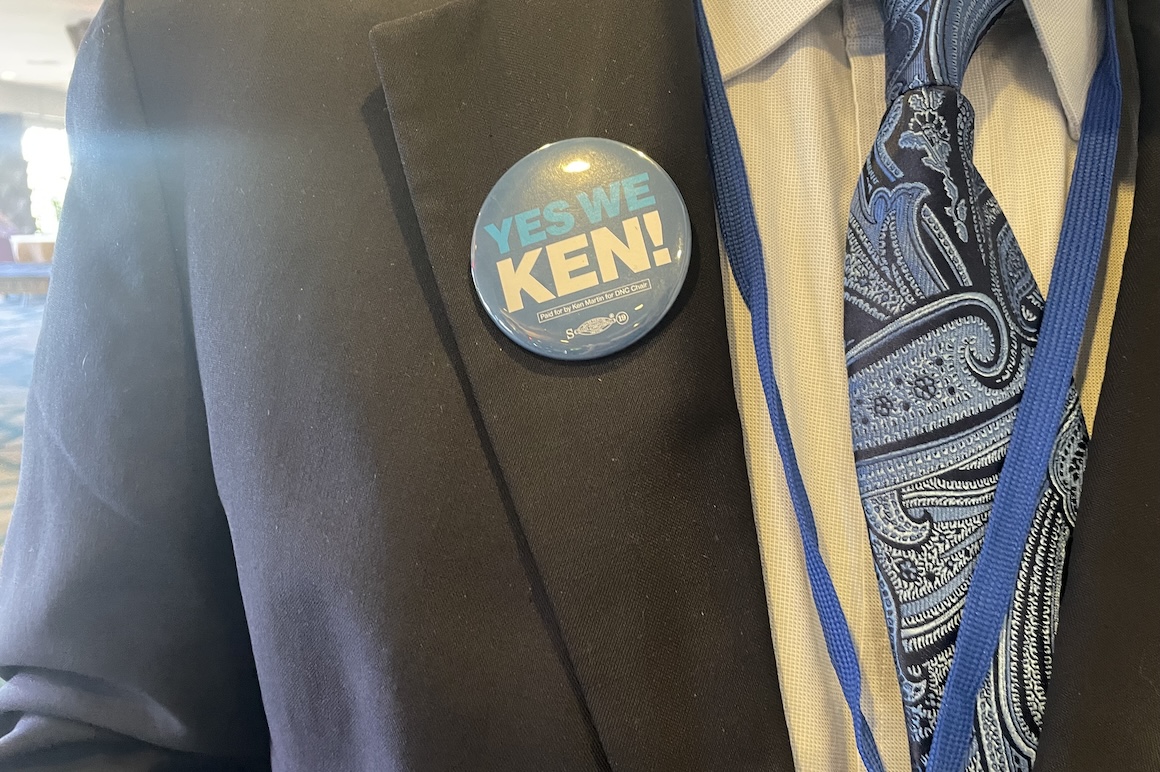
He has entered the race as something of an early favorite, locking down about half of the endorsements needed to win. In Arizona, his fans sported “YES WE KEN!” buttons and he set up a makeshift war room dubbed the “Kenquarters.”
Like Martin, Wisconsin Democratic Party Chair Ben Wikler told the crowd that he righted the ship in his state, where “we’ve been able to win seven out of the last 10 statewide elections.” He called for a “permanent campaign” with omnipresent national organizing.
When DNC chair candidates did call for change, they talked more about transforming tactics than overhauling ideology.
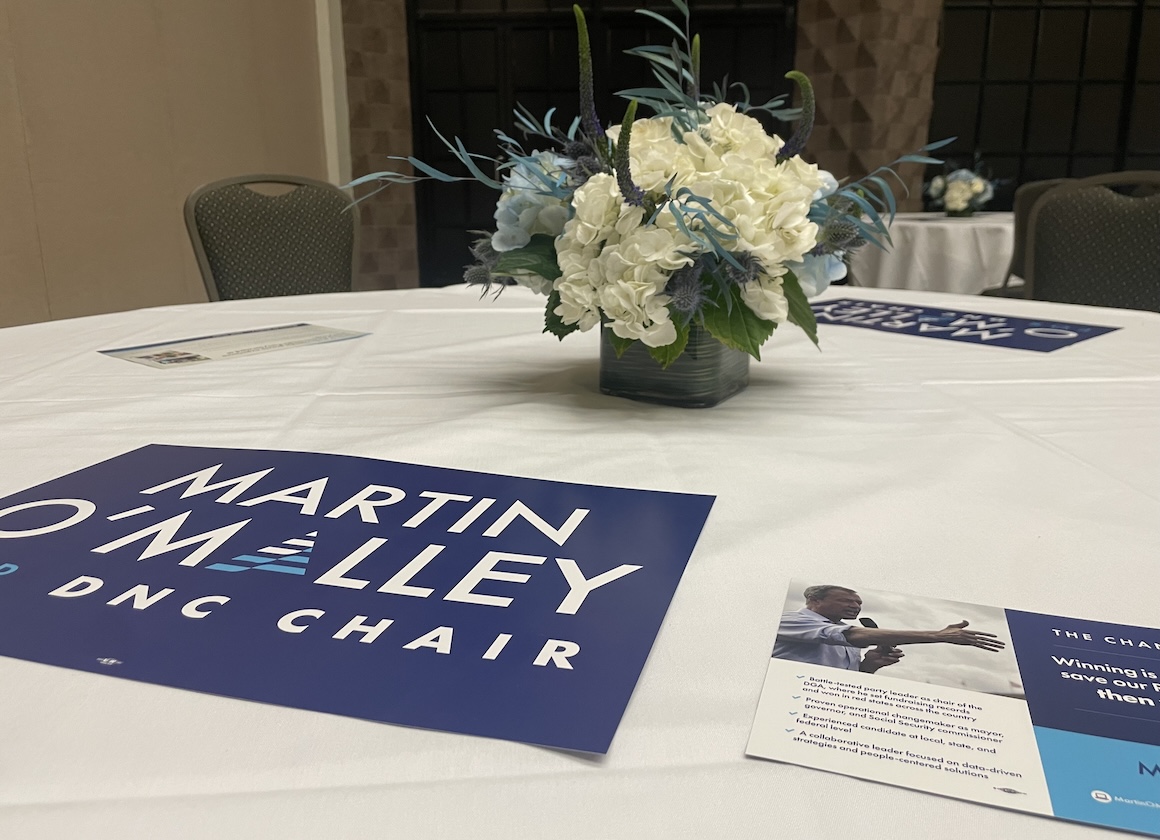
Maryland Gov. Martin O’Malley said in his speech that the party needs to do things differently to win. But, he said, “the good news is the change is really just a return to our true selves to be a party of working people all across America.”
And O’Malley, too, said that he was a “proven operational turnaround leader,” pointing out that President Joe Biden had trusted him to revamp the Social Security Administration when he tapped him as its commissioner.
James Skoufis, a little-known New York state senator representing a Trump-loving district, went the furthest in making the case for transforming the DNC. But he talked more about strategies than ideology, saying that he would go on Fox News and Joe Rogan’s podcast — a reference to Vice President Kamala Harris’ decision to rebuff the show whose interview with Trump boasted 52 million views on YouTube.
He also promised to end “sweetheart deals” and “contracts with vendors that have been ripping off the DNC for cycles.”
Some bigger-name Democrats who could shake up the DNC chair race, like U.S. Ambassador to Japan Rahm Emanuel or Ohio Sen. Sherrod Brown, could still decide to run.
At times, some Democrats argued they needed to stay the course on cultural issues.
In a fiery speech, Harrison lambasted critics in his party who want to walk away from “identity politics.” Democrats began their meeting on Thursday with a “land acknowledgement,” a symbolic gesture that grants that the land a person is standing on previously belonged to Native Americans, which conservatives have derided as “woke.”
As Democrats tried to figure out a path forward, there was a quiet sense among some here that they wouldn’t be out of power for long. It was a stark contrast from people elsewhere in their party who are worried that a realignment could rob them of power for years. After all, these Democrats reasoned, Americans had voted for Trump before — and then quickly grew tired of him, as evidenced by the 2018 midterms and then again in the 2020 presidential election. They took comfort in the fact that voters this year supported liberal ballot initiatives and Democratic Senate candidates in states Trump won.
“Something had to work for Ruben Gallego to win a Senate seat right here against somebody who was a Trump sycophant in terms of Kari Lake,” said Harrison. “Those mixed results don’t say that this was a landslide. It doesn’t say it’s an existential crisis for the Democratic Party.”
Peggy Grove, vice chair of the Pennsylvania Democratic Party, said they have a “good chance” at winning the House in the midterms.
“Yesterday was the bitch day,” she said. “Today started the rebuilding.”


Politics
Trump’s MAGA allies have a new plan for mass deportations. It could splinter the coalition.
A group of President Donald Trump’s MAGA allies released a playbook Wednesday to fulfill the largest deportation push in U.S. history. It could very well split Trump’s coalition.
The plan from the Mass Deportation Coalition — an organization led by some prominent Trumpworld veterans, immigration restrictionist groups and hawkish policy experts — rests on one crucial pillar: A major immigration enforcement crackdown on workplaces, modeling the strategy that former President Dwight D. Eisenhower’s administration used to deliver the nation’s largest deportation initiative in history.
“There is no chance for a mass deportation program if worksite enforcement is not the centerpiece,” the playbook, shared first with POLITICO, reads. “Enforcement at scale means focusing on physical areas where illegal aliens are concentrated: worksites.”
That strategy almost certainly promises to alienate some of the Trump administration’s allies in the agriculture, construction and hospitality industries, which all rely heavily on undocumented labor. Farm groups in particular hold significant sway in Trump’s Washington and have already shown prowess in steering the administration away from worksite enforcement when those efforts disrupted the industry.
Worksite raids could also prove deeply unpopular with voters, whose views have turned increasingly negative toward Trump on immigration and seemingly forced the administration to ramp down its deportation push.
The White House and the Department of Homeland Security did not respond to requests for comment.
The release of the group’s playbook — which also offers recommendations from digitizing the employment verification process to barring unauthorized immigrants from accessing credit — comes as the Trump administration enters a new stage of internal immigration enforcement.
In the months since an immigration surge in Minneapolis left two U.S. citizens dead, the administration pivoted its message on mass deportations while overhauling its leadership at the Department of Homeland Security. Border czar Tom Homan replaced Customs and Border Protection chief Greg Bovino in Minneapolis and drew down the immigration enforcement presence in the city; the president ousted DHS Secretary Kristi Noem and tapped then-Sen. Markwayne Mullin (R-Okla.) to replace her; and a POLITICO review of official administration social media accounts found that references to “mass deportations” sharply decreased in March.
In a statement, White House spokesperson Abigail Jackson denied that the White House has shifted its deportation approach.
“Nobody is changing the Administration’s immigration enforcement agenda,” she said in a statement. “President Trump’s highest priority has always been the deportation of illegal alien criminals who endanger American communities. As the Department of Homeland Security has repeatedly said, approximately 70 percent of deportations to date have been illegal aliens with criminal records.”
Still, the Mass Deportation Coalition is trying to push the White House back toward a more aggressive immigration approach. Its members include Mark Morgan, the former acting commissioner of CBP under Trump; Erik Prince, a Trump ally and former Blackwater CEO who has pitched the White House on privatizing immigration detention operations; and a number of conservative organizations like the Heritage Foundation.
The group commissioned a poll last month by McLaughlin & Associates, one of Trump’s pollsters, that found a majority of likely U.S. voters support deporting all migrants who entered the country illegally. The poll also found that 70 percent of likely voters support “strengthening workplace immigration enforcement to help raise wages for American workers.”
However, those results differ drastically from other recent polling on immigration, like a January POLITICO poll amid the Minneapolis surge which found that nearly half of U.S. adults say Trump’s mass deportation campaign was too aggressive, including 1 in 5 of his 2024 voters.
“Special interests and industry have been able to operate in the shadows, and to lean on lawmakers and administration officials,” said Mike Howell, president of the Oversight Project and a member of the Mass Deportation Coalition. “We’re taking that fight public, and we don’t think that they’re well situated to win that fight, because their arguments don’t sell with the American people.”
The group’s stated goal of 1 million deportations in 2026 mirrors a private goal among White House officials, the Washington Post reported last year. It would mark a significant uptick in apprehensions: The Department of Homeland Security said it deported just over 600,000 individuals in 2025, though independent analyses put the number lower.
Industry groups are warning worksite enforcement would disrupt supply chains. Last June, after immigration raids on farms and meatpacking plants sent a shiver through the agriculture industry and drew negative headlines, Agriculture Secretary Brooke Rollins and others successfully lobbied the president to pivot to focus on blue cities instead — a move that eventually culminated with the tumultuous operation in Minneapolis.
“The president made clear where he stands on the issue, and made clear how he wants to see the policy enforced,” said John Hollay, president of the National Council of Agricultural Employers. “If [immigration raids] were to occur again on farm operations, that’s going to disrupt the food supply chain, and we’ve made that very clear. We know the president is committed to ensuring our food supply chain is not disrupted and that prices at the grocery store are not raised unnecessarily.”
Democrats are opening a new front in their midterm offensive over Iran.
VoteVets Action Fund is rolling out a $250,000 ad campaign Wednesday targeting Rep. Derrick Van Orden (R-Wis.) over his support of the war with Iran, according to details shared first with Blue Light News.
It’s one of the first examples of Democrats putting real money behind the issue in the midterms since President Donald Trump’s attack on the country more than a month ago. And it comes as Republicans grow increasingly worried that the war’s impact on prices could hurt the party at the ballot box this fall.
The ad attacks Van Orden, an at-risk Republican and combat veteran, for backing a Pentagon push for $200 billion more for the Iran operation as prices at the pump continue to rise, and after he called last year for cuts to the Department of Veterans Affairs. The ad accuses Van Orden of backing cuts to veterans’ care — though in the hearing referenced, the Republican advocates for slashing bureaucrats to add more doctors.
The spot sheds light on how Democrats are working to weaponize the war: by arguing that Trump is spending big abroad while further pinching voters’ pocketbooks and, in VoteVets’ case, stiffing veterans.
“Look at that gas pump. We’re paying the cost every damn day of this war in Iran. But for Congressman Van Orden, we’re not paying enough. He’s going for another $200 billion dollars to spend in Iran,” a male Marine Corps veteran narrates in the clip.
“This is the same guy who backed big cuts to VA care for vets,” the veteran says, referring to significant staffing reductions at the agency since Trump returned to office, including thousands of medical personnel. “Vets like me, we understand the cost of war. But if we don’t have the money to take care of our veterans, we damn sure can’t afford another war. Call Van Orden on it.”
VoteVets, whose PAC works to elect Democratic veterans, intends to expand its Iran ad campaign into other battleground districts, with a particular focus on GOP veterans who the group argues are blindly following Trump in abandoning his campaign-trail pledge to end endless wars.
“There’s absolutely no doubt that voters throughout the country, and particularly in Rep. Van Orden’s district, are very aware of the fact that every single day we spend billions of dollars [on] this war in Iran is yet another day that not only is the affordability crisis ignored, but it’s getting even worse,” said former Rep. Max Rose, a New York Democrat who serves as a senior adviser to VoteVets. “What this first video represents is our commitment to holding every single Republican veteran in the House of Representatives accountable for their lies, hypocrisy and absence of courage.”
Van Orden, a retired Navy SEAL who served in Iraq and Afghanistan, slammed VoteVets as a “running joke in the veteran community” in a statement to Blue Light News. He expressed support for Trump’s military operation and the supplemental funding plan that the White House has been reviewing. But Van Orden stressed that he continues to oppose putting uniformed troops on the ground in Iran.
“Iran has been at war with the United States for 47 years. When we start putting a price tag on American citizens’ lives, we’ve already lost sight of our responsibility,” Van Orden said. “Every single American murdered by these radical Muslim mullahs is priceless, and every American life we can save is beyond value.”
The 30-second spot will run during NCAA games and other live sporting events, as well as on broadcast, radio, streaming services and social media platforms. It represents an escalation in Democrats’ rhetoric and aggression as the party seizes on growing voter backlash to the now monthlong conflict that Trump is threatening to intensify.
Democrats have already been hammering Republicans over affordability as the average price of a gallon of gas soars over $4. Now they’re eyeing ways to connect other cost concerns to the ballooning spending on the war amid reporting that Republicans are considering further reductions to federal health spending to bankroll the military effort — returning to some of their signature issues of the cycle to argue that the GOP is prioritizing fealty to the president over voters’ pocketbooks.
Other Democrat-aligned groups are joining in. Battleground Alliance PAC flew a plane over a minor league baseball game in Pennsylvania over the weekend with a banner targeting Republican Rep. Ryan Mackenzie that read “Mackenzie: Your Iran Vote = Sky High $$$Gas.” The group is planning similar stunts in more than half a dozen other swing districts across Michigan, Iowa, Nebraska and Ohio.
“We’re in a war of choice, which is spending an enormous amount of money, and we’re going to get more health care cuts and oil price increases,” said Andrew Grossman, a senior adviser to the labor-backed Battleground Alliance PAC. “And so the cost of living — like the chaos and the Republican Congress just saying yes always to President Trump — is hitting Americans in our pocketbooks, and that is the single most important issue of our moment.”
Mackenzie’s campaign manager, Andres Weller, dismissed the move in a statement as “the same political stunts that people are tired of. An outside group did the same thing at the same place in 2024, and all it accomplished was annoying people who were trying to enjoy a baseball game with their family and friends.”
Democrats’ ramp-up comes as Republicans are increasingly fearful a prolonged war will hurt their chances of holding onto power in the midterms. The conflict is already fracturing the MAGA coalition. And polls show a majority of Americans are against the operation in Iran, including an Ipsos survey released Tuesday that found two-thirds of Americans want the U.S. to end its involvement even if the president does not achieve all his goals, and that 56 percent expect the conflict will have a negative impact on their personal financial situation.
Voters are “going to look to their members of Congress to see if they double down or be an independent voice [on Iran],” Samuel Chen, a Pennsylvania-based GOP strategist, said. “If they’re doubling down on it in these tight seats in Pennsylvania and Wisconsin and other places, that could be the difference.”

The strongest impetus for a deal — the hourslong security lines at some U.S. airports — is already dissipating…
Read More
- Judge blocks Trump order to end funding for NPR and PBS

- ‘No evidence it’s real’: Officials see few signs Trump’s NATO rhetoric is turning into action
- ‘I don’t care about that’: Trump moves the goal posts on Iran’s uranium stockpile

- Mike Johnson caves to the Senate, paving the way for likely DHS shutdown deal
- Former White House official: Trump’s Supreme Court attendance could be ‘perceived as intimidation’
- The Strait of Hormuz is the U.S.’ problem now — whether Trump likes it or not
- Sen. Mark Kelly slams Pete Hegseth for injecting Christian rhetoric into Iran war

- Hill staffers brace for their boss’s ‘TMZ moment’
- Trump’s strategy to calm markets during Iran war is falling flat

- Trump’s MAGA allies have a new plan for mass deportations. It could splinter the coalition.
-

 Politics1 year ago
Former ‘Squad’ members launching ‘Bowman and Bush’ YouTube show
-

 The Dictatorship1 year ago
Luigi Mangione acknowledges public support in first official statement since arrest
-

 Politics1 year ago
Former Kentucky AG Daniel Cameron launches Senate bid
-

 Politics1 year ago
Blue Light News’s Editorial Director Ryan Hutchins speaks at Blue Light News’s 2025 Governors Summit
-

 The Dictatorship7 months ago
Mike Johnson sums up the GOP’s arrogant position on military occupation with two words
-

 The Dictatorship1 year ago
Pete Hegseth’s tenure at the Pentagon goes from bad to worse
-
Uncategorized1 year ago
Bob Good to step down as Freedom Caucus chair this week
-

 Politics12 months ago
Democrat challenging Joni Ernst: I want to ‘tear down’ party, ‘build it back up’