
Congress
A split at the top: Why Thune and Johnson are at odds this week

Speaker Mike Johnson and Senate Majority Leader John Thune have largely worked in lockstep since January. This week, they hit a rough patch.
The two men are known for rising above whatever theatrics are embroiling their respective conferences. But in recent days they became enmeshed in just that, when they publicly split and shadowboxed over a pair of internal GOP dilemmas over politically toxic issues.
The fissure emerged when Johnson trashed a measure that Thune tucked into last week’s government funding deal to allow senators to sue the government and reap damages for electronic records seizures. With the Louisiana Republican calling the provision “a bad look,” the House Wednesday unanimously passed a bill to repeal it in a major rebuke.
Johnson suffered his own loss at the hands of Thune this week when the South Dakota Republican rebuffed the speaker’s calls to amend the House’s Jeffrey Epstein disclosure bill to include more protections for victims and whistleblowers. The Senate passed the bill by unanimous consent, after months of Johnson trying to slow it down in the House and ultimately succumbing to an end-run by Rep. Thomas Massie (R-Ky.).
In an interview Wednesday, Thune downplayed the episodes, calling the phone records provision a “Senate issue” to work through and noting the congressional debate over the Epstein files “took on a life of its own” in the final stages.
“We work very well together. Communicate regularly. There are always going to be hiccups along the way,” Thune said. “And I’ve served in the House. They are very different institutions and different cultures and ways of doing things but we make it work.”
The split marked an unexpected round of turbulence for the mild-mannered GOP leaders, who meet weekly when both chambers are in session and are generally viewed as having a good working rapport.
Now they face two huge challenges they will need to navigate together: Obamacare subsidies are set to expire at the end of next month, threatening health insurance premium hikes for millions of Americans, and the leaders face competing factions in both chambers when it comes to how to respond. In January, Thune and Johnson will once again have to rally their members around a bill to avoid another government shutdown. At stake in all the fights is how the GOP’s handling goes over with voters ahead of next year’s midterm elections.
The friction points reflect a well-worn dynamic of congressional life — the House and Senate operate at times in split-screen political realities despite Thune, Johnson and their conferences belonging to the same party.
Thune, like most of the Senate, didn’t know Johnson before the low-key House member ascended to the speakership in the fall of 2023. But the two men developed a rapport before Thune took over as GOP leader in January. They are viewed as more aligned in their day-to-day operations and temperament than some of their predecessor pairings, including former Senate GOP leader Mitch McConnell and the House’s former top Republican Kevin McCarthy.
“They work well together. And they get along well,” Sen. John Hoeven (R-N.D.), a close Thune ally, said of the two GOP leaders. “They not only have a professional relationship, they like each other.”
Another Republican senator who knows Thune and Johnson said they had “worked very well together” so far, adding that some tension between the two chambers is “probably healthy.”
“They’re very similar,” said the senator, who was granted anonymity to speak candidly about the leaders.
That doesn’t change the fact that senior House Republicans, including some Johnson allies, are still smarting over the inclusion of the payout language for senators in last week’s funding package. It was designed to give special recourse to Senate Republicans who had their phone records seized during Jack Smith’s investigation into Trump’s 2020 election interference. House Republicans have said they didn’t learn about it until after the Senate passed the bill and it was the House’s turn to act on reopening the government.
For an angry swath of House Republicans, the episode reinforced their long-standing anxieties about being jammed by the Senate and painted Johnson — who also said he didn’t find out about the provision until after Senate passage — as embarrassingly out of the loop.
Johnson quickly promised the House would vote on separate legislation to repeal it, and the House passed the rollback Wednesday night with zero opposition. Thune also got an earful from his own members during a closed-door lunch Wednesday, including from typical leadership allies like Appropriations Chair Susan Collins (R-Maine).
Rep. Chip Roy (R-Texas), a former Senate staffer, said Wednesday as he made the case for repealing the provision ahead of the vote that the House needed to “hip check” the Senate.
Johnson, meanwhile, told reporters that Thune was “a trustworthy, honest broker, and that’s why I was so surprised when we found out about that [phone records] provision.”
Across the Capitol, Senate Republicans believe Johnson dropped a hot potato in their lap in the form of the bill to release the Epstein files. Johnson presided over bitter infighting for months over the bipartisan push to force a vote on the matter. By the time Johnson agreed to it, he was on the verge of being on the losing side of an open rebellion within his ranks and seemingly at odds with Trump, who suddenly urged Republicans to support it Sunday night.
Johnson framed his pivot around a hope the Senate would alter the bill before clearing it for Trump’s signature.
“I talked to John Thune over the weekend. I just texted him. We’re going to get together. We’ll talk about this,” Johnson told reporters as he left the House floor Tuesday following the 427-1 vote to release the files.
But Senate Republicans, including members of leadership, never had an appetite for making changes. Many GOP senators privately made clear they didn’t want Thune to drag out the Epstein discussion as Johnson had, and Thune never publicly opened the door to amending the bill.
Two people granted anonymity to discuss private party dynamics said that if Thune had bowed to Johnson’s push for changes, it would have risked keeping Republicans mired in the Epstein issue for weeks.
“What was [Thune] supposed to do with a bill that passed the House 427-1 … had no objections in the Senate and the president said he’d sign?” one of the people said.
“That is House drama,” said another GOP senator granted anonymity to speak candidly about the situation. “We don’t need that over here.”


Washington is locked in a high-stakes game of chicken over Department of Homeland Security funding, raising the possibility that thousands of federal workers could go unpaid for several more weeks — if not longer.
The shutdown is already the longest ever experienced by any part of the federal government, and in recent days the political sparring has gone from being a mostly partisan showdown between Republicans and Democrats into a messy internal battle for the GOP.
Both the House and Senate have adjourned for two weeks, with neither chamber seriously considering returning early despite a wave of online outrage and calls from the White House to return to session. Instead, House Republicans and Senate Republicans have spent the last several days pointing fingers at each other, while Democrats dig in against funding immigration enforcement agencies without implementing guardrails the GOP has resisted.
“The House has their process, we have ours and this happens periodically,” Sen. John Hoeven (R-N.D.) told reporters Monday.
There is no immediate hope the standoff, which has affected tens of thousands of workers since it began Feb. 14, will soon end. An administration official granted anonymity to speak candidly said that “people are thinking this will go into the summer.”
“Morale is low. The TSA getting paid while the rest of us summer is not playing well inside the building,” the official added.
Bipartisan negotiations over immigration enforcement changes have gone almost nowhere, according to several people granted anonymity to candidly describe the talks. House and Senate Republicans are in a public tug-of-war over their competing Plan Bs. And President Donald Trump is doing little to unite his party behind a consensus position — let alone pushing them to cut a deal with Democrats.
Perhaps most worrying for those eager to end the stalemate is that the strongest impetus for a deal — the hourslong security lines at some U.S. airports — is already dissipating.
White House press secretary Karoline Leavitt defended Trump’s decision to step in and fund TSA paychecks — a move privately encouraged by some Republicans — saying that the president had to do “what’s right to end this crisis that we’ve had at air travel and at airports across the country.”
But a DHS official granted anonymity to speak candidly said Trump’s decision to pay airport screeners, as well as the unanimous passage of a Senate GOP plan to fund the vast majority of the department, stripped Republicans of their main pressure point.
“Remember in the last shutdown, it was airport chaos that forced the seven Democrats to switch sides and fund the government,” the official said.
While about 50,000 airport security officers are now getting paid under Trump’s executive action, thousands more workers remain furloughed or working without pay. Those include more than 2,000 employees of the premier federal cybersecurity agency, more than 4,000 FEMA workers as well as more than 1,000 Coast Guard civilians.
DHS spokesperson Lauren Bis said in a statement that the record-breaking shutdown was affecting department employees tasked with protecting Americans and visitors for the upcoming World Cup soccer tournament and America 250 anniversary celebrations,
“Democrats need to stop holding these hard-working DHS employees’ pay hostage and putting politics above national security,” she said.
But as far as Democrats are concerned, they have struck a shutdown-ending deal — the Senate legislation passed early Friday morning by voice vote that would fund all of DHS except for Immigration and Customs Enforcement and some parts of Customs and Border Protection. House Republicans rejected that bill and passed their own legislation late Friday that would fund all of DHS through May 22.
No senator attempted to pass the House measure in a brief Monday morning session, and in a sign that a consensus deal is nowhere close, some Senate Republicans want to instead try to fund the entire department through the party-line budget reconciliation process. That would bypass Democrats but require time-consuming procedural steps and potentially create messy new divides among Republicans.
Still, Hoeven said Republicans might have no better choice than to enact DHS legislation themselves for the remainder of Trump’s term.
“We’re not going through this again with the Dems,” he told reporters after the Senate session Monday. “We’re taking this off the table.”
Sen. John Kennedy (R-La.) also argued Republicans need to accept that Democrats will never fund the immigration enforcement agencies that became politically toxic on the left after federal agents killed two people in Minneapolis in January.
“The only thing I know to do is to take the Democrats out of it,” Kennedy said in an interview. “Just do the entire DHS budget under reconciliation.”
The problem for Republicans is they want to do much more than DHS funding in reconciliation, with the House and Senate GOP holding vastly different visions for the effort. Conservatives in both chambers are pushing to offset any new spending with cuts elsewhere — a politically tricky ultimatum.
Under the plan Senate GOP leaders passed last week, the consensus funding bill agreed to by Democrats would be paired with a reconciliation bill narrowly focused on immigration enforcement. Senate Majority Leader John Thune warned that trying to do all of DHS under the party-line process “gets a lot more complicated.”
Instead, Thune approached Senate Minority Leader Chuck Schumer after the House rejected the Senate-passed bill to try to find another path to funding as much of DHS as possible. But expectations for a deal are low, given Democrats’ repeated rejections of stopgap funding bills. Still, Thune is expected to spend most of the two-week break trying to find a bipartisan path out of the funding impasse, according to a Senate GOP aide granted anonymity to disclose private scheduling.
A bipartisan group in the House has pitched its own plan to pair DHS funding with immigration enforcement changes. But the Senate conversations aren’t headed in that direction, absent a shift from the White House, with Thune saying the “ship has sailed” after Democrats rejected multiple GOP offers on enforcement restrictions.
Thune is dealing with pressure from the White House, online activists, House Republicans and even some of his own members to bring the Senate back into session before its scheduled April 13 return date.
In a head-scratching subplot, a few Senate Republicans have publicly suggested they did not agree with the deal they could have derailed in advance, while others have privately questioned Thune’s strategy given how quickly it unraveled in the House.
The bill was approved at 2:19 a.m. Friday after Senate GOP staffers ran a “hotline” — an established process for clearing measures slated for passage by voice vote or unanimous consent.
In addition to checking with Senate offices in the hours before the vote, Thune also briefed his conference Thursday evening on a developing plan to try to pass a bill funding as much of DHS as possible, leaving ICE and parts of CBP for reconciliation.
But Sen. Rick Scott (R-Fla.) said later that morning he opposed the deal. Asked why he didn’t object to the hotline or on the floor — or if he would try to pass the House bill in the Senate — a spokesperson pointed back Monday to his social media posts.
Sen. Mike Lee (R-Utah) similarly expressed regrets online after his social media followers aired outrage about the overnight vote. He explained on X that he “had every reason to believe President Trump and House Republicans were on board” with the play and thus “declined to call in an objection.” Spokespeople for Lee didn’t respond to questions Monday.
Hoeven, a close Thune ally, defended the majority leader Monday saying he “absolutely” believed leadership was handling the DHS funding fight well. He brushed off some of the intraparty grumbling as sour feelings about the long-running standoff.
“I think there’s some real frustration because the Democrats want to go back to open borders, and they’re blocking funding,” Hoeven said. “So I think you’re hearing some of that from senators.”
Eric Bazail-Eimil, Katherine Tully McManus, Calen Razor and Riley Rogerson contributed to this report.
The House Rules Committee advanced a measure Friday evening that would fund the entirety of the Homeland Security Department through May 22 — without setting up debate or a separate vote on the funding bill itself.
The panel, after a raucous meeting that devolved into shouting at multiple points, voted 8-4 on party lines to advance the measure to the floor.
The rule includes a “deem and pass” provision, a tactic that allows legislation to be passed by the House automatically once the rule itself is adopted. While there will be one hour of floor debate and a vote on the rule, there will not be a standalone House vote on the DHS spending bill.
Rep. Jim McGovern (D-Mass.) described himself as needing “a neck brace” from the whiplash of hearing Republicans argue for hours that the Senate’s early-morning voice vote on a different DHS funding measure was “shameful” for lack of transparency and accountability.
House Appropriations Chair Tom Cole (R-Okla.) accused the Senate of moving their bill “in the middle of the night, with the smell of jet fumes in the air,” lamenting that the House was left “to take it or leave it.”
House leaders, McGovern suggested, have chosen a similar path by fast-tracking the eight-week DHS stopgap.
“You’re in charge,” he told Rules Chair Virginia Foxx (R-N.C.). “You can do whatever the hell you want to do.”
Sen. Rand Paul (R-Ky.) is considering a bid for president in 2028, as Republicans jockey for the future of the GOP post-Trump.
In a “CBS Sunday Morning” interview airing Sunday, a reporter asked Paul about an article that implied he would be running for president.
“We’re thinking about it,” Paul said. “I would say fifty-fifty,” adding that he would make a final decision after the midterm elections.
Paul ran for the Republican nomination for president in 2016 with a libertarianism-focused campaign but ultimately dropped out after a poor performance in the Iowa caucuses and a shortage of cash. He instead ran for reelection to the Senate.
Paul has had a complex relationship with his own party and with President Donald Trump, often finding himself the lone Republican on certain issues. More recently, he was the only Republican to support a joint resolution that would limit Trump’s war powers in Iran.
His father, former Rep. Ron Paul, also ran for president three times: first as a Libertarian in 1988, and twice as a Republican in 2008 and 2012.
- The DHS shutdown might never end
- Trump says he has ‘no problem’ with Russian oil tanker bringing relief to Cuba

- Midnight train from GA: A view of America from the tracks as airports struggle

- Democrats clamored for George Santos’ ouster. Soon they could face having to evict one of their own.

- ‘I just want to go home’: Despair settles over the Capitol as DHS deal hopes evaporate
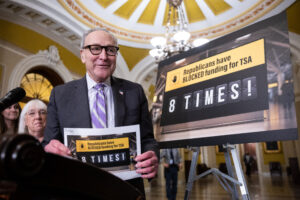
- Schumer rolls out Democrats’ midterm energy pitch

- Special election shocker has Florida Republicans nervous about redistricting

- GOP framework still ‘best landing spot’ for DHS funding, Thune says
- Delaware judge reassigns multiple Musk cases after accusations of bias

- Leavitt on Trump’s TSA order: ‘It should not have come to this point’

-

 The Dictatorship1 year ago
Luigi Mangione acknowledges public support in first official statement since arrest
-

 Politics1 year ago
Former ‘Squad’ members launching ‘Bowman and Bush’ YouTube show
-

 Politics1 year ago
Former Kentucky AG Daniel Cameron launches Senate bid
-

 Politics1 year ago
Blue Light News’s Editorial Director Ryan Hutchins speaks at Blue Light News’s 2025 Governors Summit
-

 The Dictatorship7 months ago
Mike Johnson sums up the GOP’s arrogant position on military occupation with two words
-

 The Dictatorship1 year ago
Pete Hegseth’s tenure at the Pentagon goes from bad to worse
-
Uncategorized1 year ago
Bob Good to step down as Freedom Caucus chair this week
-

 Politics11 months ago
Democrat challenging Joni Ernst: I want to ‘tear down’ party, ‘build it back up’