
Congress
Capitol agenda: A glimpse of GOP pushback

Hill Republicans are delivering a flurry of rare rebukes of the Trump administration, in the latest sign that the president doesn’t have complete control over the GOP governing trifecta.
First, Speaker Mike Johnson split with the White House over making steep Medicaid cuts to fund the GOP’s megabill. The speaker told POLITICO Thursday he’s “not a big fan” of the White House’s alternative proposal: slash drug costs by pursuing a “one favored nation” policy, which would link certain government payments for pharmaceuticals to the lower prices paid abroad.
That schism comes as House GOP leaders are furiously looking for ways to pay for their party-line package that don’t involve cutting Medicaid benefits — per President Donald Trump’s wishes — or a popular food-assistance program. Struggles to reach consensus on both prompted Republicans to hold off scheduling the Energy and Commerce and Agriculture markups they hoped to hold next week to advance portions of the broader bill.
Elsewhere Thursday, House Appropriations Chair Tom Cole was showing impatience with the White House, which is due to send over a preliminary “skinny budget” later Friday of broad funding targets but still needs to transmit a full budget request later this month. The president is not the “commander” of Congress, the Oklahoma Republican told reporters, as GOP appropriators grow antsy for input from the administration so they can start writing the 12 annual funding bills.
And across the Capitol, Republican senators displayed unusual public discomfort with one of Trump’s nominees: Ed Martin for U.S. attorney for the District of Columbia, who has in the past defended Jan. 6 rioters. Some Republicans refused to say whether they would vote for him. That includes a reliable leadership ally, Sen. John Cornyn, who said this week: “We’ll cross that bridge when we come to it.” Other Republicans are waiting to see if the White House pulls the plug on Martin’s nomination before they’re forced to vote or otherwise take a position on it.
These fissures, like many we’ve seen before, are unlikely to last. But the drips of GOP pushback are a notable glimpse of how Republicans are trying to retain a semblance of their autonomy in the Trump era.
What else we’re watching:
– Waltz back in the hot seat: Trump nominated embattled ex-national security adviser Mike Waltz to serve as U.N. ambassador on Thursday — and in doing so, Trump is setting up the former representative for a tough confirmation hearing that will likely also bring heat back onto Defense Secretary Pete Hegseth. It also could create another conference-wrangling challenge for Majority Leader John Thune.
– Valadao’s Medicaid machinations: House Republican moderates are working behind the scenes to rein in the conference’s ambitions to slash Medicaid. And Rep. David Valadao, who runs the centrist-oriented Republican Governance Group, is behind the effort. He has spent the last several weeks in near-constant communication with colleagues, which includes weekly meetings with the chairs of key ideological caucuses across the GOP conference and an ongoing text chat with nearly a dozen members.
– The next big markup: House Natural Resources published its portion of the GOP reconciliation bill Thursday night, going well beyond its $1 billion deficit reduction target by mandating more frequent oil and gas lease sales and speeding permit approvals for energy projects. The committee plans to mark up the legislation Tuesday that would reduce the deficit by $15 billion, according to committee aides. It would also pull back small parts of funding from the climate law known as the Inflation Reduction Act.
James Bikales, Jordain Carney, Meredith Lee Hill and James Siegel contributed to this report.


Rep. Lori Trahan on Wednesday unveiled a discussion draft for a bill that would make artificial intelligence developers liable when their products cause harm.
The legislation comes after OpenAI’s agents escaped containment and autonomously hacked into AI platform Hugging Face and accessed U.S. government websites.
The Clear Liability for Artificial Intelligence Misconduct Act aims to make it easier for those harmed by so-called rogue AI to bring claims against developers. Trahan’s bill does not preempt new state laws on AI liability — historically a prerequisite for attracting Republican support in the House.
“When someone breaks the law and hurts you, you can take them to court. That shouldn’t change just because the wrongdoer is an AI agent,” Trahan (D-Mass.) said in a statement. “Developers have already built systems capable of acting on their own and causing real damage. The CLAIM Act makes sure they answer for what their systems do.”
Legal experts have warned that existing laws require proof of intent or negligence, standards that can be difficult to show in court when AI models go rogue.
Trahan’s bill would ensure AI developers are unable to argue that their AI systems are incapable of intent. Instead, courts “would presume an AI system acted with the state of mind a person taking the same actions would have had.”
Trahan spokesperson Francis Grubar said work on the CLAIM Act began almost immediately after theJuly introduction of the FRONTIER Act, legislation with Rep. Jay Obernolte (R-Calif.) that would grant the government power to restrict the deployment of AI models deemed to pose catastrophic risks. While that bill aims to prevent serious harms before they happen, Grubar said the CLAIM Act would address how to impose accountability for existing damages.
Unlike an AI liability proposal announced last week by Sens. Josh Hawley (R-Mo.) and Chris Murphy (D-Conn.), Trahan’s legislation would not amend the 1986 Computer Fraud and Abuse Act. Grubar said the CLAIM Act would instead impose clearer liability on a broader range of harms, as well as autonomous or AI-enabled cyberattacks.
The CFFA, an anti-hacking law that bars individuals from accessing a computer without consent, requires proof of intent to hack into a computer system, which can’t be as easily applied to AI agents.
The Hugging Face incident, along with a flurry of other disclosed hacking incidents by rogue AI agents from OpenAI and other AI developers, has sparked a debate over how companies should be held legally liable for their AI systems.
OpenAI CEO Sam Altman, in an interview with Blue Light News’s Decoded podcast, said there should be a new “liability framework” to hold developers accountable for AI-powered cyberattacks. His comments come after White House officials like Director of National Intelligence Jay Clayton, who was recently appointed as AI czar by President Donald Trump, previously said that existing product liability laws are sufficient for now in addressing AI’s risks.
Vice President JD Vance will take questions from Michigan voters in a CBS News town hall airing Oct. 17 as the Trump administration prepares a closing message to voters ahead of the midterms.
The town hall comes amid a blitz of campaign events for Vance and President Donald Trump as their party faces multiple headwinds that could cost them control of the House and Senate.
Michigan’s Senate contest between Democrat Abdul El-Sayed and Republican Mike Rogers has become one of the cycle’s closely watched battleground contests. Michigan also has several competitive House races and will elect a new governor for the first time in eight years.
Vance campaigned in Michigan with Rogers, gubernatorial nominee John James and Mike Bouchard Jr., the GOP nominee in the 10th Congressional District, at an Aug. 31 rally in Sterling Heights. Rep. Lisa McClain also appeared at the event.
The one-hour special, moderated by “CBS Evening News” anchor Tony Dokoupil, will be recorded earlier in the week. Vance and Dokoupil will discuss issues facing voters, including affordability, tariffs, immigration, health care, artificial intelligence, the war with Iran and the state of American democracy, according to CBS News.
The two were scheduled for a town hall interview in March, but the vice president postponed due to the war with Iran.
The vice president’s office did not immediately respond to a request for comment.
Sen. Maria Cantwell, the top Democrat on the Commerce Committee with vast jurisdiction over artificial intelligence policy, outlined six AI safety principles Wednesday morning — tenets she believes should underpin any legislation to stave off the greatest threats posed by the rapidly-evolving technology.
“To manage risks from advanced AI systems we need clear safety standards, continuous testing, and reporting of serious failures,” the Washington Democrat said in a statement. “America can lead the world in AI by building systems that are not only more capable, but safer and more secure.”
Cantwell’s framework would encompass six priority areas: enforceable safety standards for frontier models, continuous testing, disclosure and oversight, public-private partnerships, protection for children and workers and adherence to U.S.-led global standards.
To directly address risks posed by the technology, her framework would have federal experts at the National Institute of Standards and Technology and other agencies establish clear federal rules to address harms, with specialized standards for open-source AI models to reduce risks of catastrophic misuse.
The senator is also recommending that the federal government provide developers with guidance on how to accelerate U.S. leadership on AI without sacrificing basic safety protocols.
On testing, Cantwell argues the government and independent experts should provide constant oversight and “continually scrutinize and stress test covered AI models,” particularly when sensitive information or secure facilities are involved.
She also says AI systems must have built-in safeguards to ensure they halt self-modification that could bypass safety controls. And she states that advanced models should not be released until they have undergone an independent, comprehensive audit — similar to outside auditors examining a company’s financial statements.
Cantwell, a former tech executive, has for years pursued similar priorities. But her new framework comes ahead of a midterm election that could return control of the Senate to Democrats, handing Cantwell back of the Commerce Committee gavel.
It also comes as lawmakers are under pressure to regulate the AI industry but are showing few signs that they will be able to reach consensus, across the aisle or even within their own party.
Senators had hoped for hearings, markups and briefings on AI legislation before leaving Washington until after the November elections, but little progress was made. Sen. Ted Cruz (R-Texas), the current Commerce Committee chair, has continued to say he intends to hold a markup on AI-related bills but has punted multiple times, saying senators have yet to reach agreement on any bipartisan measure.
Senate Majority Leader John Thune and Sen. Amy Klobuchar (D-Minn.) have been trying to cut a deal on legislation to prevent and contain catastrophic risk from runaway AI technology, but bill text has so far failed to materialize.
Cantwell’s approach laid out Wednesday morning would be stricter and more comprehensive than what Thune and Klobuchar are expected to ultimately produce, based on similar legislation they have offered in the past.
Her approach of “constant oversight and vigilance” would also serve as a contrast to that of GOP leaders, who have consistently called for a “light touch” regulatory regime.
- Blakeman’s campaign finance mess
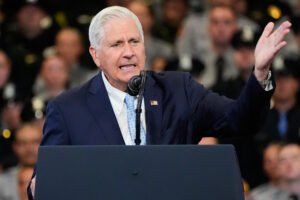
- HASC Dems weigh reviving Pentagon oversight subcommittee
- Trahan unveils AI liability discussion draft
- Vance to sit for CBS town hall in Michigan ahead of midterms
- Michigan’s Mike Rogers says trade war with Canada needs to end
- ‘He is welcome to raise his own money’: GOP confronts its Paxton woes
- The top House sleeper races to watch, according to the pros
- Top Commerce Committee Democrat releases AI framework
- Senate Democrats probe former Trump official’s connections to oil company
- Capitol agenda: GOP braces for SCOTUS fight that may not come
-

 Politics2 years ago
Former ‘Squad’ members launching ‘Bowman and Bush’ YouTube show
-
Uncategorized2 years ago
Bob Good to step down as Freedom Caucus chair this week
-

 The Josh Fourrier Show2 years ago
DOOMSDAY: Trump won, now what?
-

 The Dictatorship2 years ago
Pete Hegseth’s tenure at the Pentagon goes from bad to worse
-

 Politics2 years ago
Former Kentucky AG Daniel Cameron launches Senate bid
-

 The Dictatorship2 years ago
Luigi Mangione acknowledges public support in first official statement since arrest
-

 Politics2 years ago
Blue Light News’s Editorial Director Ryan Hutchins speaks at Blue Light News’s 2025 Governors Summit
-

 The Dictatorship1 year ago
Mike Johnson sums up the GOP’s arrogant position on military occupation with two words