
Congress
Johnson digs in against proxy voting, citing House’s ‘integrity’

Speaker Mike Johnson is digging in against allowing proxy voting for the House’s new parents, heightening a standoff with members of his own party that has frozen legislative action in the chamber.
“While I understand the pure motivations of the few Republican proxy vote advocates, I simply cannot support the change they seek,” Johnson said in a Wednesday post on X.
The speaker is in a serious bind after suffering a stunning defeat over a procedural vote Tuesday, prompting him to send the House home until next Monday. Johnson’s initial effort to block a vote on a proxy-voting measure from Rep. Anna Paulina Luna (R-Fla.) failed after eight fellow Republicans joined her and every Democrat.
Luna was on the cusp of forcing a vote on her bill under a discharge petition, which can circumvent leadership’s control of the floor.
If Johnson attempts a similar move next week, Luna and several of her GOP allies insist they will vote against any effort to reopen the floor. The speaker’s leadership circle, meanwhile, says if he doesn’t try to kill Luna’s petition, House Freedom Caucus hard-liners who oppose proxy voting will themselves defeat any attempt to get House business moving as usual.
Johnson’s circle is aware of the optics of opposing accommodations for new mothers while also upholding their pro-life values and not risking electoral blowback ahead of the midterms.
“As the father of a large family, I know firsthand the difficulty and countless sacrifices that come with balancing family life and service in Congress,” Johnson wrote Wednesday. “New mothers and all young parents face real challenges in this regard. We truly empathize with them.”
But he said he had an obligation to “defend and uphold the Constitution and the integrity of this institution, which has stood the test of time for more than two centuries.”


Members of Congress are desperate for backup in their battle with the Trump administration over control of federal cash. The oversight agency that would lean into that fight is sitting on its hands.
The independent Government Accountability Office concluded earlier this week that the White House illegally withheld more than $1 billion for education and health care research programs — the latest in more than a half-dozen such findings GAO has published since the start of President Donald Trump’s second term.
But the agency has yet to use its unique power to take the president to court to challenge those “impoundments,” and lawmakers who are tired of the administration running roughshod over their funding prerogatives want GAO to act.
There’s one problem: GAO is currently run by an interim director, acting Comptroller General Orice Williams Brown, because the Senate has yet to confirm a long-term replacement following her predecessor’s retirement last year. And lawmakers fear she’s reluctant to exercise her temporary authority to take such dramatic legal action.
“They are empowered to sue,” Sen. Susan Collins (R-Maine), chair of the Senate Appropriations Committee, told reporters last week. “I think the biggest problem is that we have an acting director of the GAO, who understandably is wary of suing the administration without direct congressional approval.”
The recent rulings came on the heels of Trump’s unilateral cancellation of $810 million in other congressionally approved spending the previous week — which GAO quickly deemed illegal — as well as his decision to allow hundreds of millions more to expire as the fiscal year ended Sept. 30.
The search for a permanent GAO leader, meanwhile, appears to be at a standstill. A designated group of 10 senior lawmakers is supposed to be searching for replacement candidates to recommend for Trump’s nomination, but the members have yet to meet — nine months since former Comptroller General Gene Dodaro departed at the end of his 15-year term.
“We would like a GAO director who’s a man or a woman of integrity and going to do the job that needs to be done. That’s our focus,” said Sen. Gary Peters of Michigan, who is part of the selection group as the top Democrat on the Homeland Security and Governmental Affairs Committee.
He said it was accurate that the group has made no progress toward recommending nominees.
The Washington Sun reported Thursday that the administration has floated the idea of Trump nominating Eric Ueland, a top official at the White House budget office and former longtime Senate aide, to head GAO. Blue Light News has not independently confirmed the potential nomination.
If Ueland is nominated, however, there is no guarantee he would have the votes for confirmation in a narrowly divided Senate, given the perception of his loyalty to the president and doubt he would challenge Trump’s funding moves.
In the meantime, lawmakers in both parties are urging the acting director to sue, while a GAO spokesperson maintains that the agency “has not made a decision to file any lawsuits at this time” and that the acting comptroller general “legally exercises all the functions and duties” of the role.
The fact that GAO is operating without a Senate-confirmed leader “is definitely stifling their ability to hold the administration accountable,” Sen. Chris Van Hollen (D-Md.) said in an interview, adding that he believed Dodaro was “clearly building toward making a case” prior to his retirement.
Dodaro said in an interview during his final days at GAO that he considered a lawsuit against the Trump administration “a last resort.” He explained that “in every case we’ve identified so far, people were already suing” and that “Congress has the ability to correct these things and to deal with the distribution of funds.”
What the former inspector general did not expect, however, is the Supreme Court’s suggestion last fall that GAO is the only entity with standing to sue the Trump administration for violating the decades-old Impoundment Control Act, which was designed to ensure presidents spend all the money Congress approves.
Dodaro said he was “surprised” by that suggestion, given his belief that “the law is very clear that GAO’s ability to sue doesn’t preclude anybody else from suing.”
A year later, the president has continued to flout Congress’ authority to dictate how federal dollars get spent. Top administration officials and some Republicans in Congress have publicly belittled GAO as a partisan and noncredible oversight agency since Trump’s return to office.
And after the federal watchdog concluded last week that Trump’s recent funding cancellation is unconstitutional, White House budget director Russ Vought claimed on social media that GAO makes its “legal assessments based on whether Democrats are in the White House.”
Potentially bolstering GAO’s arguments in a lawsuit, lawmakers added provisions to the government funding bills Trump signed into law this year designed to protect their own power of the purse, though Republicans bucked Democratic demands to enact the most aggressive constraints — including to block Trump’s ability to cancel federal dollars at the end of the fiscal year.
Some Republicans are now embracing more stringent methods to stifle Trump’s funding moves, however, after he slashed hundreds of millions dollars through the “pocket rescissions” tactic last month.
“I’m very disappointed in their action here, and it will have to be rectified,” Sen. Mike Rounds, a South Dakota Republican, said about Trump’s latest funding cancellation in an interview.
But he also said he doesn’t know if GAO or another entity should sue: “I’m not sure who should do it. All I know is I want a different result than what we have right now.”
Senate Judiciary Chair Chuck Grassley is firing back at Democrats on his committee who have criticized the GOP’s treatment of former special counsel Jack Smith — saying it was Democrats who acted in an embarrassing manner at a recent hearing with Smith by “falling over themselves” to defend the “unlawful and unconstitutional actions” of the Biden-era prosecutor.
The Iowa Republican’s letter to top Judiciary Democrat Dick Durbin of Illinois, obtained exclusively by Blue Light News, also accuses Democrats of withholding records from Republicans in the past and refusing to engage in legitimate oversight of Smith’s activities.
“You see, your side can’t argue about Rules when your side doesn’t play by them,” Grassley wrote to Durbin.
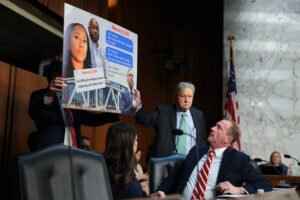
Grassley’s letter was transmitted less than 24 hours after Durbin demanded Grassley apologize on behalf of his fellow committee Republicans for antagonizing Smith, who brought criminal charges against President Donald Trump for seeking to overturn the 2020 election and mishandling classified documents.
Durbin specifically called out Missouri GOP Sen. Eric Schmitt, who falsely accused Smith of attending an NBA game in Atlanta with the subtext that it was used to conspire with local prosecutors on criminal charges against Trump. Durbin said the minority should have had access to those records before the hearing.
He also scolded Grassley and his team for not sharing those underlying records that Schmitt, as well as fellow Missouri GOP Sen. Josh Hawley, referenced during the hearing relating to a call that took place between Smith and the Public Integrity Section of the Justice Department about a decision to bring an updated indictment against Trump in the 2020 election subversion case.
In his letter responding to Durbin, Grassley took the opportunity to call out committee Democrats for instances where he believes they ran afoul of Senate rules by withholding or leaking information about nominees — such as during the confirmation battle for Supreme Court Justice Brett Kavanaugh in 2018 and the much more recent fight to seat Emil Bove as a judge on the U.S. Court of Appeals for the Third Circuit in 2025.
And he criticized Democrats for not joining him in a litany of investigative pursuits — from Smith to alleged corruption among former President Joe Biden’s family members — and insisting that the heart of his work is based in respect for whistleblowers who come forward to expose injustice.
“By now it should go without saying that my Democratic colleagues had every chance to assist in my constitutional duty to conduct oversight of these matters,” he wrote. “They all failed to lend a hand or request to join my oversight.”
Grassley also told Durbin that his staff is currently “working to obtain an agreement to provide you access” to records referenced by Schmitt and Hawley during last month’s hearing with Smith, “and spending considerable time in doing so.
“In fact,” Grassley continued, “my staff have already reached out to yours to schedule a meeting next week to review records as well as the ones you’ve recently written me about.”
He added, however, that “some records will not be shared with you until a later date,” as he intends to continue his investigation into Smith.
“The investigation is active, the hearing is not the end of my work,” said Grassley, who believes Smith weaponized the judicial system to damage Trump and, among other things, illegally obtained lawmaker phone records in the process.
In a post on X Thursday, Grassley said Smith “should apologize for taking the bank records of 42 Iowans & 4,782 Americans.”
Spokespeople for Smith and Durbin did not immediately respond to requests for comment.
Michigan GOP Senate nominee Mike Rogers signaled he would accept support from AIPAC as he remains locked in a tight contest against Democrat Abdul El-Sayed.
Rogers was asked during a debate Thursday whether he would welcome public backing from the American Israel Public Affairs Committee — and he pointedly did not rule it out.
“Anybody that wants to help my campaign stop” El-Sayed, he said, “I’ll take all of that help.”
AIPAC’s super PAC, United Democracy Project, uncorked more than $30 million against El-Sayed in Democrats’ bruising primary. El-Sayed turned the deluge into a cudgel, railing against the group’s heavy spending to rally progressives to his side as support for Israel cratered among Democrats amid the war in Gaza.
The group does not appear to have spent on television ads since, according to tracker AdImpact.
The debate moderator asked Rogers about an Axios report from August that said allies of the Republican had asked AIPAC not to advertise on his behalf. The report said the group scrapped a video ad against El-Sayed a day after Rogers spoke with AIPAC board chair Michael Tuchin.
Rogers also reportedly attended fundraisers hosted by AIPAC in California in August.
A representative for UDP declined to comment.
Rogers and El-Sayed clashed over U.S. military aid for Israel in their debate. Rogers said he supports Israel’s “right to defend itself in a very difficult neighborhood,” while El-Sayed said “I don’t want our tax dollars buying weapons for other countries.”
- Grassley slams Democrats for ‘falling over themselves’ to defend Jack Smith
- This watchdog can bark. Congress wants it to bite.
- Byron Donalds says he is not a ‘yes man’ to Trump

- Mike Rogers opens the door for AIPAC support in Michigan Senate race
- Hegseth: Military will publicly execute Fort Hood shooter
- Mike Johnson voices uncertainty about his future if GOP loses control
- Capitol agenda: GOP ads have yet to overwhelm voters, poll finds
- Justice Democrats announce new executive director

- Iran’s drones reveal US military weakness
- Democrats call on Chuck Grassley to apologize to Jack Smith for basketball gaffe
-

 Politics2 years ago
Former ‘Squad’ members launching ‘Bowman and Bush’ YouTube show
-
Uncategorized2 years ago
Bob Good to step down as Freedom Caucus chair this week
-

 The Josh Fourrier Show2 years ago
DOOMSDAY: Trump won, now what?
-

 The Dictatorship2 years ago
Pete Hegseth’s tenure at the Pentagon goes from bad to worse
-

 Politics2 years ago
Former Kentucky AG Daniel Cameron launches Senate bid
-

 The Dictatorship2 years ago
Luigi Mangione acknowledges public support in first official statement since arrest
-

 Politics2 years ago
Blue Light News’s Editorial Director Ryan Hutchins speaks at Blue Light News’s 2025 Governors Summit
-

 The Dictatorship1 year ago
Mike Johnson sums up the GOP’s arrogant position on military occupation with two words