
Politics
Hochul’s how-to guide to stopping ICE


ICE TO SEE YOU: Gov. Kathy Hochul’s office is advising local governments that zoning and state environmental laws can stymie Immigration and Customs Enforcement from building or expanding detention facilities in their communities.
Those legal barriers — spelled out in a letter sent today by Hochul to local government leaders — represent the latest effort by her administration to halt ICE’s efforts in New York.
“We need localities focused on keeping our communities safe, which depends upon the efforts of local law enforcement, civil servants, and regulators,” Hochul wrote in the letter, which was exclusively obtained by Playbook. “While my administration will continue to demand answers and transparency from federal immigration authorities, should you become aware of these projects, my office is ready to partner with you to determine any appropriate next steps to protect our local communities.”
The missive is a new front in Hochul’s broader push to erect roadblocks against President Donald Trump’s sweeping deportation campaign — which includes a push to build or convert facilities in parts of New York.
New York lawmakers and Hochul agreed in May to a package of sweeping measures meant to limit Trump’s immigration enforcement.
Included in those measures were provisions that required expanded public notice — including holding at least two hearings — for the expansion or construction of an immigration detention facility. The law also prohibits local governments from providing financial benefits meant to offset the cost of a facility.
Hochul’s Republican critics have railed against the measures, which were first proposed during the aggressive deportation crackdown in Minnesota, which left two U.S. citizens dead.
Broome County Sheriff Fred Akshar is set to testify Tuesday to the House Judiciary Committee in Washington on “the continuing tragedy of sanctuary laws.” Akshar’s office did not immediately return a message seeking comment.
Local government officials have already sounded an alarm this year over ICE’s apparent efforts to expand the agency’s detention capacity by leasing or expanding sites in Batavia, Newburgh and Rochester.
Hochul wrote to Homeland Security Secretary Markwayne Mullin earlier this summer requesting more information on ICE’s New York plans.
Last month her administration got a reply.
An ICE official wrote to the governor that the agency has “not directed the establishment of a detention facility” in Rochester. In Batavia, ICE is “in the early stages” of weighing a bedspace and usage expansion at a site. And in the Hudson Valley, the agency confirmed that “an acquisition [is] underway to identify a new facility to lease through the General Services Administration” that would house its investigations, enforcement and removal operations.
Details were scant in the letter, but the response is the first time the federal government has formally laid out any of its plans for ICE expansion in New York to state officials.
On Monday in New York City, Mayor Zohran Mamdani and state Attorney General Letitia James offered some of their own push back: two lawsuits seeking to stop the Trump administration from making it harder for immigrants lawfully in the U.S. to change their status.
The suits target a federal rule change set to take effect Friday. The change would give immigration agents more leeway to deny green cards or visas to lawful immigrants on the basis of being a “public charge” — someone who’s using social safety net programs. The rule change would allow agents to factor in the use of Medicaid or food assistance into their decision making.
The Trump administration has said the rule is necessary to ensure the country is not authorizing immigrants who drain public resources.
Mamdani countered that, rather than saving the U.S. money, the change will force immigrants to forgo routine medical care, increasing the likelihood of medical emergencies.
“None of this is abstract,” Mamdani said. “People could die as a result of these changes.”
James said the administration’s rule change is overly broad and flies in the face of more than 100 years of legal precedent.
“This public charge rule goes back to 1822, where Congress basically said that it only applies to individuals who cannot support themselves, not individuals who apply every now and then for public assistance because they fall on hard times,” she said. — Nick Reisman and Joe Anuta
From the Capitol

REGENTS EXAM PHASE-OUT COMING: The high school class of 2027 will be the final one required to pass the state Regents exams to graduate.
The state Board of Regents authorized the Education Department today to move forward with the next phase of the “New York Inspires” program. As part of that program, the board voted last year to adopt a framework that lets students demonstrate proficiency through other measures like projects or coursework. That framework will replace the Regents exam.
While the Regents will remain as an option, it will no longer be a requirement for high school graduation, beginning with students graduating in 2028, education officials said during the board’s monthly meeting today.
“For years, we looked at what elite private schools provide for their students and they do not worry about the Regents exam,” State Education Commissioner Betty Rosa said. “They don’t even worry when you apply to colleges that it’s on their transcript.”
The department said it plans to advance the regulation changes to the board by February 2027 so it can implement the changes in the 2027-28 school year. The board unanimously passed a resolution to that effect today.
Districts will have to develop strategies for assessment that draw on multiple sources of evidence, including classroom performance, student work and state assessments.
Some Regents board members sought more clarity on resources to support families.
“What I did not hear was what resources, what tools do we have for parents and students who are in this purgatory period?” said Regents member Hasoni Pratts, a New York City public school parent.
The news comes as the state grapples with abysmal performance on this year’s reading exams — despite New York spending more per pupil than any other state in the country. Experts and advocates have been questioning what those results say about student learning, and precisely what led to those fluctuations. — Madina Touré
FROM CITY HALL

DEEPFAKE CRACKDOWN: Manhattan District Attorney Alvin Bragg announced today that his office seized control of a dozen domains used to create, disseminate and sell AI deepfake porn.
The sites in question featured AI-generated images and videos of roughly 1,200 individuals — primarily women and celebrities — engaging in sexually explicit activity.
“These horrific violations of privacy follow victims into their careers and personal lives, and take an immense toll on their emotional and mental well-being,” Bragg said. “We were able to seize these domains because a brave survivor stepped forward. And while victims of these sites are largely celebrities, we know that anyone can be a victim of these crimes, particularly in domestic violence cases.”
New York penal law prohibits the dissemination of pornography without a subject’s consent, and violations are punishable by up to a year in prison. That statute was updated in 2023 to explicitly prohibit AI-generated porn.
Bragg’s announcement comes as lawmakers in Albany and Washington grapple with the looming threat of artificial intelligence. But Bragg declined to comment on the potential role of the Manhattan DA’s office in working towards larger scale AI regulation.
“This is a crime in New York State,” he said, referring to the circulation of deepfake pornography. “We don’t have to talk about regulation, legislation. This is a crime now.” —Molly Reinmann
FROM THE CAMPAIGN TRAIL
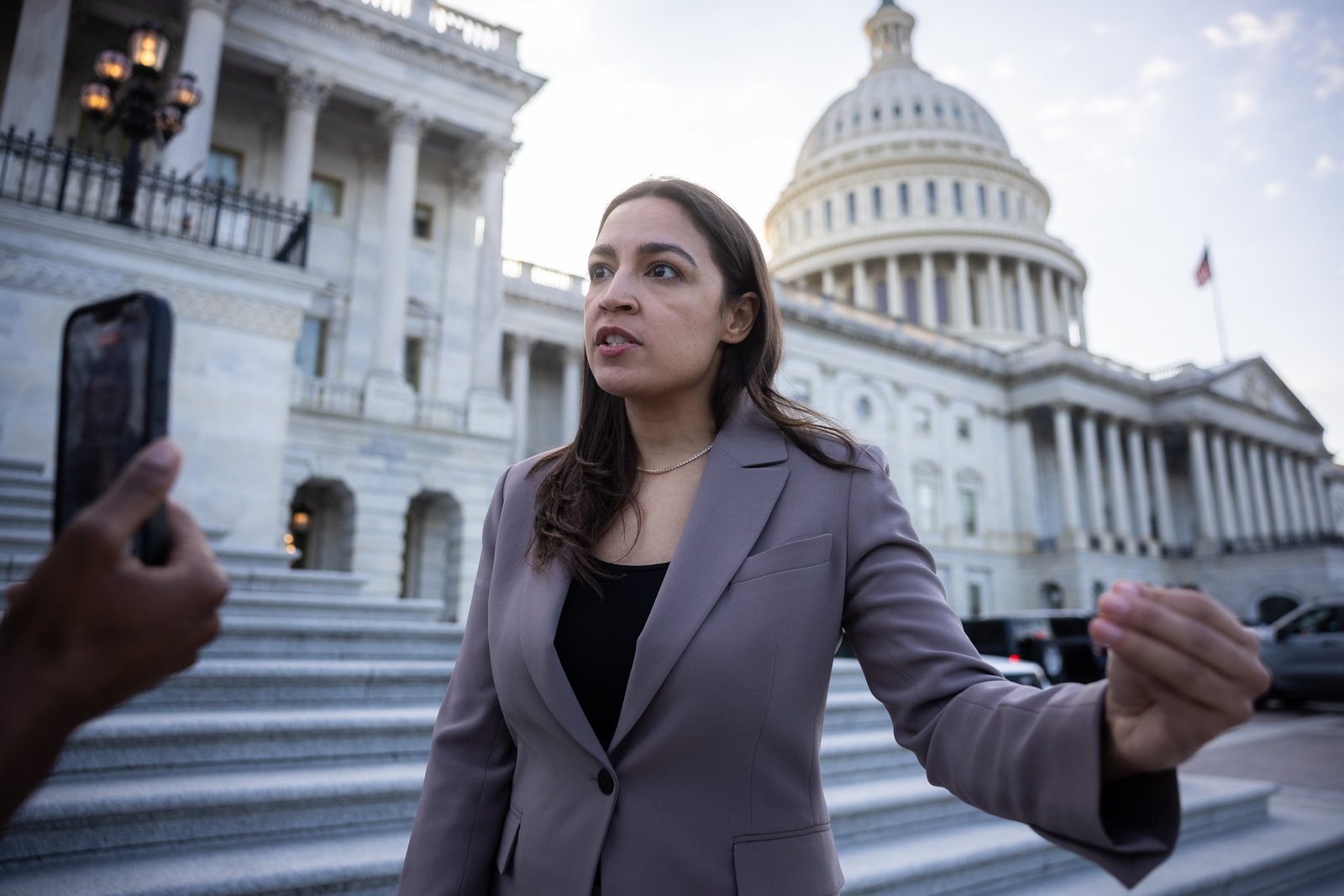
2028 VISION: Rep. Alexandria Ocasio-Cortez is leaning into the speculation swirling around her 2028 aspirations.
“In some ways, I understand the interest. But I wanted to write to you today to be direct about what I’m focused on,” Ocasio-Cortez wrote in a fundraising email. “Frankly, I could not care less about titles or positions for myself. That’s not why I got into this work. What matters to me is changing this country so that it finally works for all of us, and that’s why my focus is on the decision working people around the country will make in the next 50 days.”
She added that her political operation is “mobilizing resources, not just to get me re-elected or build for a future campaign, but most importantly to win the midterms and take back the majority.”
Ocasio-Cortez, who’s been active on the trail boosting down-ballot candidates, has kept the door open for either a Senate run or a presidential bid in 2028 — though some progressives are urging her to aim for the White House.
Any clarity on her 2028 decision before this coming Election Day seems unlikely, though — especially given how “concerned” she says she is “by how some in our party are talking” about the midterms.
“There is a narrative taking hold in Washington that the Republicans are already cooked,” her email continued. “That kind of complacency is how we grasp defeat from the jaws of victory. … All of this is why I am not spending this fall thinking about myself. I am spending it working my butt off to deliver a majority in the House and the Senate.” — Madison Fernandez
A DIFFERENT LAUDER GIVES: Estee Lauder Chair William Lauder gave $500,000 to the super PAC backing Republican gubernatorial candidate Bruce Blakeman.
Lauder’s contribution comes after his uncle, prolific GOP donor Ronald Lauder, ceased his political giving this year. Ronald Lauder was the principal backer of a super PAC aiding Republican Lee Zeldin’s 2022 bid against Hochul.
William Lauder wasn’t the only deep-pocketed titan to donate to the Blakeman PAC recently. Home Depot founder Ken Langone, a GOP megadonor who once led Republicans for Cuomo, gave $50,000. — Nick Reisman
IN OTHER NEWS
— STALLED SECURITY: More than eight months into his term, Mamdani is still waiting on federal security clearance. (Gothamist)
— LEGIONELLA LOCATIONS: A Yankee Stadium cooling tower tested positive for the bacteria that can cause Legionnaires’ disease, according to the New York City Health Department. (Daily News)
— SIGN LANGUAGE: A PAC funded by Knicks owner James Dolan launched a $250,000 billboard campaign backing Blakeman and blaming Hochul for an exodus from the state. (NY Post)
Missed this morning’s New York Playbook? We forgive you. Read it here.


President Donald Trump’s decision to name hard-line loyalist Stephen Miller as his top aide cemented what many Republicans were already privately fearing: There will be no party-wide GOP reckoning with this week’s midterm bloodbath.
Instead, with Trump still in office for another two years, most have grown resigned to the reality that the president is going to lean in on a confrontational approach with Congress — and is not willing to change course.
Republicans on Capitol Hill and inside the Trump administration are questioning how and whether they can break with the president now after having green-lit much of his agenda, according to more than a dozen GOP lawmakers, senior aides and Trump officials interviewed for this story, some of whom were granted anonymity to speak candidly about the party’s future.
Trump’s decision Friday to elevate Miller, the architect of his unpopular mass deportation policy and an advocate of fierce partisan confrontation, crystallized the frustration.
“There needs to be some self-reflection for Republicans,” Rep. Marlin Stutzman (R-Ind.) said in an interview about the midterm losses Friday morning. “There should be some heads rolling at the White House because we lost badly.”
Hours later, heads did roll. Trump announced Miller would replace Susie Wiles as his new chief of staff.
“Horrible decision,” Stutzman said in response.
One House Republican, when informed that Trump had named Miller his chief of staff, replied: “Please tell me you’re lying to me right now, just to get a reaction.”
The immediate aftermath of the election has sharpened the GOP’s core issue for the past decade: They are struggling to navigate the man who they reshaped their entire identity around, and whose record low approval with voters helped to fuel generational losses within the party.
The Iran war is another area where some Republicans are having regrets. Vice President JD Vance identified it as the main reason for the party’s defeat in his election post-mortem.
The problem with Vance’s assessment, one senior Hill Republican said, is, “we’ve been fucking voting for the war since March — because they told us to.”
Republicans and Trump advisers expect the president to wield massive influence in the 2028 GOP primaries, another reason many are staying quiet.
“Everyone is staring at each other and wondering who will speak up and blame Trump first,” said one GOP operative who worked on a battleground race Democrats won. They, like others in this article, were granted anonymity to speak candidly. “But we’ve been here before. I’m not holding my breath. He still controls the party and its primaries, at least for now.”
The White House responded to Blue Light News’s request for comment by referring to Trump’s praise for Miller on Friday. The RNC declined to comment.
Miller wrote on social media that he is “honored beyond words to serve as [Trump’s] White House Chief of Staff” and “the mission now is more clear than ever: Fight with all of our soul to support our President.”
How much lawmakers will distance themselves will be put to the test quickly: House Republicans will have an immediate opportunity to break with Trump and the war next week, when Rep. Thomas Massie said in an interview with Blue Light News he will trigger his articles of impeachment against Secretary Pete Hegseth. “There are a lot of questions about Hegseth,” House Oversight Chair James Comer (R-Ky.) said Friday.
Some senior Republicans are privately nudging Trump officials to ditch Hegseth before the vote, according to two people with direct knowledge of the conversations. The White House is sticking by Hegseth so far, however.
House Republicans will also have a chance to elect new leadership next week, including a new chair of the National Republican Congressional Committee. But in a sign of what’s to come, none of the candidates — including Reps. Brian Jack (R-Ga.) and Rudy Yakym (R-Ind.) — nor any other GOP leadership candidates have publicly suggested doing more to break with Trump.
A small group of Republicans on Capitol Hill have privately declared, as of Tuesday night, that “MAGA is over,” and it’s time for a “reset,” as one House GOP aide put it — and yet it’s a sentiment no prominent Republican is willing to say publicly.
Rep. Chris Smith (R-N.J.), one of the longest-serving members of the House, said he wasn’t going to “blame” others for Tuesday’s losses, which left him as the sole GOP incumbent survivor in his home state. Asked if Republicans were dragged down by the president, Smith replied: “I don’t want to answer that.”
Rep. Warren Davidson (R-Ohio) went a step further. He declined to name Trump, but he said in an interview that he was tired of GOP leaders “ignoring” voters — a remarkable position for a party that Trump transformed into a working-class coalition.
“We had a lot of Republican leaders out there saying ‘everything’s fine.’ And you kind of had the boomer generation saying, ‘Well, yeah, back in my day, interest rates were 15%, so everything’s good,’” said Davidson, a 56-year-old former Army Ranger. “Well, you had a lot of hardworking young people who felt really ignored, and they they went to the polls and said, ‘Stop ignoring us.'”
Davidson said Republicans need to start discussing their problems quickly, or suffer the electoral consequences again.
“Bad news doesn’t get better with time. So avoiding talking about something doesn’t solve the problem,” he said. He said Vance “walked a pretty good line” by being “candid” in his election post-mortem Wednesday.
Vance and other potential 2028 presidential contenders like Sen. Ted Cruz don’t have much time to waste if they want to chart a new path away from Trump. Cruz issued his own post-mortem that included a call to focus more on voters’ economic concerns. Florida Gov. Ron DeSantis said “this midterm was a rebuke of the president and Congress.”
French Hill, the powerful Financial Services Committee Chair who narrowly survived a strong Democratic challenge in his own deep-red Arkansas seat Tuesday night, pointed to “President Trump’s unfavorability” which hit “races across the country.” Hill added: “He will be considered a lame duck, and that often has members of both political parties looking out at who will be the standard-bearers in the 2028 presidential election.”
Most others have remained silent in public.
One thing is certain: The utter devastation in deep-red seats is stirring deep anger among many Hill Republicans, who believe something needs to change.
It’s fueling private recriminations at Trump’s political operation that his advisers didn’t take early warnings seriously about the extent of the damage in states like North Carolina. Trump’s now-former chief of staff Susie Wiles will join his political operation, the president announced Friday.
Trump’s team has blamed “candidate quality” for the losses, instead of the president himself.
“Candidate quality matters. Unless you’re running for the U.S. Senate. They apparently don’t care if you would lose to a pinecone,” said a House Republican, referring to Trump’s hand-picked North Carolina Senate nominee Michael Whatley.
The National Republican Senatorial Committee declined to comment.
Sen. Tim Scott (R-S.C.), who leads the Senate campaign arm and saw Democrats flip a Senate seat in his own state, did not answer reporters’ questions on Thursday. The South Carolina Republican has a policy of not talking to reporters in the halls — and he didn’t start when Blue Light News and others asked why Republicans lost so badly.
Back in August, some Republicans in seats Trump won by double digits were already telling the White House to keep the president away from their districts. Others publicly broke from the White House on mass deportations and the Iran war.
NRCC Chair Richard Hudson had largely dismissed those concerns when Blue Light News asked him in a hallway interview on Sept. 1.
“Based on our polling, the president’s a net positive in every district. And I’ve been encouraging him to get out and do events and do rallies. I’m going to continue to do that,” Hudson said. “I think the more he talks about his record and incredible achievements he’s made over the last Congress, I think the better.”
Then, Hudson lost his own reelection bid. He is the first ever NRCC chair in history to be defeated in a general election.
Mia McCarthy, Andrew Howard and Samuel Benson contributed reporting.
Even the head of House Democrats’ top super PAC didn’t fully anticipate the size of their massive midterm wave.
Heading into Election Day, House Majority PAC president Mike Smith told Blue Light News Tuesday’s results, which have netted them a whopping 252 House seats with more yet to be called, was “on the very high end” of the group’s expectations.
The group spent at least $283 million on ads this cycle, per ad-tracking firm AdImpact, making them the largest Democratic spender in House races this cycle and a significant force behind the party’s big night.
As Democrats turn their attention to 2028, Smith remains optimistic the party can hold on to its majority.
His confidence stems in part from a projection that Democrats will respond to the affordability concerns that were the core of the party’s promise to voters.
If Democrats don’t make efforts to address the rising cost of living, “then it’s a totally different story,” Smith said.
Q: How were you feeling in the final days before Tuesday?
Obviously this would have been on the very high end of what we expected. Over the last three months, overall our polling has been pretty consistent. Our whole thought was, with the right environment, if we have the right message and the right types of candidates in, not just the 50-50 districts, but like deeper in the map, that we could put those seats in play and we could potentially win.
Going into Election Day, our whole feeling was there’s a clear path to like 235-plus [seats]. We were playing in districts that, if you were to rank them from like one to 435, some of those districts were like 250, 255, right? And I would throw IN-05, CO-03, KY-06, SC-01, some of the Florida races. SC-01 wasn’t ever going to be seat 225. That was always in the 240s and maybe even 250s. But we took a chance because we saw what the national environment looked like. We saw what the data was coming back in within these individual races. So I think we were optimistic. But to be totally honest, in our heads, you have to play in seat 255 to get to seat 240. You have to spread out the map. You have to force Republicans on their heels, and then you start piecing together how you get to the 240-245 range. Once the numbers started coming back, that was the best case scenario for us. Everything came together.
You guys cut reservations in some reach districts, only to go back up in the final few days. On the outside, it appeared like cutting spending in those reach districts was a bad sign. What went into those last-minute spending decisions?
A lot of the places we made reservations back in April, and then continued to add on to that over the course of the summer. Partners and allies in a bunch of different places took over our reservations. We tried to be smart by locking in the lowest possible rates in very expensive markets, [so that] even if HMP wasn’t the entity spending, we still had partners and allies that were taking over their reservations. In doing all that we saved about $130 million that we could reinvest.
The challenge with some of the races was by a week out, our money was spent. And in some of those districts, there weren’t any partners willing to step up and do it. Florida is a good example of that.
That’s where we just had to make a decision that there weren’t the resources there, and we had to leave the reservations on the table. Around that time, Mayor Bloomberg was like, “We can’t let these races get away from us. We need to do everything we can,” and that’s where we went back into some of those places.
Did you feel the need to adjust your messaging at all once MAGA Inc. and Elon Musk’s PAC joined CLF on the airwaves?
The short answer is no. The messaging was fairly consistent. Early on, our whole feeling was we need to reframe how voters perceive Democrats. When voters think about what Democrats are fighting for, the first thing we want them to think about is cost of living, the economy. At the same time, bringing to light Republican policies that are increasing the cost of living, or focus on things that are anything but that.
Over several months, we did a bunch of battleground research looking at ‘how does corruption tie into that,’ which culminated in what we would describe as the cost of Republican corruption, and how that is impacting your day to day and your cost of living. That’s what we went into Election Day with.
Overall, we ran, I don’t know, 1300 different types of ads, whether TV, digital, direct mail, or whatnot. 76% of those ads talked about the economy. 60% of those ads focused on corruption, because in so many of them, those two things were interlinked in voters’ minds.
Republicans continued to focus on the same thing. It was trying to paint Democrats as out of touch or extremists. And again, the theory of the case from the beginning was us focusing on economic concerns, especially when we figured out we could tie that corruption lens into it. That’s going to be more important to voters than folks talking about socialism or anything else.
Democrats were able to prevent Republicans from capitalizing on their redistricting gains. Are you worried about those gains bearing fruit in a less favorable environment, maybe as soon as 2028?
In a different environment, these races are going to come together in a much different way. So I do think it’s something that we need to be hyper-focused on. That said, I don’t think redistricting is going to go away.
I’m actually pretty hopeful that these huge shifts across every demographic group that we just saw, as long as Democrats continue to focus on the issue that matters most to voters.
If we don’t, then it’s a totally different story.
Are you saying the fate of Democrats’ House chances in 2028 to keep these seats is predicated on Congress passing something, even with the current president still in the White House, that addresses affordability issues?
I wouldn’t say passing. Soon-to-be Speaker Hakeem Jeffries, since we won, his message is that Democrats are focused on three things: costs, care and corruption.
When we come into power, we are going to be hyper-focused on fighting to bring down the cost of living for voters. I think Donald Trump is still this outsized X-factor in everything. He’s still the sitting president in the White House. So I wouldn’t say it’s like, “Oh we have to pass 300 bills. That’s the only way we’re going to be successful.” I think we just need to show voters that we are willing to get stuff done, and in instances where we need to, work across the aisle to pass stuff that’s going to be helpful to voters. I think if we do that, then I think we’re setting ourselves up for success going into ‘28, both with the White House and the House and the Senate. Donald Trump is still going to be this huge factor in all of this, and I don’t think voters are going to be like, “Democrats weren’t able to accomplish this,” and think that that was us. They’re going to continue blaming Donald Trump going into Election Day 2028.
To go back to redistricting, do you want Democrats in these states where they have newly-won trifectas to take up redistricting even if Republicans don’t push for it again?
I think Democrats need to do everything that it will take to win, and if that means that in states where we control the state house, the state senate, a governor’s race, we have an opportunity to redraw the map, I think we need to do it.
What were the seats Democrats flipped that surprised you the most?
I would say NJ-02 [Rep. Jeff Van Drew’s seat], It was a district where we had looked at it — we did not think that it was credibly possible, to be totally honest.
I’d say North Carolina as a whole, probably. We felt good about NC-01, NC-11 for a while…. [NRCC Chair and North Carolina Rep.] Richard Hudson, we looked at that district. There was a clear path to winning it. There just wasn’t money, at the end of the day. NC-13, NC-14, same thing. The makeup of the districts, they’re not bad targets for Democrats. It was just, how much can we spread resources out? But the total implosion in North Carolina by Republicans at the federal level, at the state level — that was probably one of the biggest surprises.
A version of this article first appeared in Blue Light News Pro’s Morning Score. Want to receive the newsletter every weekday? Subscribe to Blue Light News Pro. You’ll also receive daily policy news and other intelligence you need to act on the day’s biggest stories.

The Clyburn test
lead image
-

 Politics1 year ago
John Legend advises Trump to drop the ‘dictator s‑‑‑’ if he wants Nobel Peace Prize
-

 Politics2 years ago
Former ‘Squad’ members launching ‘Bowman and Bush’ YouTube show
-
Uncategorized2 years ago
Bob Good to step down as Freedom Caucus chair this week
-

 The Josh Fourrier Show2 years ago
DOOMSDAY: Trump won, now what?
-

 The Dictatorship2 years ago
Pete Hegseth’s tenure at the Pentagon goes from bad to worse
-

 Politics2 years ago
Former Kentucky AG Daniel Cameron launches Senate bid
-

 The Dictatorship2 years ago
Luigi Mangione acknowledges public support in first official statement since arrest
-

 Politics2 years ago
Blue Light News’s Editorial Director Ryan Hutchins speaks at Blue Light News’s 2025 Governors Summit