
Congress
Crypto bill ethics talks wobble as senators eye Trump engagement

Senators emerged from a closed-door meeting focused on ethics language that Democrats want to insert into landmark cryptocurrency legislation split over the status of the talks, with one Republican calling the negotiations a “circus.”
A bipartisan group of senators met in the Capitol Tuesday with a top White House crypto policy adviser to negotiate language that would restrict government officials’ engagements with digital assets — a key demand for Senate Democrats who have raised concerns about the Trump family’s crypto businesses. Lawmakers are trying to come to a deal ahead of a Thursday markup in the Senate Banking Committee.
“The Democrats are trying to find reasons to vote against the bill and making up a bunch of bullshit excuses,” said Sen. Bernie Moreno (R-Ohio), who called the meeting a “circus.”
“Super annoying,” he added.
Other members struck a more positive note.
“Sen. Moreno is prone to exaggeration,” said Sen. Ruben Gallego of Arizona, a key Democratic negotiator. “We are working constructively. I think that could be his interpretation and then, it that’s the interpretation, maybe he should stop going to the meetings.”
Sen. Cynthia Lummis (R-Wyo.), a key GOP negotiator, said lawmakers are “making progress.”
“You have to go into those discussions assuming that the other side is negotiating in good faith,” she said. “And if that turns out not to be the case, then shame on them, not shame on me. I’m trying to get a deal here.”
Patrick Witt, a top Trump administration crypto policy adviser, is representing the White House in the talks. But lawmakers on both sides say they want sign-off from Trump on any final ethics deal.
“Whatever we agree to, it has to be signed off by Trump,” Gallego said earlier Tuesday. “And if he doesn’t sign off on it, then it doesn’t happen.”
Lummis said in an interview that she and Sen. Kirsten Gillibrand (D-N.Y.) have agreed to seek a meeting with Trump about the ethics issue if White House staff are unable get him on board.
“If we end up with a ethics proposal that the White House staffers think is on the bubble in terms of the president’s ability to swallow it, it would be important for us to go,” she said.
Republicans have said that ethics language can’t go into the bill that the Banking panel votes on this Thursday due to jurisdictional issues, but Democrats are insisting on a deal ahead of the markup. Gallego told reporters the ethics issue “will have to be addressed before the Banking Committee,” but added: “It doesn’t necessarily have to be addressed through the Banking Committee.”


North Dakota Sen. Kevin Cramer said Thursday that he had concerns about Elon Musk’s influence over national security matters after Ukraine was blindsided by a disruption of a satellite communications service developed by Musk’s SpaceX.
“We’re putting too many eggs in one company’s basket when it comes to our space assets,” the Republican member of the Armed Services Committee said. He added about Musk that he was concerned about the power of “one individual and one company over America’s ability to protect the domain of space, which is a war-fighting domain.”
Cramer received a briefing Thursday from Air Force Secretary Troy Meink that he said focused on getting an update on Starshield — a military product based on SpaceX’s Starlink technology. Cramer told reporters before the briefing that he wanted Congress and the Pentagon to “pour a lot of resources … into making sure there’s lots of competition both for satellite production and satellite launch.” “I’m uncomfortable with the potential vendor lock in space, and I think the events of the last couple of weeks have demonstrated greater concern, even than just simply cost,” Cramer said.
Musk has been under days of scrutiny — including fresh pledges by Democrats to investigate him next year — after the Wall Street Journal reported that he ordered the recent slowdown in Starshield capabilities over the Russia-Ukraine war theater.
Cramer, asked about the Journal reporting after the closed-door briefing, said that he wasn’t sure if Musk ordered the slowdown and that the “culpability of multiple people … was left somewhat loose.”
“By that I mean, discussions with the president before, discussions with the president after. … Obviously I don’t think it could have possibly happened without Elon Musk’s knowledge, whether or not you know how supportive he was one way or the other,” Cramer said.
Cramer added that he believed there could have been a broad misunderstanding within the U.S. government and within SpaceX about how reliant Ukraine was on the satellite technology. But he said it was incumbent that the operation of satellite technology like Starshield must “be exclusively with the authority of the United States government.”
“There are certain things the government has to do that can’t be so dependent on others,” Cramer said. “And fighting wars is one of those things.”
The top Democrat on the Senate Finance Committee wants to revive a clean energy tax credit program he argues was a booming success — and says he has the receipts to prove it.
Sen. Ron Wyden of Oregon is releasing a new report of IRS data, shared first with Blue Light News, showing that, in the first two years of the Democrats’ 2022 climate law, nearly $2.5 billion in direct payments went directly to schools and other tax-exempt entities to cover electric school buses, rooftop solar, electric vehicles and more.
Wyden said in a press release the numbers prove there is “massive demand” for “any and all” programs that lower energy costs and rebuild aging infrastructure, after Republicans gutted many of these wind and solar tax credits in their tax and spending megalaw last summer.
“When Democrats have a trifecta of power, reinstating the wind and solar tax credits and bolstering the Direct Pay Program will be a top priority to help bring an end to Trump’s energy crisis,” said Wyden, who is poised to take back the Finance gavel if control of the Senate flips in the midterms.
The report, prepared by Democratic staff for the committee, argues the current “energy crisis,” where Americans’ utility bills are rising, was manufactured by Republicans and the direct result of the Trump administration’s clean energy incentive rollbacks.
Wyden said he would revive the solar and wind tax credits if given the chance to chair the Finance Committee again, plus boost what’s known as the Direct Pay Program, which schools and tax exempt entities can use on rooftop solar, electric vehicle purchases, heat pumps and more.
“If we’re back in the majority — and I think we will — I will be introducing that bill [to restore] the clean energy tax credits that had billions of dollars in the market in the first couple of years,” Wyden said in an interview last month regarding his plans. “I’ll be introducing that right away.”
Wyden, who has led his party on the Finance Committee since 2015, wrote the bulk of the 2022 Inflation Reduction Act’s climate and clean energy provisions.
Facing a blue wave, Republicans have found bipartisanship.
A new Blue Light News poll shows that 66% of Republican voters this midterm want a Democratic House to find common ground with President Donald Trump to pass legislation next year, assuming the party flips that chamber in November.
Democrats don’t seem sold on the unity vibe. Almost the same percentage of Democratic voters want their party to block Trump and GOP proposals they disagree with, even if that means fewer bills get passed.
The GOP’s team-player spirit is also showing up in Republicans’ campaign messaging too — far more than in previous cycles.
Across all House and Senate races, GOP candidates or outside groups backing them have run nearly 200 ads that mention bipartisanship, working across the aisle or “both sides,” according to a Blue Light News analysis of AdImpact data. That’s up more than 60% from 2024.
An ad from Michigan GOP Senate candidate Mike Rogers says he’ll “bring both parties together” to lower prices. Iowa Rep. Zach Nunn told voters in an ad he is “one of the most bipartisan members of Congress.” And Arkansas Rep. French Hill is touting how the housing law he backed “passed with bipartisan support.”
The focus is a notable change from 2024. Back then, GOP candidates and groups ran more than 90 ads that promised to “stop Biden” or “stop Democrats.” That rhetoric is all but gone from GOP ads now.
Still, it remains to be seen if GOP lawmakers elected in November can collaborate with the different factions of the Democratic party that may be more — or less — willing to reach across the aisle.
Seventy-one percent of progressive voters, for example, indicated they would prefer Trump obstruction over finding common ground, compared to 57% of moderates, according to the polling. Progressives were also more likely to say Democrats’ highest priority if they retake the House should be doing everything they can to block Republicans’ agenda.
The one exception for Dems: affordability. Fifty-seven percent of Democratic midterm voters indicated they’d prefer the party do whatever it takes to pass legislation lowering the cost of living, even if it’d give the GOP a win — including 56% of progressive voters and 58% of moderates.
What else we’re watching:
— DEMS’ TREASURY TARGETS — Democrats are readying for a showdown with Treasury Secretary Scott Bessent if they take back power in November. The Democrats who would lead the committees overseeing the Treasury Department and IRS are preparing to investigate Trump’s alleged self-enrichment schemes and efforts to dismantle regulatory agencies, according to people with direct knowledge of Democrats’ plans granted anonymity to describe them.
— WYDEN’S CLEAN ENERGY PLAN — Sen. Ron Wyden wants to bring back a clean energy tax credit program he says new data proves was wildly successful in helping keep down Americans’ energy expenses. The top Democrat on Senate Finance is releasing a report of IRS data, shared first with Blue Light News, showing $2.5 billion in direct payments made in the first two years of the Democrats’ 2022 climate law to cover electric school buses, rooftop solar, electric vehicles and more. Wyden said he would revive the solar and wind tax credits if given the chance to chair the panel again, plus boost what’s known as the Direct Pay Program, which schools and tax exempt entities can use on clean energy infrastructure.
Jessica Piper, Danny Nguyen, Michael Stratford and Kelsey Brugger contributed to this report.
- Trump plans to fast-track arch despite legal challenge
- GOP senator questions Elon Musk’s influence over military assets
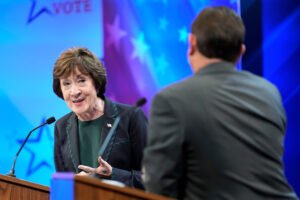
- The good, the bad and the unruly from over two dozen candidate debates
- How a fake pollster may have moved some 2026 elections
- Top Senate Finance Democrat maps out clean energy plan
- Australian treasurer says opponents want higher inflation for political gain
- Rising bond yields will add billions to budget pressure: Australian treasurer
- Capitol agenda: Some Republicans get bipartisan curious
- America’s Heartland sows doubt in the GOP

- Europeans aren’t betting on a Democratic Congress to save Ukraine
-

 Politics2 years ago
Former ‘Squad’ members launching ‘Bowman and Bush’ YouTube show
-
Uncategorized2 years ago
Bob Good to step down as Freedom Caucus chair this week
-

 The Josh Fourrier Show2 years ago
DOOMSDAY: Trump won, now what?
-

 The Dictatorship2 years ago
Pete Hegseth’s tenure at the Pentagon goes from bad to worse
-

 Politics2 years ago
Former Kentucky AG Daniel Cameron launches Senate bid
-

 The Dictatorship2 years ago
Luigi Mangione acknowledges public support in first official statement since arrest
-

 Politics2 years ago
Blue Light News’s Editorial Director Ryan Hutchins speaks at Blue Light News’s 2025 Governors Summit
-

 Politics1 year ago
John Legend advises Trump to drop the ‘dictator s‑‑‑’ if he wants Nobel Peace Prize